Five Subscriptions in One Chat Window Is Still Five Subscriptions
Nine plain checks separating real Claude GTM stack consolidation from five subscriptions behind one chat window, plus the connection covering 150M+ companies.
Vibe Prospecting team9 min readAugust 10, 2026
TL;DR
Moving five sales tools behind one chat window changes how the work feels, not what the card statement says.
The cancel test: a new connection only counts as consolidation if you can name the contract it retires and the date that contract ends.
Every connection you open loads tool descriptions before you type, so five to seven of them eat 55,000 to 70,000 tokens of a 200,000-token window.
Pick one join key, a persistent company ID or the web domain, and name one owner per field, or the tool that runs last quietly wins.
One Vibe Prospecting connection covers 150M+ company profiles, 800M+ professional profiles and 18 buying-signal categories that fragmented setups buy three times.
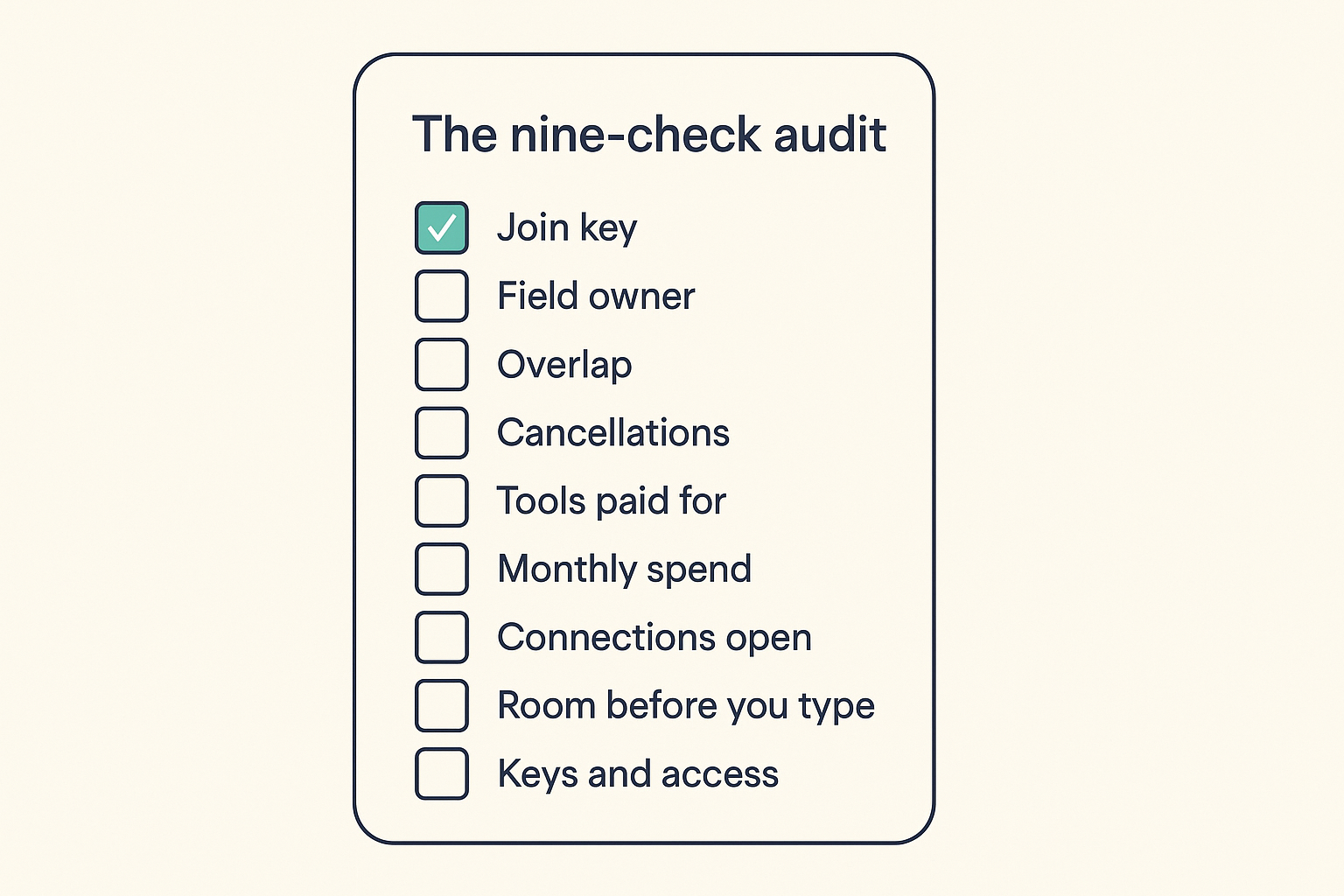
Nine pass or fail checks you can run before lunch, scored so that failing the join key or the field owner outweighs passing four of the others.
Count the sales tools on your card statement. Now count the connections you wired into Claude last month. If the second number went up and the first one did not move, what you built is orchestration, not Claude GTM stack consolidation, and that gap shows up on the invoice long before anyone notices it in the chat window.
Nobody disputes that one chat window beats eight browser tabs. The argument starts at renewal, when somebody asks the flat question that has no diagram-shaped answer: what were you paying before, what are you paying now, and which contract went away? Below is the audit that answers it, in nine checks you can run without booking an architecture review.
Start With the Invoice, Not the Architecture
The quickest way to find out whether your setup consolidated anything is to put last month's card statement next to this month's. A diagram can leave things out. A statement cannot.
Three Numbers to Write Down Today
How many products you pay for, counted by contract rather than by logo on a slide.
What those contracts cost each month, including any minimum you agreed to and then forgot.
How many connections your assistant loads before you type the first word.
What Those Numbers Usually Say
A 2026 look at GTM stacks published by Unify puts the average at 8.3 products per seller, with 73% of teams reporting two or more that do overlapping jobs. Those are vendor figures rather than independent research, and they match what people describe out loud: one product to find companies, a second to fill in the details, a third to send, a fourth to take call notes. Putting all four behind one prompt retires none of them.
Why One Chat Window Still Feels Like Five Tools
Because the connection standard carries questions and answers, not meaning. MCP, the open standard Anthropic published for wiring assistants to outside tools, tells Claude how to call each product. It holds no opinion about whether two of those products mean the same business when they both say Acme.
The Three Things That Break Quietly
A webinar signup, an ad click and a second pricing-page visit land in three separate products, so no single row ever holds the whole story.
Two products are both allowed to write the same field, and the one that happens to run last wins by accident instead of by rule.
Acme Corp, Acme Corporation and ACME Corp, Inc. arrive as three businesses, and every count built on top of them is wrong.
The Record Is the Problem, Not the Surface
Ask the teams living this and one sentence keeps coming back: the products are fine, what fails is that context does not survive the trip between them. Talking to all of them from one box does not fix the trip. It puts a friendlier surface over it. If you want the mechanics, our walkthrough on matching company records across sources covers how the join is supposed to work.
The Cancel Test: What Did Connecting It Let You Drop?
A new connection counts as consolidation only when you can name the contract it retires and the date that contract ends. No end date, no consolidation. That is the whole test, and it is deliberately hard to talk your way around.
Run It One Connection at a Time
Text
Cancel test, one line per connection you added

  connection ............  ____________________
  contract it retires ...  ____________________
  end date booked .......  ____ / ____ / ______
  monthly delta .........  ______ (vendor + tokens)

  blank end date  ->  this was an addition, not a consolidation
Fill that in for every connection you added this quarter. Any connection whose second line reads "nothing yet" is one you pay for twice: once to the vendor, and once in the room it occupies before your assistant has done a minute of work.
Every Connection Eats the Room Your Agent Works In
Claude reads a description of every tool it can reach before it reads your first sentence, so each product you connect quietly shrinks the space left for the job itself. Anthropic's own write-up on advanced tool use puts a five-connection example at roughly 55,000 tokens of tool descriptions, and mentions internal setups that reached 134,000.
Where the Ceiling Shows Up
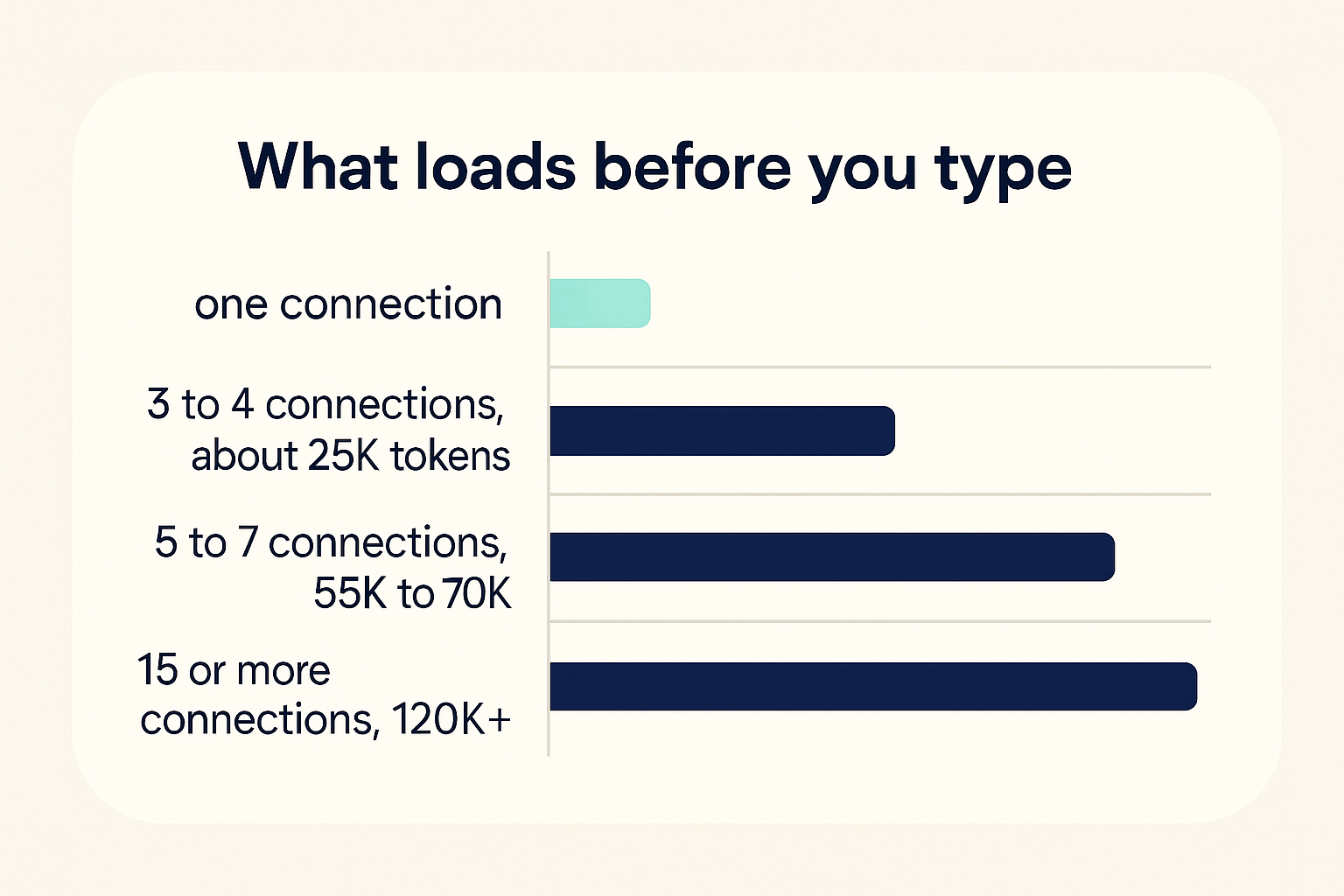
Three or four connections cost around 25,000 tokens before you type, which is comfortable.
Five to seven land between 55,000 and 70,000, and that band is where the assistant starts reaching for the wrong tool.
Fifteen or more push past 120,000, which is over half the room in a 200,000-token window.
Each separate action a product exposes adds 500 to 2,000 tokens, so a few chatty products can cost more than many quiet ones.
What Deferred Loading Fixes, and What It Leaves Alone
Claude Code 2.1.7, released on January 14, 2026, added tool search so descriptions load only when they are wanted, once they pass about 10% of the window. Anthropic measured that as roughly an 85% cut, leaving 191,300 tokens of working room where the older behaviour left 122,800. Genuinely useful. It also ends no contract and settles no argument between two products about the same job title. Our note on how much room each connection takes has the full accounting.
Auditing this week? Trade three data connections for one and re-measure the room you get back. Connect Vibe Prospecting.
Two Tools, One Field, and No Tie-Break Rule
Pick one key to join records on, then name one owner for each field, and the arguments stop before they start. Most setups skip both steps and find out what that costs on the morning a good phone number gets replaced by a worse one.
Pick the Join Key First
Best choice is a persistent company ID from whoever supplies your data, because it survives a rename or an acquisition.
Next best is the web domain, the most dependable general-purpose key in B2B.
Worst choice, and by far the most common, is a company name typed by a person.
Whichever you pick, make it a required field in every system that holds a record.
Then Name One Owner Per Field
What the field holds
Who should own it
What happens when they disagree
Deal stage and amount
Your CRM
The CRM wins, and the value only travels outward
Work email and job title
Your data connection
The connection wins, unless a rep confirmed it on a call
Company size, industry and head office
Your data connection
The connection wins, refreshed on a set cadence
The business identity itself: ID, domain, name
Your data connection
The connection wins, and nothing else may edit it
Recent company activity and engagement
Sending tool plus data connection
Add a new row, never write over an old one
The Nine Checks You Can Run Before Lunch
Every check passes only if you can point at a setting, a contract or a measured number, and the first two carry more weight than the other seven combined. Opinions do not count as evidence here.
The Checklist
#
What you are checking
Passing looks like
Failing looks like
1
Join key
One company ID or domain, required everywhere
You match on company names
2
Field owner
Each field has one named owner, written down
Whoever writes last wins
3
Overlap
One connection answers company, people and activity questions
Two products return the same field
4
Cancellations
An end date is booked on the contract you replaced
"We will cancel it later"
5
Products paid for
Fewer contracts than three months ago
Same count, one extra line
6
Monthly spend
Down, measured after the cancellations cleared
Up, and nobody looked
7
Connections open
Five or fewer
Seven or more, and the wrong tool keeps getting picked
8
Room before you type
Under 15% of the window, and you measured it
Over 30%, or never measured
9
Keys and access
Every key has an owner and a rotation date
Twenty keys and nobody knows whose
Reading Your Score
Seven or more passes: consolidated. Spend the time tuning field rules instead.
Four to six: the chat layer works, the data underneath does not. Start at check 1.
Three or fewer: wrapped, and every connection added from here makes it worse.
Failing check 1 or 2 outweighs passing any four of the rest.
What One Connection Actually Replaces
Vibe Prospecting is built to be the row that disappears rather than one more row on the list: a single connection that finds companies, finds the people inside them, fills in the details and carries recent company activity, holds up at real volume, and bills from one shared credit pool. Powered by Explorium Enterprise Business Data.
One Connection Instead of Three
150M+ company profiles and 800M+ professional profiles pulled together from 50+ premium sources.
Finding companies, finding the right people by seniority, enrichment, event lookup, and 18 buying-signal categories spanning 80+ types, all reachable from the same place.
97.8%+ company match accuracy, which is the number that makes a single source of truth defensible when someone challenges it.
Volume That Survives a Real List
Up to 1,000 records per call, handled on the server rather than inside the chat, at 100 requests per second on 99.999% uptime.
Connections that work inside the chat load every row into the window and stall somewhere between 20 and 100 records.
Every record comes back with a persistent ID, which is exactly the join key check 1 is asking for.
One Credit Pool Instead of Several Minimums
Free Explorium account, no sales call, no charge per seat.
Credits sit in one shared pool across every endpoint. Explorium's own model puts that at 30% to 60% less agent-workload spend than paying per endpoint or per seat.
Ask for a preview and you get 5 representative records plus a cost estimate before anything is charged.
What that answers is not "which product is best". It is the narrower question the audit keeps landing on: which rows on the statement can now hold one name instead of three. Coverage and pricing detail sit on the Vibe Prospecting overview page.
Try It Against a List You Already Know
Add it where you already work, ask for a preview on 25 accounts you know cold, and compare field by field before you go near a contract. In Claude Chat and ChatGPT that is a one-click install from the connector store. In Claude Code, install the Vibe Prospecting Plugin.
Claude Code
# Claude Code, from the official Anthropic plugin store
/plugin install vibe-prospecting@claude-plugins-official

# Any other terminal agent
npx skills add explorium-ai/vibeprospecting-plugin --all
/vpai:vibe-prospecting

# Claude Chat, Claude Cowork and ChatGPT
# add Vibe Prospecting from the connector store, nothing to hand-edit
Then Ask for a Preview
Text
Ask in chat:

  "Here are 25 accounts I already know well. Give me size,
   industry, head office and whoever owns the buying decision,
   and tell me what the whole list would cost before building it."

  ->  5 representative records back, plus a cost estimate
  ->  nothing charged until you say go
The Order That Keeps You Honest
Compare on accounts where you already know the right answers, not on a random sample.
Adopt the persistent ID as your join key and make it required in the CRM.
Set the owner per field, then disconnect whatever just lost write access.
Cancel what you replaced, then re-measure. The bill moves when the contract ends, not when the install finishes.
Two sellers and a founder, no RevOps hire. They ran one product for finding companies, a second for filling in contact details, a sending tool and a call recorder. They wired all four into Claude over a weekend and the founder told the board the stack had been consolidated. Nine weeks later the card statement read the same as before, plus one new line.
Then they ran the audit. Checks 1 and 2 failed outright: no join key, no named owner for anything. Check 3 explained the rest, because the finding product and the details product both returned company size, industry and head office, and disagreed on roughly a third of the accounts. They moved both jobs onto one connection, kept the sending tool and the recorder because those really do different work, and made the persistent company ID required in the CRM. Two contracts ended.
The chat window looked identical afterwards, which is the point worth holding onto: consolidation is something you can see on a statement, not something you can feel in a prompt.
The Short Version
Routing five subscriptions through one assistant is a nicer way to work and a worse way to forecast spend, and the only proof that anything consolidated is a contract that ended and a spend number that fell.
Start where the overlap is thickest, which is almost always the data underneath. That is the layer where three products answer the same question three ways, and the layer where collapsing to one connection removes a contract, a schema, a set of keys and a preload cost in the same move. Everything else on the audit gets easier once checks 1, 2 and 3 pass.
Ready to make one row on the statement do the work of three? Add Vibe Prospecting (vibeprospecting.ai), preview 25 accounts you already know, and only then book the cancellation.