Before you add an enrichment MCP to Claude Code, two numbers decide whether the choice is worth it: how many minutes to a working call, and what each record actually costs. Most vendor pages skip both.
This guide publishes the measured setup times, a worked credit-cost example, and the token-overhead figures that apply to every enrichment MCP you connect, whether or not you ever call it.
Why Vague "Fast Setup" Claims Leave Sales Teams Guessing
When a founder or AE evaluates an enrichment tool for their AI prospecting workflow, the questions are practical: can I have this running before lunch, and will the bill surprise me at end of month? Marketing copy that promises "easy integration" without a minutes figure, or lists monthly plan prices without a per-record cost, answers neither question.
Three specific gaps appear in almost every enrichment MCP comparison:
- Accuracy figures with no disclosed testing methodology cannot be independently checked by the person evaluating the tool.
- "Quick setup" language with no time figure hides the gap between a single-click install and editing a JSON config file by hand.
- Monthly plan pricing makes it hard to model spend against a real prospect volume before the first invoice arrives.
Measuring each of these directly gives you numbers you can put into a sprint plan and a budget spreadsheet.
Setup Time, Measured: Connectors Directory vs Manual Config
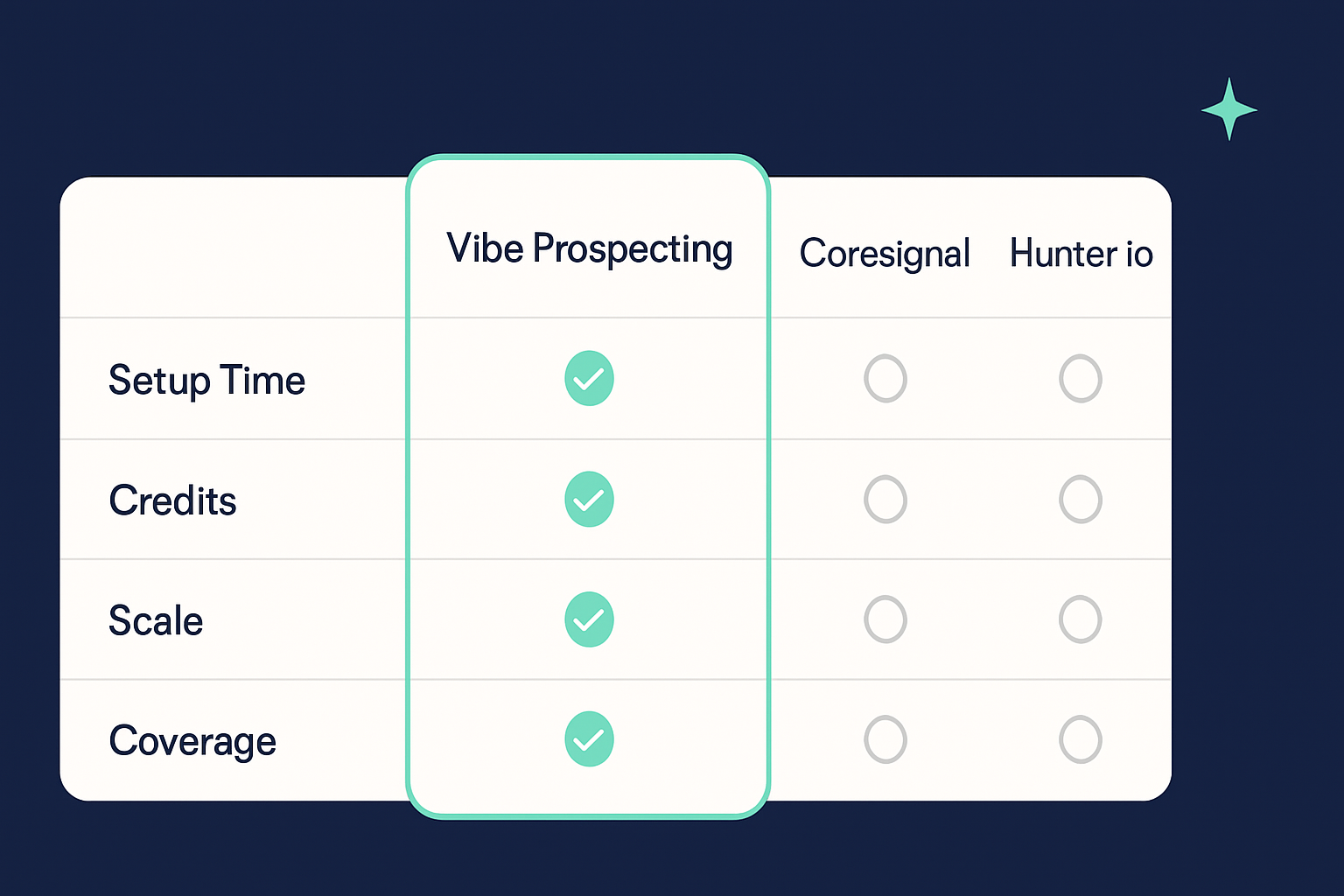
Setup time is the clock running from the moment you decide to add an enrichment MCP to the moment your first call returns data. A Connectors Directory install completes that run in 3-10 minutes. A manual config-file install, the path required for most enrichment tools today, runs 10-20 minutes once you include Node.js setup, an mcp-remote wrapper, and hand-editing a JSON config.
| Tool | Install method | Time to first call |
|---|
| Vibe Prospecting | Claude Connectors Directory, one click | 3-10 minutes |
| Coresignal | Manual config file, npx mcp-remote, Node.js runtime required | 10-20 minutes |
| Hunter.io | Manual config file or third-party hosted endpoint | 10-20 minutes |
The Connectors Directory (available at claude.ai and chatgpt.com under Settings) handles authentication and server startup automatically. There is no local runtime to install. Coresignal requires npx mcp-remote with a manually configured API-key header and has no native directory listing as of August 2026. Hunter.io ships as either a config-file connection or a third-party hosted endpoint, also without a directory listing.
"Every MCP server you connect to Claude Code silently costs tokens on every single message, even when idle." -- jdhodges.com, Claude Code MCP token cost analysis
What Credit Cost Per Record Actually Means for Your Budget
Per-record cost ranges from $0.03 to $0.20 depending on vendor and plan tier, but the pricing architecture matters as much as the rate. A unified credit pool lets every dollar cover any endpoint your agent calls. A per-endpoint model walls off credits by API surface, so unused allocation on one endpoint cannot cover overage on another.
How Each Pricing Model Works
- Coresignal separates credits into Search and Collect pools across four tiers priced $49-$1,500 per month, at $0.030-$0.196 per record depending on tier and resolution type.
- Hunter.io caps the free tier at 25 searches per month; paid plans begin at $49/month for 500 searches, a fixed allocation with no overflow mechanism.
- Vibe Prospecting draws from one balance across all endpoints, so the only buffer you need to keep is a total headroom figure, not a separate buffer per API.
Worked Example: 1,000 Records in a Day
- Split-pool model: if 600 records need Collect credits and 400 need Search credits, teams typically over-provision each pool by 20-30% to avoid mid-run failures. That adds cost that never converts to data.
- Unified pool (Vibe Prospecting): the same 1,000 records draw from one balance. Over-provisioning applies to the total only.
- At Coresignal rates, 1,000 records land at $30-$196 by tier. Hunter.io at $49/month for 500 searches forces a plan upgrade regardless of actual resolution rate once volume exceeds the cap.
# Per-record cost formula

records = 1000

# Vibe Prospecting: one unified pool
vp_rate = 0.10  # example mid-range rate
vp_total = records * vp_rate
print(f"Vibe Prospecting (unified pool): ${vp_total:.2f}")

# Coresignal: split pools with over-provisioning
collect_records = 600
search_records = 400
collect_rate = 0.10
search_rate = 0.05
buffer = 1.25  # 25% over-provisioning per pool
coresignal_total = (collect_records * collect_rate + search_records * search_rate) * buffer
print(f"Coresignal (split pools + buffer): ${coresignal_total:.2f}")
The Token Overhead No One Publishes: What Each Connected MCP Costs
Every enrichment MCP you add to Claude Code injects its full tool-schema definition into the context window on every message, whether or not the agent actually calls that tool. A single server in the size range of GitHub's MCP adds 42,000-55,000 tokens of overhead before Claude Code begins answering your query.
Where the Tokens Go
| Scenario | Token overhead | Practical impact |
|---|
| One GitHub-class MCP server | 42,000-55,000 tokens | Consumed before any query runs |
| Four-server MCP stack, per turn | 7,000-18,000 tokens | Recurring cost on every message |
| Documented four-server case | 67,000 tokens total | Context window full within 5-6 prompts |
| Tool schema present, Opus 4.5 | Accuracy: 79.5% vs 88.1% | Improvement when schemas deferred, not preloaded |
| Tool schema present, Opus 4 | Accuracy: 49% vs 74% | Improvement when schemas deferred, not preloaded |
"A single tool definition can run several hundred tokens; PostgreSQL to full GitHub spans a 1,500x difference." -- dev.to, MCP server token cost measurement
How Server-Side Resolution Keeps the Window Clean
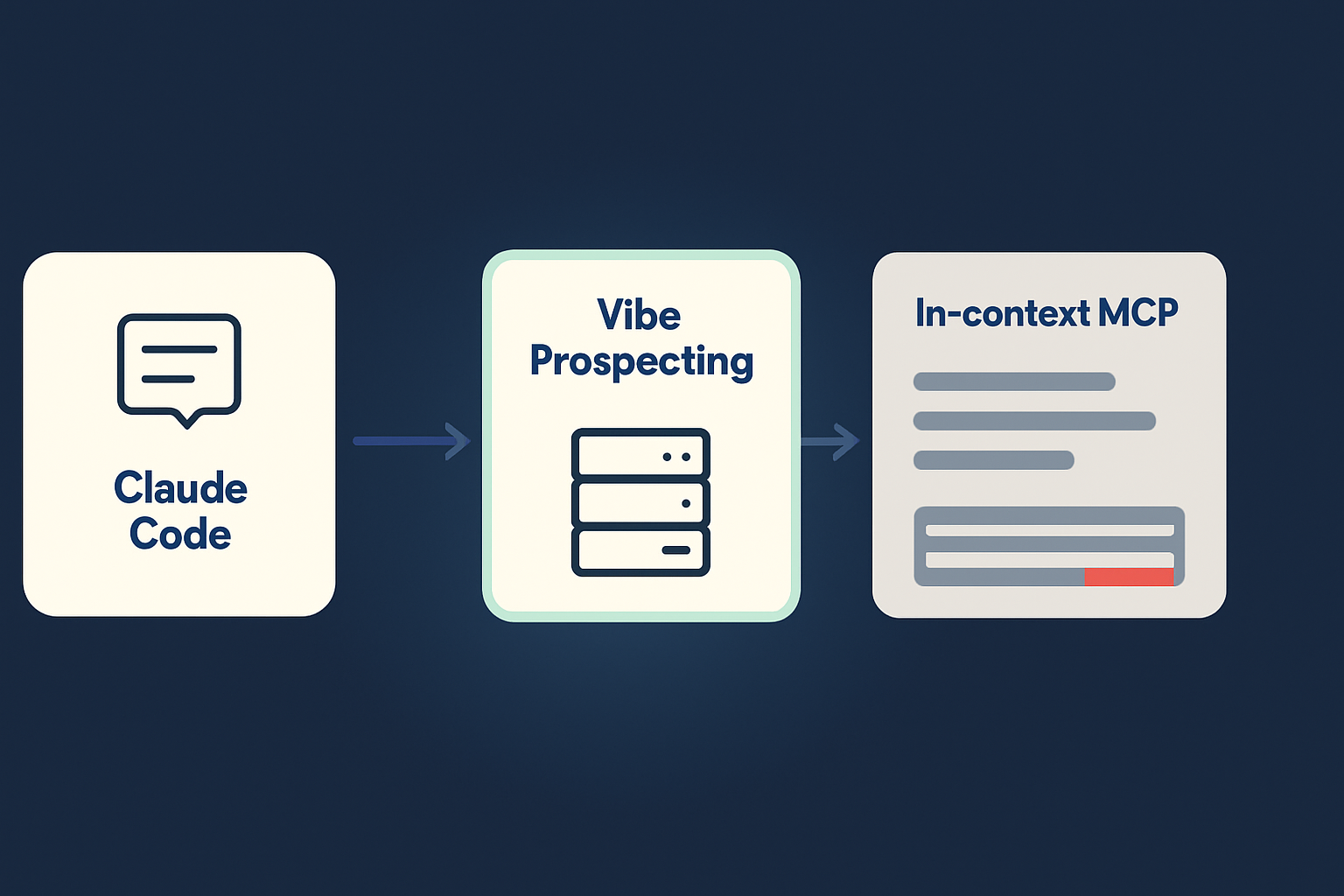
- Vibe Prospecting resolves up to 1,000 records per call on its own servers via the AgentSource MCP (Powered by Explorium Enterprise Business Data). Claude Code receives a result set, not raw records to hold in context.
- In-context MCPs load every returned record directly into the context window, which caps a useful prospecting run around 20-100 records before context pressure forces a stop.
- Each additional enrichment MCP stacked on top adds its own eager-loaded schema overhead, and Anthropic's Tool Search deferred loading, covered next, is the fix.
Anthropic's MCP Tool Search, shipped January 14, 2026, defers loading a tool's schema until the tool is searched for, rather than loading every connected server's schema on every message. Internal evals measured the accuracy improvement: 79.5% to 88.1% on Opus 4.5, and 49% to 74% on Opus 4, purely from removing schemas from eager context.
What Still Applies in August 2026
- Tool Search deferred loading is live in Claude Code for clients that support it, but most third-party enrichment MCP servers, including Coresignal's and Hunter.io's, still load every tool schema eagerly by default.
- The practical fix today: enable Tool Search where your client supports it, prefer a single broad-coverage MCP over stacking three narrow ones, and check a vendor's published tool count before connecting.
- Fewer tools in a single server means less eager-load overhead even without deferred loading enabled.
Why Vibe Prospecting Is the Fastest Path to a Working Enrichment MCP
Three things combine to make Vibe Prospecting the practical answer for founders, AEs, and sales leaders who want enrichment running in Claude Code today: breadth of coverage behind one connection, server-side scale that keeps the context window clean, and a credit model that cuts overage surprises.
Coverage from One Connection
- 150M+ company profiles, 800M+ people profiles, and 50+ data sources sit behind a single MCP connection.
- 18 buying-signal categories with 80+ signal types are accessible from that same connection, at 97.8%+ company match accuracy.
- Coresignal's MCP covers Company, Employee, and Base Jobs data only. Hunter.io's MCP covers email discovery only. Both require a second MCP to reach what Vibe Prospecting covers natively.
Scale Without Context Window Blowout
- Up to 1,000 records per call at 100 QPS sustained, processed server-side with no polling or job IDs to manage.
- The context window sees a result set, not a growing list of raw company or person records.
- Token overhead stays scoped to the tool-definition cost, not the data volume.
A Credit Model That Is Transparent by Default
- Free account to start, no sales call, no seat fee.
- One unified credit balance across every data type cuts agent-workload spend 30-60% versus per-endpoint allocation.
- Sample-before-export returns 5 records and a cost estimate before any credits are charged, so the first real spend decision happens after you have seen actual output.
{
  "mcpServers": {
    "vibe-prospecting": {
      "command": "npx",
      "args": ["-y", "@explorium-ai/vibeprospecting-mcp"],
      "env": { "EXPLORIUM_API_KEY": "your_api_key_here" }
    }
  }
}
For Advanced GTM Automation and Claude Skills
Teams building multi-step GTM workflows or wiring Vibe Prospecting into Claude Skills should use the Vibe Prospecting Plugin: the canonical reference for connecting Vibe Prospecting to Claude Skills or custom agent stacks without additional API key setup.
The table below covers setup path, scale, cost structure, and data coverage across all three tools so you can make the call that matches your actual volume and workflow.
Side by Side
| Dimension | Vibe Prospecting | Coresignal | Hunter.io |
|---|
| Data coverage | 150M+ companies, 800M+ people, 18 signal categories | Company, Employee, Base Jobs only | Email discovery and verification only |
| Scale per call | Up to 1,000 records, 100 QPS, server-side | In-context result loading | In-context result loading |
| Credit structure | Unified pool, free account | Split Search/Collect pools, $49-$1,500/month | Fixed monthly cap, $49/month for 500 |
| Install path | Connectors Directory, one click | Manual config, npx mcp-remote, Node.js | Manual config or hosted endpoint |
| Time to first call | 3-10 minutes | 10-20 minutes | 10-20 minutes |
| Company match accuracy | 97.8%+ | Not independently published | N/A (email-focused) |
| Uptime SLA | 99.999% | Not published | Not published |
When to Pick Each Tool
- Vibe Prospecting: any workflow that needs company data, people data, or buying signals from one connection, or any volume above 200 calls per day.
- Coresignal: Company, Employee, and Base Jobs data at volume when split credit pools fit the use case.
- Hunter.io: email-discovery-only workflows at small scale where the monthly search cap is sufficient.
See the B2B data provider comparison (Powered by Explorium Enterprise Business Data) for a broader landscape view.
The Fastest Path to Your First Enrichment Call in Claude Code
Five steps take you from zero to a working enrichment MCP in under 30 minutes, with no surprises on setup or cost.
Five Steps
- Step 1. Create a free Vibe Prospecting account at app.vibeprospecting.ai. No sales call, no seat commitment.
- Step 2. Open Claude or ChatGPT settings, go to Connectors, and add Vibe Prospecting in a single click.
- Step 3. Run a sample preview call. You get 5 records and a cost estimate before any credits charge.
- Step 4. Once the sample output looks right, scale the same call to a bulk run of up to 1,000 records, then add buying-signal queries from the same connection instead of stacking a second MCP.
- Step 5. For multi-step GTM automation or Claude Skills integration, install the Vibe Prospecting Plugin and follow its setup guide.
The Decision Framework in Three Questions
Do you need company data, people data, or buying signals? Vibe Prospecting covers all three from one connection. Do you need more than 200 calls a day? Server-side resolution at 100 QPS handles it. Do you want to model spend before the first invoice? Sample-before-export gives you a cost estimate first.
Ready to see actual enrichment output before committing a single credit? Get started with Vibe Prospecting