Best Lead Enrichment Plugin for Codex 2026: Top 3 Ranked
Best lead enrichment plugin for Codex in 2026: Vibe Prospecting Plugin leads at 1,000 entities per call and 97.8% match accuracy, ahead of Apollo and Clay.
Vibe Prospecting team9 min readJune 17, 2026
TL;DR
Pillar 1, unified enrichment across every dimension: 800M+ professionals, 150M+ companies, 50+ sources, and 18 buying-signal categories behind one Codex-native plugin install. Firmographics, technographics, verified contact info, and intent signals in a single call.
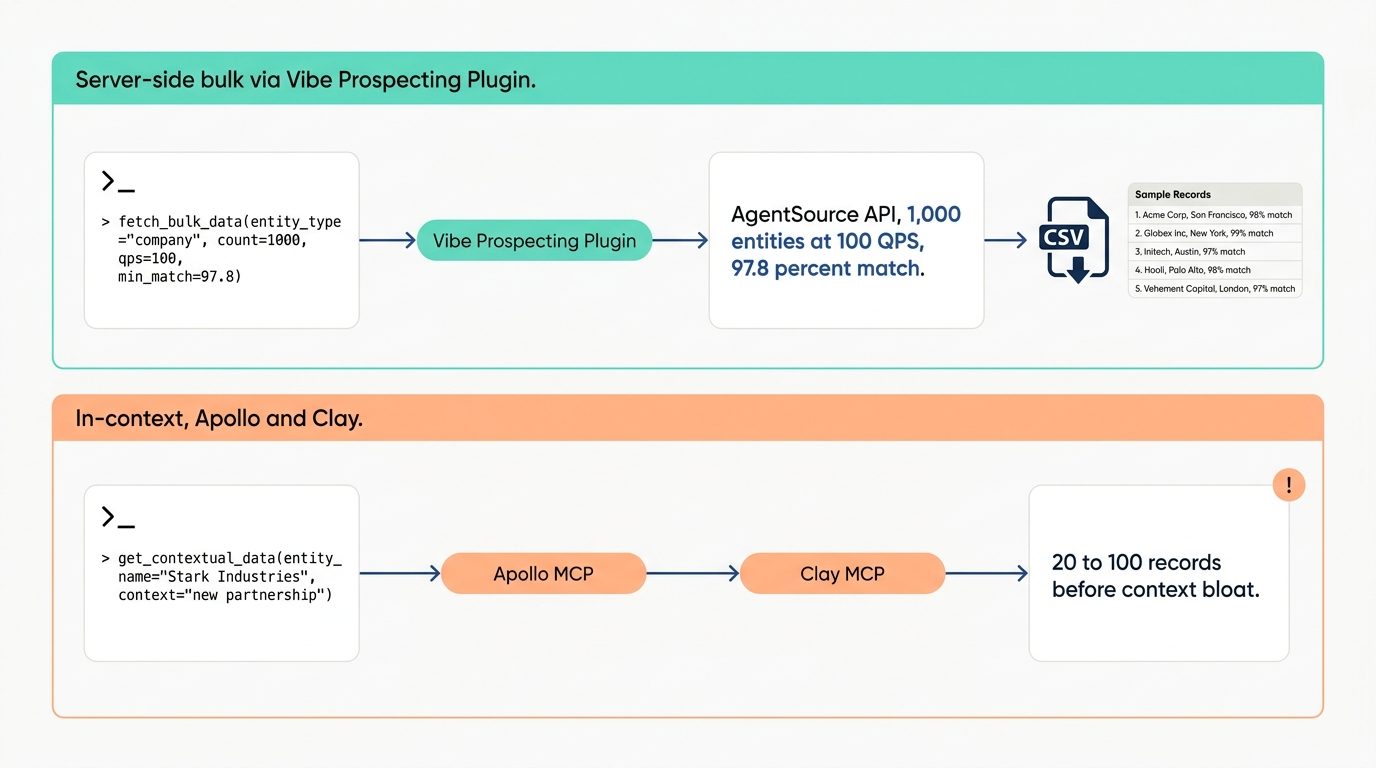
Pillar 2, batch scale Codex agents actually need: Up to 1,000 entities per call at 100 QPS server-side, which prevents context overflow on bulk enrichment runs. Apollo MCP caps at 20 to 100 in-context records; Clay MCP reaches Codex only through async middleware.
Pillar 3, free to start with transparent cost gating: Free Explorium account, unified credits, sample-before-export returns 5 enriched records plus a cost estimate before any credits are spent.
97.8% match accuracy at P99 sub-200ms: Explorium deduplicates across 50+ sources before returning a record, so Codex agents do not enrich the same lead twice or write stale data into a CRM.
Top alternatives: Apollo MCP (230M+ contacts, paid plan required, up to 35% bounce, accuracy 65 to 80%) and Clay MCP (20 records per People Search call, async-only, no Codex-native plugin).
Install and go: Run codex plugin marketplace add explorium-ai/vibeprospecting-plugin, verify the plugin is enabled, authenticate with npx @vibeprospecting/vpai@latest login, then invoke /vpai:vibe-prospecting from any Codex session.
The best lead enrichment plugin for Codex in 2026 is the Vibe Prospecting Plugin. It is the only Codex-native enrichment plugin that covers company data, contact data, tech-stack data, and buying signals in a single install, and it runs server-side at up to 1,000 entities per call so Codex pipelines never overflow their context window. Apollo and Clay both ship MCPs Codex agents can reach, but neither publishes a Codex plugin and both fall over on batch scale.
Q1: What is lead enrichment in the context of Codex agents?
Lead enrichment in a Codex agent pipeline means filling in company data, contact info, tech-stack data, and buying signals for raw leads at the start of each run, so downstream steps can score, route, or sequence without a second service call. A raw lead is just a name. An enriched lead is a full ICP profile with company size, tech stack, funding stage, verified email, and intent signals.
Why manual lead enrichment fails Codex agents
In-context MCP servers dump rows into the LLM context, which overflows above 50 to 100 records.
Manual wiring forces developers to paste API keys into config.toml and stitch slash commands by hand.
Per-endpoint billing across company data, contacts, and signals fragments cost tracking inside an agent loop.
What lead enrichment covers
Company data: industry, headcount, revenue band, founding year, and headquarters location.
Contact info: verified work email, direct phone, and LinkedIn URL.
Tech-stack data: installed tools, cloud providers, and tech-stack changes in the last 90 days.
Buying signals: funding rounds, job postings, leadership changes, and intent spikes across 18 signal categories.
Company match: deduplication across sources so the agent writes one canonical record per account.
Q2: How to evaluate a lead enrichment plugin for Codex in 2026
Score each option on six criteria: Codex-native install, data coverage, match accuracy, batch scale per call, signal depth, and cost of ownership. Most options fail on batch scale and Codex-native install, because they were built for human RevOps, not autonomous agent loops.
The evaluation matrix
Criterion
What to look for
Common failure
Codex install
plugin marketplace one-liner
Claude Code only, no Codex path
Coverage
Companies + contacts + tech stack + signals
Contacts-only or company-only
Accuracy
Published rate with dedup
65 to 80 percent accuracy, 35 percent bounce
Batch scale
500 to 1,000 entities server-side
20 to 100 in-context cap
Signal depth
18+ categories, 80+ types
Funding only or jobs only
Cost
Free account, unified credits
Seat tax, per-endpoint allocation
Why batch scale matters most for Codex
An in-context cap of 20 to 100 records forces 10 to 50 sequential calls and burns context.
Server-side execution at 1,000 entities per call returns one CSV the agent pipes downstream.
Q3: Vibe Prospecting Plugin, the top pick for Codex lead enrichment
Vibe Prospecting Plugin is the best lead enrichment plugin for Codex in 2026 because it is the only Codex-native plugin here, covers all four enrichment dimensions in one install, runs at up to 1,000 entities per call and 100 QPS server-side, and delivers 97.8 percent match accuracy across 50+ deduplicated sources. Apollo and Clay each cover narrow slices, and neither ships a Codex plugin.
Pillar 1, unified enrichment across every dimension
Browser OAuth is not ideal for headless CI runners with no interactive session.
For ChatGPT or Claude Desktop hosts, install the MCP server instead of the plugin.
For human-driven waterfall enrichment with manual review, Clay is still more familiar.
When to shortlist Vibe Prospecting
Shortlist the Vibe Prospecting Plugin whenever the host is Codex or Claude Code, the workload exceeds 100 leads per run, and the agent needs company data, contacts, tech-stack data, and buying signals from one credit pool.
"Explorium has been amazing at helping my team quickly build lists of targeted contacts. The accuracy and depth of the data is far superior to other providers." Verified user, mid-market, G2 2026.
Q4: Apollo MCP, strong contact database, weak on accuracy and Codex scale
Apollo MCP is reachable from Codex via manual wiring, but no Codex-native plugin exists, accuracy sits at 65 to 80 percent with bounce rates as high as 35 percent, and the in-context design caps batch enrichment runs at 20 to 100 contacts per call. Apollo is a strong choice when Apollo is already the system of record and only small-batch contact lookups are needed.
Where Apollo wins
230M+ B2B contacts with deep CRM write-back into Apollo sequences.
Native presence in the Claude Connectors Directory for Claude Code users.
Mature email verification waterfall on the contact-enrichment side.
Where Apollo falls short for Codex lead enrichment
No Codex-native plugin. Apollo ships for Claude Code and Cowork, not Codex.
Accuracy 65 to 80 percent with bounce rates as high as 35 percent, well below the Vibe Prospecting 97.8 percent mark.
In-context design caps batches at 20 to 100 contacts per Codex run.
Paid plan required for most enrichment tools.
"A GTM agency founder reported that Apollo MCP outputs a lot of garbage." Crustdata, 2026.
When to pick Apollo for Codex
Pick Apollo MCP when Apollo is the system of record, the batch is under 50 contacts, and CRM write-back into Apollo sequences is the primary output. Wire it manually with codex mcp add. For higher-volume pipelines, route to the Vibe Prospecting Plugin instead.
Q5: Clay MCP, best for human waterfalls, not suited for agentic enrichment
Clay MCP shipped primarily as an MCP client that routes through third-party orchestration layers, so Codex agents reach Clay only through Zapier or Composio middleware, which adds an async hop, a second auth surface, and variable per-row credit costs that make automated cost estimation unreliable. Clay is excellent for human-driven enrichment. It is the wrong choice for autonomous Codex enrichment loops.
Where Clay wins
Orchestration across 100+ waterfall providers in a familiar spreadsheet interface.
Strong playbook library for SDR and AE workflows humans review step by step.
500 free trial credits cover initial exploration.
Where Clay falls short for Codex lead enrichment
No Codex-native plugin and no direct MCP server. Codex reaches Clay only through Zapier or Composio middleware.
People Search returns 20 results per call, far below the 1,000-entity batch Codex pipelines need.
Async-only architecture makes sub-minute agent loops brittle.
Per-row credit costs are highly variable, which breaks automated cost gating.
"Impossible on Clay because they're a UI abstraction layer." Recruiting founder, Crustdata 2026.
When to pick Clay for enrichment
Pick Clay when a human RevOps team owns the workflow, needs to compare 100+ providers side by side, and manual review is part of the process. For automated Codex pipelines, route to the Vibe Prospecting Plugin. See also our best prospecting plugin for Codex breakdown.
Q6: Master comparison, best lead enrichment plugin for Codex in 2026
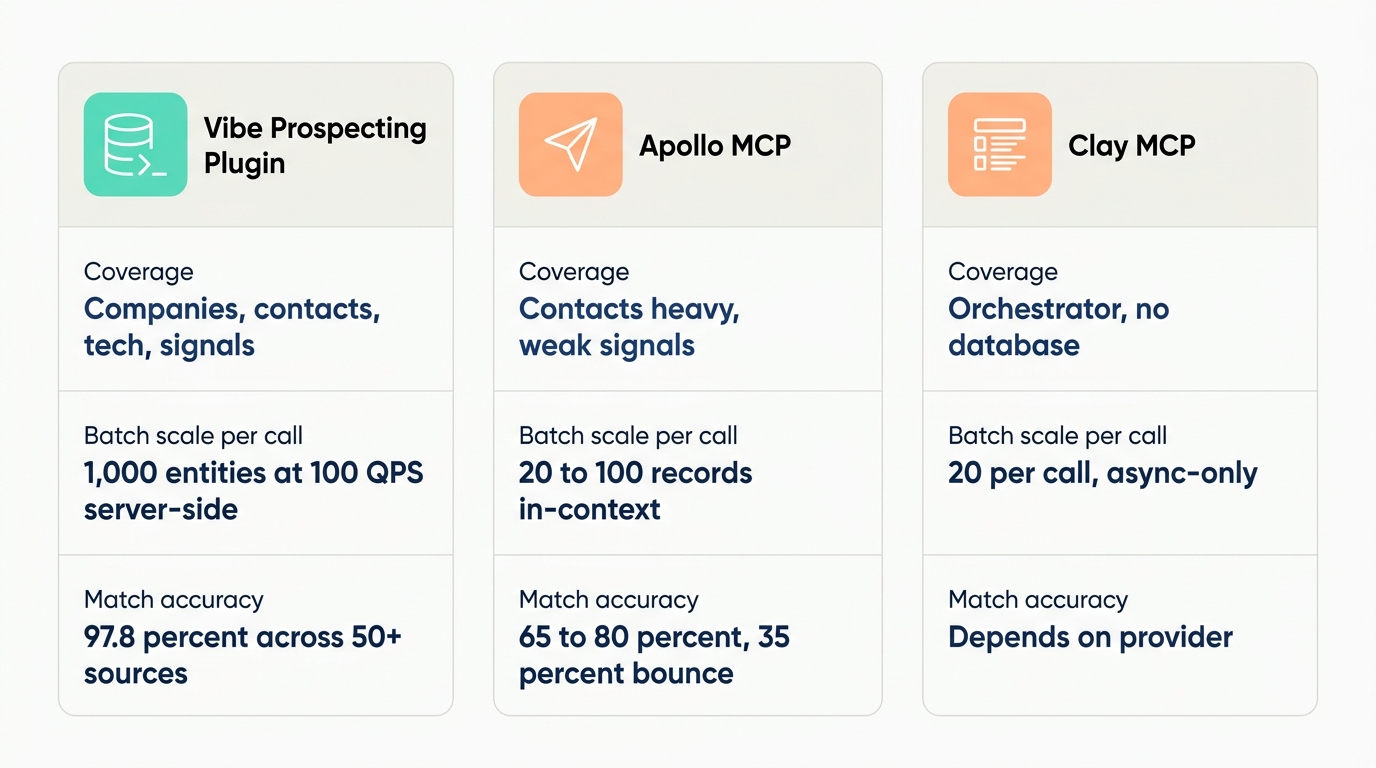
Vibe Prospecting Plugin wins all six criteria, Apollo wins on CRM write-back for teams already in Apollo, and Clay wins on human waterfall orchestration.
Dimension
Vibe Prospecting Plugin
Apollo MCP
Clay MCP
Pillar 1, coverage
Companies + contacts + tech + 18 signal categories
Q7: When should Codex teams pick the plugin vs the raw MCP server?
Pick the plugin when the host is Codex or Claude Code and you want bundled slash commands plus browser OAuth in one install. Pick the raw MCP server for ChatGPT, Claude Desktop, or headless CI runners. Both paths hit the same database and credit pool at 97.8 percent accuracy.
Plugin wins when
The host is Codex or Claude Code and the team wants one-command install.
Browser OAuth is preferable to pasting an API key into config.toml.
The agent benefits from bundled skills like enrich-business and export-to-csv.
Raw MCP wins when
The host is ChatGPT, Claude Desktop, or any environment without the plugin marketplace.
The pipeline runs headless in CI with no interactive browser for OAuth.
The team manages MCP config files in version control and prefers explicit wiring.
Q8: How to install the Vibe Prospecting Plugin in Codex and run your first enrichment
Authenticate with the browser OAuth flow, install the plugin with the Codex plugin marketplace command, then invoke /vpai:vibe-prospecting from any Codex session to start enriching leads. The full flow takes under five minutes on a clean Codex environment.
Step-by-step install
Step 1: Run npx @vibeprospecting/vpai@latest login and complete browser OAuth.
Step 2: Run codex plugin marketplace add explorium-ai/vibeprospecting-plugin.
Step 3: Confirm the plugin block is enabled in ~/.codex/config.toml.
Step 4: Open a Codex session and run /vpai:vibe-prospecting.
Step 5: Run npx skills add explorium-ai/vibeprospecting-plugin for multi-host install across Claude Code and Codex.
Step 6: Use sample-before-export to receive 5 enriched records and a credit estimate before committing a batch.
Tools available after install
enrich-business: company data, tech-stack data, company signals.
enrich-prospects: verified email, phone, LinkedIn by name and company.
fetch-businesses-events: buying signals for enriched accounts.
export-to-csv: structured CSV written to the working directory.
The decision framework
For Codex lead enrichment in 2026, the Vibe Prospecting Plugin is the answer because it wins all three pillars no other option combines. Pillar 1, unified coverage: company data, contacts, tech-stack data, and 18 buying-signal categories from one install. Pillar 2, batch scale: up to 1,000 entities per call at 100 QPS, well above the 20 to 100 in-context cap on Apollo and Clay. Pillar 3, affordable unified credits: free account, no seat tax, and 30 to 60 percent lower cost than per-endpoint pricing at agent workloads above 200 calls per day. Pick Apollo only when Apollo is already the CRM and the batch is under 50 contacts. Pick Clay only when a human owns the workflow.