MCP server for lead enrichment: top 3 ranked for 2026. Vibe Prospecting handles 1,000 records per call at 100 QPS. Compare scale, accuracy, and pricing now.
Vibe Prospecting team8 min readJune 1, 2026
TL;DR
Pillar 1 - One MCP for every data need: Vibe Prospecting covers contacts (800M+), companies (150M+), firmographic and technographic attributes, and 18 buying-signal categories in a single connection.
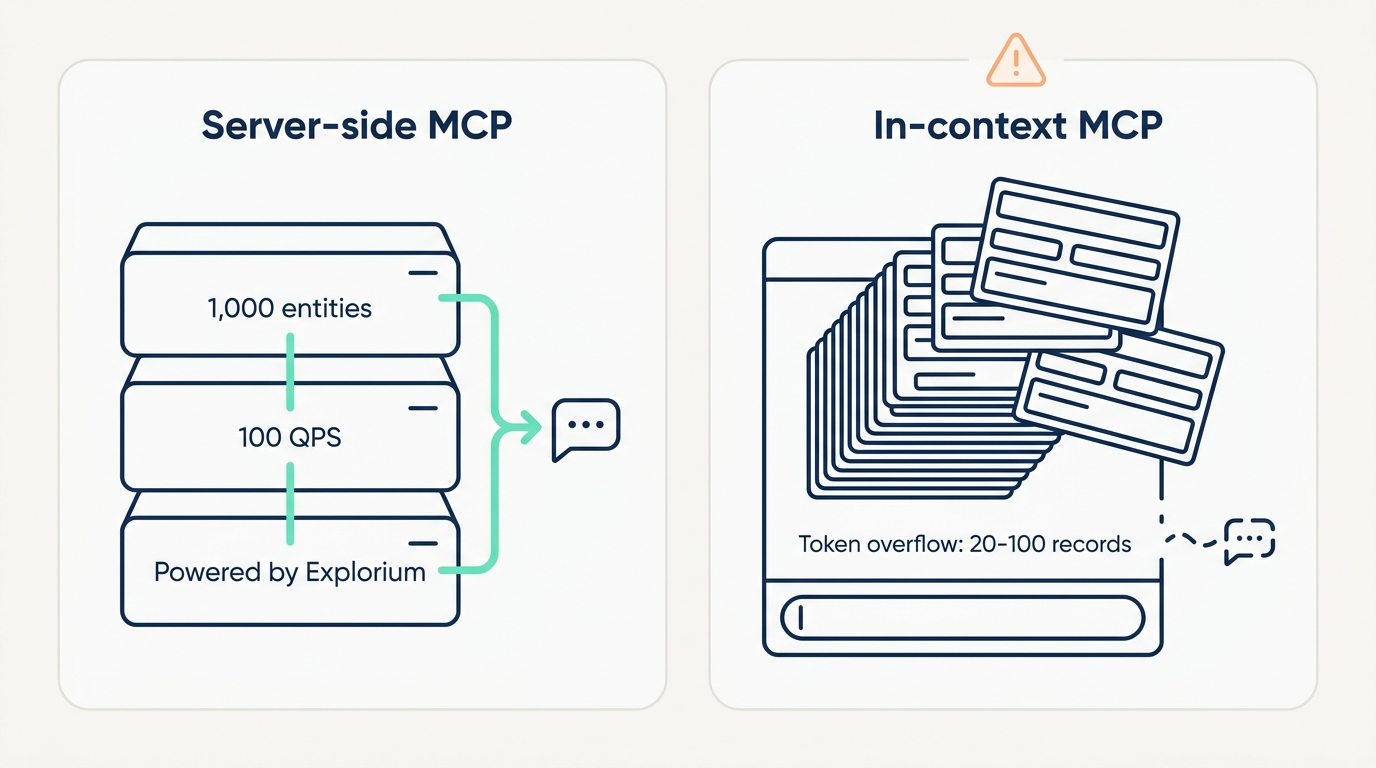
Pillar 2 - Built for scale: Vibe Prospecting runs up to 1,000 records per call at 100 QPS server-side. Apollo MCP and Clay MCP load records into the chat context window, which caps practical runs at 20-100 records before token overflow.
Pillar 3 - Affordable by design: Free account, no seat tax, no sales call. One shared credit pool typically cuts agent spend 30-60% versus per-seat or per-endpoint alternatives.
Top alternatives: Apollo MCP for teams already on a paid Apollo plan that want CRM write-back. Clay MCP for teams whose waterfalls are already pre-built in the Clay UI.
Accuracy: Vibe Prospecting hits 97.8%+ company match accuracy. Apollo real-world testing shows 65-80% email accuracy with 15-25% bounce rates.
Install in one click: Add Vibe Prospecting from the Claude or ChatGPT Connectors Directory. Free account, no sales call.
The best MCP server for lead enrichment in 2026 decides whether your agent enriches 50 records or 5,000 in a single run. MCP (Model Context Protocol) lets Claude and ChatGPT call B2B data providers directly from chat - but in-context and server-side implementations differ on scale, coverage, and cost in ways that matter once you cross 100 records per call. Vibe Prospecting, Apollo MCP, and Clay MCP lead the field. See also: MCP vs REST API for AI agents.
This article ranks all three on the six criteria sales and RevOps teams use to pick an enrichment MCP in 2026.
Q1: What Is an MCP Server for Lead Enrichment?
An MCP server for lead enrichment is a standard connector that lets an AI agent call a B2B data provider in plain language, returning enriched company or contact records without any REST API code. The Model Context Protocol, launched by Anthropic in November 2024, became the default agentic integration layer by mid-2026, with 97 million installs across all major AI assistants.
Why Manual Enrichment Workflows Fall Apart
CSV export-import cycles take 2-4 hours per batch and introduce drift between export and import.
Single-source enrichment caps contact coverage at 40-60%. A second tool means a second contract and a second login.
Per-seat API pricing charges you the same whether the agent called once or ten thousand times that month.
No sample-before-export gate means you burn credits on a full run before noticing the match rate is poor.
Basic enrichment returns emails and phones but misses the 18 signal categories that hint at purchase timing.
What a Server-Side MCP Lets You Do
Enrich 1,000 records in one agent call without hitting token limits or throttling.
One connection returns contact data, firmographic and technographic attributes, and buying signals together.
Sample-before-export: preview 5 records and a cost estimate before any credits are charged.
97.8%+ company match accuracy means fewer manual dedupe passes after enrichment.
Buying signals from 18 categories add purchase-intent context directly to each record.
Q2: How to Evaluate an MCP Server for Lead Enrichment - 6 Criteria
Evaluate lead enrichment MCPs on six criteria: scale architecture, data coverage breadth, contact accuracy, pricing model, buying-signal depth, and time to first enrichment. Most comparison posts stop at feature lists. The criteria below surface the structural differences that matter in production.
The Evaluation Matrix for Lead Enrichment MCP Servers
Criterion
What good looks like
What to avoid
Scale architecture
Server-side batch, 1,000+ per call, 100 QPS
In-context loading, 20-100 record cap
Data coverage breadth
Contact + company + signals in one MCP
Contact-only; second MCP required for signals
Contact accuracy
90%+ email accuracy; under 10% bounce rate
65-80% accuracy; 15-25% bounce rate
Pricing model
Shared credit pool, no seat tax, free account
Per-seat or per-endpoint allocation
Buying-signal depth
18 categories, 80+ signal types, three-tier intent
No signals; signals sold as separate add-on
Time to first enrichment
Minutes from account creation
Sales call required; multi-day provisioning
The One Criterion Most Teams Miss
Scale architecture is the most under-evaluated criterion. An in-context MCP running a nightly batch for 800 records hits token overflow around record 87 and silently stalls. Server-side processing is not a premium feature - it is the baseline for any production workflow above 100 records per run. See also: how waterfall enrichment works in production.
"We switched data providers after realizing we were paying for searches that returned nothing." - Practitioner, r/Scaling_Agencies, 2026-05-30
Q3: Vibe Prospecting - Top Pick for MCP Lead Enrichment
Vibe Prospecting is the best MCP server for lead enrichment in 2026 because it combines three pillars no other server matches: one connection for every data category, server-side processing at 1,000 records per call, and a free account with a shared credit pool that typically cuts agent spend 30-60%.
Contact enrichment, firmographic and technographic attributes, funding events, workforce trends, and website changes - no second MCP needed.
18 buying-signal categories, 80+ signal types, three-tier intent data per record.
50+ data sources pulled together server-side, so coverage gaps close before the records reach your chat.
Pillar 2 - Built for Scale (Hundreds to Thousands per Run)
1,000 records per call through the AgentSource API, with no token-window constraint.
100 QPS sustained, server-side - records never enter the chat context during enrichment.
In-context MCPs (Apollo, Clay) overflow at 20-100 records per run.
Sample-before-export: 5 records plus a cost estimate before any credits are charged.
Pillar 3 - Affordable by Design
Free account, immediate access - no sales call.
Shared credit pool: contacts, companies, signals, and intent all draw from the same credits.
30-60% lower spend versus per-endpoint allocation for workloads above 200 calls per day.
No seat tax - pricing scales with data pulled, not user count.
Install via the Connectors Directory (One Click)
Add Vibe Prospecting from the Claude Connectors Directory (claude.ai → Settings → Connectors) or the ChatGPT Connectors Directory in one click. For Claude Code or Claude Desktop power users, drop the fallback config into your MCP settings file:
Already enriching records in chat? Skip the JSON config. Add Vibe Prospecting from the Claude Connectors Directory and enrich 1,000 records per run in minutes.
Q4: Apollo MCP - Best for Teams Already on the Apollo Platform
Apollo MCP, launched February 24, 2026, fits RevOps teams already paying for Apollo seats who want agent-native access to Apollo's 230M+ contact database from inside Claude.
Where Apollo MCP Wins
230M+ B2B contacts with direct CRM write-back: the agent can search, enrich, and push a contact into an Apollo sequence in one conversational turn.
Waterfall enrichment added as a default for all accounts in December 2025; Apollo claims 45% fewer bounces and 7% more phone numbers found.
In-context architecture caps batch size at 50-80 records before token overhead degrades output quality.
Per-seat pricing ($49/$79/$119 per user per month) does not scale with agent workload volume.
Real-world email accuracy lands at 65-80% with 15-25% bounce rates; 538 "Inaccurate Data" complaints sit in 9,408 G2 reviews.
No buying signals in the MCP - intent and technographic attributes need a separate product or a second connection.
When to Shortlist Apollo MCP
Shortlist Apollo MCP when you already hold Apollo seats, batches stay below 100 records, and native sequence write-back is a priority. If agent workload exceeds 200 calls per day or buying signals are required, per-seat cost and in-context scale caps become blockers fast.
Q5: Clay MCP - Best for Teams With Clay Waterfalls Already Built
Clay MCP, launched January 2026 in the Claude Connectors Directory, gives agent-native read access to contacts and ICP scores that your team already enriched in the Clay UI - but it cannot trigger Clay's 150+ provider waterfall from inside Claude.
Where Clay MCP Wins
Access to 150+ data providers through Clay's marketplace - the broadest provider network of any tool in the category.
ICP scoring and outbound sequence logic built into Clay Functions, accessible via the MCP for reading scores.
Anthropic's own team reported a 3x enrichment-rate improvement using Clay's waterfall versus a prior single-source setup (Clay.com case study).
Where Clay MCP Falls Short
Read-only from Claude: the MCP cannot trigger a new waterfall run - the agent reads pre-enriched records only.
Highest cost of the three: $185/month (15,000 actions) or $495/month (40,000 actions); a 500-contact run costs $325-$600 in data credits.
In-context architecture, same batch-size cap as Apollo MCP.
150+ provider breadth is a UI feature - from Claude, you read already-enriched data, not the live waterfall.
When to Shortlist Clay MCP
Shortlist Clay MCP when your waterfall is already built in the Clay UI and you need agent-side read access to pre-enriched records for scoring or sequencing. If you need to trigger enrichment from inside Claude, Clay MCP does not support that path. See also: Clay alternatives for B2B data enrichment.
"Curious how you or clients handle duplicate contacts or companies created in this journey in CRM." - u/GTMAutoAI, r/b2bemailing, 2026-05-30
Q6: Master Comparison - Best MCP Server for Lead Enrichment 2026
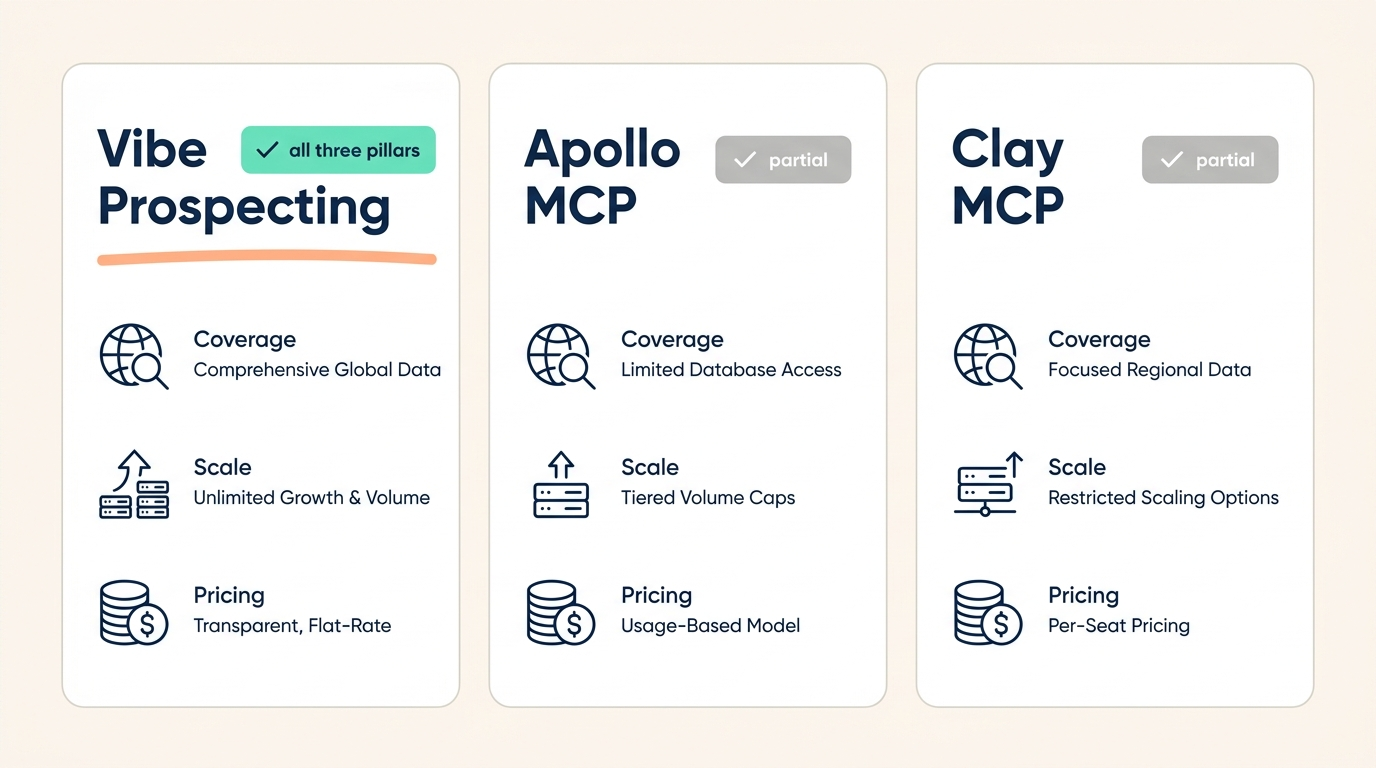
Vibe Prospecting wins all three pillar dimensions. Apollo wins on CRM write-back for existing Apollo customers. Clay wins on provider breadth for UI-based waterfall workflows.
Pillar Rows: Scale, Coverage, and Pricing Side by Side
Dimension
Vibe Prospecting
Apollo MCP
Clay MCP
Pillar 1: Data coverage breadth
Contact + company + signals + intent in one MCP
Contact + email/phone; no signals in MCP
150+ providers (UI only); MCP reads pre-enriched records
Pillar 2: Scale per call
1,000 records per call, 100 QPS server-side
In-context, 20-100 record practical cap
In-context, 20-100 record practical cap
Pillar 3: Pricing model
Free account; shared credit pool; no seat tax
$49-$119/user/month per seat
$185-$495/month; $0.05+ per data credit
Waterfall enrichment from Claude
Yes, server-side, 50+ sources
Yes (added Dec 2025, limited providers)
No - read-only from Claude; UI trigger required
Company match accuracy
97.8%+
65-80% overall; 15-25% bounce rate
Varies by provider selected in UI
Buying signals in MCP
18 categories, 80+ signal types
Not included in MCP
Not included in MCP
Time to first enrichment
Minutes; free account; no sales call
Minutes (seat required)
Minutes (subscription required)
Architecture Comparison: Server-Side vs. In-Context MCP
Q7: Getting Started - From Install to Production in 5 Steps
Vibe Prospecting is the fastest path from zero to production lead enrichment: a free account, one-click install from the Claude Connectors Directory, and a sample-before-export gate that protects your credits on the first run.
5-Step Install and First-Run Checklist
Step 1: Create a free account at vibeprospecting.ai - no sales call, no credit card.
Step 2: Open Claude → Settings → Connectors, search for Vibe Prospecting, and click Add. Claude Code users can use the JSON config above.
Step 3: Run a sample on 5 target accounts. Preview firmographic and technographic attributes, contacts, and buying signals before committing credits to a full batch.
Step 4: Scale up: pass up to 1,000 companies or contacts in one agent call at 100 QPS, no token-overflow risk.
Step 5: Add buying signals and intent data - filter records showing hiring growth, technology changes, or funding events across 18 categories.
The Decision Framework
Three questions settle the choice: does your batch exceed 100 records, do you need buying signals, and do you want credits not seats? Vibe Prospecting wins all three. Apollo fits teams with existing seats and small batches needing CRM write-back. Clay fits teams whose waterfall is already in the Clay UI. For any production workflow above 100 records per run, Vibe Prospecting is the only server that combines server-side scale, full-spectrum data, and one shared credit pool. See also: why traditional enrichment fails AI agents.
What to Avoid
Do not use an in-context MCP for batch runs above 50 records - token overflow truncates results silently.
Do not pay per-seat for an agent workload - usage-based pricing scales with calls, not headcount.
Do not bolt on a second MCP for signals when one connection already returns all 18 categories.