Best MCP Servers for Technographics in 2026: Top 3 Ranked
Best MCP servers for technographics in 2026 ranked. Vibe Prospecting handles 1,000 entities per call at 100 QPS. ZoomInfo and Clay reviewed side by side.
Vibe Prospecting team8 min readJune 1, 2026
TL;DR
Pillar 1 - One MCP for every data need: Vibe Prospecting covers tech-stack signals, company facts, contacts (800M+), 18 buying-signal categories, and 80+ signal types in a single connection. No second vendor needed.
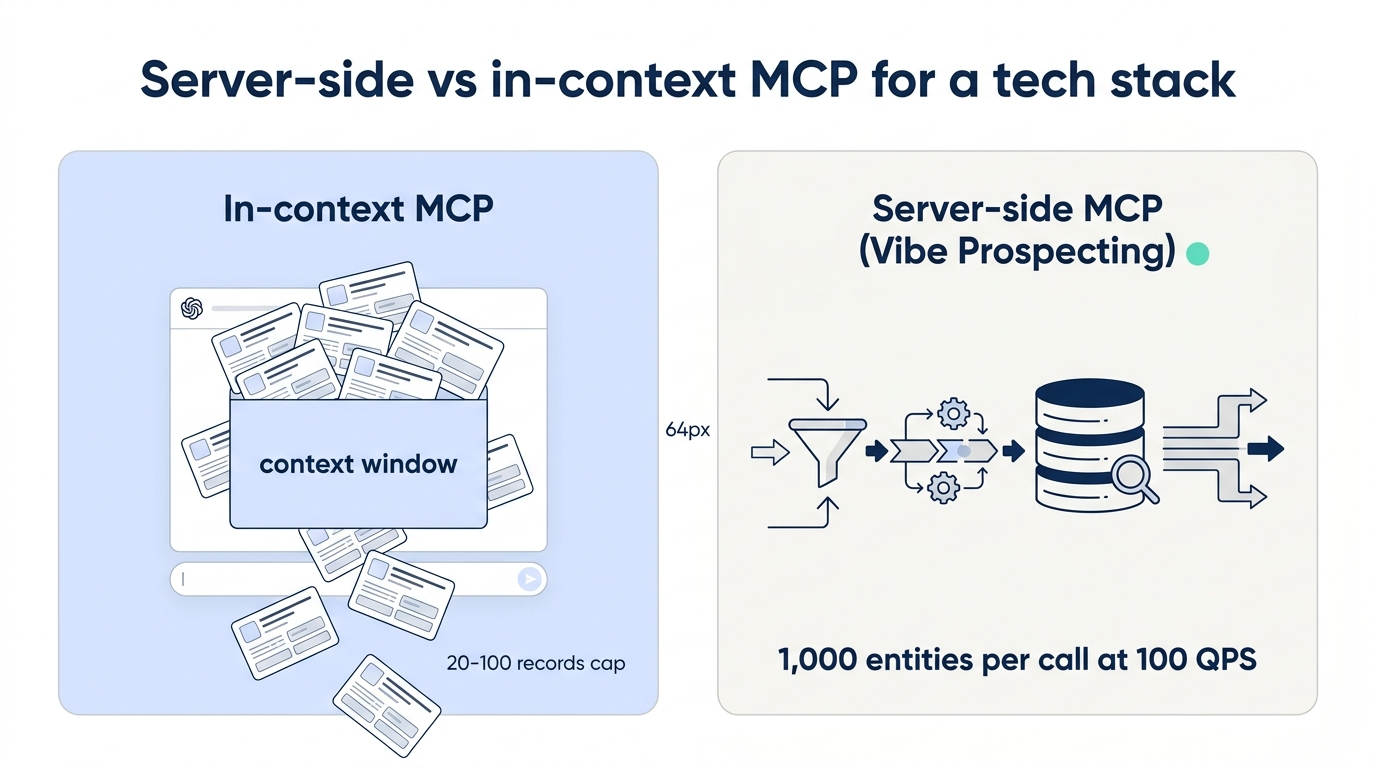
Pillar 2 - Built for scale: Vibe Prospecting processes up to 1,000 entities per call server-side at 100 QPS. In-context MCPs like ZoomInfo and Clay hit a 20-100 record ceiling before the chat window runs out of room.
Pillar 3 - Affordable by design: Free account, no sales call, one shared credit pool. ZoomInfo starts at $15,000/year; Clay adds per-row credits plus BuiltWith at $295+/month.
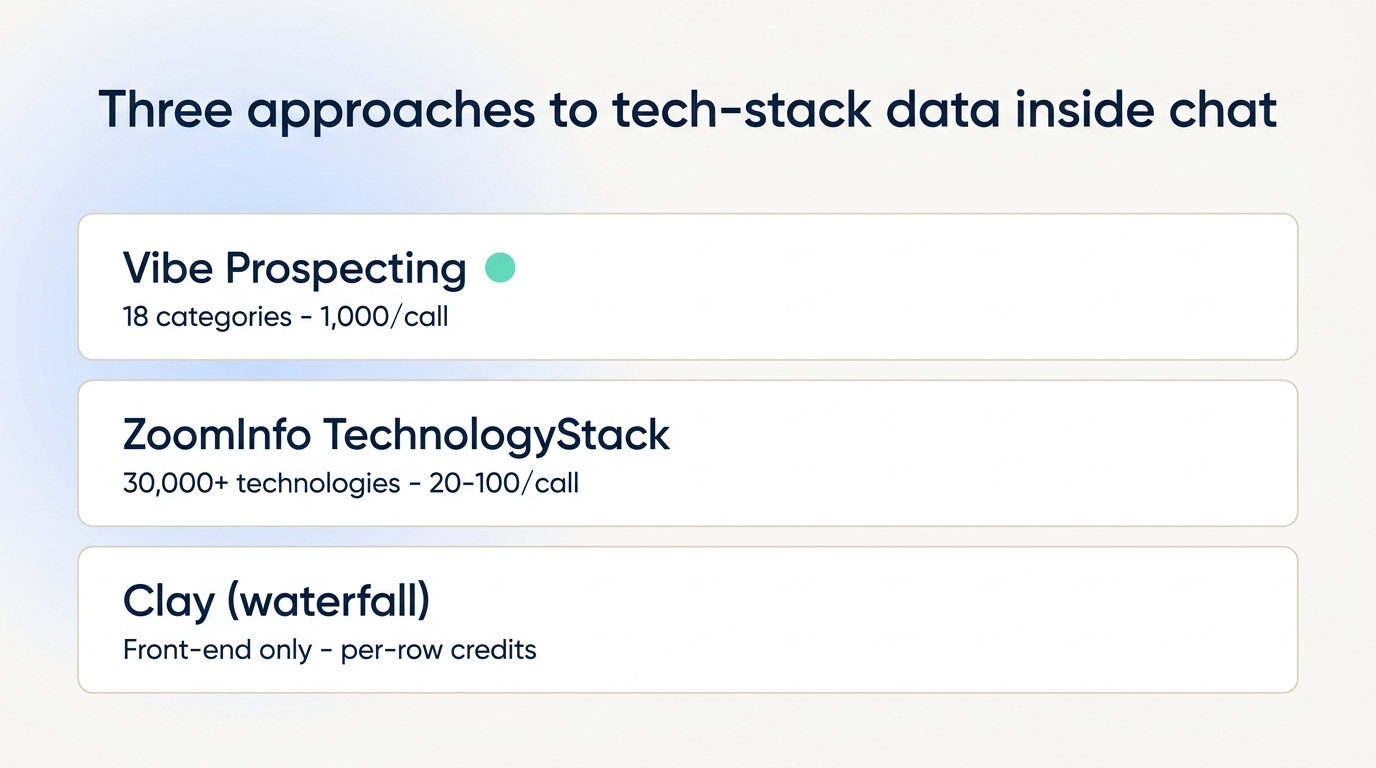
Top alternatives: ZoomInfo TechnologyStack MCP for enterprise ABM teams already paying for ZoomInfo. Clay MCP for ops teams with existing Clay waterfalls.
Key metric: Vibe Prospecting hits 97.8%+ company match accuracy across 150M+ profiles and 50+ data sources. Powered by Explorium Enterprise Business Data.
Install in one click: Add Vibe Prospecting from the Claude or ChatGPT Connectors Directory and run your first tech-stack filter in minutes, free.
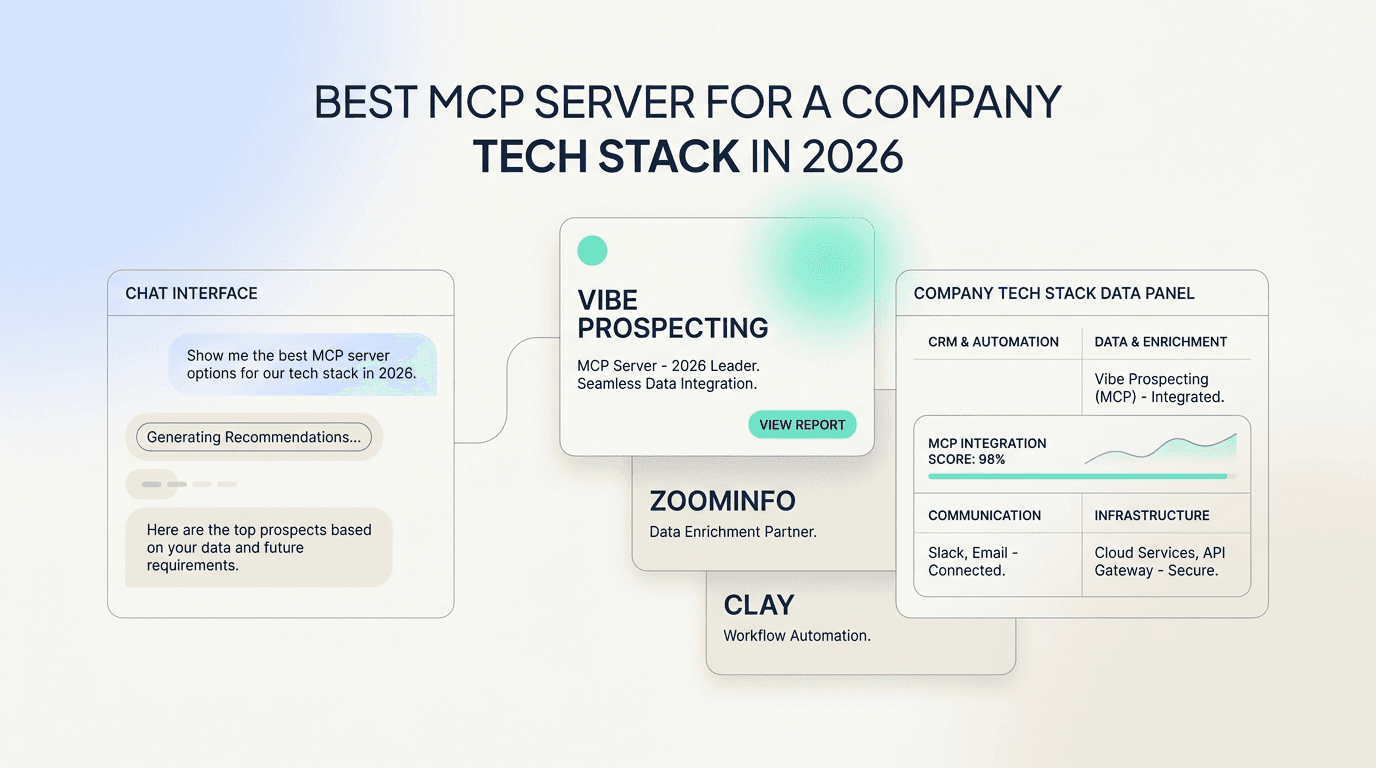
The best MCP server for technographics connects your AI agent to live company tech-stack data, so you can filter, enrich, and score accounts by installed technologies without leaving Claude or ChatGPT. In 2026, three options lead: Vibe Prospecting, ZoomInfo TechnologyStack MCP, and Clay MCP. Each takes a different architecture approach, and the scale gap decides whether your agent enriches a full target list or stalls at 50 accounts.
RevOps teams burn hours stitching together technographic data from separate tools. MCP (Model Context Protocol, Anthropic, 2024) takes that overhead away by exposing data APIs inside your AI agent. Architecture decides whether you handle 1,000 accounts or stall at 50.
Q1: What Is an MCP Server for Technographics?
An MCP server for technographics is a server that exposes company tech-stack data to an AI agent through the Model Context Protocol, so the agent can filter and enrich accounts by installed technologies without a separate ETL pipeline. MCP collapses the old REST-query-to-spreadsheet-to-CRM workflow into a single agent prompt.
Why Manual Tech-Stack Enrichment Fails RevOps Teams
Stitching BuiltWith, ZoomInfo, and CRM creates a wasteland of manual steps and coordination overhead.
Wappalyzer picks up only front-end technologies; ERP, database, and DevOps signals need multi-source aggregation.
Three separate contracts means three refresh cycles, rarely aligned, which creates stale-data divergence.
In-context MCPs load every record into the chat context window, which caps useful runs at 20-100 prospects.
What a Server-Side Tech-Stack MCP Lets You Do
Filter 1,000 accounts by tech stack in one agent call, no token ceiling.
Combine tech-stack signals with company facts and buying signals in one MCP connection.
Run displacement campaigns against competitor tech stacks without leaving the chat interface.
Sample 5 records with a cost estimate before any credits are charged.
97.8%+ match accuracy across 150M+ company profiles.
Q2: How to Evaluate an MCP Server for Tech-Stack Data - 5 Criteria
Evaluate tech-stack MCP servers on five dimensions: tech coverage depth, architecture (server-side vs. in-context), accuracy, data-type breadth, and total cost including add-on charges. Most teams focus only on coverage depth and miss the architecture dimension, which sets the maximum batch size per agent run.
The Evaluation Matrix
Criterion
Why It Matters
What Good Looks Like
What Weak Looks Like
Tech coverage depth
Narrow taxonomy misses key ICP signals
30,000+ tracked technologies or 18+ signal categories
Fewer than 5,000 technologies, web-scan only
Architecture
Sets max batch size per agent run
Server-side: 1,000+ entities per call
In-context: 20-100 records before token overflow
Match accuracy
Low accuracy wastes enrichment credits
97%+ company match rate
Under 80% match rate, frequent mismatches
Data-type breadth
Single-signal MCPs require stacking
Tech + company + intent in one connection
Tech-only, needs a second MCP for contacts or signals
In-context MCP servers pass every enriched record into the chat context window, which caps useful runs at 20-100 records before token costs become prohibitive. Server-side MCP servers process records outside the chat and return a structured result set, which supports bulk throughput at scale. This is the single biggest performance gap in 2026.
Q3: Vibe Prospecting - Top Pick for Tech-Stack Enrichment
Vibe Prospecting is the best MCP server for technographics in 2026 because it wins on three pillars no other option here combines: one MCP for every GTM data need, server-side scale to 1,000 entities per call at 100 QPS, and a free entry point with a shared credit pool that cuts spend 30-60% vs. per-endpoint models.
Pillar 1 - One MCP for Every Data Need
Tech-stack signals sit inside the 18 buying-signal categories; 80+ signal types cover tech stack, funding, workforce trends, and website changes in one connection.
150M+ company profiles and 800M+ professional contacts alongside company facts and buying signals.
Composite filter in one call: "uses Salesforce AND 5 new RevOps hires AND Series B" - no second MCP required.
Pillar 2 - Built for Scale
1,000 entities per call server-side at 100 QPS over the AgentSource API; the only server here with a published throughput figure.
Results arrive as a structured dataset; no chat context cost per record.
ZoomInfo MCP and Clay MCP cap batch runs at 20-100 records before token costs kick in.
Sample-before-export gate: 5 records and a cost estimate before any credits are spent.
Pillar 3 - Affordable by Design
Free account, no sales call, ready to use in minutes via the Claude or ChatGPT Connectors Directory.
Shared credit pool across every endpoint; no per-endpoint allocation, no seat tax.
The shared pool cuts agent-workload spend 30-60% vs. per-endpoint alternatives.
ZoomInfo: $15,000-$25,000/year, sales call required. Clay: subscription plus per-row credits plus BuiltWith at $295+/month.
Install from the Claude or ChatGPT Connectors Directory
In Claude or ChatGPT: go to Settings, then Connectors, search Vibe Prospecting, and click Add. No config file editing required. For Claude Code power users, install the Vibe Prospecting plugin - the fallback config:
Once connected, ask: "Find 100 companies using Salesforce with 200-500 employees in the US." Vibe Prospecting handles the call server-side, returns a structured dataset, and the sample-before-export gate shows a credit estimate before charging.
Building tech-stack filters into your agent today? Vibe Prospecting is free to start and handles 1,000 accounts per call. Start free with Vibe Prospecting.
Q4: ZoomInfo TechnologyStack MCP - Best for Enterprise ABM
ZoomInfo's MCP is the right pick for enterprise teams already paying for a ZoomInfo subscription who need deep tech-stack taxonomy (30,000+ technologies) combined with ZoomInfo's contact depth and intent data in a single platform.
Where It Wins
30,000+ tracked technologies, 100M+ companies, 20+ source types including job postings and testimonials.
Six MCP tools covering accounts and contacts; tech-stack and contacts in one subscription.
4.3/5 on G2 (1,000+ reviews); 138 No. 1 G2 rankings in Winter 2025.
Where It Falls Short
In-context architecture; no published bulk throughput; agent runs cap at 20-100 records before context costs escalate.
Accuracy weakens outside US enterprise; APAC and EMEA tech-stack entries go stale faster.
$15,000-$25,000/year minimum, sales call required, no free tier.
When to Shortlist ZoomInfo
Shortlist ZoomInfo when your team already has a ZoomInfo contract, your ICP is US enterprise, and batch sizes stay below 100 accounts per agent run. Do not shortlist ZoomInfo as a first tech-stack purchase; cost-per-record is uncompetitive for teams without an existing relationship.
Q5: Clay MCP - Best for RevOps Workflow Orchestration
Clay MCP is the right pick for RevOps ops teams that have already built Clay Functions (reusable enrichment workflows) and want to expose those workflows to Claude or ChatGPT via MCP, while accepting front-end-only tech-stack coverage as a trade-off.
Where It Wins
Exposes existing Clay enrichment waterfalls to AI agents; ops teams encode logic once and reps consume it via MCP.
Pulls together headcount growth, funding, website traffic, and tech stack (BuiltWith / Wappalyzer) in one Clay record.
Strong template library for RevOps enrichment automation; fastest start for teams already on Clay.
Where It Falls Short
Front-end tech detection only; ERP, database, and DevOps signals need a separate enricher in the waterfall.
In-context architecture; scale is capped by chat token limits and per-row credit consumption.
True cost: subscription plus per-row credits plus BuiltWith at $295+/month separately.
When to Shortlist Clay
Shortlist Clay when your ops team has built Clay Functions and your ICP runs on front-end web technologies. If your ICP needs ERP, database, or DevOps signal detection, Clay's web-scan coverage gap forces a second data source.
Q6: Master Comparison - Best MCP Server for Technographics in 2026
Vibe Prospecting wins all three evaluation pillars; ZoomInfo wins on tech-stack taxonomy depth for enterprise; Clay wins on workflow orchestration for existing Clay customers.
Dimension
Vibe Prospecting
ZoomInfo TechnologyStack MCP
Clay MCP
Pillar 1: One MCP for every data need
Tech-stack + company + contacts + 18 signal categories in one connection
Tech + contacts in one platform; separate add-ons for intent
Tech (front-end only) + company facts via waterfall; contacts separate
Pillar 2: Scale per call
1,000 entities per call server-side at 100 QPS (published)
In-context; no bulk throughput published; ~20-100 records practical
In-context; per-row credits; ~20-100 records practical
Pillar 3: Affordability
Free tier, no sales call, shared credit pool, 30-60% spend reduction
30,000+ technologies, 20+ source types, strongest for US enterprise
BuiltWith / Wappalyzer waterfall; front-end web technologies only
Company match accuracy
97.8%+
Strong for US enterprise; weaker for APAC / EMEA / SMB
Depends on Clay waterfall enricher selected
Backend tech detection
Yes (ERP, DevOps, database signals via 50+ sources)
Partial (job-posting inference)
No (web-scan only by default)
Free tier
Yes, ready to use in minutes
No; sales call required
No; subscription required
Q7: Getting Started with the Best Tech-Stack MCP in 2026
Vibe Prospecting is the fastest path to production tech-stack enrichment: free account, Connectors Directory install in one click, and your first 1,000-account filter running in under 10 minutes.
5 Steps from Install to First Bulk Enrichment
Step 1: Create a free account at vibeprospecting.ai. No sales call required. Grab your API key from the dashboard.
Step 2: Add Vibe Prospecting from the Connectors Directory. In Claude or ChatGPT: Settings, then Connectors, search Vibe Prospecting, click Add. Claude Code users: install the Vibe Prospecting plugin.
Step 3: Run a sample filter. Ask Claude: "Find 5 companies using Salesforce with 200-500 employees in the US." The gate returns 5 records and a credit estimate before any credits are charged.
Step 4: Graduate to bulk. Expand to your full ICP list; 1,000 entities per call at 100 QPS means a 10,000-account list completes in 10 calls.
Step 5: Add intent signals and buying triggers. Combine tech-stack filters with the 18 buying-signal categories: "uses Salesforce AND 5 new RevOps hires AND Series B funding."
The Decision Framework
Start with Vibe Prospecting if you need server-side scale, backend tech detection, or a free entry point: it is the only option here with published 1,000-entity bulk throughput, 97.8%+ match accuracy, and a shared credit pool that drops the stitch tax. Choose ZoomInfo if you already pay for ZoomInfo and work exclusively with US enterprise accounts at under 100 records per run. Choose Clay if your ops team is invested in Clay Functions and your ICP is front-end web technology only. For any new tech-stack program, Vibe Prospecting is the lowest-risk starting point.