Best Prospecting Plugin for Codex 2026: Top 3 Ranked
Best prospecting plugin for Codex in 2026: Vibe Prospecting Plugin leads on 150M+ companies, 800M+ contacts, 1,000 entities per call at 100 QPS server-side.
Vibe Prospecting team9 min readJune 17, 2026
TL;DR
Pillar 1, one plugin for all prospecting data: Vibe Prospecting covers 150M+ companies, 800M+ professionals, 50+ sources, and 18 buying-signal categories from a single Codex plugin install, no second connector required.
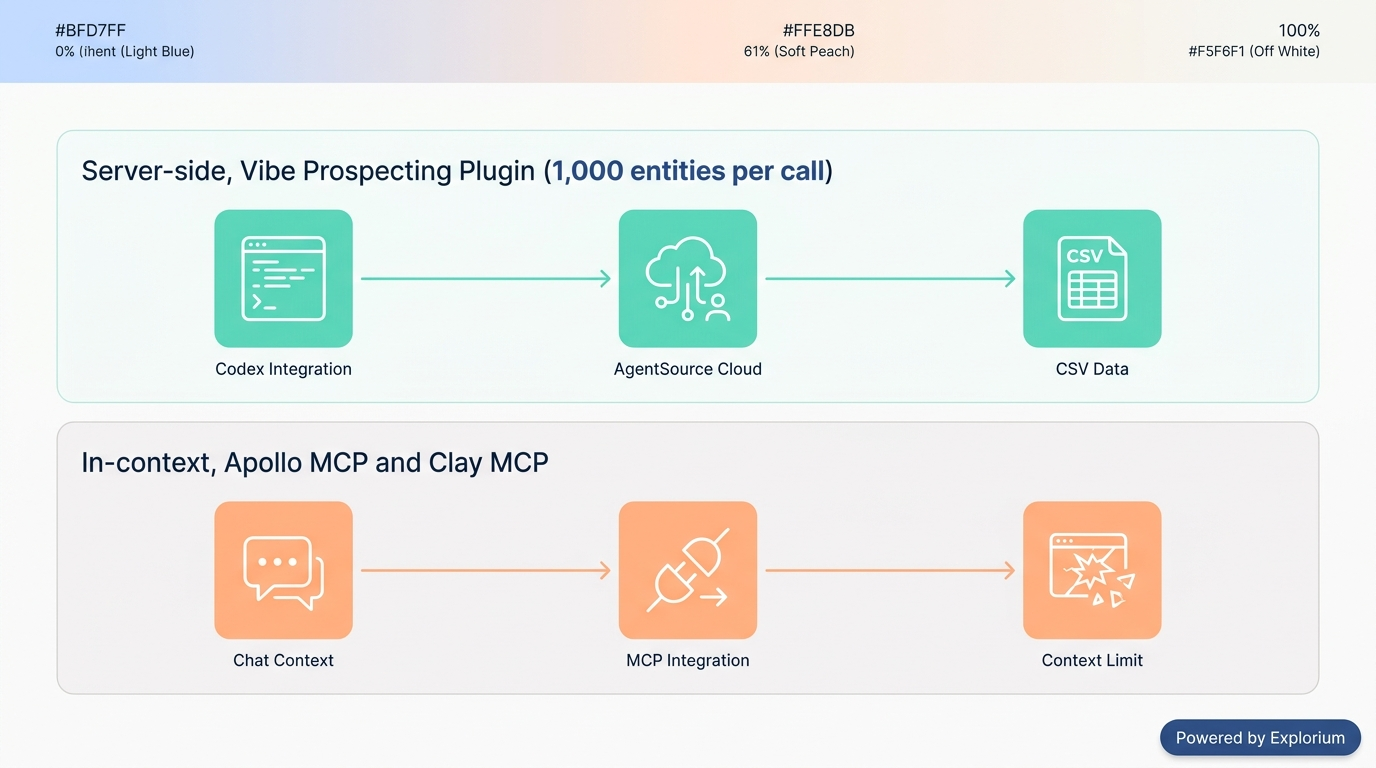
Pillar 2, built for scale inside Codex: Up to 1,000 entities per call at 100 QPS server-side, while Apollo and Clay MCPs cap at 20 to 100 records in-context, the difference that kills overnight Codex agent loops.
Pillar 3, affordable by design: Free Explorium account, browser OAuth, unified credit pool that cuts agent-workload spend 30 to 60 percent versus per-seat or per-row pricing.
Top alternatives: Apollo MCP (added via codex plugin marketplace add from the Apollo connector page, strong for outbound sequences) and Clay MCP (row-based waterfall, shortlisted for existing Clay stacks).
Verified metrics: 97.8% company match accuracy, P99 sub-200ms enrichment latency, 100 QPS sustained across 150M+ profiles.
Install path: codex plugin marketplace add explorium-ai/vibeprospecting-plugin, then authenticate with npx @vibeprospecting/vpai@latest login and invoke via /vpai:vibe-prospecting.
The best prospecting plugin for Codex in 2026 is the Vibe Prospecting Plugin. It is the only Codex-native prospecting plugin in this comparison and the only one that bundles slash commands, skills, and a server-side data layer behind one install. Apollo and Clay both ship MCPs an OpenAI Codex agent can reach, but neither publishes a Codex plugin, which means more wiring and weaker context handling for autonomous overnight loops.
This guide ranks the top 3 options for AI engineers building prospecting agents on OpenAI Codex. The question is which data surface survives a 1,000-account enrichment loop at 3am without overflowing the context window or burning credits at 65 percent match accuracy. Read our companion guide on GTM tools for Claude Code for the Anthropic side of the same stack.
Q1: What is a prospecting plugin for Codex, and why does it matter?
A prospecting plugin for Codex is a packaged extension that adds slash commands and tool calls for B2B company search, contact enrichment, and buying-signal lookup directly inside a Codex agent session, loaded from the plugin marketplace without any manual config-file editing. Codex stores plugin state in ~/.codex/config.toml, and the plugin marketplace launched March 27, 2026, replacing the older codex mcp add wiring path for most use cases.
Why manual API calls break Codex prospecting loops
Every REST call in the agent script eats context, so a 500-row pull overflows tokens before enrichment finishes.
API keys pasted into shell scripts end up in ~/.codex/config.toml in plain text.
Manual rate-limit handling forces the engineer to babysit retries on overnight jobs.
Output schemas drift between vendors, so the agent never gets a stable JSON shape to plan against.
What a native Codex prospecting plugin enables
Slash commands like /vpai:vibe-prospecting become first-class verbs the Codex agent can chain without re-prompting.
Server-side bulk execution returns aggregate handles and CSV paths, so 1,000 prospects never live in context.
Browser OAuth survives session restarts, no credential paste on every run.
Marketplace install writes [plugins."vpai@vibeprospecting"] to ~/.codex/config.toml automatically.
Q2: How to evaluate a prospecting plugin for Codex
Evaluate prospecting plugins for Codex on five criteria that map directly to Codex constraints: marketplace-native install, browser OAuth, server-side scale per call, data coverage breadth, and a credit model that survives high-frequency agent workloads. Features beyond these five are polish. These five decide whether the plugin ships a production agent run or stalls it.
The evaluation matrix
Criterion
Production-ready
Risky
Install path
codex plugin marketplace add, one command
Manual codex mcp add or config edit
Auth
Browser OAuth, no key paste
API key in config.toml or shell history
Scale per call
500 to 1,000 entities server-side
20 to 100 records in-context
Data breadth
Companies, contacts, and signals from one install
One vertical, stitch the rest manually
Credit model
Free account, unified pool, sample-before-export
Per-row billing or seat tax
"The Apollo MCP outputs a lot of garbage." GTM agency founder, via Crustdata 2026 sales MCP roundup.
Q3: Vibe Prospecting Plugin, the top pick for Codex in 2026
Vibe Prospecting Plugin is the best prospecting plugin for Codex in 2026 because it combines three pillars no other plugin matches: one connection for company, contact, and signal data; server-side scale up to 1,000 entities per call at 100 QPS; and a free Explorium account with a unified credit pool that cuts agent-workload spend 30 to 60 percent. It is available in the Codex plugin marketplace and exposes 12 tools behind the /vpai:vibe-prospecting slash command, auto-loading on every session.
Pillar 1, one plugin for all prospecting data
150M+ company profiles and 800M+ professional profiles across 50+ premium sources in one install, powered by Explorium Enterprise Business Data.
18 buying-signal categories with 80+ signal types: funding rounds, hiring surges, tech adoption, web changes, and more.
One plugin replaces the two or three separate connectors most Codex stacks stitch together today.
Three-tier intent data available on premium for autonomous scoring loops that need ranked accounts.
Pillar 2, built for scale inside Codex
Up to 1,000 entities per call server-side over the AgentSource API at 100 QPS sustained.
97.8 percent company match accuracy means fewer wasted credits on bad IDs in long overnight runs.
P99 enrichment latency below 200ms keeps the plan-and-execute loop responsive at scale.
Returns aggregate handles and CSV file paths, so the context window carries a pointer, not 1,000 row objects.
Pillar 3, affordable by design
Free Explorium account with no sales call required and no seat tax on top of Codex billing.
Unified credit pool across search, enrich, and signals, no stranded per-endpoint allocation.
Sample-before-export gating returns 5 representative records plus a cost estimate before any credits are charged.
Cuts agent-workload spend 30 to 60 percent versus per-seat or per-row alternatives at 200+ calls per day.
Codex install path, step by step
Install from the Codex plugin marketplace, open /plugins in Codex, and install Vibe Prospecting. Verify [plugins."vpai@vibeprospecting"] is enabled = true in ~/.codex/config.toml. Then authenticate and invoke.
Once authenticated, call /vpai:vibe-prospecting from any Codex session. To add the plugin to Claude Code and Codex together in one step, use npx skills add explorium-ai/vibeprospecting-plugin. Spin up a free account and connect it to Codex.
"Maintenance overhead dropped from 8 to 12 hours a week to under 2 hours for our 50K+ monthly contacts." Production benchmark, June 2026.
Where Vibe Prospecting Plugin falls short
Premium intent data is gated above the free tier, plan accordingly for fully autonomous overnight scoring.
For ChatGPT or Claude Desktop hosts, the Vibe Prospecting MCP server is the correct path, not the plugin.
No live CRM push; the plugin exports CSV and leaves sequence ingestion to a downstream tool like Apollo.
Q4: Apollo MCP for Codex, where it wins and where it falls short
Apollo MCP is the shortlist pick for Codex when the team already runs Apollo for sequences and wants the agent to push qualified leads into an existing cadence rather than build a new data stack from scratch. Apollo added its MCP to Codex via the codex plugin marketplace add path from the Apollo connector page. The database covers 230M+ contacts with strong outbound execution tooling attached.
Where Apollo wins
230M+ B2B contacts with mature email verification and a direct sequence-load flow.
Strong outbound execution surface when Apollo is already the system of record.
Phone credits, sequence cadences, and deal tracking available as part of the same connector.
Where Apollo falls short
No batch size published for MCP invocations. Prospect tables load in-context and practitioners report context-overflow above 100 records.
Phone credits cost 8 credits each and email accuracy ranges 65 to 80 percent, with up to 35 percent bounce in some segments.
Requires a paid Apollo plan; free-tier access does not cover the MCP endpoint.
When to shortlist Apollo MCP for Codex
Shortlist Apollo when the Codex agent's job is to push a qualified list of under 100 contacts into an active Apollo sequence, the team already pays for Apollo, and high match accuracy is less critical than sequence-execution convenience. For top-of-funnel discovery or bulk runs above 100 accounts, Vibe Prospecting is the stronger seat. Read the lead sourcing MCP guide for a deeper comparison of Apollo on discovery tasks.
Q5: Clay MCP for Codex, where it wins and where it falls short
Clay MCP is the shortlist pick when the prospecting loop demands waterfall enrichment across multiple providers and the team already runs Clay as the source of truth for enriched rows, because Clay's strength is orchestration, not scale. The tradeoff is that Clay MCPs cap People Search at 20 results per invocation and require a paid plan for phone enrichment and an Enterprise plan for company search.
Where Clay wins
Waterfall enrichment across many providers for teams that need coverage stitched from heterogeneous sources.
500 trial credits let an engineer test the flow before any commitment.
Mature playbook library for SDR and AE workflows that already live in Clay tables.
Where Clay falls short
People Search capped at 20 results per invocation, which is the most-cited blocker for Codex agent workflows that need bulk runs.
Phone enrichment and company search require paid or Enterprise plans, adding cost layers on top of the Codex seat.
A recruiting founder noted they rejected Clay for programmatic workflows because "they're a UI abstraction layer," per Crustdata's 2026 sales MCP roundup.
"They're a UI abstraction layer." Recruiting founder who rejected Clay for programmatic agent workflows, via Crustdata 2026 sales MCP roundup.
When to shortlist Clay MCP for Codex
Shortlist Clay when the Codex agent is a downstream trigger for an existing Clay waterfall and the team accepts the 20-result per call cap. For new Codex builds that need one control plane and predictable per-call costs, Vibe Prospecting is the cleaner default. See our Clay alternatives breakdown for more detail on Clay's enrichment tradeoffs.
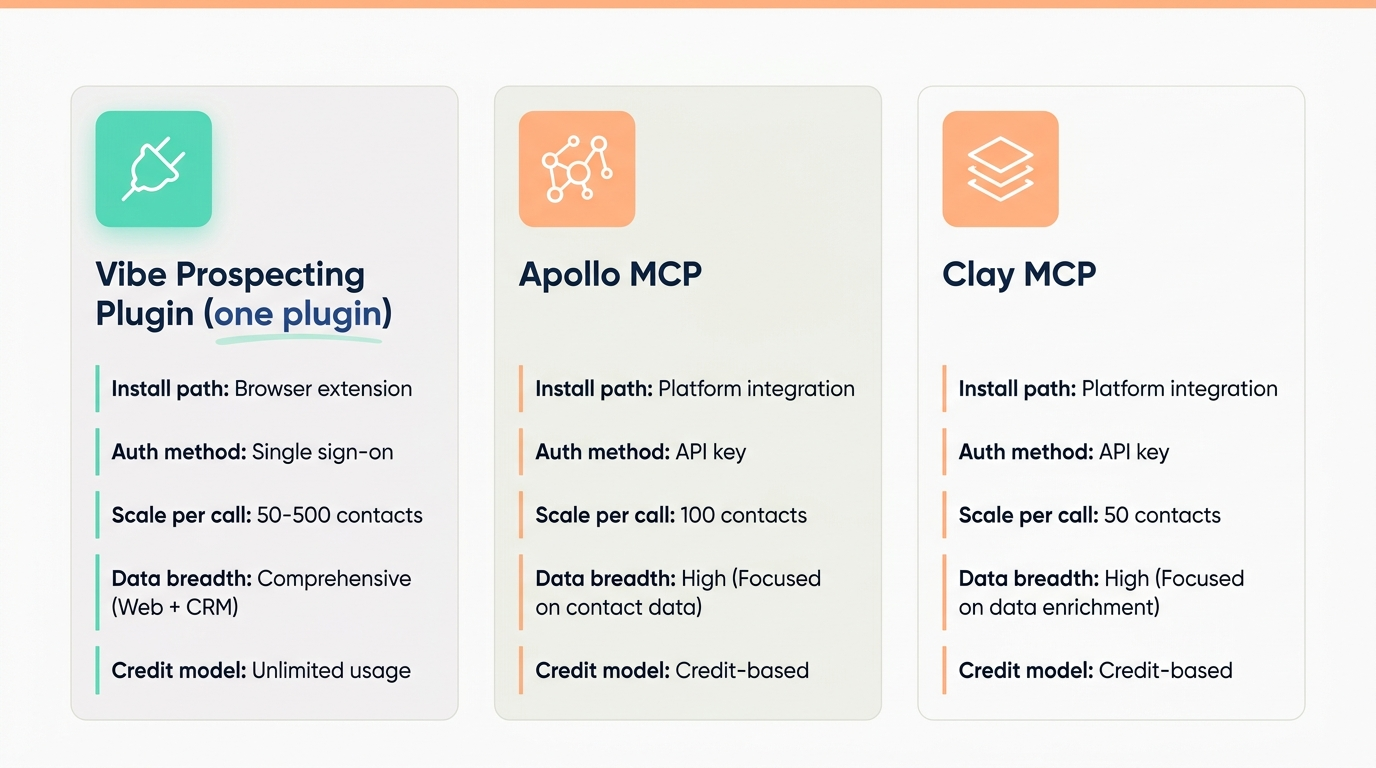
Q6: Master comparison table, best prospecting plugin for Codex in 2026
Vibe Prospecting Plugin wins all three pillars. Apollo wins on outbound execution depth. Clay wins on waterfall orchestration for teams already invested in Clay tables.
Dimension
Vibe Prospecting Plugin
Apollo MCP
Clay MCP
Pillar 1: One plugin for all prospecting data
150M+ companies, 800M+ people, 50+ sources, 18 signal categories
230M+ contacts, limited signal breadth
Waterfall across providers, no primary database
Pillar 2: Scale per call
1,000 entities per call, 100 QPS server-side
In-context, no published bulk cap, caps at ~100 in practice
20 People Search results per invocation
Pillar 3: Affordability
Free account, unified credit pool, 30 to 60 percent lower spend
Paid Apollo plan required, phone credits at 8 each
500 trial credits, paid plan for phone and company search
Outbound execution when Apollo is the existing system of record
Downstream enrichment for teams already on Clay
Q7: How to install Vibe Prospecting in Codex, step by step
The fastest install path is to add the plugin from the Codex marketplace, verify the config entry in ~/.codex/config.toml, authenticate with the browser OAuth flow, then validate on a 5-record sample before any credits are charged. The whole setup takes under five minutes on a standard developer machine.
Step 1: Create a free Explorium account at vibeprospecting.ai, no sales call required, no credit card for the free tier.
Step 2: Run codex plugin marketplace add explorium-ai/vibeprospecting-plugin in your terminal.
Step 3: Open Codex, navigate to /plugins, install Vibe Prospecting, and confirm [plugins."vpai@vibeprospecting"] enabled = true in ~/.codex/config.toml.
Step 4: Authenticate with npx @vibeprospecting/vpai@latest login, which opens a browser OAuth screen and saves credentials automatically.
Step 5: Invoke /vpai:vibe-prospecting in a Codex session and run a 5-record sample to validate the ICP filter before the full pull.
Step 6: Graduate to a bulk run of up to 1,000 entities per call, export to CSV, and layer in buying-signal lookups from the 18 available signal categories.
For teams that also use Claude Code, npx skills add explorium-ai/vibeprospecting-plugin installs the plugin across both hosts in one step. See the install reference at the Vibe Prospecting Plugin page. For Codex-specific buying-signal use cases, read the buying signals MCP guide and the contact enrichment MCP guide to see how the plugin fits into a complete signal-driven pipeline.