

Your best AE gives two weeks' notice on a Tuesday. By Friday, twenty open accounts need a new owner, and everything anyone actually knows about them, who the real buyer is, what almost killed the renewal, which stakeholder ghosts email but answers a call, lives in that rep's head, their notes app, and a folder of AI chat threads nobody else has ever opened. The CRM says stage and amount. It says nothing about any of that. This is the part of a departure that never makes the exit interview, and it is exactly the account knowledge that gets lost when a rep quits, and never rebuilt.
What Actually Walks Out the Door When a Rep Quits
It is never the deal stage or the contract value. Those live safely in the CRM. What disappears is the texture around the deal, the champion's real title versus the one on the org chart, the objection that almost sank the renewal, the side conversation that explains why a stakeholder went quiet. None of that was ever written down anywhere durable, so there is nothing left to hand off once the person carrying it is gone.
Why It Was Never Captured in the First Place
- A CRM field asks for stage and amount, not "who actually signs this," so reps default to a personal notes app for the details that matter.
- Drafting a quick follow-up in a chat window is faster than opening the CRM, so context quietly piles up in chat history instead.
- Nobody checks whether an account record is complete until the rep who owned it has already left the building.
The Slack Export Trap: Why a Chat-Log Dump Doesn't Save You
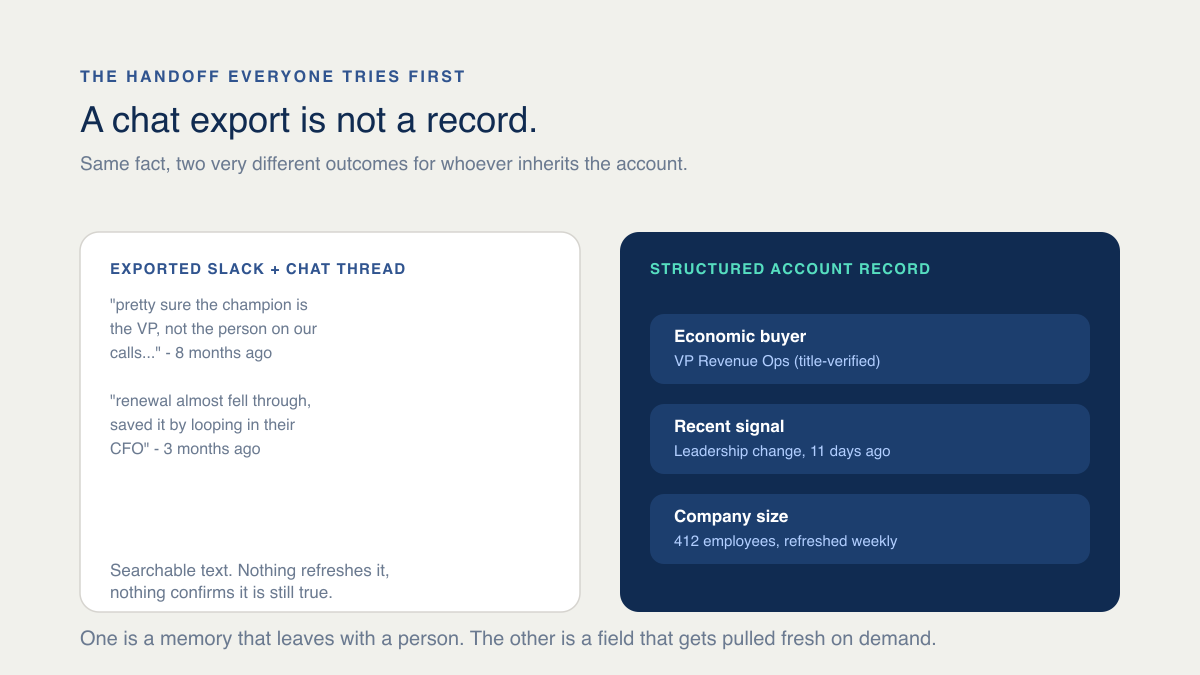
The instinct on a departing rep's last week is to export their Slack channel and AI chat history into a shared doc. That preserves fragments of conversation, not a record anyone can actually use, so the next person still has to read pages of loosely related text to find the one fact they need.
Archiving Text Is Not the Same as Structuring Data
- A keyword search across an exported chat thread returns messages, not a verified company size or a current title.
- Nothing in an archived conversation updates itself when the company it describes changes.
- Two reps who documented the same account differently leave behind two conflicting stories, and a wiki has no way to say which one is current.
Stacking an AI summarizer on top of the export does not fix this either. Ask it to reconstruct an account history from a pile of disconnected messages and it will confidently invent the connective tissue between them rather than flag what is actually missing. Feeding a messy input into a smart tool just produces a confident, wrong answer at higher speed.
The Real Price Tag of a Rep Leaving
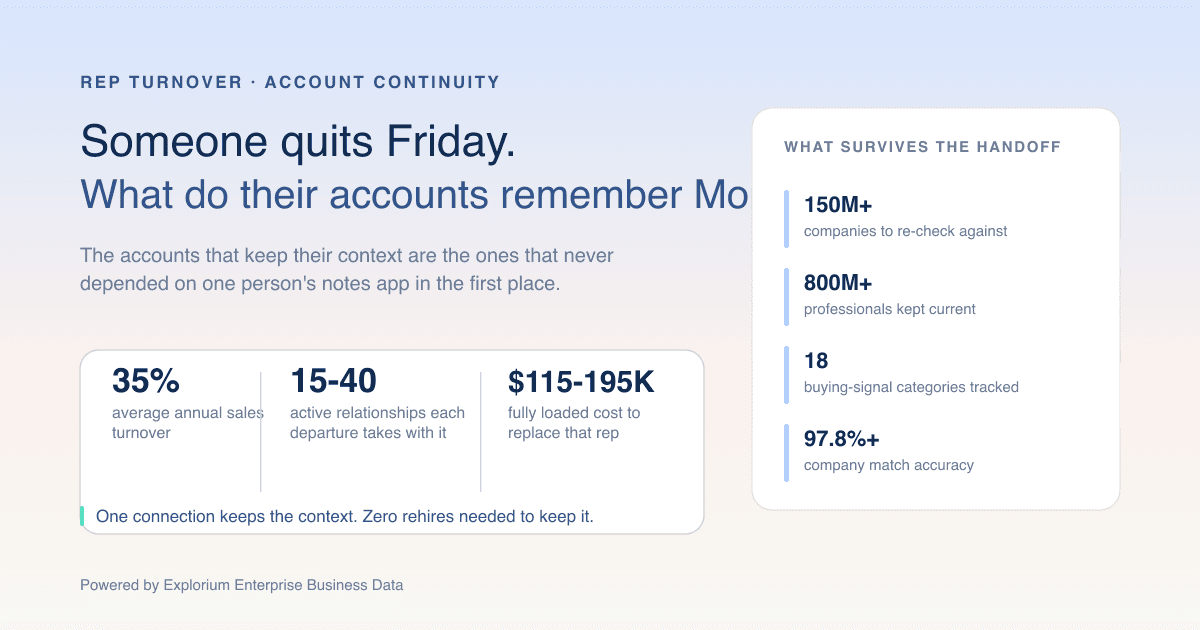
Replacing a departing rep runs $115,000 to $195,000 fully loaded once recruiting, ramp, and lost pipeline velocity are counted, and that rep typically takes 15 to 40 active prospect relationships with them on the way out. The account-knowledge gap is what turns that number into a multi-month drag instead of a one-time cost.
Where the Cost Actually Lands
| Cost driver | Relying on the rep's memory | Running a chat handoff first |
|---|---|---|
| Rehire and ramp | $115K-$195K, plus weeks re-learning every account | Same rehire cost, but ramp starts from a complete record |
| Relationships at risk | 15-40 per departure, often undocumented anywhere | Contact details persist in a record the new owner inherits |
| Data freshness at handoff | Contact data decays 22.5%-70% a year with no refresh trigger | Refreshed the week before the rep's last day |
| Time to a productive handoff | Weeks of shadowing and exit-interview reconstruction | A single chat session, before the departure, not after |
Already watching this happen every time someone puts in notice? Test the chat handoff below before your next resignation letter lands. Start free at vibeprospecting.ai →
What Belongs in the CRM vs. What's Fine to Live in Someone's Head
Company size, tech stack, contact titles, and recent company activity should all live in the CRM as fields that refresh on their own. Only genuinely subjective relationship notes, tone, rapport, who prefers a call over an email, belong in free text tied to a person. Split the record this way and most of an account's context stops depending on anyone remembering to log it.
The Split That Actually Holds Up
| Account detail | Where it should live | How it stays current |
|---|---|---|
| Company size, industry, revenue band | Structured CRM field | Refreshed on a schedule, not typed once at deal creation |
| Tools the account already runs | Structured CRM field | Same refresh cadence as company details |
| Contact titles and role changes | Structured contact record | Re-checked against a large, current professional dataset |
| Recent company activity (funding, hiring, leadership changes) | Structured signal feed on the account | Pulled automatically, not noticed on a call and forgotten |
| Relationship tone and deal narrative | Free-text CRM notes | Still a person's job, now the smaller half of the record |
A 15-Minute Handoff You Can Run in Chat Before Someone's Last Day
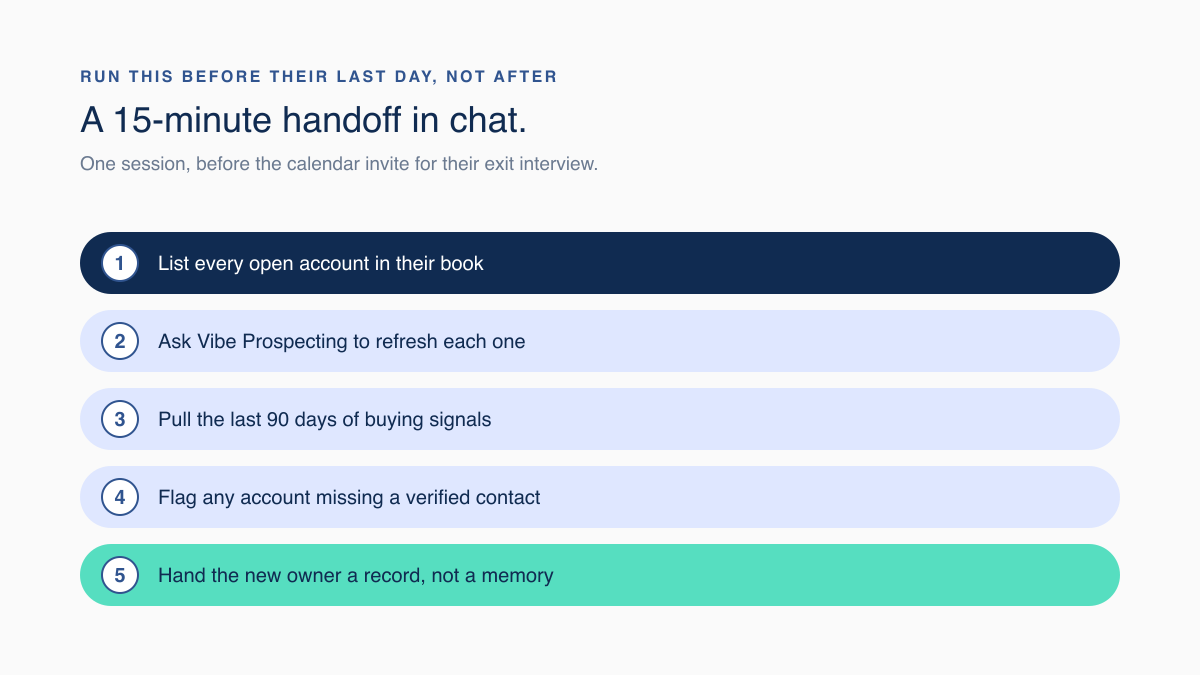
Instead of an exit interview, run the departing rep's book through a chat session and let it come back with a refreshed record for whoever inherits the accounts. This takes about as long as scheduling that exit interview would have.
The Four Things to Ask For
- List every open account in the departing rep's book, no matter how small.
- Ask Vibe Prospecting to refresh company size, tech stack, and contact titles for each one.
- Pull the last 90 days of buying signals per account so the new owner sees recent context immediately, not months-old notes.
- Flag any account missing a verified current contact so it gets manual review before reassignment, not after.
Here's roughly what that chat prompt looks like: