


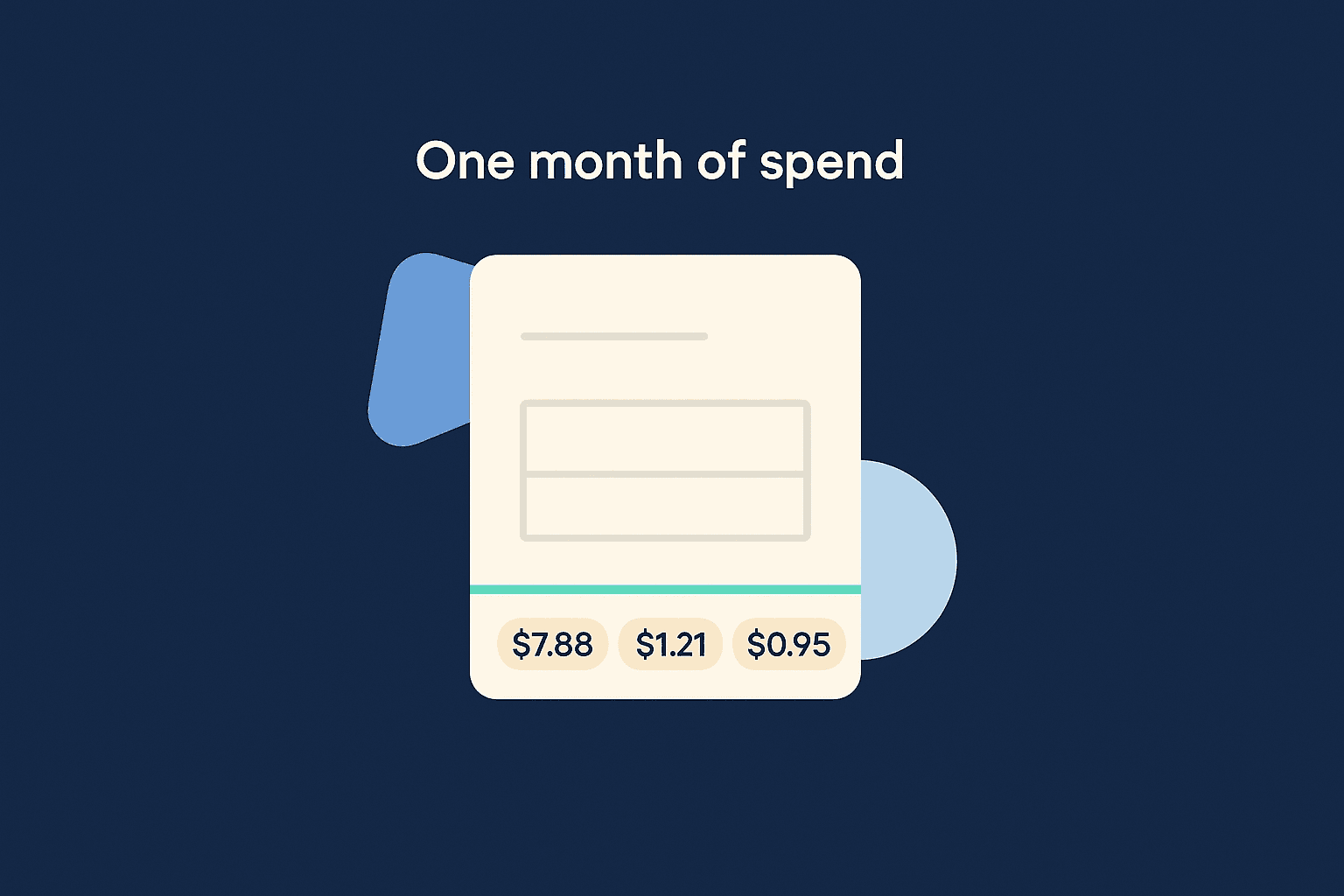
Ask a founder what the prospecting tools cost and you get a monthly figure in about two seconds. Ask what one account costs and the room goes quiet. Cost per account is the number that turns a bill into a decision, and hardly anyone can produce theirs, because getting there means admitting that one invoice has three honest answers depending on which accounts you agree to count.
The bill has quietly moved onto meters too. 42% of software products now sell a usage-based option, up from 27% in 2023, and IDC expects 70% of vendors to leave pure per-seat pricing by 2028 (Bridges, 2026). Your plan still reads like seats. The invoice does not.
What follows is the whole calculation on one worked month of $9,452, in plain arithmetic you can run in a chat window rather than a finance model: which accounts to divide by, which lines actually move when you prospect harder, the lower price that costs more per usable record, and the credits you paid for and never spent.
Count the Accounts Before You Count the Money
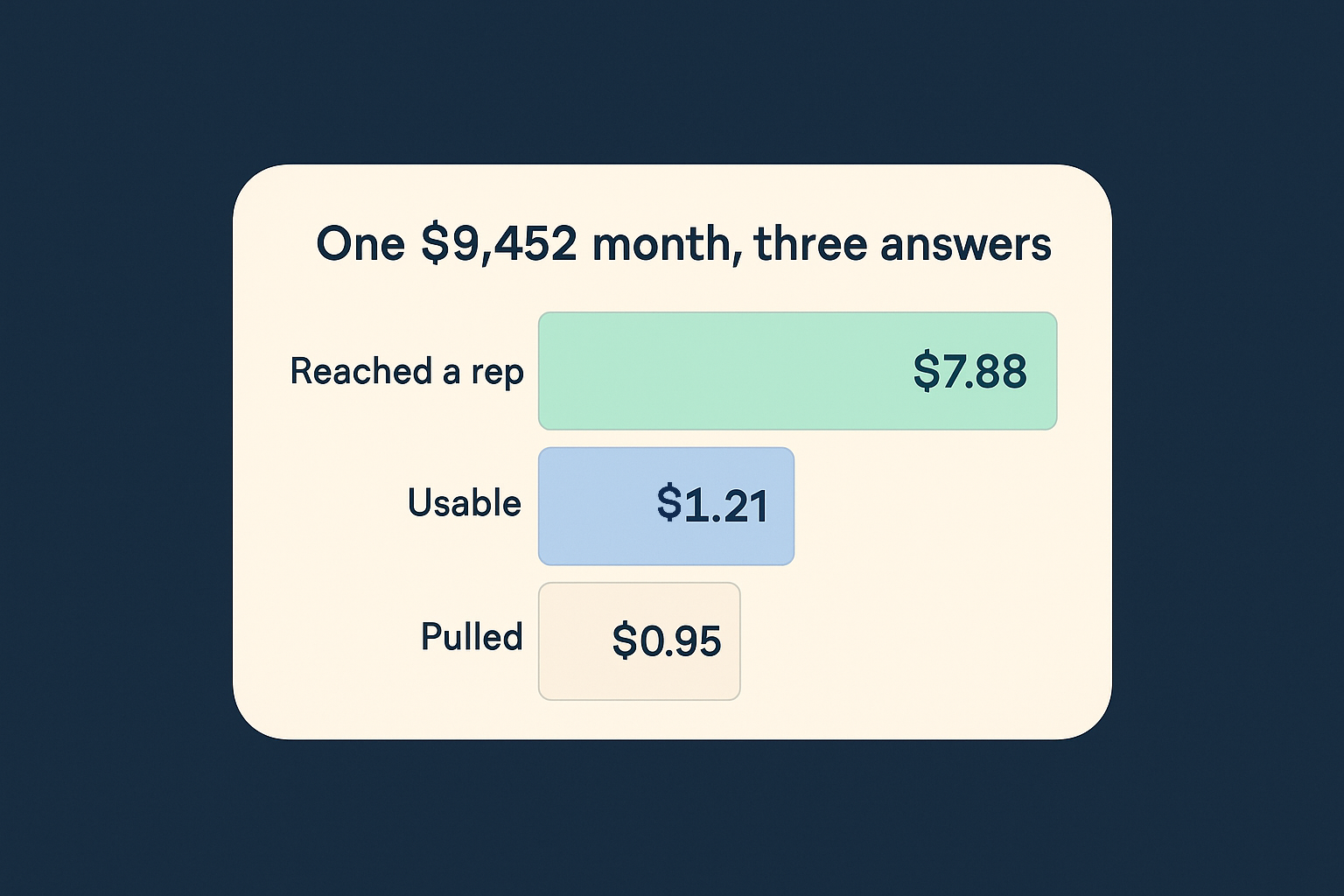
Three counts are all defensible, and choosing between them swings the answer 8.3x on identical spend: accounts a rep actually touched, accounts you could work, and accounts you pulled. Nothing about the money changes between those rows. Only the population does.
| What you counted | How many | Per account | Good for |
|---|---|---|---|
| Accounts a rep touched | 1,200 | $7.88 | Board slides and cost of winning a customer |
| Accounts you could work (78% matched) | 7,800 | $1.21 | Planning next quarter's volume |
| Accounts you pulled | 10,000 | $0.95 | Comparing what data itself costs |
Say Which One You Mean, Every Time
- Write the count next to the money, always. A figure with no population attached cannot be compared to last quarter or to anyone else's.
- Take all three counts from one system over one period, or you are dividing two different months by each other.
- The quiet failure is switching counts between quarters without saying so. A flat month then looks like a win, or a loss, and neither happened.
- Publish all three side by side. It ends the argument where two people were never discussing the same thing.
Add Up the Bill in Two Columns
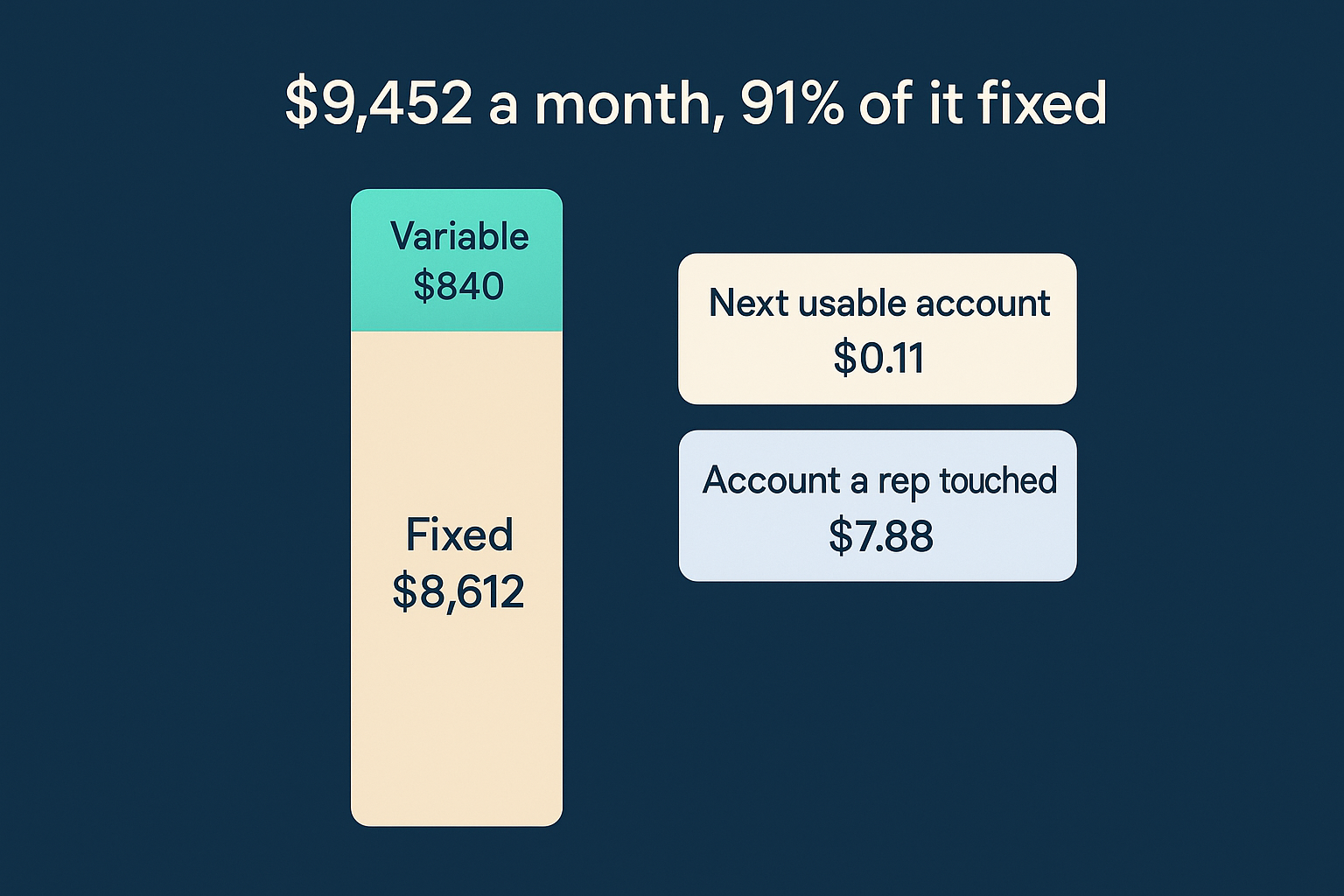
Sort every line into what you pay whatever happens and what grows when you prospect more. In the worked month that is $8,612 against $840, which totals $9,452. Only the second column responds to anything you decide this week.
| Line | Column | Per month |
|---|---|---|
| Keeping the plumbing working: 10 hrs a week at $125 | Pay it anyway | $5,412 |
| Contract floor on the platform | Pay it anyway | $2,000 |
| 8 seats at $150 | Pay it anyway | $1,200 |
| 10,000 enrichment calls at $0.06 (2 credits at $0.03) | Grows with volume | $600 |
| Model tokens for scoring | Grows with volume | $150 |
| Email sends | Grows with volume | $90 |
| Whole month | $9,452 |
The Awkward Third Column
- Prepaid packages look like usage on the invoice and behave like a contract in reality. The money leaves on the day you buy, spent or not.
- Tier upgrades and minimum-commit true-ups sit here too. A slow quarter turns into a lump sum nobody put in the plan.
- The more tools you run, the more of these you collect. Providers overlap 20% to 35%, worth $40,000 to $120,000 a year of paying twice in a set of ten or more (Unify, June 2026).
Why Prospecting More Never Moves the Invoice
The next account you can work costs $0.11. An account that reached a rep costs $7.88 once everything is counted. That roughly 70x gap is the first column, and it is why the bill sits still while the effort goes up.
Where the Savings Actually Live
- 91% of that month is money you owe before anyone opens a chat window. Halving the second column saves $420. Retiring one $2,000 floor saves five times that.
- Two people arguing about credit prices while a contract floor sits untouched are optimising the smaller of the two columns.
- So the useful goal is not a target dollar figure. It is a shrinking ratio between the two columns, because only one of them answers to anything you decide this week.
"A working GTM engineering stack costs $300 to $1,500 a month. The enterprise version of the same six functions runs past $200,000 a year." @SimplicityWeb3 on X, August 2026
The Lower Price That Costs You More
Take the price of a call and divide it by the share of calls that come back with what you asked for. $0.060 at a 78% match is $0.077 a usable record. $0.045 at a 52% match is $0.087. The second option is 25% less per call and 13% more per record you can do anything with.
Match Rates Are Never One Number
- Sector moves them further than provider does: 75% to 90% on software and tech, 40% to 60% in manufacturing, 45% to 65% in healthcare (Derrick, March 2026). A blended average hides which segment is expensive.
- Records go stale at 22% to 30% a year per Dun and Bradstreet, so re-run the sum quarterly. Ten points off the match rate adds roughly 15% to the price of a usable record at the same call price.
- Count only records that returned the fields you needed. A partial answer that fails your own scoring rules is not an account you can work.
- Published accuracy sets your expectation, not your result. Vibe Prospecting reports 97.8%+ company match accuracy, and your own list hygiene still decides what you see. Measure it on your list before you sign anything.
Credits You Paid For and Never Spent
What a credit really cost you is the package price over the credits you spent before they lapsed, not the credits printed on the receipt. $749.99 for 25,000 credits reads as $0.030. Spend 17,500 of them and you paid $0.043, which is 43% more than the number you compared against.
- Credits are valid for 12 months, do not roll over once that date passes, and packages are not refundable (Explorium pricing). The free account is 100 credits good for 90 days.
- One enrichment can consume 1 to 5 credits depending on what you asked for, and each piece of recent company activity costs 1. So a headline credit price is not a cost per account until you know your own consumption.
- Waste on a scattered set of tools runs near 30% of purchased credits, which is the largest hidden multiplier on the whole calculation (credits versus subscriptions, compared).
Three Questions Worth Asking Before You Buy
- If a call finds nothing, does it still spend a credit? Published answers are rare, so ask and keep the reply in writing rather than assuming either way.
- At the exact fields we request, how many credits does one enrichment consume?
- What becomes of credits we have not spent when the term ends?
The Line That Never Appears on an Invoice
Somebody keeps the connections working, and that time belongs in the first column whether or not anyone bills for it. The published benchmark is ten hours a week at a loaded $100 to $150 an hour, which comes to $4,333 to $6,500 a month and $52,000 to $78,000 across a year (Unify, June 2026).
What That Time Is Actually Spent On
- At $5,412 in the worked month it is the biggest single line, larger than the seats and the contract floor put together, and no vendor ever sends you a bill for it.
- A source changes its fields upstream and the job keeps running while returning less. Nothing alerts. Somebody notices on a Thursday.
- Retries, duplicate handling, backfills after a bad run, and the evening a nightly job dies before Monday's sequence.
- Two habits keep the figure honest: log the hours for four weeks before you estimate, because measured always beats guessed, and use loaded cost rather than salary over 2,080 hours.
Run It in a Chat Window, Not a Spreadsheet
Export last month's spend as three columns, paste it into Claude or ChatGPT, and ask for the split and the three prices. Twenty minutes, no model to build.

