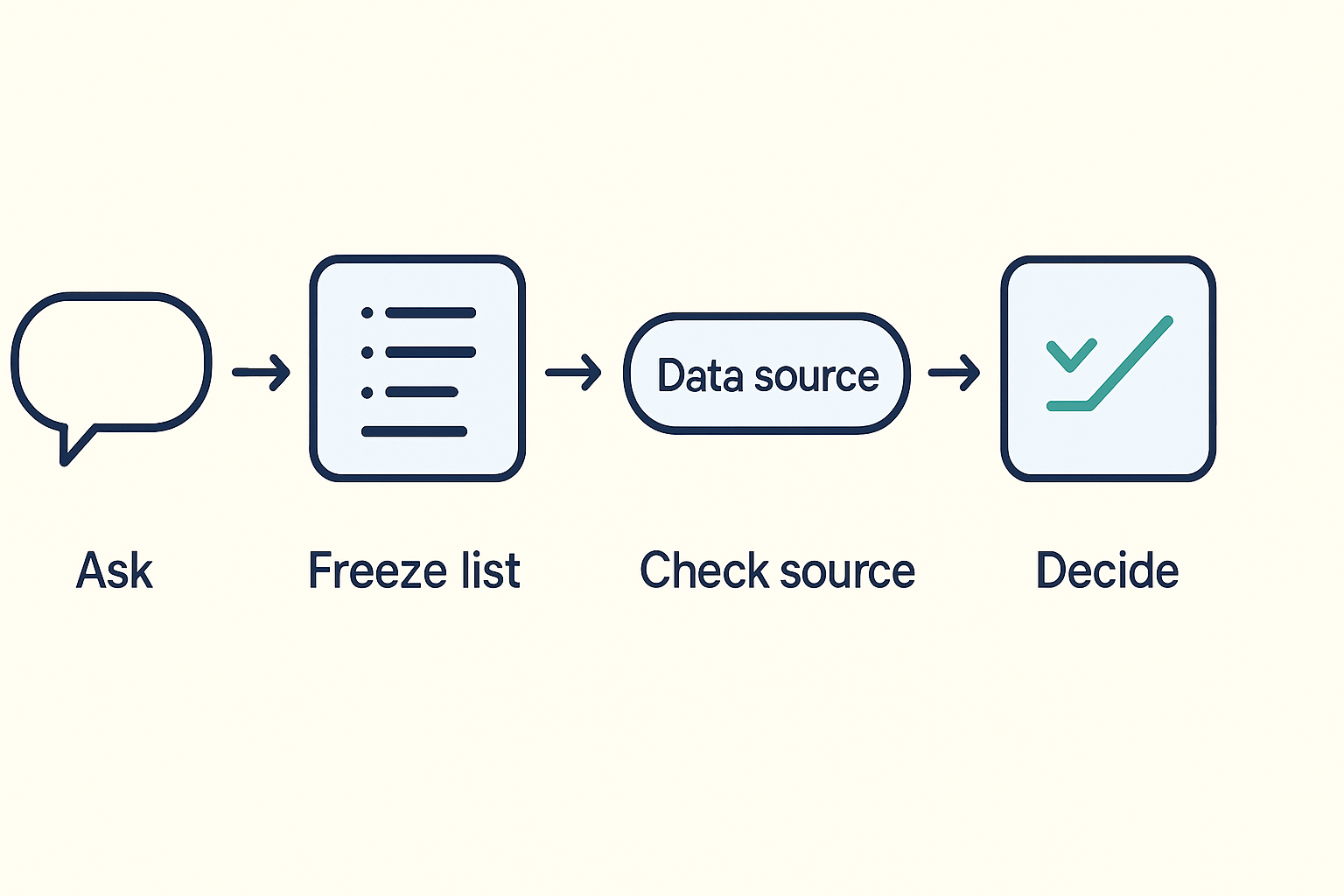


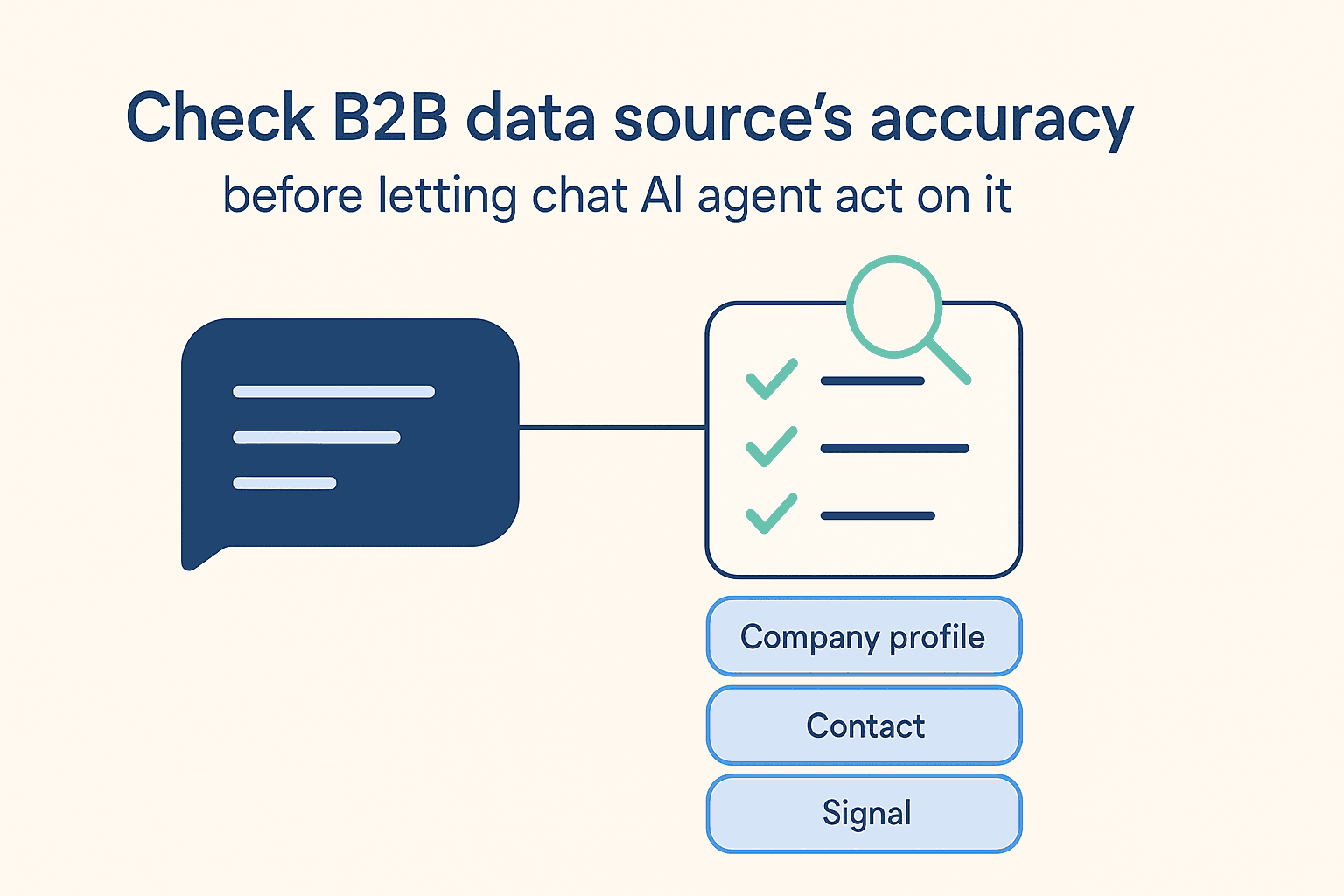
Ask a chat AI agent to qualify a lead and it will answer instantly and confidently, whether the company record behind that answer is current or a year out of date. The agent has no way to know the difference. Before you let an agent touch real pipeline, you need a way to test b2b data accuracy before the AI agent ever sees the record, not after a bad call already went out. This guide walks through a 5-step test any founder, AE, or RevOps lead can run in a chat window in under an hour, using Vibe Prospecting (built on Explorium Enterprise Business Data) as the worked example.
Why a "95% Accurate" Claim Tells You Nothing Yet
A vendor's accuracy percentage is only as good as the list it was measured against, and most vendors measure against their own database. A comparison this year of open pricing and coverage claims across providers found numbers ranging from the mid-80s to mid-90s on what was supposed to be the same kind of data, with no shared list behind any of them.
The three questions a bare percentage cannot answer
- What list was this number measured against, and can I see it?
- How old is the sample the vendor tested?
- Did anyone outside the vendor confirm the result?
What a number you can actually trust looks like
- Vibe Prospecting runs on Explorium data with 97.8%+ company match accuracy, disclosed and open to a re-test against your own sample.
- The underlying dataset spans 150M+ companies and 800M+ people pulled from 50+ named sources, not one closed catalog.
- 99.999% uptime means the number still holds when you actually run the full test, not just a hand-picked demo.
Freeze a Test List Before You Ask a Source Anything
Pull 300 to 1,000 records out of your own CRM, save a timestamped copy, and never hand the raw list to a vendor's sales team. Once a source knows which records you are checking, the test stops being a test.
How big a sample, and how many sources to test
- 300 records gives you a directional read; 1,000 gives you a ranking you can defend.
- Run the exact same list against every source, never a reshuffled subset.
- Include a mix of company sizes and industries that matches your actual pipeline, not just the easy ones.
- Cap it at 3 to 5 sources. Include at least one that stores records and one that researches live if you are deciding between those two approaches.
Rules for a list that actually holds up
- Save a hash and a timestamp of the file before the first chat message goes out, so a later re-test has something to compare against.
- Mix in a few hard cases, small companies, recent renames, alongside the easy, well-known ones.
- Drop any record you already know is wrong. It only muddies the score.
Mistakes that quietly ruin a test list
- Sharing the raw list with a vendor before the test lets them clean it up first.
- Testing only recognizable, easy companies hides the gap that actually matters.
- Skipping the timestamp means you cannot prove the test is fair on a re-run.
Score Four Things Separately, Not One Blended Number
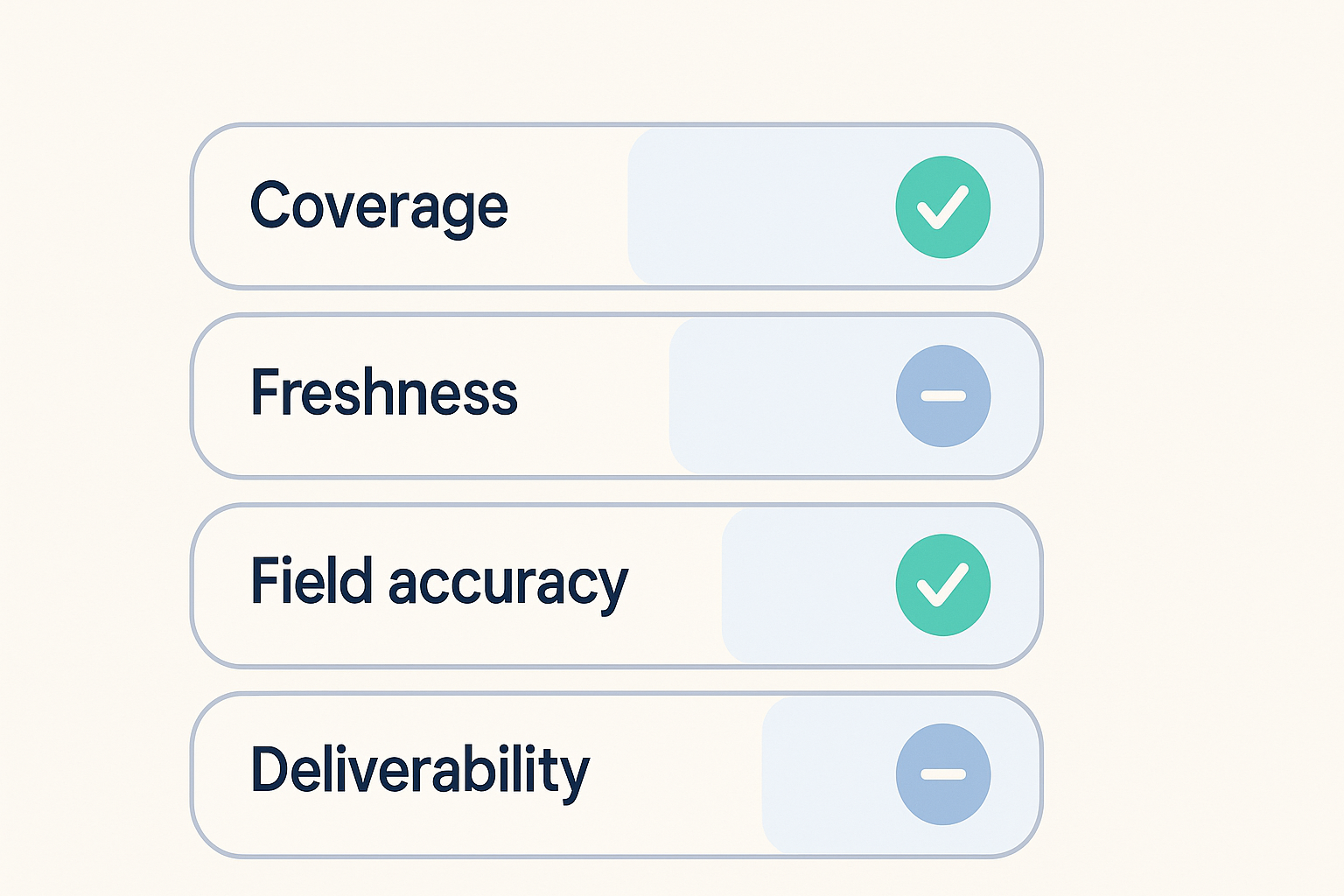
Coverage, freshness, field accuracy, and deliverability each catch a different way a source can fail, and averaging them into one score hides which one broke. A source can return a match for almost every company on your list and still hand you a funding stage from two rounds ago.
The four checks to run
| Check | How to run it | What it quietly misses |
|---|---|---|
| Coverage | Count how many of your frozen records got a match at all | Sources that measure coverage against their own catalog, not your list |
| Freshness | Compare the returned timestamp to a recent event you already know happened | "Last crawled" passed off as "last confirmed" |
| Field accuracy | Check each field you actually plan to use, one by one, against ground truth | Only the company name gets checked; nothing else does |
| Deliverability | Send a real test through a third-party checker, not the source's own tool | "Verified" quietly standing in for "lands in the inbox" |
Why one average score hides the real problem
- A single blended score can bury a source that is weak on freshness but strong on coverage.
- One number gives you nothing to point at when you need to re-test.
- Four separate scores tell you exactly which failure an agent is going to hit first.
Vibe Prospecting's underlying company and people data covers all four checks against one frozen list, so a single test run gives you a real answer on every axis instead of one average.
What Your Chat Agent Does When the Data Is Quietly Wrong
A chat agent does not pause to double-check a suspicious fact; it reasons forward from whatever it was handed with the same tone whether the data is right or wrong. A duplicate account, a funding round that closed a year ago, or a parent company mapped to the wrong subsidiary all look identical to the agent, and each one changes its answer.
Three quiet failure patterns
- A duplicate record makes the agent double-count deal size in a pipeline summary.
- A stale funding stage gets a company qualified into the wrong tier.
- A broken parent-child link attributes a buying signal to the wrong company entirely.
Why testing first shrinks the damage
- Running the test first turns "is the agent smart enough" into the right question, "is the data underneath it good enough."
- A source you have already scored limits how far a bad fact can travel before someone catches it.
- Vibe Prospecting keeps recent company activity and signal data inside one tested source instead of stitching several unverified feeds together.
A "Verified" Record Still Is Not a Deliverable Inbox
"Verified" usually just means the address passed a format or mailbox-ping check when it was added to the database, not that it will land anywhere today. A contact can change jobs, a catch-all server can accept mail at the SMTP level regardless of whether a real inbox exists, and a small company's thin public footprint can soften the whole picture without anyone noticing.
A dead send costs more than the one lost message
Every bounce chips away at the sending domain's reputation, and once mailbox providers flag a domain, legitimate future sends from that same domain start landing in spam for weeks, well past the one contact that actually bounced.
How to check deliverability for real
- Run an actual send test through a third-party checker instead of trusting the source's own verification badge.
- Track the bounce rate by domain type instead of one blended pass rate.
- Re-check the same sample again at 30 and 90 days, since a list decays even if nothing about it looks different today.
Stored Lookups vs. Live Web Research: Pick the Right Test for Each
A source that pulls from a maintained database and one that researches the web live in response to a chat question are solving two different problems, and testing them on the same axis penalizes one unfairly. A stored lookup is fast, affordable, and only as current as its last refresh. A live research pass costs more and takes longer, but it can catch something that changed an hour ago.
When each approach actually wins
- Stored lookups win on cost and speed when you are checking hundreds or thousands of accounts.
- Live research wins on freshness for the rare, high-stakes lookup where an hour matters.
- A quick chat lookup and a multi-minute live research pass are not the same purchase, and should not be scored like one.
Comparing cost per check, not just accuracy
- A bulk stored lookup across a full list costs a small fraction of what a live research pass costs per record.
- Live research pricing tracks the number of searches and reasoning steps it takes, not one flat rate.
- Weigh cost per check alongside accuracy, or a lower-cost source gets penalized for something it was never built to do.
Vibe Prospecting's chat interface runs the stored-lookup model, built to check a full list at once rather than one record at a time, which is what makes a real test practical to run in a single sitting.
Let Someone Outside the Vendor Confirm the Result
No vendor should be the only one grading its own claim, since the incentive to round up is obvious. An independent methodology only means something when nobody paid to be included in it.
What to ask for from an outside check
- A published methodology, not just a chart of results.
- A ground-truth list that no source under test had a hand in building.
- A frozen date, so nobody can quietly re-run the test after the fact.
Signs a result was paid for
- The sponsor of the test also happens to rank first in its own results.
- There is no methodology document anywhere, just a summary graphic.
- The test list itself is never shown, so nobody outside can challenge the ranking.
Already grading a source by the number on its landing page? Run the same test against Vibe Prospecting's disclosed 97.8%+ company match accuracy in a free chat session, no subscription required. Start free →
Vibe Prospecting: The Worked Example of a Source You Can Actually Check
Vibe Prospecting wins this test on three things a landing-page percentage never covers: one connected source instead of stitched-together tools, a chat interface built to check a real list in one sitting, and a pricing model that does not punish you for a run that comes back messy.
One connected source instead of three half-answers
- 150M+ company profiles and 800M+ people profiles sit behind one chat interface, not three separate logins to reconcile.
- 50+ underlying sources feed into one accuracy number, not an average across mismatched vendor catalogs.
- Recent company activity and buying signals stay inside that same tested source.
Built to check a real list, not a cherry-picked demo
- A full test list checks in one chat session instead of one record and one reply at a time.
- 97.8%+ company match accuracy is disclosed up front, against a range that other providers' own published numbers put anywhere from the mid-80s to the mid-90s.
- 99.999% uptime means the test does not stall out halfway through.
Pricing that does not punish a messy test run
- Credits sit in one shared pool, so a partial or failed test does not waste a separate allocation the way per-tool pricing does.
- A free account gets you into a real test within minutes, before any sales conversation.
- Coresignal's own published pricing shows the risk of the alternative: real spend often lands 30 to 80 percent above the advertised plan price.