


Your company records are only as useful as your ability to trust them. When two records describe the same business, merging them wrong is worse than leaving them separate. The question every sales leader and RevOps team faces in 2026 is not just "how accurate is our matching tool?" but "at what score is it safe to merge without a human in the loop?" This guide answers that question with specific thresholds, a plain-English breakdown of precision versus recall, and a comparison of what leading data providers actually publish about their match accuracy.
Why a Headline Accuracy Number Can Mislead You
A vendor that says "97% accuracy" is telling you how often its system gets the right answer across a test set. What it is not telling you is how that number breaks down at each confidence band. In practice, most errors cluster in the 0.80 to 0.90 range, and the system performs close to perfectly above 0.95. So the headline figure is an average that obscures where the risk lives.
There is a second problem: that test set belongs to the vendor. It was built from their own data, cleaned to their standards, with naming conventions that match their graph. Your CRM export came from ten different sales reps using different abbreviations and no consistent domain policy. The accuracy on your data could be meaningfully different.
What Goes Wrong When You Skip the Threshold Step
- Two unrelated companies end up sharing one account record. Every deal, contact, and activity tied to that account is now tangled.
- A subsidiary gets merged into its parent. Revenue attribution changes for every deal on both records.
- Your AI prospecting agent reads merged account data as ground truth. The research it returns is based on a record that no longer represents a real company.
- Undoing a bad merge takes longer than the matching job took to run.
Precision, Recall, and Which One Matters for Sales Data
Precision and recall are the two numbers underneath any accuracy claim. Getting them straight changes how you interpret any vendor benchmark.
Precision is the share of matches your system flags that are actually correct. If your tool returns 100 matches and 97 of them are real, precision is 97%.
Recall is the share of real matches your system manages to find. If there are 120 true match pairs in your dataset and your tool identifies 100 of them, recall is 83%.
You cannot maximize both at the same time. Raising precision means becoming stricter, so more true pairs go unmatched. Raising recall means casting a wider net, so more false pairs slip through.
The Tradeoff at a Glance
| Score | What it measures | Best fit |
|---|---|---|
| Precision | How many flagged matches are correct | Any workflow where bad merges are costly |
| Recall | How many true matches the tool actually finds | Dedup sweeps where missing a match is the main risk |
| F1 score | Equal weight on both errors | Baseline benchmark only |
| F0.5 score | Precision counts twice | Auto-merge on CRM or pipeline data |
| F2 score | Recall counts twice | Fraud screening or sanctions-style sweeps |
F0.5 Is the Right Target for Most Sales Teams
For account data feeding a CRM or a prospecting workflow, a bad merge is harder to fix than a missed match. A missed match just means one record sits unlinked -- fixable later. A bad merge contaminates ownership, attribution, and every downstream piece of research tied to that account. Weighting precision more heavily, which is what F0.5 does, fits that reality better than the equal-weight F1.
The Three-Tier Confidence Policy
Once you have a matching tool that returns a per-match confidence score, you need a written policy for what each range means operationally. Here is the framework that works for most sales and RevOps teams.
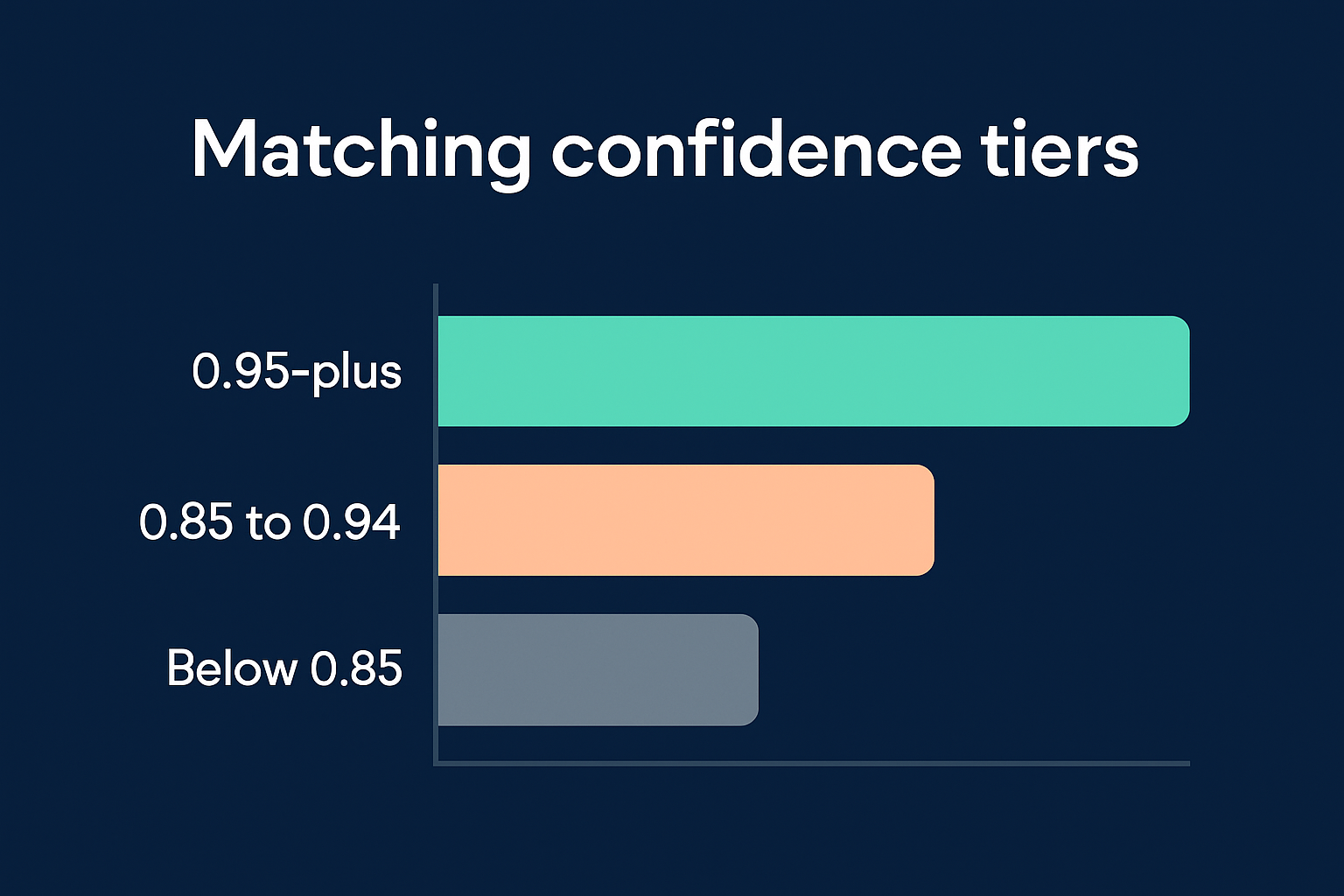
0.95 and Above: Safe to Auto-Merge
At this range, company name, domain, and at least one additional signal (registered legal name, employee range, or headquarters) all point to the same entity. Reserve unattended auto-merge for this band only.
0.85 to 0.94: Route to Human Review
Matches in this band are plausible. They are not obviously wrong, but they carry enough ambiguity that a person should look before records are combined. Common cases here include companies that recently rebranded, subsidiaries with names similar to their parent, and records from different data sources with no shared identifier.
Below 0.85: Do Not Merge
The false-positive rate in this range typically makes any auto-merge counterproductive. Flag these as unmatched and either leave them separate or run a targeted cleanup pass on just those records.
Signals That Support a Confident Match
A high confidence score should be backed by corroborating evidence, not a single strong indicator. Domain match alone is not sufficient to auto-merge, because domains get acquired and reused. Here are the signals that, when they agree, justify clearing the 0.95 bar.
- Domain: the single strongest signal, but only reliable when two other signals agree.
- Registered legal name or known aliases: trading names differ from legal names -- both should be checked.
- Employee count range: wildly different headcount figures for the same supposed company are a red flag.
- Headquarters location: different countries usually means different entities, not a data quirk.
Cases That Should Stay Out of the Auto-Merge Queue
- Any record pair where the domain differs and no legal name match exists.
- Parent-subsidiary pairs, since merging them changes deal ownership across both entities.
- Records built from incomplete inputs -- if a domain field is missing, the confidence score was computed without its strongest signal.
Checking Your Thresholds in Vibe Prospecting
Vibe Prospecting runs on premium business data built by Explorium, covering 150M+ company profiles sourced from 50+ data inputs. Because all that data lives in one place, a match runs against a single source of truth rather than asking you to reconcile results from different vendor feeds.
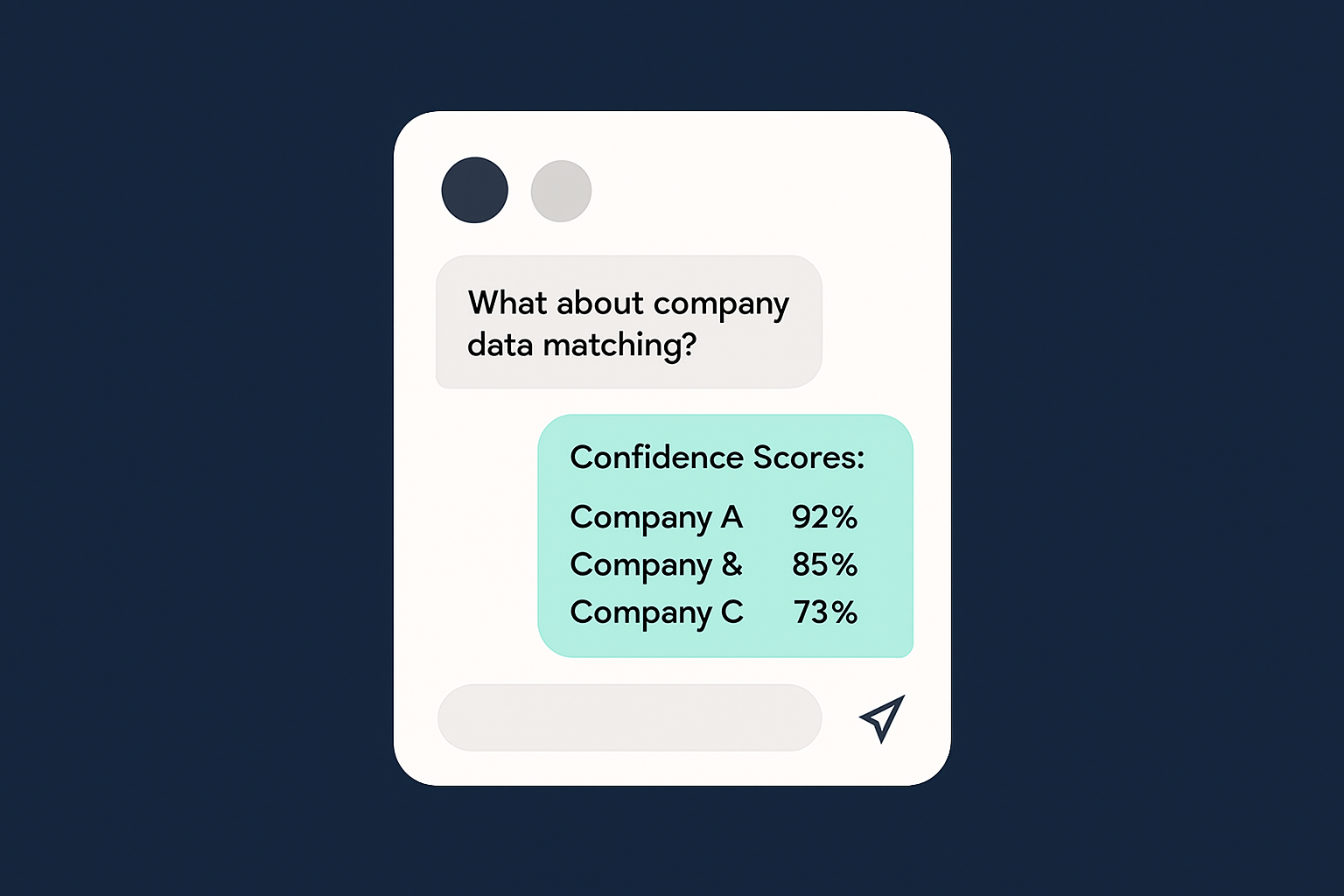
In the chat interface, you can ask directly: "Match these company records and show me confidence scores for each." The response comes back with a score per pair, not just a merged result, so you see which pairs cleared the 0.95 bar and which landed in the review band before anything is written back to your pipeline.