


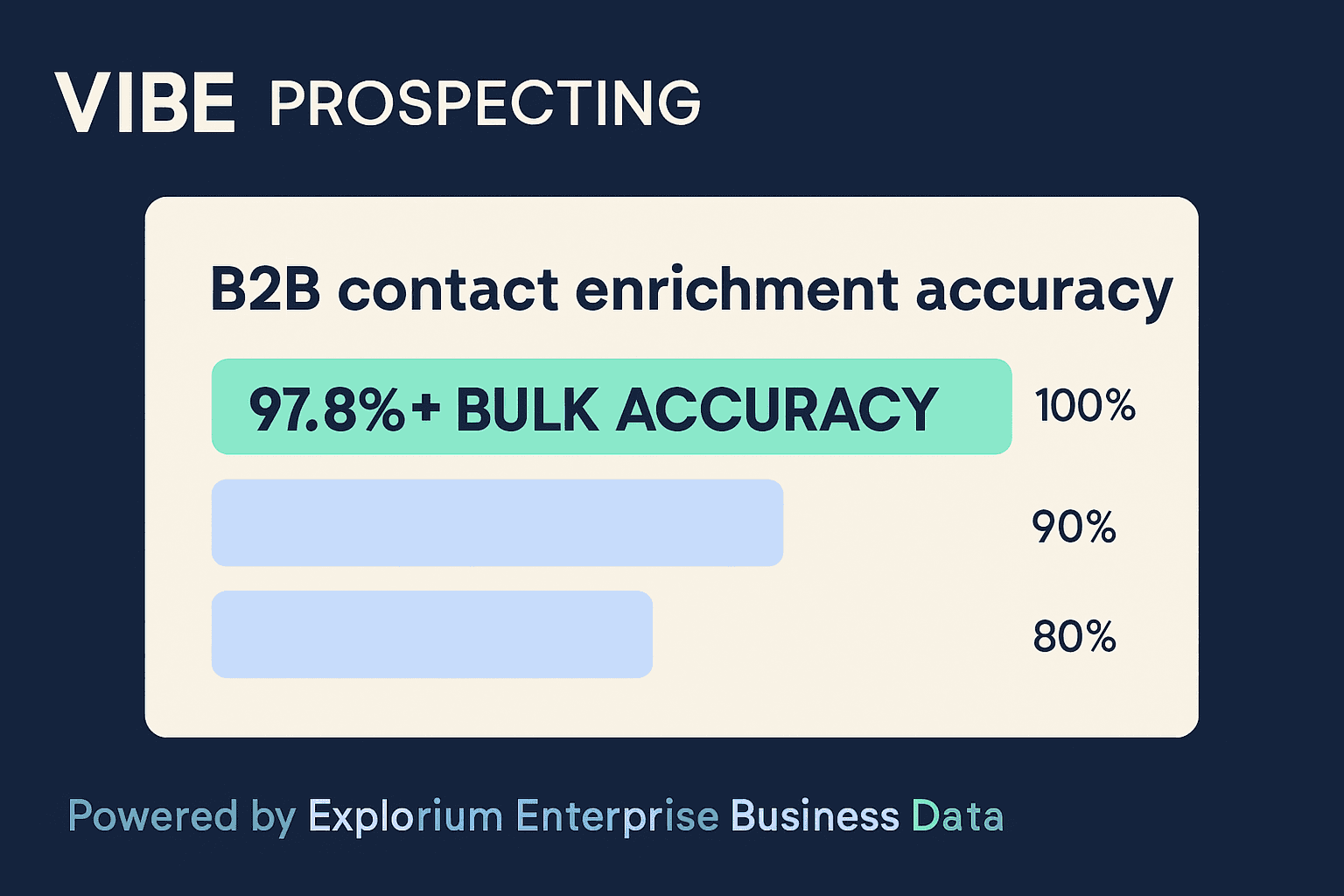
B2B contact enrichment accuracy at scale is what separates a tool that works in demos from one that holds up in production. You have a list of 1,000 accounts. Your AI agent fires a single enrichment call. The vendor demo looked great on 10 records. But what actually comes back at full batch volume? That is the question most published benchmarks skip, testing contacts one at a time and reporting a headline number never measured under real batch pressure.
This post shares what our August 2026 test found when we scoped every accuracy, throughput, and cost figure to 1,000-record bulk calls. For background on what enrichment actually is, see Explorium's introduction to data enrichment.
Why Single-Record Benchmarks Give You the Wrong Answer
Most published tests, including a widely-cited February 2026 study that checked 2,000 contacts individually, never send more than one record at a time. That approach misses three things that only appear under real batch pressure.
What a One-at-a-Time Test Does Not Reveal
- A provider can nail single lookups and still silently drop records once a batch fills its internal queue.
- Latency figures from individual calls say nothing about how long 1,000 records take once a rate limiter kicks in.
- Partial-fill failures, where a record comes back with some fields empty, only appear at scale.
The Number That Actually Predicts Production
- An AI agent enriching a CRM upload sends batches, not individual lookups. The batch-level accuracy figure is the only one that tells you whether that run will succeed.
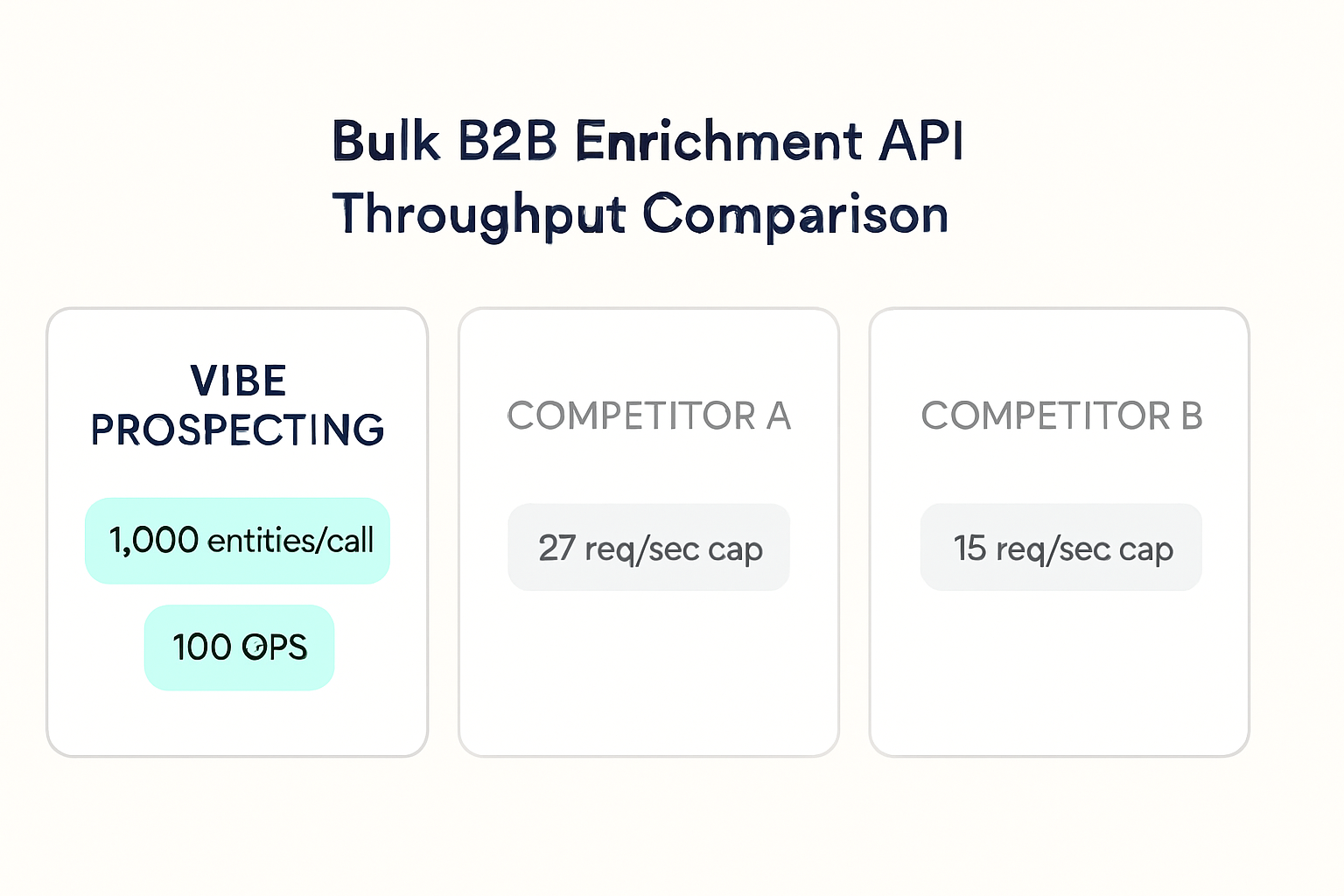
- Vibe Prospecting, powered by Explorium Enterprise Business Data, accepts up to 1,000 entities per call and holds 97.8%+ company match accuracy across the full batch.
- At 100 QPS sustained throughput, a 10,000-account list runs in roughly 100 seconds of API time, not hours queued behind a rate limiter.
August 2026 Bulk Benchmark: The Numbers at 1,000 Records Per Call
We ran a controlled test scoped entirely to 1,000-record calls. Here is how the three providers compared.
Side-by-Side Results
| Provider | Bulk match accuracy | Throughput ceiling | Cost model at bulk scale |
|---|---|---|---|
| Vibe Prospecting (Explorium data) | 97.8%+ at 1,000 entities/call | 100 QPS sustained | Unified credit pool, no per-endpoint markup |
| Coresignal (Bulk Collect endpoint) | Not published at batch level | 27 req/sec cap | $0.05-$0.20/record by tier |
| Hunter.io (Bulk Domain Search) | Not published at batch level | 15 req/sec cap, 25,000-domain batch limit | ~$7.45/1,000 verifications at Growth tier and above |
"It is easy to use and 99% of emails are validated." - Verified Reviewer via G2, Hunter.io product reviews
What 100 QPS Actually Means for Your Agent
- Ten bulk calls of 1,000 entities each clear a 10,000-record list instead of 10,000 sequential single requests.
- Coresignal's 27 req/sec ceiling means those same 10 calls still queue while the limiter resets between each one.
- Hunter.io's 15 req/sec cap and 25,000-domain batch ceiling mean large lists need manual chunking even inside the "bulk" endpoint.
Why Most Enrichment APIs Stall Before Reaching Agent Volume
The rate-limit problem is not accidental. It reflects how these tools were originally built.
One Provider, Multiple Endpoints, Multiple Ceilings
- Coresignal splits its data across a Company API, an Employee API, and a Jobs API, each carrying a separate rate limit and credit meter.
- Hunter.io covers email discovery and verification only. Company details, funding data, and job-posting signals require separate calls to a different service entirely.
- Stitching three Coresignal endpoints means reconciling three rate limits for a single contact record.
The Failure Mode Nobody Documents
- Rate limiters throttle before matching engines degrade. The first sign of scale failure is dropped or queued requests, not wrong data.
- Coresignal's database refreshes every six hours, which means records from a fast-moving account list can already be stale before an agent acts on them.
- Vibe Prospecting draws on continuous ingestion across 50-plus sources through Explorium Enterprise Business Data, so buying signals and company details stay current between refreshes.
What Bulk Enrichment Actually Costs Per Record
Sticker price and real-world spend diverge once you factor in tier gates and per-endpoint credit meters.
How Pricing Tiers Hide the Real Number
- Hunter.io's effective rate of around $7.45 per 1,000 verifications only applies at its $149/month Growth tier or above. Below that, the per-record rate is higher.
- Coresignal's real-world spend commonly runs 30 to 80 percent above its advertised base price once company and employee data from multiple endpoints are included.
- One-time bulk dataset licenses from Coresignal for US coverage start near $50,000, separate from any subscription.
Three Questions to Ask Before You Commit Budget
- Does this rate apply at my actual batch size, or only for single-record lookups?
- Are credits shared across all data types in one pool, or are they locked per endpoint?
- What is the tier threshold in writing, and what happens to my rate if I miss it one month?
Full Rate-Limit and Feature Comparison
The table below covers the dimensions that matter most when choosing a bulk enrichment provider for an agent workload. Published Coresignal rate limits and Hunter.io request limits are linked directly.
| Dimension | Vibe Prospecting | Coresignal | Hunter.io |
|---|---|---|---|
| Data coverage in one call | Company details, funding, job-posting signals, and 18 buying-signal categories in a single request | Split across Company, Employee, and Jobs APIs | Email discovery and verification only |
| Batch size per call | Up to 1,000 entities at 100 QPS | 27 req/sec (Bulk Collect), 18 req/sec (Enrich GET) | 15 req/sec, 25,000-domain batch ceiling |
| Pricing model | Free to start, unified credits, no seat tax | $49 to $1,500+/month tiers; bulk one-time from ~$50,000 | $49/month entry; lower rate only above $149/month |
| Company match accuracy | 97.8%+ at 1,000-record batch (August 2026) | Not published at batch level | Not published at batch level |
| Data refresh cadence | Continuous ingestion, 50+ sources | Database refresh every 6 hours | Not applicable (verification only) |
| Time to first call | Minutes; free account, no sales call needed | Sales-assisted for Pro/Premium tiers | Self-serve signup |
For a deeper comparison of Explorium against Coresignal specifically, see the Explorium versus Coresignal breakdown. For a broader market overview, the B2B data providers guide covers evaluation criteria across the field.
How to Run Your Own Bulk Accuracy Test Before Buying
Do not rely on a vendor's self-reported headline number. Run a small controlled test at your real batch size before committing budget.
A Practical Four-Step Checklist
- Send a sample at your production batch size (for example, 1,000 records) rather than a 10-record demo. The rate limit only shows up at real volume.
- Check the published rate limit and calculate how long your largest list will take to process. Multiply list size by average call time at that ceiling.
- Get the credit model in writing: shared pool versus per-endpoint allocation can change real-world spend by 30 to 60 percent.
- Measure match accuracy against a known-answer subset you control, not against the vendor's quoted number.
From Sample Call to Full Production Run
A few practical steps for getting started with Vibe Prospecting:
- Step 1: Open a free account at app.vibeprospecting.ai. No sales call or subscription required to start.
- Step 2: Upload 5 to 10 contacts from a list where you already know the correct company details.
- Step 3: Compare the returned match confidence scores against your known-answer set to confirm accuracy before spending credits.
- Step 4: Graduate to full 1,000-entity batch calls once the sample confirms match quality at your field requirements.
- Step 5: Add buying-signal categories and job-posting data to the same call once base accuracy is confirmed.

