

The best sales plugin for Codex in 2026 is the Vibe Prospecting Plugin. It is the only option in this comparison that covers the full sales motion behind one Codex-native install: ICP list building, contact enrichment, buying-signal scoring, CSV export, and sequence handoff. Apollo and Clay expose MCP servers Codex agents can reach, but neither ships a Codex-native plugin and neither bundles the complete sales data layer.
This guide ranks the top 3 options for RevOps teams running agentic sales workflows on OpenAI Codex. For the Anthropic side of the same stack, read our best GTM plugin for Codex and best prospecting plugin for Codex guides.
Q1: What is a sales plugin for Codex?
A sales plugin for Codex is a packaged unit that gives a Codex agent the data and tools to run the full sales motion autonomously: discover ICP-fit accounts, enrich contacts, surface buying signals, export a sequence-ready CSV, and pass records to an outbound tool without leaving the terminal. That scope is broader than a prospecting plugin, which covers only list building and enrichment. A sales plugin adds signal scoring and sequence handoff to the same install.
The OpenAI Codex plugin marketplace launched March 27, 2026 and counts 5M+ weekly active users. Plugins register in ~/.codex/config.toml under a [plugins."vpai@vibeprospecting"] block, so agents invoke them as slash commands inside any Codex session.
Why multi-tool stacks fail Codex agents
- Re-authentication at every seam multiplies credential surface and adds latency.
- Mismatched schemas force row transforms between steps and risk context overflow.
- Signal-to-sequence latency grows when providers run on different refresh cycles.
- Cost visibility collapses when credits span three dashboards, not one shared pool.
Q2: How to evaluate a sales plugin for Codex
Score each option on six criteria: Codex-native install path, OAuth-first auth, server-side scale per call, full sales workflow coverage (discovery plus enrichment plus signals plus sequence handoff), file I/O contract, and total cost of ownership for autonomous loops. Most options miss the first three because they were built for browser-based RevOps or for Claude Code, not for Codex agent loops.
The sales plugin evaluation matrix
| Criterion | What to look for | Common failure mode |
|---|---|---|
| Codex install | codex plugin marketplace add, or npx skills add | Plugin documented for Claude Code or ChatGPT only |
| Auth | Browser OAuth, no key paste into config.toml | API key sitting in ~/.codex/config.toml |
| Scale per call | 500 to 1,000 entities server-side | 20 to 100 records blown into chat context |
| Sales workflow breadth | ICP discovery + enrichment + signals + sequence export | Contacts only, or companies only, or no signal layer |
| File I/O | Native CSV export to working directory | JSON dump into chat, no structured file written |
| Cost model | Shared credit pool, free account tier | Per-endpoint allocation or seat tax on top of credits |
Where Apollo and Clay drop out for agentic sales
- Apollo MCP covers contacts and sequence push, but skips buying signals and company-level ICP scoring.
- Clay is a UI abstraction layer, not a server, so Codex routes through Zapier or Composio middleware.
- Both force manual
codex mcp addwiring with no bundled slash commands for the sales workflow.
Building agentic sales workflows on Codex and want the full data layer in one install? Start free with the Vibe Prospecting Plugin.
Q3: Vibe Prospecting Plugin for Codex
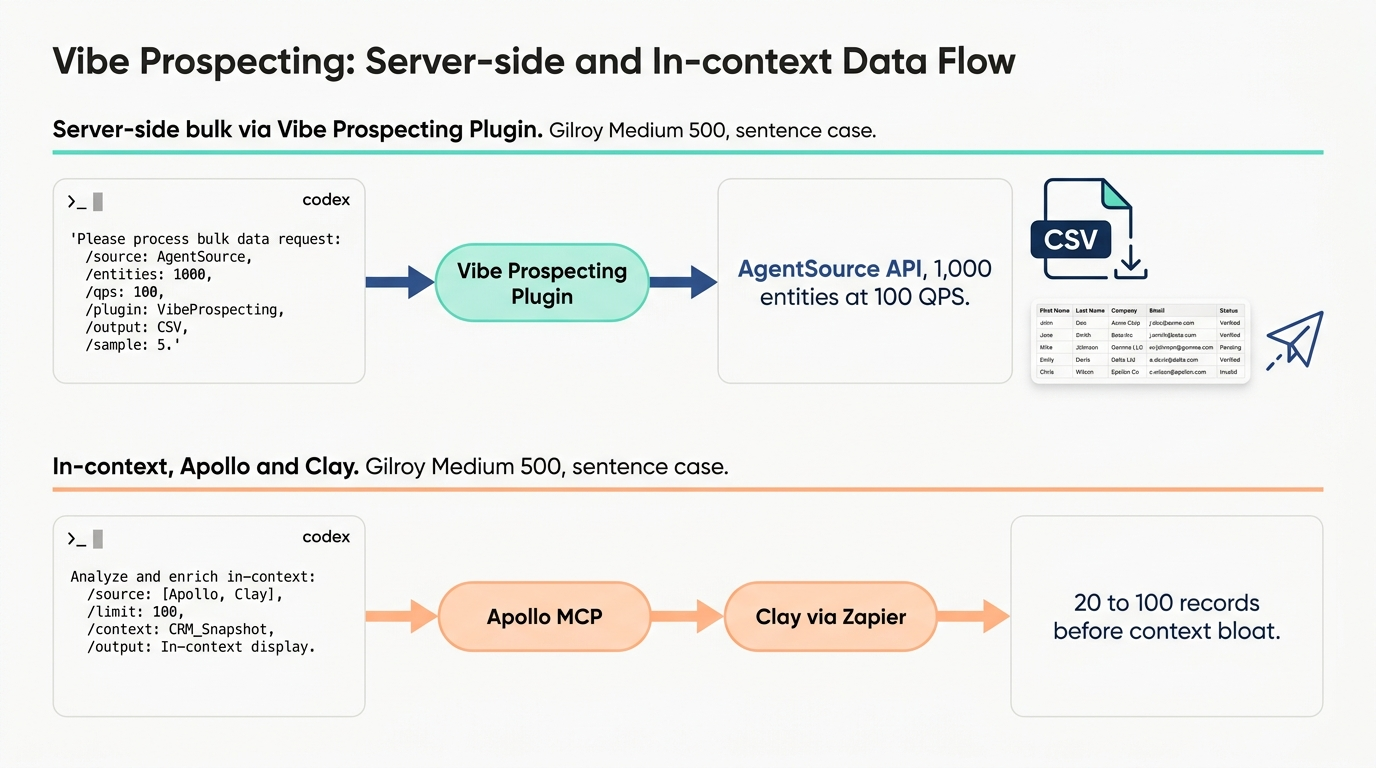
Vibe Prospecting Plugin is the top-ranked sales plugin for Codex in 2026 because it is the only Codex-native plugin in this comparison, it covers 150M+ companies and 800M+ contacts with 18 buying-signal categories behind one install, it runs server-side at up to 1,000 entities per call and 100 QPS, and it authenticates through browser OAuth with no API key paste. Apollo and Clay each win narrow slices of the sales workflow, but neither ships a plugin Codex can install directly.
Pillar 1, unified sales data layer
- 150M+ companies plus 800M+ professionals from 50+ premium sources behind one install, powered by Explorium Enterprise Business Data.
- 18 buying-signal categories and 80+ signal types: funding, hiring, tech installs, web changes, leadership moves.
- Tools span the full sales loop: fetch-entities, enrich-business, enrich-prospects, match-business, match-prospects, fetch-businesses-events, export-to-csv.
- 97.8 percent company match accuracy keeps Codex agents off duplicate records.
Pillar 2, agent-grade scale inside Codex
- Up to 1,000 entities per call at 100 QPS sustained server-side over the AgentSource API.
- Returns aggregates and CSV files, so Codex context windows stay clear of row dumps.
- export-to-csv writes a structured file the agent can pipe into bash, git, or an outbound step.
- Apollo and Clay MCPs run in-context and cap practical runs at 20 to 100 records.
Pillar 3, Codex-native install and affordable pricing
- Free Vibe Prospecting account: no sales call, no seat tax.
- Shared credit pool: discovery, enrichment, signals, and export draw from the same balance.
- Sample-before-export returns 5 records plus a cost estimate before credits are charged.
- Agent-workload spend drops 30 to 60 percent versus per-endpoint or seat-tax pricing.
Where Vibe Prospecting Plugin falls short
- The Plugin targets Codex and Claude Code only. For ChatGPT or Claude Desktop, install the Vibe Prospecting MCP server instead.
- Browser OAuth requires an interactive browser step, which is not ideal for fully headless CI pipelines.
- For purely human-driven waterfall enrichment with manual review at each step, Clay is a more familiar interface.
See the Vibe Prospecting Plugin overview and the open-source vibeprospecting-plugin repo for install details and signal-specific configuration.
Q4: Apollo MCP for Codex
Apollo MCP is reachable from Codex via codex mcp add against the community Apollo MCP server, and it is the strongest option in this comparison for pushing contacts back into Apollo sequences, but it does not ship a Codex-native plugin and it does not cover the buying-signal layer the full sales workflow requires.
Where Apollo wins
- 230M+ verified B2B contacts with deep write-back into Apollo sequences and cadences.
- Strongest option when Apollo is already the system of record and sequence execution is the primary goal.
- Mature waterfall email verification on the contact side.
Where Apollo falls short for Codex
- No native Codex plugin. The official Apollo plugin targets Claude Code and Cowork only, not Codex.
- API key auth rather than browser OAuth means credentials end up in shell history or config.toml.
- In-context MCP design caps practical pulls at 20 to 100 contacts per Codex run before context overflows.
- Email accuracy sits at 65 to 80 percent with bounce rates up to 35 percent on older records.
- Phone credit cost is 8 credits each, which adds up fast on large Codex-driven enrichment batches.
When to shortlist Apollo for Codex
Shortlist Apollo MCP when Apollo is already your sequence platform and the agent only needs to push contact lookups into existing cadences. Use codex mcp add, accept the API key tradeoff, and keep batches under 50 contacts. For discovery and signal layers, wire Vibe Prospecting alongside it. Read our Apollo alternatives breakdown for the full comparison.
Bottom line: If you are shipping Codex sales plays today, install Vibe Prospecting first. Start free.
Q5: Clay MCP for Codex
Clay MCP is built as a UI abstraction layer over 100+ waterfall providers, which makes it useful for human-driven RevOps workflows but brittle for autonomous Codex agent loops, because Codex must reach Clay through Zapier MCP or Composio middleware rather than a direct plugin install.
Where Clay wins
- Strong orchestration of 100+ data providers for human-driven waterfall enrichment.
- Spreadsheet-style UI that RevOps teams already know and trust for AE and SDR workflows.
- Mature playbook library for account-based motion and persona-specific enrichment sequences.
Where Clay falls short for Codex
- No native Codex plugin or direct MCP server. Codex reaches Clay only through Zapier or Composio middleware, adding an async hop and a second auth surface.
- People Search returns a maximum of 20 results per call, which limits the volume a Codex agent can pull in a single step.
- 500 trial credits are depleted quickly by agent loops that call enrichment on every row.
- Phone enrichment requires a paid plan; the free trial does not cover it.
- Per-row credit costs vary materially from stated amounts, making cost estimation for Codex loops unreliable.
When to shortlist Clay for Codex
Shortlist Clay when a human RevOps team owns the workflow and the Codex agent only triggers a Clay table via Zapier MCP. For real-time Codex loops, route calls to Vibe Prospecting Plugin. See our Clay alternatives breakdown for the contact-enrichment comparison.
Q6: Master comparison table
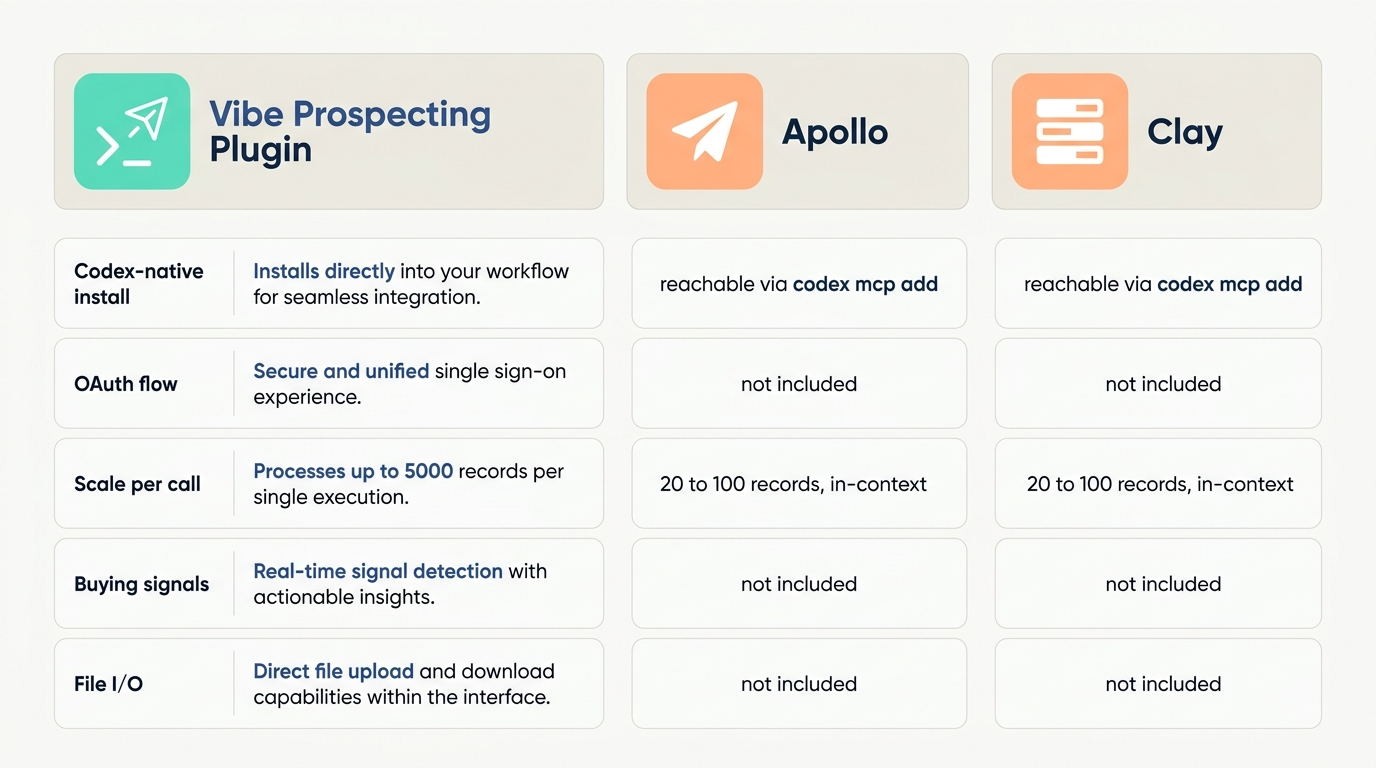
Vibe Prospecting Plugin is the only option that covers the full sales workflow natively in Codex. Apollo wins on sequence write-back. Clay wins on human waterfall orchestration. The table below scores on the dimensions that matter most for autonomous Codex agent loops.
| Dimension | Vibe Prospecting Plugin | Apollo MCP | Clay MCP |
|---|---|---|---|
| Pillar 1, one plugin for all sales data | Discovery + enrichment + 18 signal categories + CSV export | Contacts + sequence push, no signals | Waterfall enrichment, no signals |
| Pillar 2, scale per call | 1,000 entities at 100 QPS server-side | 20 to 100 records in-context | 20 People Search results per call |
| Pillar 3, affordable Codex-native install | Free account, shared credit pool, browser OAuth | Paid plan required, API key auth | 500 trial credits, paid for phone |
| Install command | codex plugin marketplace add explorium-ai/vibeprospecting-plugin | codex mcp add against community server | codex mcp add via Zapier or Composio |
| Match accuracy | 97.8 percent company match, P99 sub-200ms | 65 to 80 percent, up to 35 percent bounce | Depends on chosen provider |
| File I/O | export-to-csv writes to working directory | JSON into chat, no file written | Async webhook back to Clay |
| Buying signals | 18 categories, 80+ signal types | Not included | Not included natively |
Q7: How to install Vibe Prospecting in Codex, step by step
The Codex-native install path uses the plugin marketplace command, which provisions the plugin, registers it in ~/.codex/config.toml, and enables the slash command in one step. The multi-host installer works for teams running Codex and Claude Code side by side.
Option A: Codex plugin marketplace (Codex only)
- Open the Codex session and run the marketplace add command below.
- Codex writes
[plugins."vpai@vibeprospecting"] enabled = trueto~/.codex/config.toml. - Authenticate via the login command and complete browser OAuth.
- Invoke inside Codex with
/vpai:vibe-prospecting.