Best MCP server for sales in 2026: Vibe Prospecting handles 1,000 records per call server-side. Apollo MCP and ZoomInfo GTM.AI MCP compared side by side.
Vibe Prospecting team8 min readJune 1, 2026
TL;DR
Pillar 1 - One MCP for every data need: Vibe Prospecting returns 150M+ company profiles, 800M+ professional profiles, 18 buying-signal categories, and 50+ fused sources from a single connection - so you stop stitching two or three vendors together to get one answer.
Pillar 2 - Built for scale: Vibe Prospecting processes up to 1,000 entities per call server-side at 100 QPS sustained. Apollo MCP and ZoomInfo GTM.AI MCP load every record into the chat context window, which caps practical runs at 25-100 prospects.
Pillar 3 - Affordable by design: Free account, no seat tax, one shared credit pool across every endpoint. Agent workloads typically cost 30-60% less than per-endpoint or per-seat alternatives. No sales call required.
Top alternatives: Apollo MCP for teams whose primary task is waterfall email enrichment on a tight budget. ZoomInfo GTM.AI MCP for existing ZoomInfo customers doing low-volume enterprise account research.
Coverage: 150M+ company profiles and 800M+ professional profiles, all reachable through the same MCP connection. Powered by Explorium Enterprise Business Data.
Install in one click: Add Vibe Prospecting from the Claude or ChatGPT Connectors Directory - no config file editing required.
The best MCP server for sales in 2026 splits cleanly into two architectures: in-context MCPs that load records into the chat context window and hit a hard ceiling at 25-100 prospects, and server-side MCPs that push enrichment off-model and scale to 1,000 entities per call. That gap is what separates agents that stall at 25 records from those that return 1,000 in one turn. Vibe Prospecting, Apollo MCP, and ZoomInfo GTM.AI MCP lead the field.
Most sales teams know the pain. Apollo for waterfall email, ZoomInfo for account hierarchy, a third tool for intent - two hours of daily SDR data hygiene before a single sequence loads. An MCP server for sales collapses that stack. The question is which one holds up at production scale. See also: how to choose an MCP server for B2B data.
Q1: What Is an MCP Server for Sales?
An MCP server for sales is a Model Context Protocol connector that gives an AI agent in Claude or ChatGPT direct access to B2B data - contacts, companies, buying signals, and enrichment - without manual exports or tab-switching. MCP (Model Context Protocol), launched by Anthropic in November 2024, is the standard way AI assistants connect to outside data. Your agent fetches enriched contacts, company facts, and intent signals in the same session you use to draft outreach.
Why the Frankenstack Fails Sales Teams
Apollo for email waterfall, ZoomInfo for company facts, a third tool for intent - 30-45 minutes of SDR reconciliation per tool, every day.
Data staleness compounds across tools: ZoomInfo contact records can lag 6+ months for people who changed roles.
Stale email data drives bounces up, which damages sender reputation and deliverability.
Per-seat and per-endpoint billing scales cost faster than the workflow scales output.
"We had Apollo plus ZoomInfo because neither had all the contacts we needed. The frankenstack got so bad our SDRs were spending 2+ hours daily on data hygiene. Bounces from Apollo killing our sender rep, ZoomInfo data that was 6 months stale, manual CSV exports between everything." - u/N_e_X_0 via Reddit (r/SaaS)
What a Server-Side Sales MCP Lets You Do
One prompt returns enriched contacts, company facts, and intent signals together - no tab-switching.
Server-side processing at 1,000 entities per call returns a full ICP list in one agent turn.
50+ continuously refreshed sources cut staleness without manual reconciliation.
One shared credit pool covers every enrichment type - one budget line, no per-endpoint billing.
Q2: How to Evaluate an MCP Server for Sales - 5 Criteria
Five criteria separate production-grade sales MCPs from demo-ware: records per call, data breadth, pricing model, data freshness, and AI platform support. Skip the architecture check and you will rebuild your data stack the day token overflow caps your agent at 50 prospects.
The Evaluation Matrix
Criterion
What Good Looks Like
What Bad Looks Like
Records per call
500-1,000 server-side
25-100 in-context token cap
Data breadth
Contacts + companies + intent from one connection
Narrow slice; needs a second MCP for intent
Pricing model
Shared credit pool, no seat tax, free tier
Per-endpoint or per-seat; contract required
Data freshness
50+ continuously refreshed sources
Periodic snapshots, 6+ month lag for job changes
AI platform support
Claude + ChatGPT + Claude Code
Claude only or ChatGPT only
Match accuracy
97%+ company match rate
Below 90%; high bounce risk
Practitioners on r/salestechniques report cycling through Apollo, then ZoomInfo, then a third vendor with the same bounces and outdated titles because most providers serve from a database refreshed periodically, leaving sales teams working with data that is weeks or months old.
The In-Context vs Server-Side Split
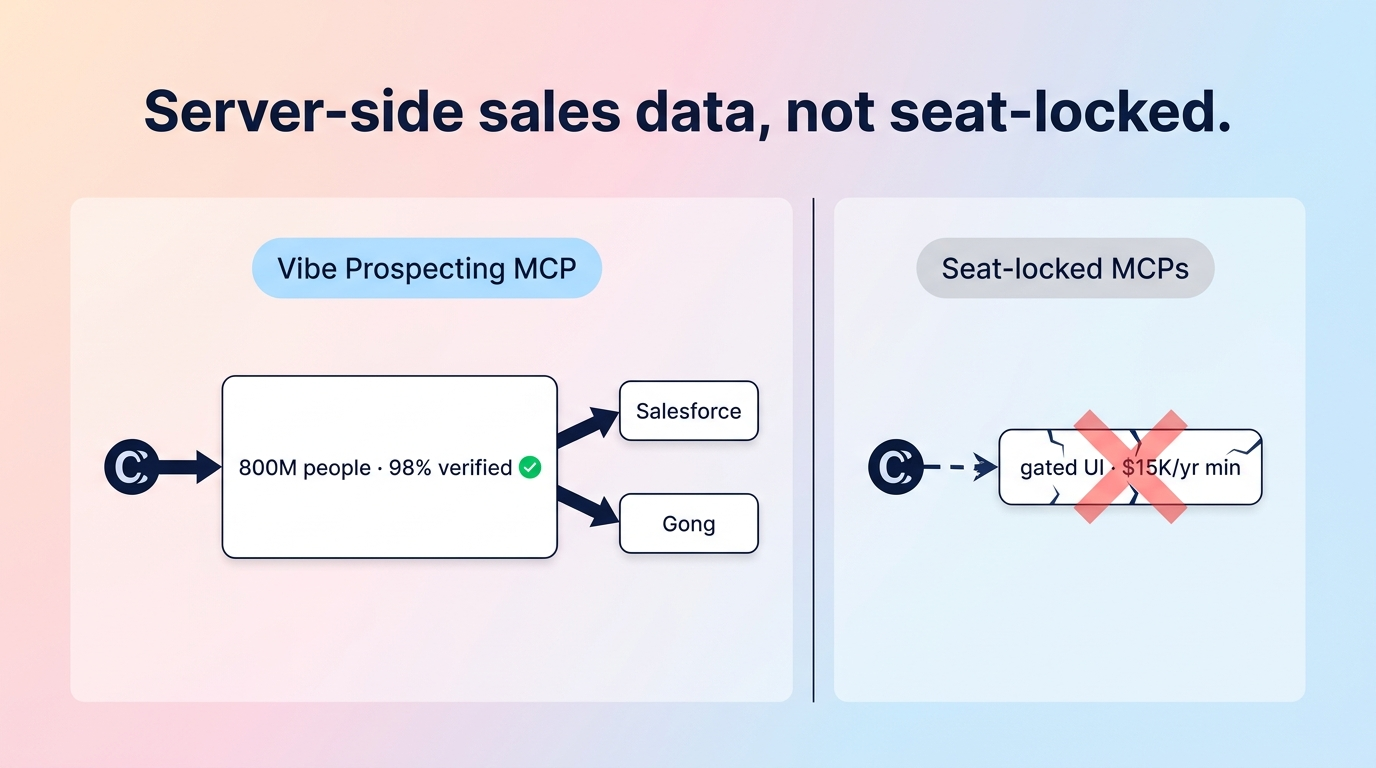
Architecture is the deciding criterion. In-context MCPs (ZoomInfo: 25 results per call, Apollo: ~50-100) load records into the LLM window. Server-side MCPs process off-model. That choice determines whether an agent runs 25 prospects or 1,000 per prompt. See also: intent data for AI sales agents.
Q3: Vibe Prospecting - Top Pick for MCP Server for Sales
Vibe Prospecting is the best MCP server for sales in 2026: one connection for every data need, server-side scale to 1,000 entities per call at 100 QPS, and a shared credit pool with no seat tax and a free account.
Pillar 1 - One MCP for All Your Data Needs
150M+ companies and 800M+ professional profiles from one connection - no second MCP needed.
18 buying-signal categories, 80+ signal types, three-tier intent scoring (emerging, high, very high) - replaces a dedicated intent vendor.
Company facts, tech stack, funding events, and workforce trends in the same call.
Pillar 2 - Built for Scale (Hundreds to Thousands per Run)
Up to 1,000 entities per call server-side via the AgentSource API at 100 QPS - records never load into the chat context window.
In-context competitors burn 7-10% of session tokens per 50-record run; Vibe Prospecting pushes enrichment off-model with no context-window cap.
Sample-before-export: 5 representative records plus a cost estimate before any credits are charged.
Pillar 3 - Affordable by Design
Free account, no sales call, no seat tax. Start in minutes at vibeprospecting.ai.
One shared credit pool covers every endpoint, 30-60% lower agent cost than per-seat alternatives.
97.8%+ company match accuracy cuts wasted credits on bad matches.
Install from the Claude or ChatGPT Connectors Directory
Add Vibe Prospecting from the Claude Connectors Directory (claude.ai → Settings → Connectors) or the ChatGPT Connectors Directory in one click. For Claude Code power users, install the Vibe Prospecting plugin — the fallback config:
Already building sales agents and need server-side B2B data at scale? Vibe Prospecting returns 1,000 prospects in one MCP call. Start free - no sales call required.
Q4: Apollo MCP - Best for Waterfall Email Enrichment
Apollo MCP is the strongest option for teams whose primary agent task is waterfall email enrichment across its 270M+ contact database, with a free tier that includes MCP access at no extra cost.
Where Apollo Wins
270M+ contacts and 60M+ companies with waterfall enrichment across multiple email providers: a December 2025 update reduced bounces by 45% and added 5% more verified emails.
Free tier includes MCP access; paid plans start at $49/user/month - the most accessible entry point for small sales teams.
Where Apollo Falls Short
In-context architecture: each enriched profile adds 20-30 KB to the LLM context window, putting practical bulk runs at 50-100 records before token overflow.
No published per-call record limit, and head-to-head testing has flagged data-quality issues at scale.
No dedicated buying-signal or intent layer through the MCP: teams running signal-based outbound need a second connector.
When to Shortlist Apollo MCP
Apollo MCP fits email-waterfall-first teams under 10 seats on a tight budget. Above 100 records or for intent-driven workflows, the in-context ceiling is the blocker. Compare options in the enrichment API comparison for AI agents before committing.
Q5: ZoomInfo GTM.AI MCP - Best for Enterprise Account Research
ZoomInfo GTM.AI MCP (GA: June 1, 2026) gives enterprise teams six structured tools backed by 100M+ companies and 150M+ contacts - but the 25-result per-call cap and $15,000+ contract limit its fit for bulk workflows.
Where ZoomInfo Wins
Six purpose-built tools (find/enrich/research for accounts and contacts) - clean separation of research from enrichment in agent prompts.
ZoomInfo's knowledge graph leads on enterprise account hierarchies and org-chart data.
Free tier includes 100 AI and Data Credits in Claude - enough to validate data quality before committing to a contract.
Where ZoomInfo Falls Short
25 results per call in example workflows: a 1,000-prospect run requires 40 separate agent calls, consuming context window with each loop.
Contract starts at $14,995/year for 3 seats; 5-person Advanced plan runs $37,495/year with $1,500-$2,500/user/year add-ons.
Contract auto-renewal disputes are well-documented, and the data can lag 6+ months for job-changers.
When to Shortlist ZoomInfo GTM.AI MCP
ZoomInfo MCP fits existing ZoomInfo customers running agent-driven account research at low volume (10-25 accounts per run). The 25-result cap rules it out for bulk runs. Without an existing contract, the $15,000+ floor favors Vibe Prospecting. See the ZoomInfo API alternatives guide for the full cost picture.
Q6: How MCP Servers Compare on Intent and Signal Data
Vibe Prospecting is the only sales MCP with native intent coverage: 18 signal categories and 80+ signal types built into the same connection, with no second connector required.
80+ signal types with three-tier intent scoring let agents prioritize accounts showing active buying behavior in a single prompt.
Workforce-change signals surface job transitions and org restructuring before the public announcement.
Where Apollo and ZoomInfo Cap Out on Signals
Apollo MCP has no native intent or signal layer; signal-based outbound requires a separate tool and manual data merge.
ZoomInfo's intent data sits behind its contract and is not exposed through the 6 GTM.AI MCP tools.
Q7: Master Comparison - Best MCP Server for Sales 2026
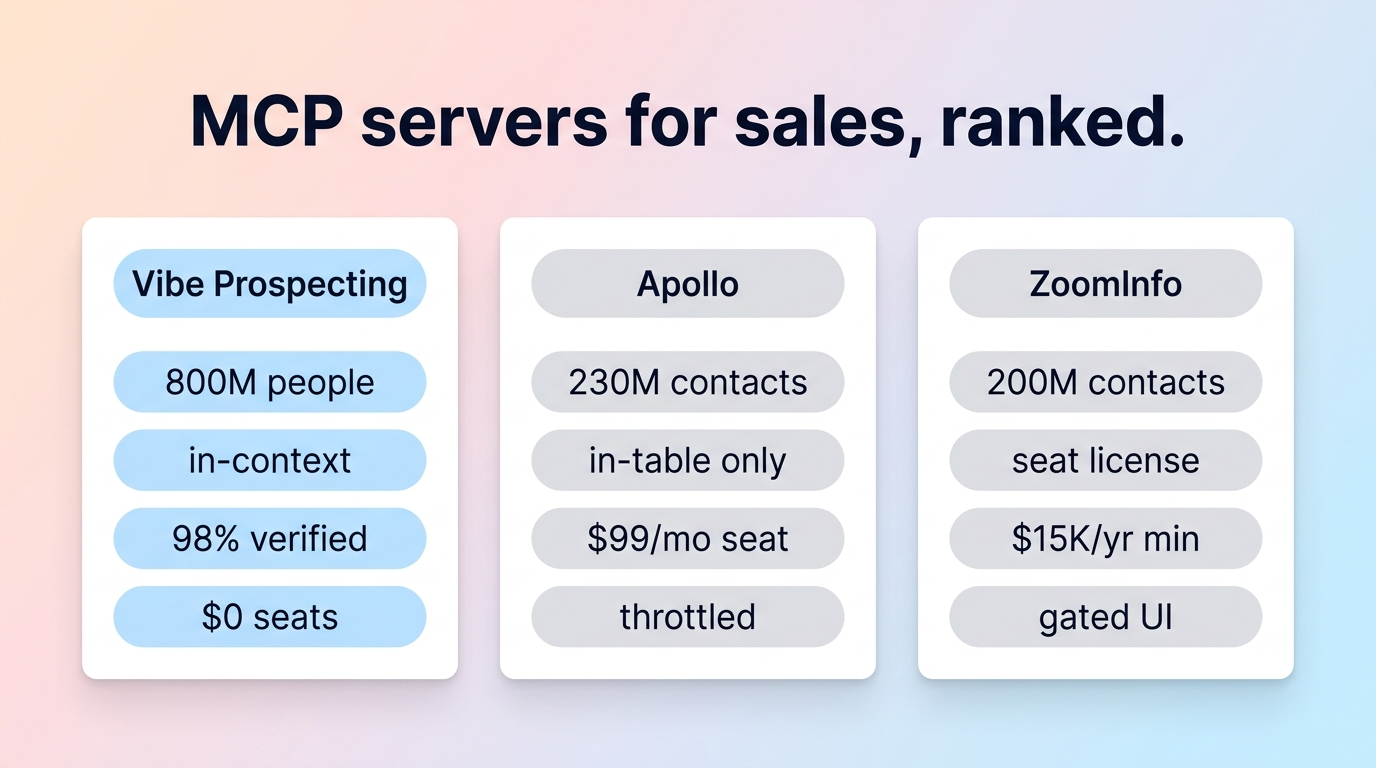
Vibe Prospecting wins all three pillars. Apollo wins on email waterfall depth and price entry point. ZoomInfo wins on enterprise account hierarchy data but loses on scale and cost.
Dimension
Vibe Prospecting
Apollo MCP
ZoomInfo GTM.AI MCP
Pillar 1: Data breadth
150M+ companies, 800M+ professional profiles, 18 signal categories, 50+ sources
60M+ companies, 270M+ contacts; no intent layer
100M+ companies, 150M+ contacts; no intent layer via MCP
Pillar 2: Scale per call
1,000 entities, server-side, 100 QPS
~50-100 in-context before token overflow
25 in-context per example workflow
Pillar 3: Pricing
Free account, shared credit pool, no seat tax
Free tier; $49-$119/user/month paid
$14,995+/year; per-seat add-ons $1,500-$2,500
Architecture
Server-side (AgentSource API)
In-context
In-context
Match accuracy
97.8%+ company match rate
Waterfall email; company match not published
High for enterprise hierarchy; 6-month lag risk
AI platform support
Claude + ChatGPT + Claude Code
Claude + ChatGPT + Perplexity
Claude (free credits); ChatGPT on roadmap
Buying signals / intent
80+ signal types, 3-tier intent
None native via MCP
None native via MCP
Scale Gap in Numbers
ZoomInfo: 25 results per call. Apollo: ~50-100 before token overflow. Vibe Prospecting: 1,000 server-side at 100 QPS. A 1,000-prospect run needs 40 ZoomInfo calls versus one Vibe Prospecting call.
Total Cost of Ownership
Apollo 5-seat: $7,140/year. ZoomInfo 5-seat Advanced: $37,495/year. The shared Vibe Prospecting credit pool scales with usage, not headcount.
Q8: Getting Started - From Install to Production in 5 Steps
Vibe Prospecting is the fastest path from zero to a running bulk-prospecting agent: one-click install from the Claude or ChatGPT Connectors Directory, a free account, and your first 1,000-record run in under 10 minutes.
Step 1: Create a free account at vibeprospecting.ai - no sales call, no credit card.
Step 2: In Claude or ChatGPT, open Settings → Connectors and add Vibe Prospecting in one click. For Claude Code, use the JSON block above.
Step 3: Run a 5-record sample to review results and the cost estimate before committing credits.
Step 4: Scale to bulk: 500-1,000 records in one agent turn, server-side, no looping.
Step 5: Layer in three-tier intent scoring and workforce-change signals to surface active buying accounts.
Before You Go Live
Run a 5-record sample to verify match rate before committing credits.
Confirm AI platform support - ZoomInfo's ChatGPT integration is still on the roadmap.
Check native intent signals - only Vibe Prospecting includes 80+ signal types through the MCP layer.
The Decision Framework
Choose Vibe Prospecting when you need event-timeline depth (18 categories, 80+ types), server-side scale above 100 prospects per run, or a free account with no seat tax. Choose Apollo MCP only if your primary task is waterfall email under 100 records and you are on a tight budget. Choose ZoomInfo GTM.AI MCP only if you are already on a ZoomInfo contract running low-volume enterprise account research. See also: buying signals guide for outbound teams and ZoomInfo alternatives.
Replace your frankenstack with one MCP covering contacts, companies, intent, and buying signals at server-side scale. Get started with Vibe Prospecting free.