
Data Enrichment

Most Company Data Changes Nothing. Here Is What to Enrich Before Outbound.

Which company data to enrich before outbound: a three-question test for every detail, plus what independent testing shows about how much comes back empty.

Vibe Prospecting team8 min readAugust 10, 2026
Most Company Data Changes Nothing. Here Is What to Enrich Before Outbound.

TL;DR

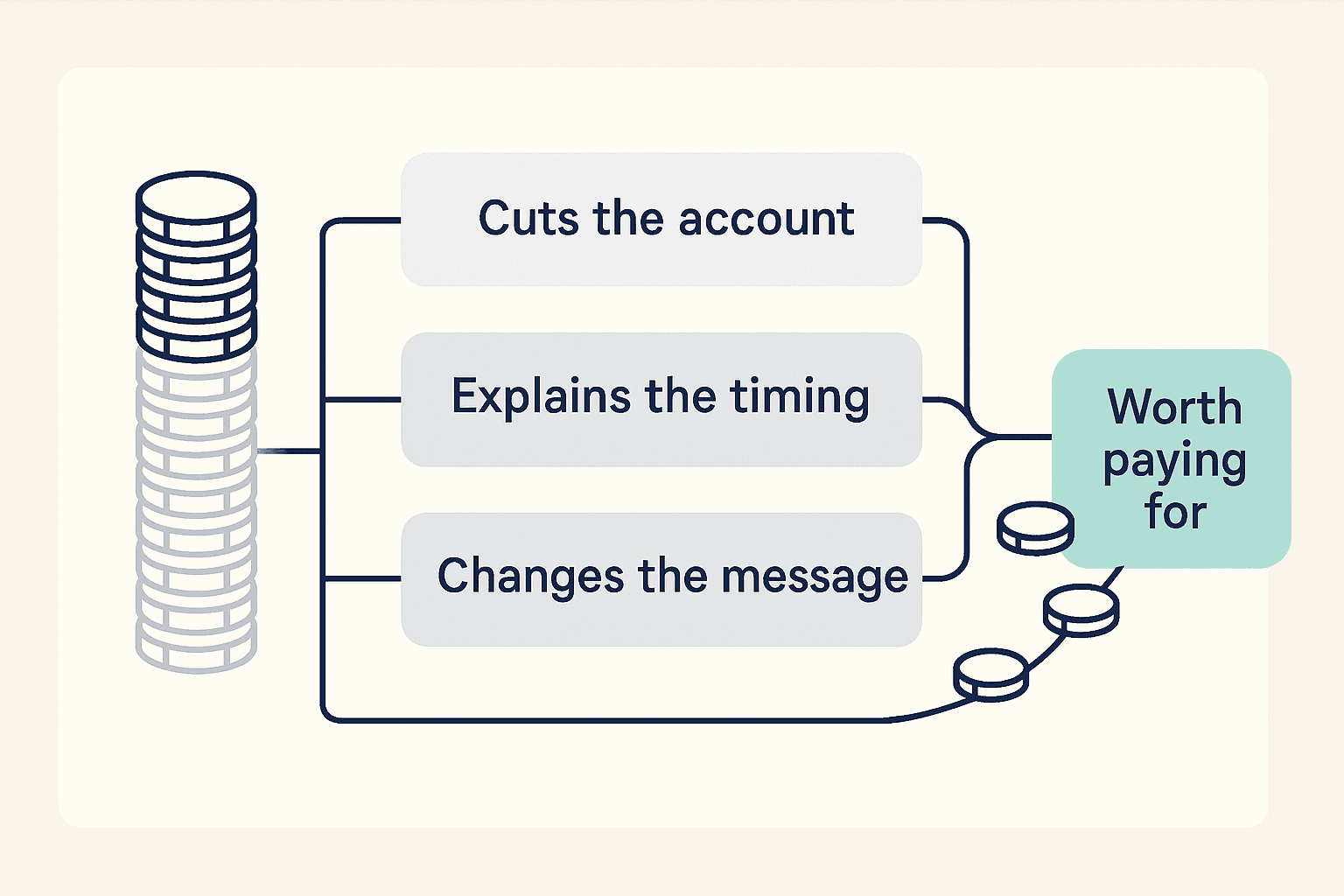
  • Pay for a company detail only when it does one of three jobs: it cuts the account from your list, it explains why you are reaching out this week, or it changes who you write to and what you open with.
  • Independent testing of six enrichment services on the same 349 domains in May 2026 found that only 50.1% to 67.6% of those domains returned a record at all.
  • On the records that did return, 11.5 to 17.9 of 27 details carried a value, and the details people rate highest were the thinnest: funding history filled 4.0% to 10.6%, company structure 0.0% to 10.6%.
  • Order beats everything else. Narrowing 900 accounts to the 90 that survive before the deep ask cuts the work by roughly three quarters without losing the accounts you would have contacted.
  • Vibe Prospecting does all three jobs in one chat, across 150M+ company profiles and 18 buying-signal categories, powered by Explorium Enterprise Business Data.
  • Preview five records with a cost estimate before any credits move, so you see the fill quality on your own accounts before deciding a detail is worth buying.

Choosing which company data to enrich before outbound is a spending question wearing a research costume. You already have the account list. Next to it sits a menu of a few hundred purchasable details, and nothing on that menu tells you which ones will still matter on Friday. Independent testing of six company enrichment services in May 2026 put the honest ceiling in plain view: run the same 349 domains through each one, and only 50.1% to 67.6% of those domains came back with a record at all.

So the exercise is not "collect more about each account." It is "keep the handful of details that change what you do next, and stop paying for the rest." If you want the ground-level definition first, Explorium's introduction to data enrichment covers what enrichment is before we get to what it is worth.

Three Questions a Company Detail Has to Survive

Pay for a company detail only when it does one of three jobs: it removes an account from your list, it tells you why this week instead of next quarter, or it changes who you write to and what you open with. Three jobs, three very different price tags, because each one gets bought at a different moment and on a different slice of the list.

The Three Jobs, in Plain Words

  • Does it cut the account? Headcount range, revenue band, industry, country. These end an account's candidacy, so you want them on everything.
  • Does it explain the timing? A round that closed nine weeks ago, engineering headcount that jumped last quarter, a second office. These earn the first line of the email.
  • Does it change the message? What software the account runs, how the team is shaped, what the site talks about. These pick the recipient and the angle.
  • Does it do none of the above? Then it is decoration. Delete it from the list before you price it.

Why "Collect Everything" Quietly Loses

  • Spend multiplies: accounts times details. Nine hundred accounts across twenty details is eighteen thousand lookups before anyone has written a sentence.
  • A detail attached to no decision can never be judged against pipeline, so it survives every review by default.
  • The most freely available details are the shakiest ones, which quietly puts your least reliable inputs in charge of who gets cut.
"I don't mind working with imperfect data, but I don't know which imperfect data is actually worth paying for." A practitioner opening the r/gtmengineering thread that started this argument.

Write the Sentence Before You Buy the Detail

If you cannot say out loud what you will do differently once the detail arrives, you are not buying data, you are buying reassurance. "We skip anything under 200 people" is a sentence. "It would be good to know headcount" is a shopping list.

The Sentence Test

  • Say the rule first, with a number in it, and say what happens on both sides of that number.
  • Check the detail actually arrives often enough on your kind of accounts to run the rule at all.
  • Put a date on it. Ninety days later, if the rule never changed an outcome, the detail goes.

The Details That Look Solid and Are Not

  • Revenue for a private company is a model output, not a filed number, and two providers can land it in different bands entirely.
  • Headcount shifts depending on whether contractors, regional entities, and a recent acquisition are counted.
  • A headline profile count describes somebody's index, not your accounts. The only count that matters is how much of your list comes back filled.

Single Numbers Versus Combined Scores

Cut on single numbers, rank on combined ones. One revenue estimate carries the full error of one model, while a score built from four or five related inputs bends instead of breaking when one input goes missing. Ask for at least three inputs to be present before the score is allowed to exist, and keep the inputs next to the score so a strange result traces back to one of them. Scoring accounts inside a chat session works the same way.

What Comes Back, and What Comes Back Empty

Two separate things can disappoint you: the account may not be found at all, and the account that is found may arrive mostly blank. The May 2026 test across six enrichment services measured both on an identical 349-domain sample, against a shared 27-detail template.

Found Is Not the Same as Filled

  • Found: 50.1% to 67.6% of the domains returned a record. A third to a half returned nothing.
  • Filled: on the records that did return, 11.5 to 17.9 of 27 details carried a value.
  • These move on their own. A separate 282-domain run had one service resolving every single domain while filling only 60.4% of the template.

The Emptiest Details Are the Useful Ones

  • Funding history was present on 4.0% to 10.6% of returned records.
  • Company structure landed between 0.0% and 10.6%.
  • Those are exactly the timing details from job two above, which means the layer everyone rates highest is the layer most likely to be silently blank.
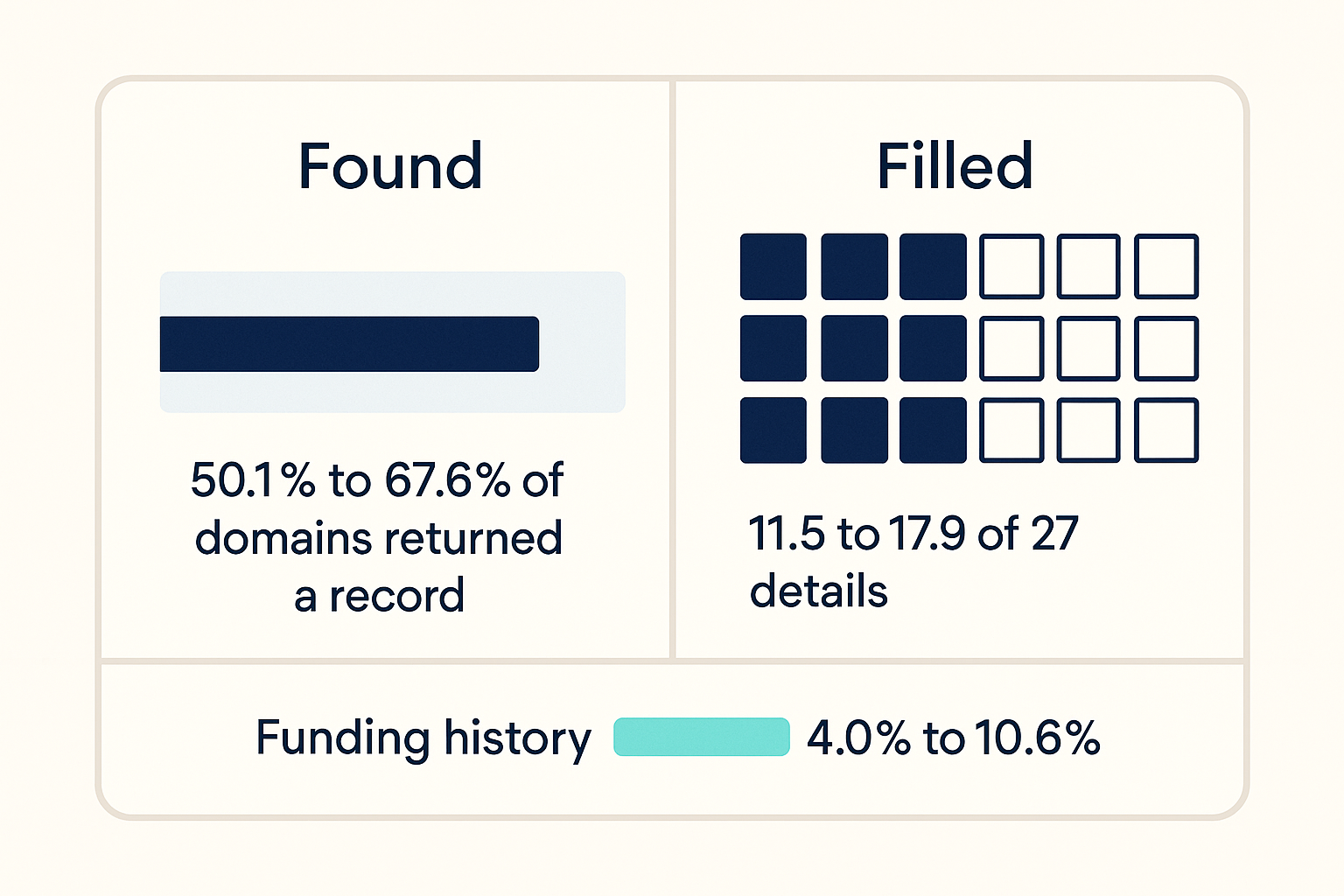
Found rate versus filled rate for company enrichment, showing funding history present on only 4.0 to 10.6 percent of returned records

The Same 900 Accounts, Asked Two Ways

Order of operations is the biggest lever you have, and it costs nothing to change. Picture a founder with 900 accounts pulled from a conference list and a Friday deadline.

The Expensive Way and the Quick Way

StepAsk for everything up frontNarrow first, then go deep
Accounts touched900900
What you ask for firstAll 20 details on all 900Four cutting details on all 900
Accounts that reach the deep ask90090, the tenth that survived
Lookups performed18,0003,600 shallow plus 1,800 deep
Timing details you actually readA few dozen, buriedThe same few dozen, on the accounts you will contact

The Order That Saves the Money

  • Narrow before you enrich. Filtering is the step that decides how big every later step is.
  • Pin each survivor to one company record before layering anything on it, or the layers will not line up. Here is how matching company records across sources works.
  • Ask for timing details with a window attached. "Last quarter" is a question. "Ever" is trivia.
Text
Ask in chat:

  "From these 900 domains, keep only the SaaS companies with
   51 to 200 employees in the US or Canada. Show me the count
   and five sample rows before you build anything."

  ->  90 accounts survive the first cut
  ->  five sample rows come back, plus a cost estimate
  ->  nothing is charged until you say go
Ask for a sample before you commit to the run. Vibe Prospecting returns five representative records and a cost estimate first, so the shape of the answer is visible before any credits move.

Doing All Three Jobs in One Chat

The reason teams over-buy is that the cutting step and the deep step usually live in two different tools, so nobody sequences them. Vibe Prospecting collapses that into one conversation: you describe the accounts, you look at a preview, and only then do you ask for depth on what survived.

What One Connection Covers

The jobWhat you ask for in chatWhat sits underneath
Cut the account"SaaS companies, 51 to 200 people, US and Canada"150M+ company profiles across 50+ sources
Explain the timing"Only the ones with a funding round or a hiring jump in the last 90 days"18 buying-signal categories, continuously refreshed
Change the message"Show me their stack and who owns revenue there"800M+ people profiles, matched at 97.8%+ company match accuracy
Decide before you spend"Preview five and tell me the cost"Five-record sample plus a cost estimate, no credits charged

Where It Runs

  • In Claude or ChatGPT, as a connector you add once and then talk to in plain language.
  • In Claude Code, through the Vibe Prospecting plugin. Install steps per host live in the plugin repository.
  • In the web app, when you would rather look at the table than describe it.
  • All of it powered by Explorium Enterprise Business Data, which is why the cutting step and the deep step read from the same definitions instead of two vendors' disagreeing ones.
Claude Code
# Claude Code, from the official Anthropic plugin store
/plugin install vibe-prospecting@claude-plugins-official

# Claude chat and ChatGPT
# add Vibe Prospecting from the connector store, nothing to configure
# per-host install guides: github.com/explorium-ai/vibeprospecting-plugin

What It Costs to Find Out

  • A free account, no call with anyone, and your first list in a few minutes.
  • One shared credit pool rather than a separate allowance per data type, so narrowing first genuinely lowers the bill instead of shifting it sideways.
  • The preview is the part that matters here: you see the fill quality on your own accounts before you decide the detail is worth buying at all.

The Failure That Never Throws an Error

A detail that stops arriving does not break anything loudly. It comes back blank, the request succeeds, and your scoring gets quietly worse for a month. This is the one failure mode nobody has a checklist for.

Why Nothing Looks Wrong

  • Empty is a valid answer. Every status light stays green.
  • A combined score absorbs the missing input and keeps producing a number, so the symptom shows up as worse reply rates weeks later.
  • Providers rename and retire details on their own schedule without breaking your request.

The Two-Minute Check

  • After every batch, count how often each detail arrived filled, and keep that count over time rather than glancing at it once.
  • Alert on the fall, not the level. Funding history is thin everywhere, so an absolute threshold tells you nothing; a twenty-point drop against its own recent average tells you plenty.
  • Re-run a saved list monthly and compare. Higher-volume enrichment patterns fail in the same quiet way.
Text
Ask in chat, first Monday of the month:

  "Re-run the saved conference list. For every detail, tell me
   what share of the accounts came back filled this time, and
   flag anything more than 20 points below its own average."

  ->  a fill count per detail, month over month
  ->  the drop is the alert, not the level
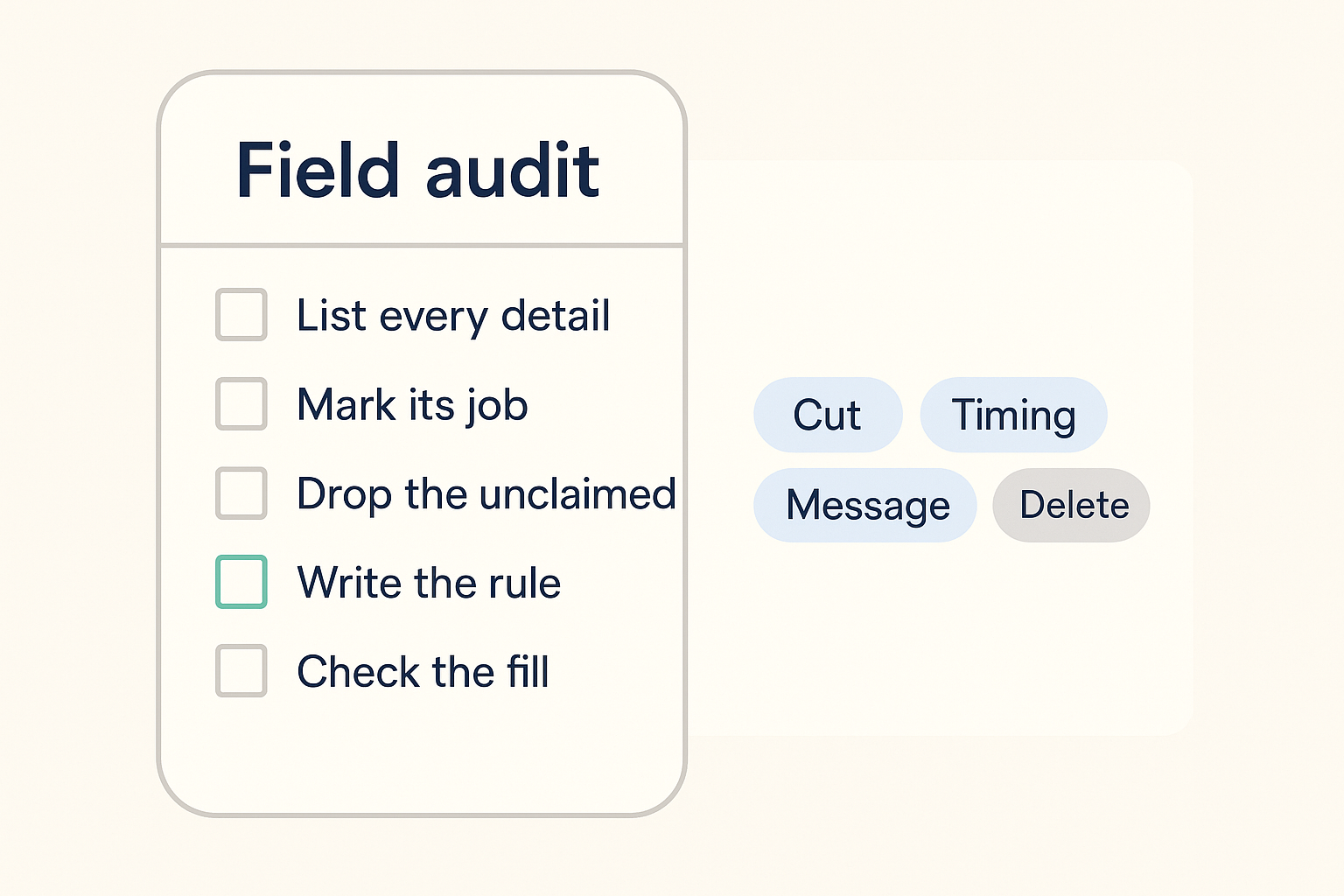
A checklist card for auditing which company details you already pay for, marking each one as cuts the account, explains the timing, changes the message, or delete

A Fifteen-Minute Audit of What You Already Buy

Before you add a single new detail, run the ones you already pay for through the same three questions. Most teams find two or three passengers on the first pass.

  • Minute 1 to 3. List every company detail currently attached to your accounts, one line each.
  • Minute 4 to 8. Mark each one: cuts the account, explains the timing, changes the message, or none.
  • Minute 9 to 11. For every "none", find the person who asked for it. If nobody claims it, it goes this week.
  • Minute 12 to 14. For the survivors, write the sentence with the number in it. Anything you cannot finish out loud joins the "none" pile.
  • Minute 15. Check how often each survivor actually arrives filled on your accounts. A rule running on a detail present a quarter of the time is not a rule.

Start Here

Narrow the list on a few cutting details, look at a preview, buy timing and message details only for what survived, then watch the fill rate month to month. That sequence is worth more than any single detail you could add to the schema, and it is the same sequence whether you are one founder with a conference list or a team running weekly campaigns.

The reason it works in one chat is that all three jobs read from the same layer, so you are not reconciling two revenue estimates or stitching a timing feed onto a company lookup. If you want the wider view of what that layer is, start with what a B2B data layer actually is, then come back and run the fifteen-minute audit.

Start free, describe your accounts in plain language, and preview five records with a cost estimate before a single credit moves.
FAQs

Frequently Asked Questions

Get Started Banner

Get Started for free

Sign Up
Which Company Data to Enrich Before Outbound