


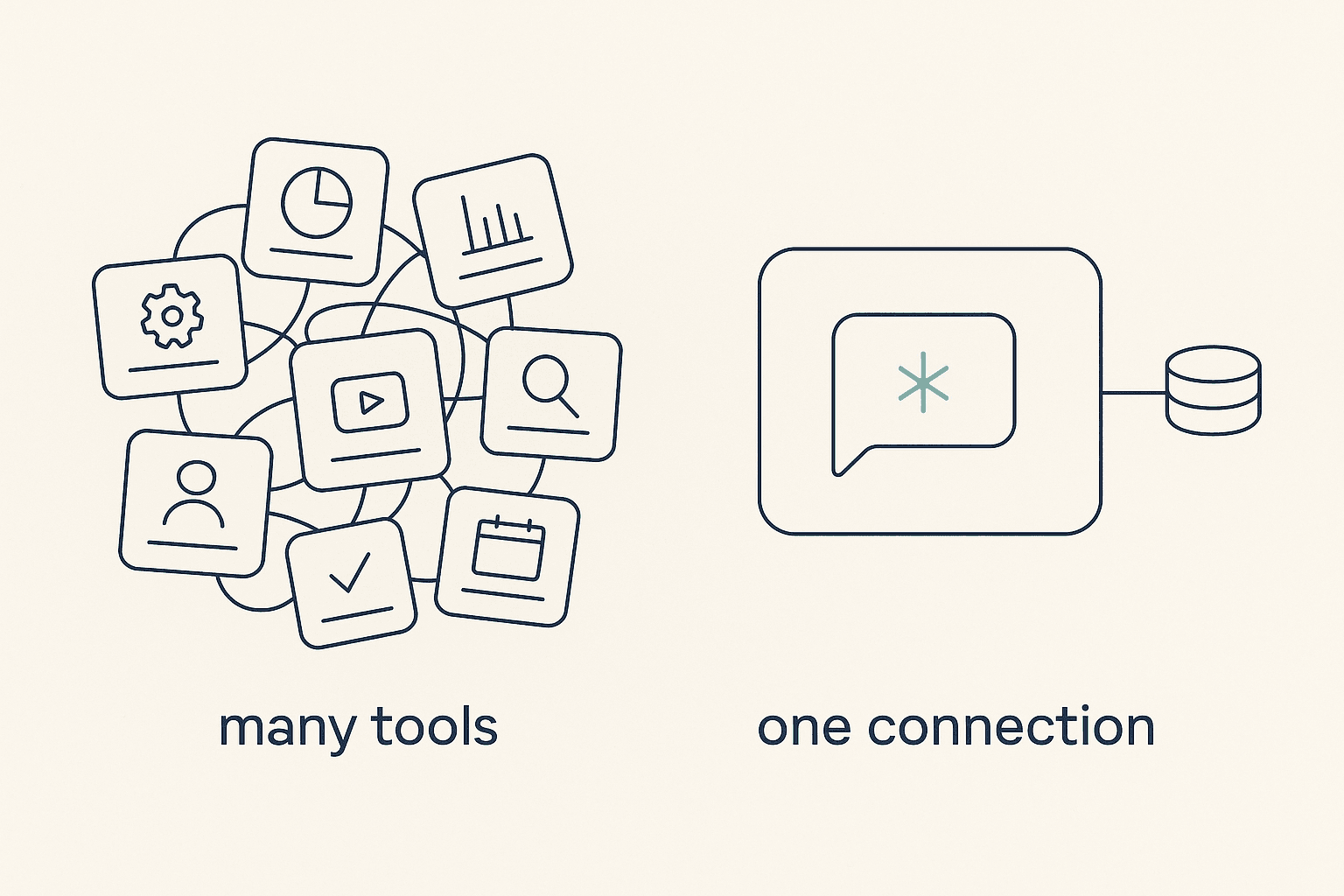
Open the tools tab on almost any revenue team's laptop and count the data subscriptions before a single prospect list reaches a rep. Ten is common. Fourteen is not rare. A newer fix has GTM engineers arguing in public: plug one key into a router that fans out across 40+ providers and let it pick a winner. That solves the login problem and creates a new one, forty response formats instead of fourteen logins. A single chat connection to one data layer sidesteps both problems at once, which is the case this guide walks through.
Why Your Data Stack Keeps Growing
A typical GTM data stack runs 10 to 14 separate subscriptions before a router or a single connection replaces them, and each one adds its own login, minimum spend, and onboarding. Nobody sets out to build it that way. A team picks a company lookup tool, then a separate contact finder, then a signals tool for hiring or funding news, then something else for intent, and by the second year nobody remembers why there are five tabs open just to build one list.
What Sprawl Actually Costs You
- Every subscription carries its own minimum spend, separate from every other tool's minimum, so idle credits in one never help pay for an overage in another.
- Every tool needs its own account, its own API key or login, and its own learning curve before it produces a usable list.
- A rep or GTM engineer ends up stitching outputs from three or four tools by hand before a list is ready to send anywhere.
The Router Workaround: One Key, Many Vendors
A newer pattern, popularized by GTM tooling startup ColdIQ, plugs a single API key into 40+ underlying data providers and returns whichever one answers first with a usable result. It is a real attempt to fix subscription sprawl, and it works for what it is built for: coverage on hard-to-find people that any one provider might miss. See ColdIQ's own product page for the full pitch.
Who a Router Actually Helps
- Teams chasing hard-to-find personas where breadth of provider coverage matters more than a clean, unified format.
- Teams already deep into ten or more point tools who want one integration point without switching data sources.
- Pay-per-lookup pricing with no long-term commitment to any single vendor's roadmap.
What a Router Does Not Fix
- Every provider behind the router still bills separately. There is no shared credit pool sitting on top of the router.
- The record that comes back could be from any of 40+ sources, and the router does not always say which one won.
- Forty native response shapes still need to be parsed somewhere in the pipeline, even if the key itself is unified.
The Real Tax Is Schema, Not Subscriptions
Every extra data provider a chat agent has to reason across adds a new response shape it has to parse, and that tax gets paid on every single call, not just once during setup. A router built to avoid dozens of billing relationships still leaves the agent holding dozens of different answer formats, because unifying the key is not the same as unifying the schema.
Compare that to a single connection: one format in, one format out, every time. Fewer shapes means fewer edge cases when a provider quietly changes what a field looks like, and fewer places for a chat workflow to break in production. See Explorium's side-by-side data provider comparison for how coverage claims on paper compare to what actually reaches a chat window in one clean shape.
Why the Source Matters as Much as the Answer
When a lookup blends results from a dozen or more unlogged providers, a wrong answer has nowhere to trace back to. Picture an AE dialing a number the tool swears is current, only to reach someone who left the role two jobs ago. Nobody can say which of the forty sources handed over the stale number, so nobody fixes it before it happens again.
A single attributable source closes that gap. Vibe Prospecting, powered by Explorium Enterprise Business Data, publishes 97.8%+ company match accuracy from one pipeline, not a blend of unlogged providers. When something looks off, there is exactly one place to check, not a stack of forty.
One Chat Connection Covers the Whole Job
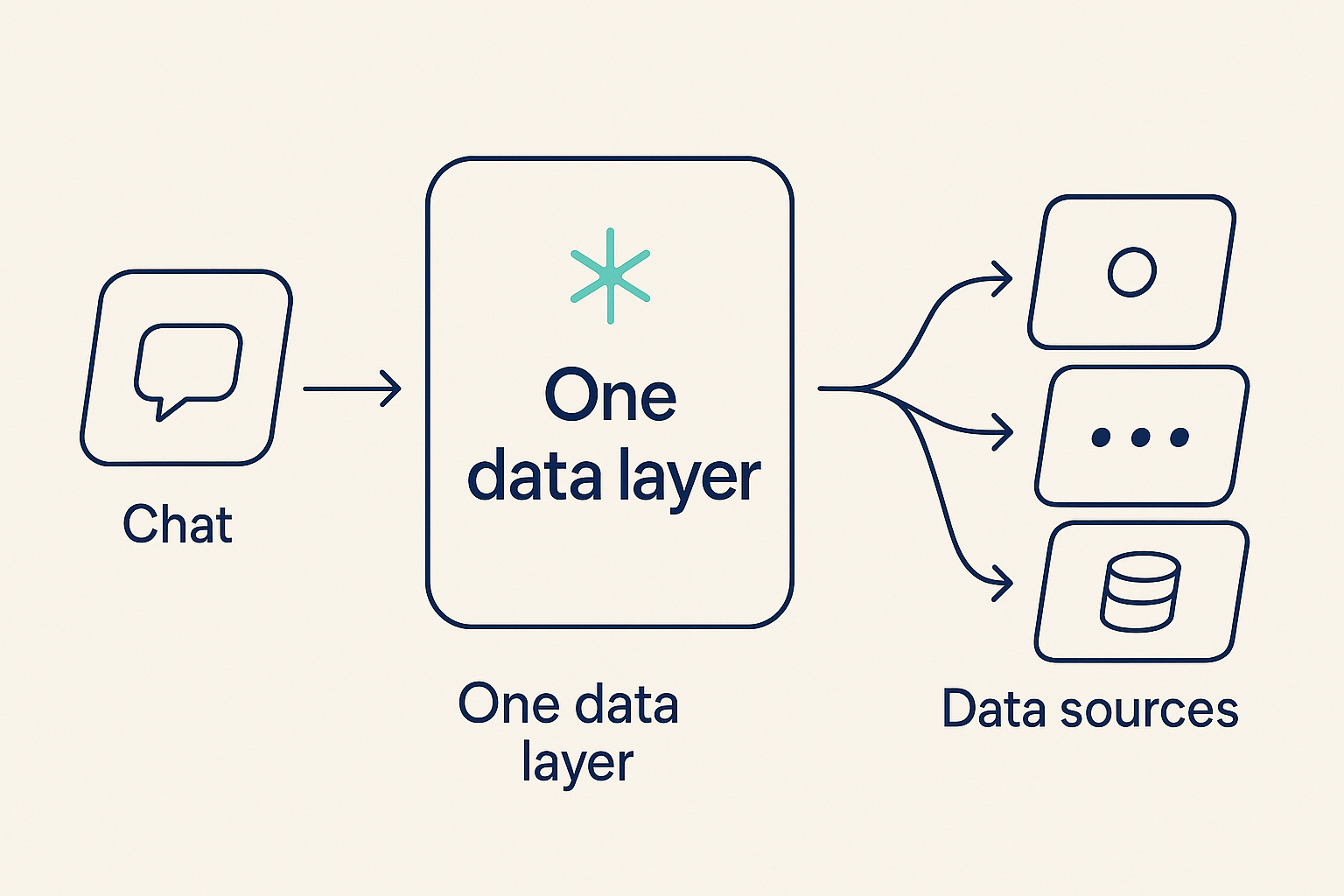
Vibe Prospecting connects once, in Claude or ChatGPT, and covers company lookups, contact details, funding and hiring news, website changes, and 18 categories of buying signals from that same connection. No second tool for signals, no third tool for intent.
- Company details and contact information pulled from the same conversation, no tab switching required.
- Funding history, hiring trends, and recent company activity available in plain language, in the same chat.
- 18 buying-signal categories with 80+ signal types, plus three tiers of intent data, without adding a second connection.
- 50+ underlying sources unified behind one response shape, instead of 40+ provider-native shapes behind a router.
How Many Records Can You Actually Pull at Once
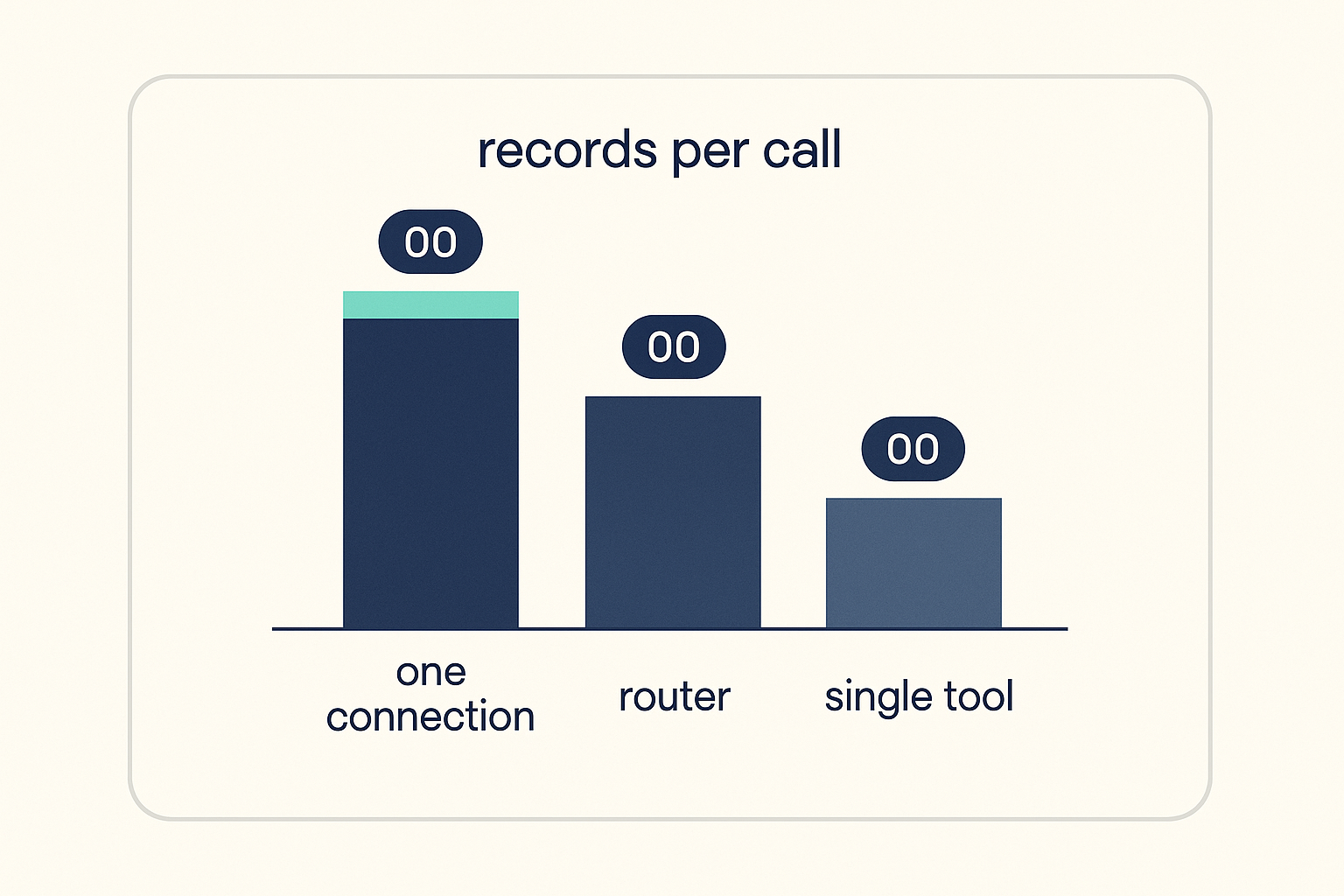
Vibe Prospecting pulls up to 1,000 records in a single call, processed on the server, while most chat-native tools load results straight into the conversation and hit a wall well before that.
| Tool | Records per call | Where it runs |
|---|---|---|
| Hunter.io (Business tier) | 50,000 searches/month at $399/mo | Shared monthly cap, no bulk streaming |
| Coresignal (entry tiers) | 5 requests/sec; 100+ requests/sec only on the $5,000/mo Elite tier | Rate-limited per plan |
| Vibe Prospecting (AgentSource) | Up to 1,000 entities per call, 100 QPS sustained | Server-side, never loaded into the chat window |
Chat-native tools that load raw results directly into a conversation tend to cap out around 100 records before the conversation itself runs out of room. Because Vibe Prospecting processes the call server-side, the chat window only ever sees the finished list, not the raw data behind it.
What It Actually Costs You Per Month
A shared credit pool that covers every data type beats paying separate minimums per tool, because idle credits on one type of lookup can cover a heavier month on another.
- Router (ColdIQ-style): $99/month minimum for 7,000 credits after a 300-credit free cap, on top of whatever the 40+ underlying providers bill separately behind that key.
- Point vendor (Coresignal): $49 to $5,000/month depending on tier, with one company or employee record costing 10-20 credits.
- Vibe Prospecting: one unified pool spanning every endpoint, 30-60% lower agent-workload spend than paying per tool, and a free account to start.
Already paying for a router or a shelf of point tools? Run the numbers against a single connection. See AgentSource MCP →
What Happens When a Vendor Shuts Down
A stack built on 14 point vendors carries 14 separate risks that a vendor pivots, gets acquired, or simply shuts the product down, and 2026 has already tested that more than once. The AI SDR category alone saw multiple vendors either pivot their entire product or lose most of their customer base within a single year.
How a Single Layer Absorbs That Risk
- Every point vendor that folds forces a re-integration project onto whichever tool replaces it.
- A router inherits the continuity risk of every provider sitting behind it, not just its own.
- A single connection backed by 50+ underlying sources can lose one source going dark without breaking the chat workflow built on top of it.
Read Explorium's guide to vendor compliance and continuity before signing a fourteenth subscription.
Who Should Still Use a Router
A router earns its place when a team is chasing a genuinely hard-to-find persona and provider breadth matters more than a clean, unified answer. If the job is finding one very specific person at one very specific company and any lead is better than none, casting the widest possible net across 40+ providers has real value. That is a narrower use case than most day-to-day list building, but it is a real one, and it is worth being honest about rather than pretending one connection wins every scenario.
Try It in Chat Before You Switch
The fastest way to compare a single connection against whatever you are running today is to ask for a small sample directly in chat before spending real credits. Type a plain request like "pull 5 fintech companies between 200 and 1,000 employees, with a contact at each," and Vibe Prospecting returns a small preview plus a cost estimate before anything is charged.
That sample-before-export step matters most for teams switching off a router or a point tool with no published accuracy number, since there is otherwise no way to size the risk before a full run.
The Full Comparison: One Connection vs the Alternatives
| Dimension | Router / multi-vendor stack | Vibe Prospecting |
|---|---|---|
| Schema the agent has to parse | Up to 40+ formats | One response shape |
| Credit pool | Billed per provider behind one key | Unified pool, no stranded credits |
| Provenance | Winning provider often unlogged | 97.8%+ accuracy, single attributable source |
| Records per call | Capped by each provider's own limit | Up to 1,000 entities, 100 QPS server-side |
| Coverage on hard personas | Broader on paper, unverified per source | 150M+ companies, 800M+ professionals |
| Continuity risk | Inherits every underlying provider's risk | 50+ sources absorb one going dark |
| Minimum monthly spend | $99/mo router plus provider bills behind it | Free account, no sales call |
| All data types in one place | 40+ provider keys and schemas | Single connection, 50+ sources unified |
Getting Started in Under 10 Minutes
The fastest way off a router or a shelf of point tools is adding Vibe Prospecting to the chat app you already use and running one bulk call against a real target list.
- Step 1: Create a free Explorium account. No sales call required.
- Step 2: Add Vibe Prospecting from the Claude or ChatGPT connectors directory in one click.
- Step 3: Ask for a small sample list first and check the accuracy and cost estimate before spending credits.
- Step 4: Graduate to a bulk call of up to 1,000 records and compare the output against whatever you run today.
- Step 5: Layer in buying signals once the core list-building step checks out.
Claude Code users can wire this in directly with the Vibe Prospecting Plugin instead of hand-editing a config file:

