


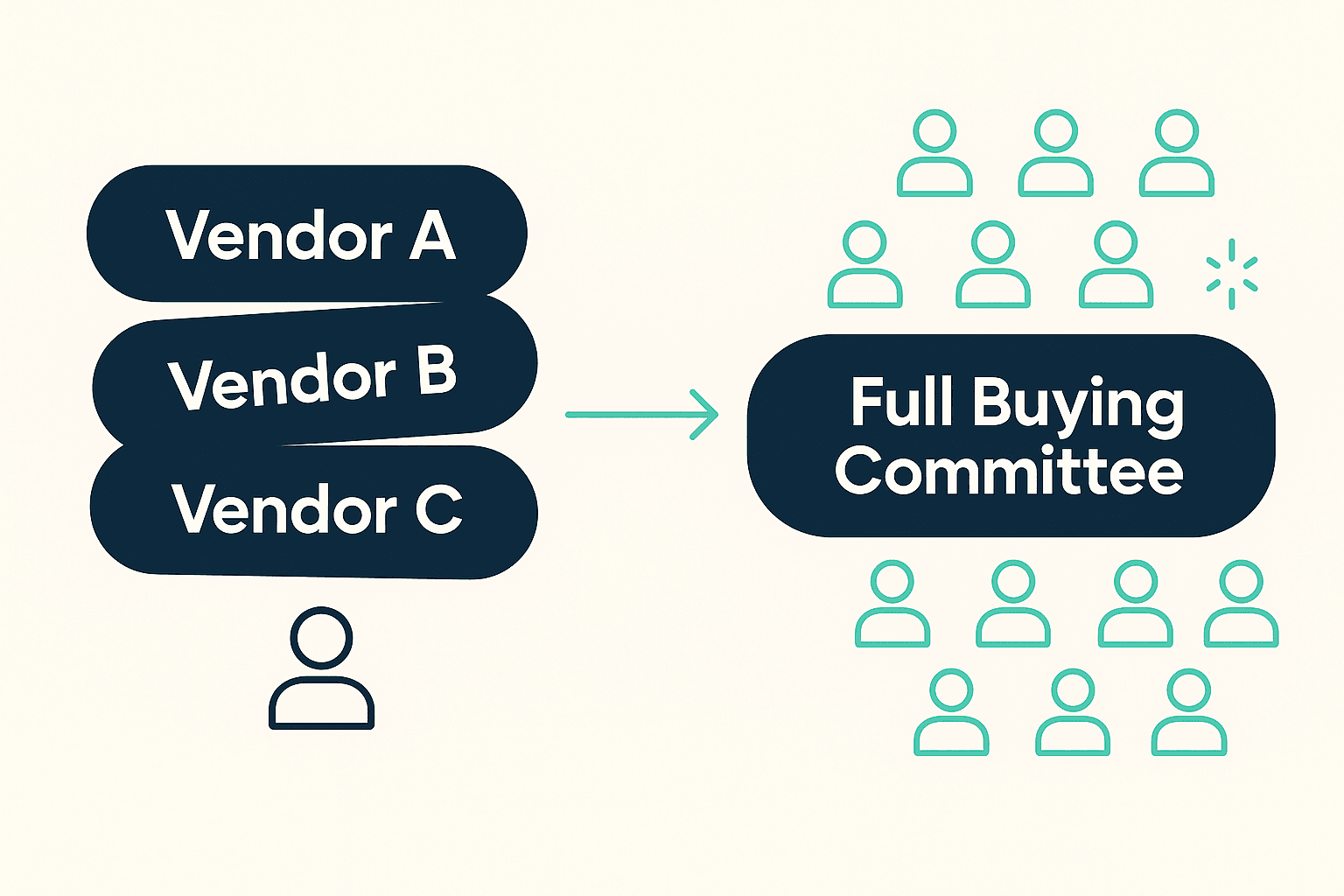
A deal today has 8 to 13 people quietly deciding whether to buy, up from about 5 in 2015. Your intent feed still only hands you one name. That mismatch, not a lack of data, is why three reps from three competing companies keep landing in the same inbox the same week while the other 7 to 12 decision-makers never hear from anyone.
Same Feed, Different Logo: Why "High Intent" Stopped Meaning First in Line
A 2026 DemandScience report found 87% of GTM teams now consider their intent data unreliable or overstated, and only about 1 in 4 flagged signals ever becomes a real opportunity. That tracks with what's actually happening underneath the dashboards: a handful of co-op and bid-stream providers resell the same raw behavior to every vendor who subscribes, so "this account is in-market" shows up on four different reps' task lists at once.
Twelfth CEO Steve Armenti has made a version of this point in interviews: when a handful of competing sales teams are all working from the identical surge list, the only thing they're collectively doing is driving up how hard it is to get that one buyer's attention, not winning anything. Once the feed is common knowledge, speed stops being an edge. The rep who hits send first on a templated "saw you're hiring" note isn't ahead of anyone, they're just the fourth email that week.
The habits that made sense before everyone had the same data
- Treating any single signal as a green light, even though a shared feed is a commodity by definition.
- Racing to be first instead of being different, when three other reps are just as fast.
- Messaging only the one name the feed surfaced and ignoring the other decision-makers at the account.
- Writing outreach generic enough to apply to any account on the list, which reads as generic to the recipient too.
What changes once you stop treating every signal equally
- Each account gets a score built from how hard-to-see its combination of signals actually is, not just whether something pinged.
- A 3-signal minimum from independent sources sets a bar a single feed cannot clear on its own.
- Outreach fans out to the 8 to 13 people actually involved, not the one person a tracking pixel happened to catch.
- The first line of the email names something specific to that company, something no shared feed could have produced.
The Fix Isn't Another Intent Feed. It's a Different Scorecard.
Buying a second or third intent tool just adds another subscriber to the same resold data. What actually separates you from the other three reps chasing the account is how you score what you already have, how many independent signals you require before acting, and how many of the committee you actually reach.
- Look at your current scoring model: does a feed four competitors can also buy carry the same weight as something only your team can observe?
- Estimate how many other vendors realistically have access to each signal source you use; that number becomes a discount, not a bonus.
- Pull company context and verified contacts in the same pass that surfaces the signal, so the account is ready to work the moment it qualifies.
How to Score a Signal by How Rare It Is
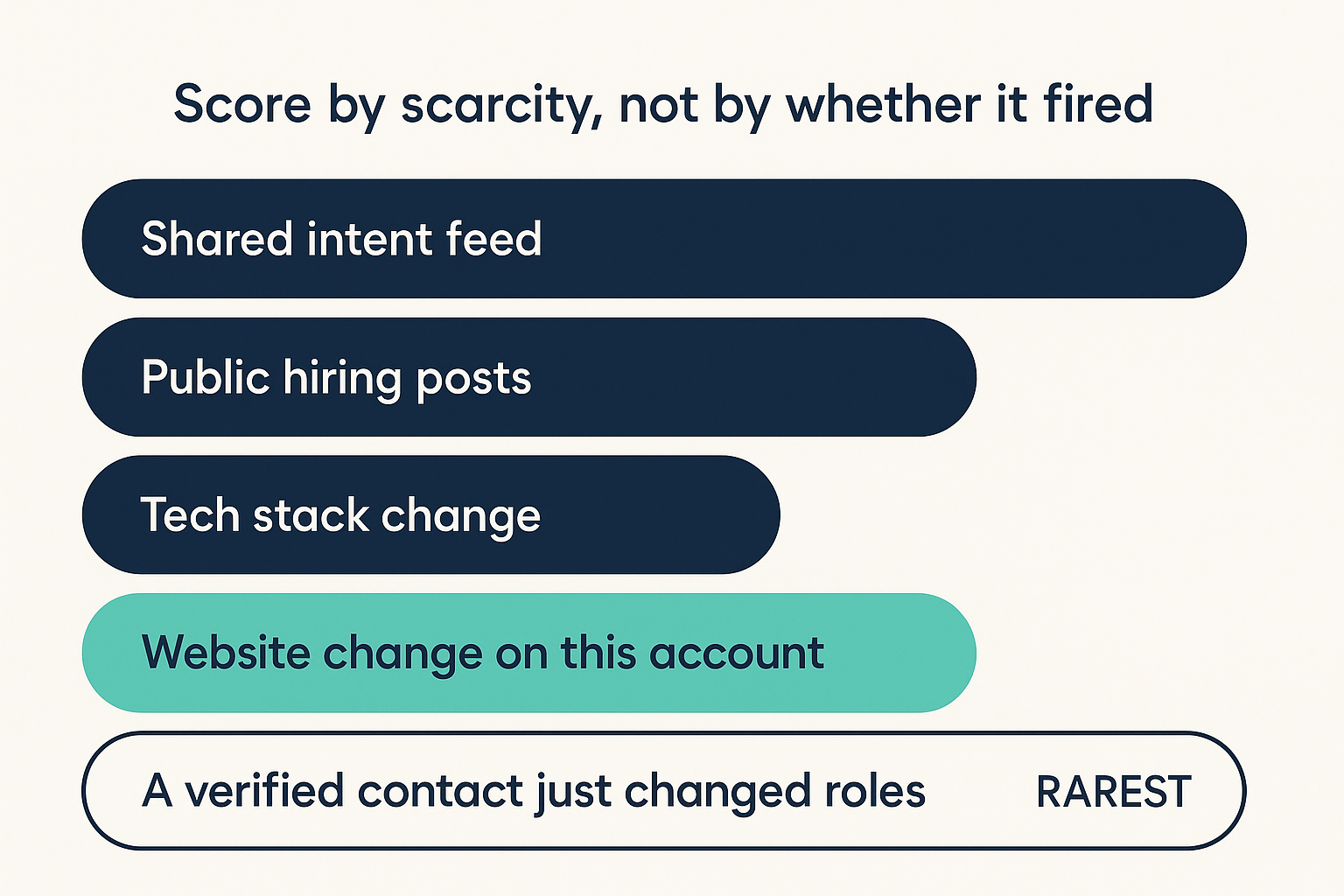
A signal's score should shrink as more vendors get access to it. A spike from a shared bid-stream feed is visible to every subscriber the moment it fires; a change on a company's own website that only your workflow detected isn't resold anywhere.
A simple rarity scale to start from
| Signal type | Roughly how many vendors can see it | Suggested weight | Where it usually comes from |
|---|---|---|---|
| A verified contact just changed roles at the account | 1 | 1.0x | Contact and role-change monitoring |
| A page or product change specific to this account's site | 1 | 1.0x | Website-change tracking |
| A new tool shows up in the company's stack | 1-2 | 0.8x | Tech-stack detection |
| A hiring surge on public job boards | 3-5 | 0.4x | Public job postings |
| A funding announcement | 5+ | 0.2x | Press release |
| An intent spike from a shared bid-stream or co-op feed | 4-6+ | 0.2x | Resold intent data |
Turning the scale into a rule
- Multiply each signal's strength by its rarity weight, then add them up across everything present on the account.
- Set a minimum total score before an account is allowed into active outreach, rather than a minimum number of signals.
- Revisit the weights every few weeks. A source that was rare last quarter gets common the moment three more vendors add it.
The Rule of Three: Don't Call an Account Qualified on One Signal
Require three signal types from sources that don't share a data provider before an account moves into active outreach. One signal could be a coincidence any competitor on the same feed could stumble into. Three unrelated signals landing on the same account at the same time is a pattern a single-feed competitor has no way to spot.
What counts as genuinely independent
- Two pings from the same resold co-op are one signal wearing two labels, not two separate signals.
- Pair something public (funding, hiring) with something account-specific (a site or stack change) and something personal (a contact's role just changed).
- Three signals from three different providers beat five signals that all trace back to one.
The objection this answers
"We already pay for an intent tool" isn't a reason to skip this. Stacking doesn't mean buying a second feed. It means layering the company and contact context you likely already have access to on top of the signal you're already paying for, and scoring the combination in one pass instead of three.
The Committee the Feed Never Mentioned
Gartner-tracked research puts a typical B2B buying group at 8 to 13 people today, roughly double the 5.4 from 2015. An intent feed names exactly one of them, and only because that's whose cookie or form fill its tracking pixel happened to catch, not because that person signs the check.
One contact versus the whole room
| Chasing the one named contact | Reaching the full committee | |
|---|---|---|
| Chance you reach the budget owner | Rarely, by luck | Built in from the start |
| What happens if that one person goes quiet | The deal stalls with no backup | Other live conversations keep it moving |
| How crowded their inbox already is | 3-4 vendors hitting the same person | Spread naturally across 8-13 people |
| Edge over competitors on the same feed | None, everyone sees the same name | Coverage most competitors never bother building |
Map the Room in the Same Step That Qualifies the Account
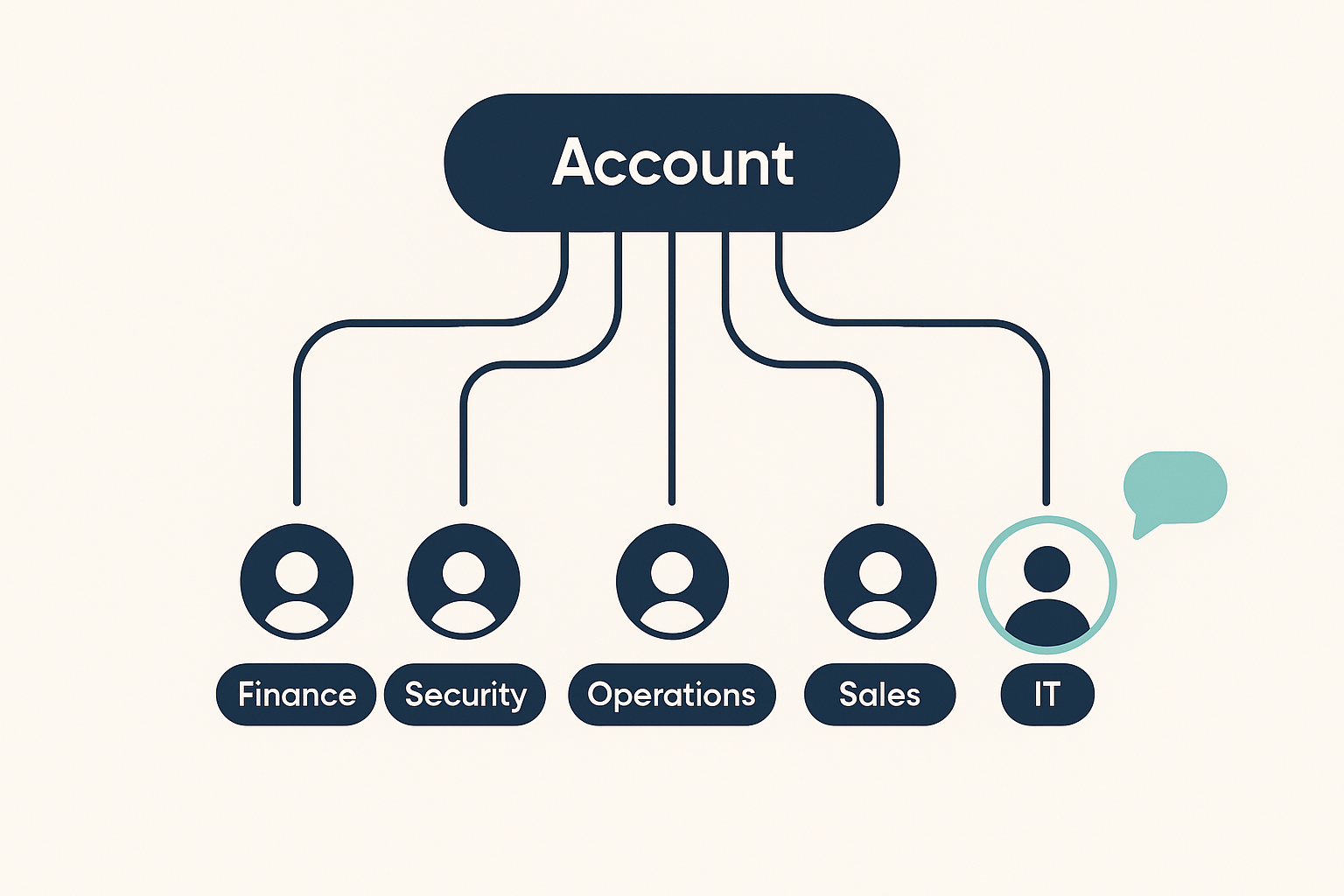
Pull the people across the functions a deal this size actually touches, budget, technical evaluation, day-to-day use, procurement, security, in the same pass that confirms the account is worth working, then reach all of them within a short window instead of trickling outreach out over weeks.
A simple mapping sequence
- Start from the account the signal stack just qualified, not from the one name the feed gave you.
- Pull people by function and seniority band, since job titles vary wildly between a 50-person company and a 5,000-person one.
- Note anything happening to each person individually, like a recent promotion or a new hire under them, as a smaller, person-level signal.
- Send a first message to every stakeholder within the same 48 hours rather than staggering it over the following month.
Write the First Line Like You Actually Looked at Their Company
"Noticed you're hiring" could be about any of a thousand companies on a list. "Your ops team just added a second tool that does roughly what ours does" could only be about this one. That difference, not cleverer copy, is what account-specific context means.
Three habits for a first message that lands
- Open with the specific thing you noticed about their company, not with your product's name.
- Speak to the function this particular person owns, based on their actual role, not a guessed title.
- End with a small, specific ask tied to what you just mentioned, not a generic "worth a quick call?"
A RevOps lead at a mid-market SaaS company put it this way, paraphrased from a product review: pulling company details, tech stack context, and verified contacts from one place instead of stitching together several tools is the part that actually saved them time, not any single data point.
Just Ask Vibe Prospecting for the Whole Picture
Instead of running a signal tool, a company-lookup tool, and a contact finder separately, you can just ask in plain language, inside ChatGPT, Claude, or the Vibe Prospecting web app, and get the signal, the company context, and the right people back in one reply.
Everything lives in one conversation
- Company lookups across 150M+ profiles and people lookups across 800M+ professionals, in the same chat.
- 18 categories of buying signals, over 80 specific types, so the rarity scoring above actually has enough raw material to work with.
- 97.8%+ accuracy matching a signal, a contact, and the right company record together, so your committee map doesn't end up attached to the wrong account.
- Company size, industry, recent hiring, and the tools a company runs all come back alongside the signal instead of needing a separate lookup.
It doesn't choke on a full territory
- Up to 1,000 companies per request, which is enough to pull full committees for a few hundred accounts in one sitting.
- Most chat-based data tools stall out somewhere between 20 and 100 records before the conversation itself gets too heavy; this is built to go further.
- Ask for a small preview and a cost estimate before anything is pulled in full, so testing a new scoring idea doesn't spend credits you didn't mean to spend.
The pricing actually matches how this workflow works
- Free to start, no sales call, and every request draws from one shared pool of credits.
- There's no separate charge per data type, so asking for signals, company context, and contacts on the same account doesn't multiply your spend the way three separate tools would.
- Teams moving from a single-feed setup to this kind of multi-part lookup have seen agent-workload spend drop 30-60%, simply because nothing is taxed per endpoint.
Power users who prefer working from Claude Code can wire it in directly instead of going through chat:

