


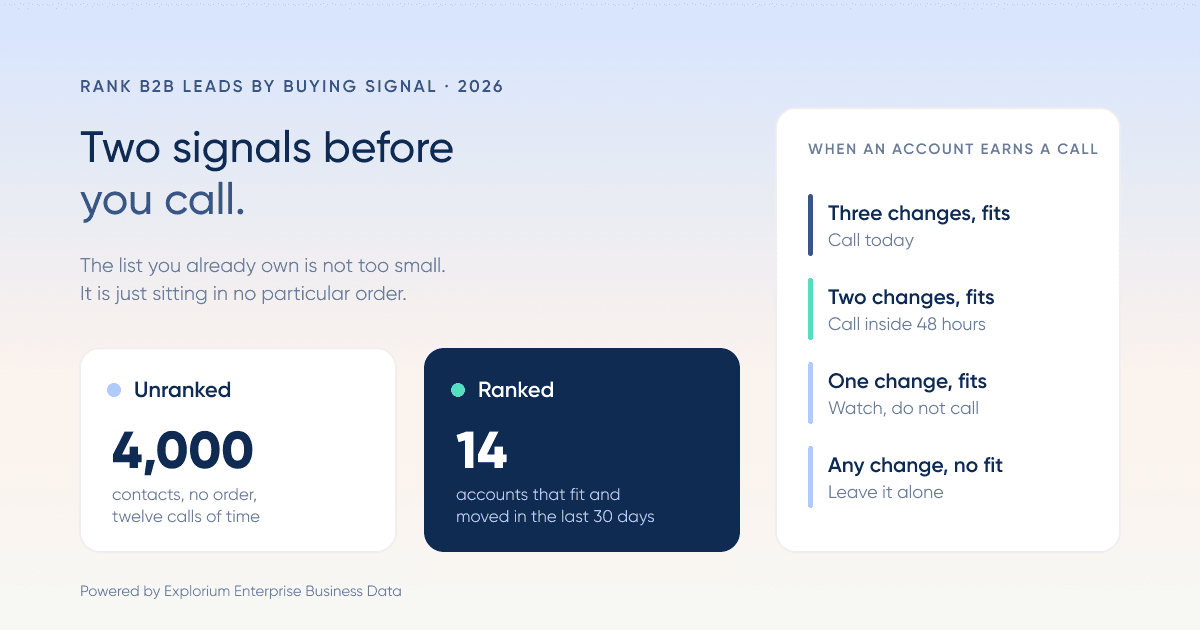
There are 4,000 contacts sitting in your CRM and Monday gives you time for about twelve calls. The useful question is not how to get to 6,000 contacts. It is which twelve. That is all it takes to rank B2B leads by buying signal: keep every name you already paid for, then let the last thirty days of company activity decide the order. Ranking, not volume, is what prioritizes a list, and a founder or an AE can finish the whole pass in a chat window before the coffee goes cold.
The List Is Not Too Small. It Is Unranked.
Adding names measures how far you can reach, and reach was never the constraint: at any given moment only a thin slice of any list is actually shopping, and nothing in the file tells you which slice. So a rep opens the spreadsheet, scrolls, picks the logos they recognise, and calls those. That is the ranking method most teams are running today whether or not anyone admits it.
What more names actually buys you
- More rows to guess through on a Monday, with the guessing still done by hand.
- A larger share of records already gone bad, since people move roles and companies get bought while the file sits still.
- Cold sends into an unsorted file land in the 1% to 5% reply band, where outreach tied to something that just happened at the company runs 15% to 25%, per SalesMotion's prospecting benchmarks.
- No account view at all, which matters when the decision is made by a group rather than the one person you emailed.
What an order buys you instead
- The rep opens a queue instead of a spreadsheet, and the top of it is defensible.
- Reach out within about two days of something changing and the same account is roughly four times likelier to convert than the one you get to in three weeks.
- Two or three changes stacking on the same company push reply rates into the 25% to 40% range.
- The base list gets reused month after month rather than repurchased, because the ranking is the perishable part, not the names.
"I'm personally a huge fan of sending 100 very well-targeted emails to people with a real reason to buy, over sending 10,000 emails to people with zero intent." Practitioner in r/LeadGeneration, August 2026
What Counts as a Real Buying Signal, and What Only Looks Like One
A buying signal is something that actually happened at a company, on a date you can point to, that tends to show up before money gets spent. Explorium tracks 18 categories of recent company activity across more than 80 types, and five of them do most of the work for outbound.
Five changes worth ranking on
- Someone new took the job. A fresh VP or C-level arrival tends to re-open vendor questions in their first quarter, which is the single cleanest reason to call this month rather than next.
- Money landed. A funding round is usually followed by a year or more of heavier spending.
- A tool went in or came out of the stack. Either direction says a team is rethinking how the work gets done.
- They are hiring into the problem you solve. Open roles that name your category are a plan someone already got approved.
- The website moved. A pricing page or a careers page changing is planning made public.
Three things that only look like signals
- A single post or press mention with nothing underneath it about who the company is.
- A traffic spike with no page behind it worth reading, which is usually a blog post doing numbers.
- Awards, rebrands, and anniversary news, where nothing suggests money is moving.
Who Could Buy, Against Who Is Buying Now
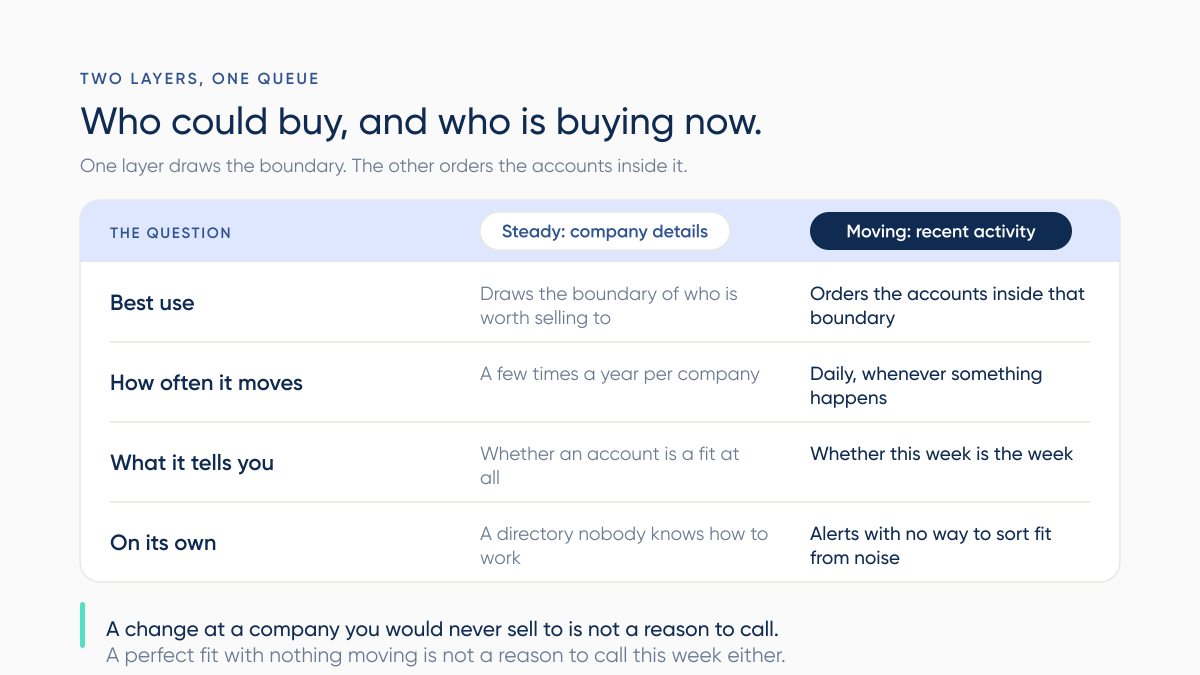
Company details tell you whether an account belongs in your world at all; recent activity tells you whether this is the week. One layer barely moves, the other moves daily, and using either one alone is where most ranking attempts fall over.
| The question | Steady layer: company details | Moving layer: recent activity |
|---|---|---|
| Best use | Draws the boundary of who is worth selling to | Orders the accounts inside that boundary |
| How often it moves | A few times a year per company | Daily, whenever something happens |
| What it tells you | Whether the account is a fit at all | Whether this week is the week |
| On its own | A directory nobody knows how to work | Alerts with no way to sort fit from noise |
Why neither half works alone
- A change at a company you would never sell to is a distraction wearing a suit.
- A perfect fit with nothing moving is a good account and a bad Monday.
- Both layers reach Vibe Prospecting through one connection, so the same company means the same company in both, and you are not matching two vendors' records by hand.
The Two-Signal Rule for Earning a Call
Ask for two separate changes inside a thirty-day window on a company that already fits before anyone dials. One change on its own is thin evidence, and a rule that fires on one produces a queue nobody trusts by week three.
| What you see in 30 days | Fits your market | What to do with it |
|---|---|---|
| Three or more changes | Yes | Call today |
| Two changes | Yes | Call inside 48 hours |
| One change | Yes | Watch it, do not call yet |
| Any number of changes | No | Leave it alone |
Why one change is a coincidence
A single open role can mean the team is growing or that somebody quit and is being replaced. Read next to headcount, funding, and what else moved that month, the same posting turns into a readable fact. Interpretation beats collection here: more inputs do not create pipeline, better reading of the inputs you already have does.
Monday Morning: What a Ranked Queue Looks Like
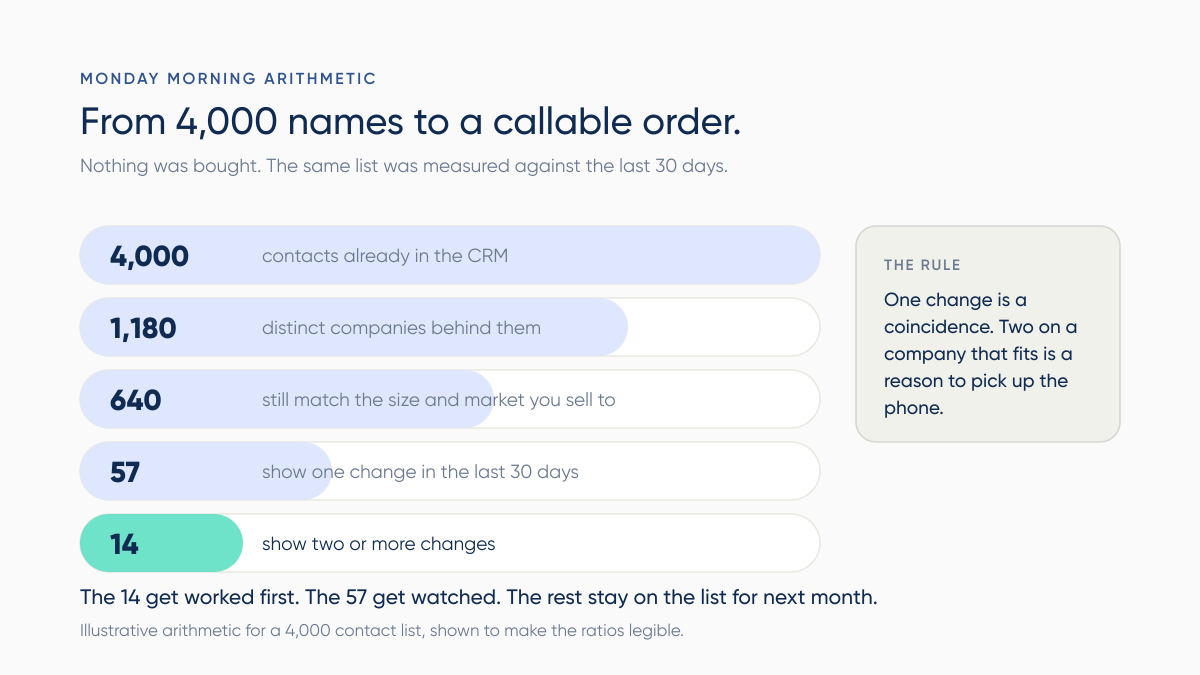
Run the rule over a real file and the numbers collapse fast, which is the point. Take that 4,000-contact CRM export as an example and follow it down.
The arithmetic of a 4,000-name file
- 4,000 contacts turn out to sit at about 1,180 distinct companies once you group them.
- 640 of those still match the size and market you actually sell to.
- 57 show one change in the last thirty days. Fourteen show two or more.
- Nothing was purchased to get there. The same file was measured against the last month.
What the rep does with fourteen accounts
- Fourteen is a week of real work, not a queue that needs triaging before it can be worked.
- The reason each account ranked becomes the first line of the message, so the opener writes itself.
- The 57 sit in a watch list and get promoted the moment a second change lands.
- Everything else stays exactly where it is and gets rescored next month, free of charge.
Sitting on a list nobody wants to call? Rank it in Vibe Prospecting for free
Ranking the Whole List Inside a Chat
Both layers arrive through one conversation with Vibe Prospecting in Claude or ChatGPT, or in the web app, and you see 5 sample records plus the credit cost before anything gets charged. No pipeline to stand up, no fields to map, no contract before the first answer.
One connection for both layers
- 150M+ company profiles and 800M+ professional profiles drawn from 50+ premium sources, all on one path.
- Company details, hiring, funding, tools in use, leadership moves, and website changes come back against the same companies, so the fit check and the ranking never disagree about who is who.
- 97.8%+ company match accuracy on the steady layer, which is what keeps the ranking stable when you rerun it next month.
Enough scale to rank, not sample
- Up to 1,000 companies per call, handled server-side, so a 1,180-company file is two passes rather than an afternoon.
- Tools that pull every record into the chat window stall somewhere between 20 and 100 records, which cannot rank a list of any size.
- Ranking a full file overnight and reading the top band in the morning is an ordinary Tuesday, not an engineering project.
Affordable enough to rerun every month
- A free account, minutes to the first answer, no sales call standing in the way.
- One shared credit pool across every kind of lookup, so nothing sits stranded in an allocation you are not using.
- Ask, look at the preview and the cost, then decide whether to pull the rest. A rerun that finds nothing costs almost nothing.

