

Open your billing dashboard and count every line item that answers some version of "tell me more about this account." Most teams stop counting around six, because the seventh and eighth start blurring into the first five. A quick GTM tool stack audit almost always turns up the same pattern: three or four subscriptions quietly doing the identical job of pulling in company details, sold under three or four different names. Here is a version of that audit you can run yourself in a chat window this afternoon, without opening a single new contract.
The Real Reason Your Tool Stack Keeps Growing
Nobody sits down and plans a bloated stack on purpose. It grows one urgent Tuesday at a time, each new tool solving that week's problem without anyone checking what else already half-solved it. A rep needs company details for a call in an hour, someone finds a tool with a free trial, and six months later that trial is a line item nobody remembers approving.
How a Lean Stack Turns Into a Tangled One
- Each new signup adds its own login, its own renewal date, and its own version of "what does this account look like."
- Two tools built to answer the same question drift apart the moment their refresh schedules don't match.
- Whoever added the tool moves teams, and the renewal just keeps auto-approving itself.
- Stack a chat-based assistant on top of that mess and it repeats whatever disagreement was already baked in, just faster.
Run This 20-Minute Chat Audit Before You Buy Anything Else
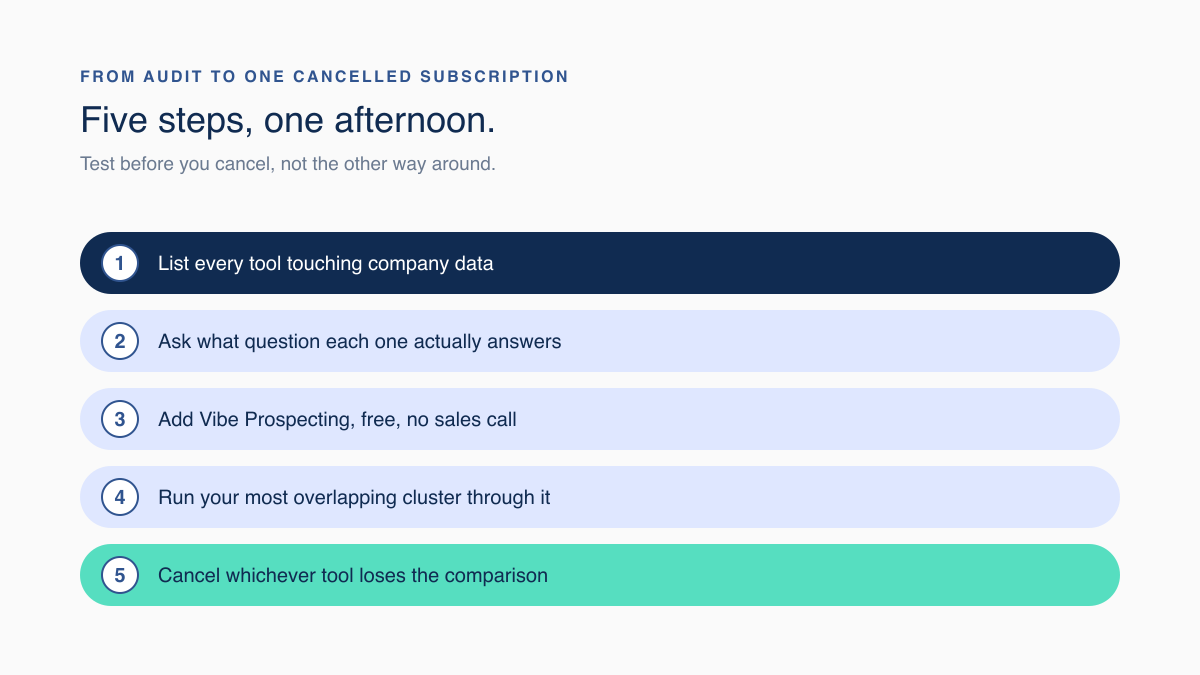
Skip the spreadsheet. Open a chat window, list every tool touching company or contact details, and ask what specific question each one is actually answering. The moment two answers look the same, you have found your first cut.
The Four Questions That Do the Sorting
- What question does this tool answer? Not its category on the invoice, the actual thing a rep asks it.
- Who else on the list answers that same question? If the answer is "nobody," it earns its keep.
- How often does it actually get opened? A tool nobody logs into is a cut regardless of what it does.
- What would break if it disappeared tomorrow? Workflow tools (your sequencer, your CRM) usually break something real. Data lookup tools rarely do, because another one already covers it.
What Usually Falls Out of the Sort
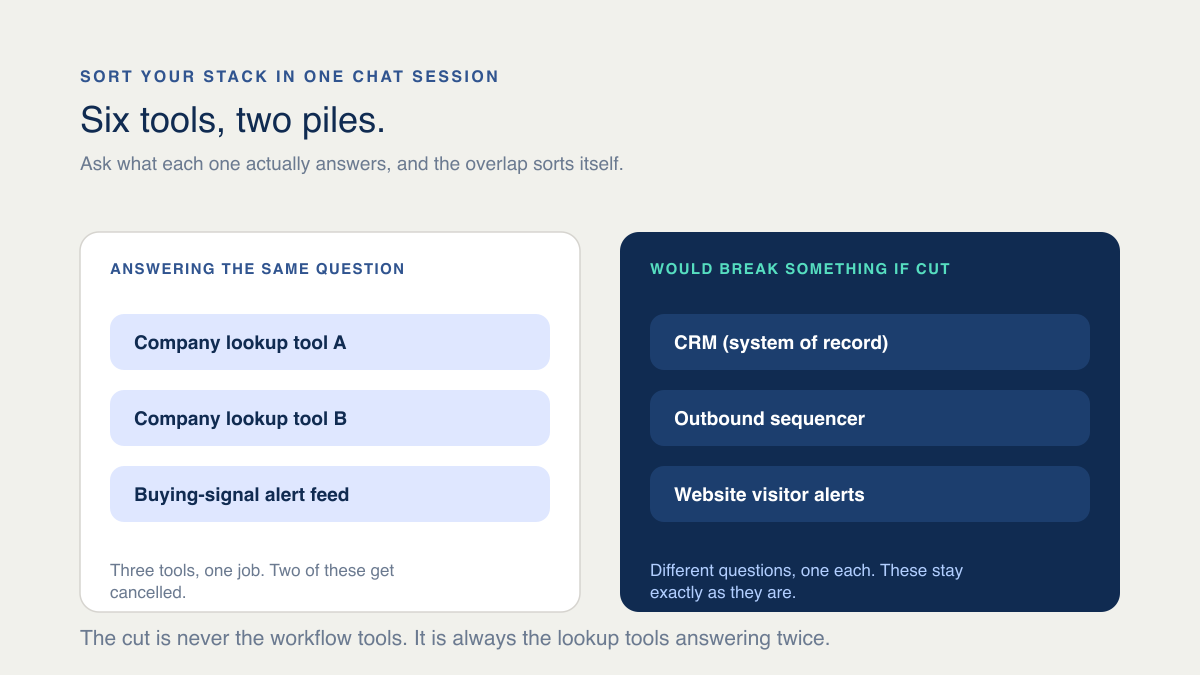
- Company and contact lookups almost always cluster into one group, because two or three tools answer the identical question.
- Buying-signal and intent alerts join that same cluster more often than teams expect.
- A website visitor tool frequently turns out to be re-checking company details a lookup tool already owns.
- Your CRM and your outreach sequencer almost never cluster with anything. They are workflow, not lookup, and this audit is not about them.
The One Category Almost Everyone Can Cut Today
Company and contact lookups are the safest place to start, because trimming them changes what feeds your stack, not how your team works day to day. Nobody has to relearn a sequence, log into a new sequencer, or update a playbook that took months to get right.
Why Lookups Are the Easy Cut
- A lookup tool is an input, not a workflow, so swapping the source behind it is invisible to the rep using it.
- One source that gets company and contact details right ends the quiet argument between two tools that never agree on the same account.
- Reps stop double-checking a number they already stopped trusting months ago.
What Stays Put, and Why
- Your sequencer holds a playbook your team spent months tuning. That is not a data problem to solve here.
- Your CRM is the system everything else reports into. Swapping it is a migration project, not an afternoon audit.
- This checklist keeps the tools your team already trusts and only touches the ones quietly doing the same job twice.
Already running your own version of this audit? Add Vibe Prospecting to Claude or ChatGPT and check one overlapping tool against it before you cancel anything.
What Three Tools Doing One Job Actually Costs You
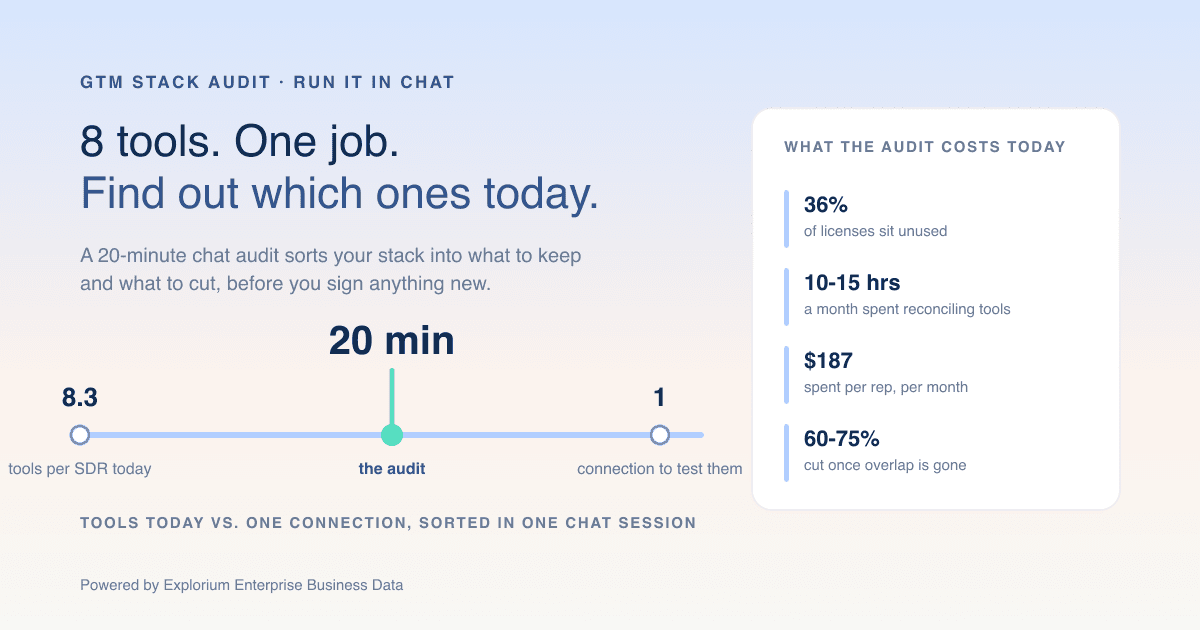
Roughly a third of the software licenses on a typical GTM team go unused in a given month, and untangling mismatched data between overlapping tools eats another 10 to 15 hours of someone's month. None of that shows up as a single line item, which is exactly why it survives the annual spending review year after year.
Where the Real Spend Is Hiding
- 36% of licenses across a typical stack sit unused once the person who requested them moves on.
- 10 to 15 hours a month go into reconciling two tools that disagree about the same account.
- $187 per rep per month is roughly what an average GTM team spends across an average of 8.3 tools per seat, a number that keeps climbing every year nobody audits it.
- 60 to 75% is the range teams report saving on the data and lookup layer specifically once three or four overlapping tools collapse into one.
A Founder Tries the Audit on a Tuesday Afternoon
A five-person startup runs three separate tools to keep tabs on its target accounts: one for company details, one for a funding-and-hiring alert feed, and one bolted onto its website to flag visitors. The founder opens a chat, lists all three, and asks each of the four sorting questions above.
Two of the three turn out to be answering the identical question, just refreshed on different days of the week. The visitor tool is the one that survives, because it is the only one watching a signal none of the others touch. The founder cancels one subscription that afternoon and puts that money toward ad spend instead, without a single rep noticing anything changed in how they work.
The Trust Problem Hiding Behind the Invoice
The bigger cost of a tangled stack isn't the invoice, it's that nobody trusts the number any single tool hands them, so every decision needs a second meeting to confirm it. One founder building against what he calls the "context gap" put it plainly: another AI layer stacked on top of an already crowded set of tools just adds another engine burning fuel, not a fix for the sprawl underneath it.
Costs That Never Make the Invoice
- Meetings that exist only to reconcile two numbers that were supposed to describe the same account.
- Hours spent maintaining a data pipe instead of building the next campaign.
- Forecasts nobody fully trusts, because the pipeline data behind them disagrees with itself.
- Any AI agent layered on top inherits every one of these disagreements and repeats them faster.
A different builder in the same space described it just as directly: the details a team needs are usually scattered across systems, and often stale or wrong by the time anyone reads them.
How Vibe Prospecting Replaces the Data Layer, Not Your Whole Stack
Vibe Prospecting is a connection you add once to Claude or ChatGPT that answers the company-and-contact-lookup question your overlapping tools were fighting over, so the audit above ends in an actual swap instead of just a spreadsheet. Powered by Explorium Enterprise Business Data.
One Connection Covering the Cluster You Just Found
- Company search across 150M+ profiles and contact details for 800M+ people, pulled together from 50+ premium sources behind one chat connection.
- Recent company activity across 18 categories, so a funding round or a leadership change shows up without a separate signal tool watching for it.
- Company matching at 97.8% and above, a number you can hold your current overlapping tools against instead of guessing which one is right.
Built to Carry the Whole List, Not a Sample
- Up to 1,000 records in a single call, enough to re-check an entire target list in one pass instead of testing ten and hoping.
- A free account with one shared credit pool across every kind of lookup, so a pilot costs nothing before a single subscription gets cancelled.
- No sales call required to start; most teams add it straight from the Claude or ChatGPT connectors directory and run their first check the same day.
Teams already working inside Claude Code can wire it in through the Vibe Prospecting Plugin instead of a browser tab, using a config close to the one below.