Claude GTM skills are free to fork, so a defensible GTM agent stack rests on the data underneath: one connection, 150M+ companies, 97.8%+ match accuracy.
Vibe Prospecting team9 min readAugust 10, 2026
TL;DR
Claude GTM skill libraries are open and free to fork, so the skills you installed this week are not what separates your results from your closest competitor's.
Three things still vary between two teams running identical skills: how much they can find, whether the match is the right company, and how much recent company activity they can see.
One Vibe Prospecting connection covers 150M+ company profiles, 800M+ people profiles, and 18 buying-signal categories, instead of a separate tool per layer.
It holds up past a demo: up to 1,000 records per call at 100 requests per second, well past the 20-100 record ceiling most in-chat enrichment connections hit.
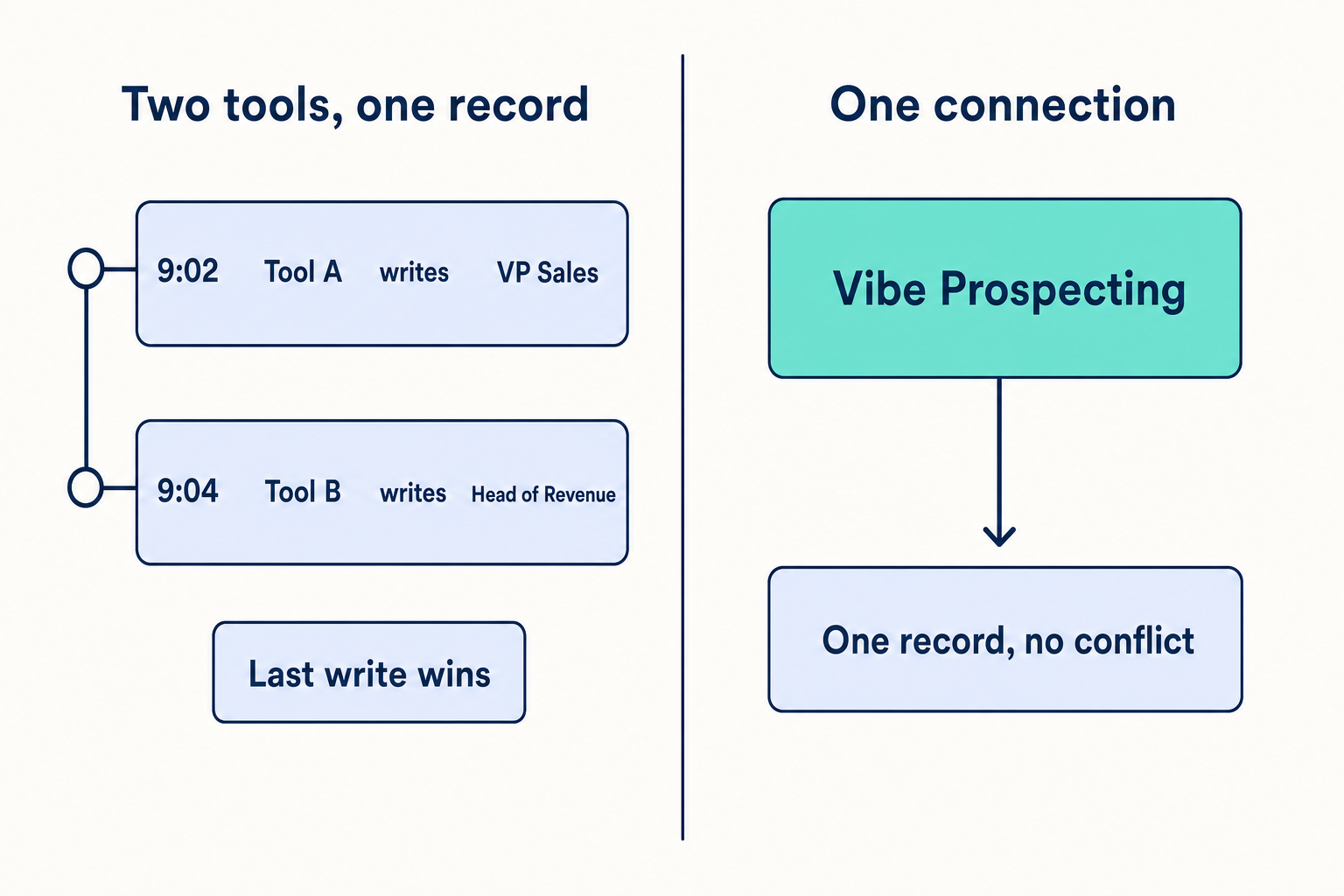
Two tools that can both write the same contact field will eventually disagree, and nobody writes the tie-break rule until a field gets overwritten.
Free account, one shared credit pool that cuts agent-workload spend 30-60%, and a 5-record preview with a cost estimate before any credits are charged.
Your competitor installed the same skill library you did. Same public repo, same prompts, same weekend. So the useful question for 2026 is not which skills to add next, it is what a defensible GTM agent stack is actually built on once the skill layer is free for anyone to fork. The short answer is the data those skills read from, because that is the one part of the stack nobody gets by cloning a repo.
The Week Copying Your Skill Library Became Trivial
Anthropic published its Agent Skills standard as an open spec in October 2025, which makes a GTM skill library a set of text files any team can publish, clone, or fork in an afternoon. That is not a forecast. Free, open-source GTM skill packs and ready-to-deploy GTM agents shipped in the same week this whole conversation started.
"friday launch because why not! /gtmskills - open source skills for gtm - pre-built plays for gtm teams, everything from account research to lead scoring. gtm-agent - open source agent for gtm - deploy eve agent on vercel with shared gtm context repo, gtm team uses it in Slack." - eliasstravik, X
What a Skill Actually Is
A skill is a set of instructions your assistant follows for one job, like researching an account or scoring a lead.
MCP, the connection standard Anthropic published in November 2024, is what lets that skill read live company information instead of a stale spreadsheet.
The instructions are copyable. What sits on the far end of the connection is not.
Three Layers, and Only One of Them Is Really Yours
Every GTM agent setup has three layers: the skills, the routing logic that picks which skill runs when, and the company, contact, and activity information every skill call reads. Two of those three are things a competitor can rebuild after reading one blog post.
The Two Layers Anyone Can Take
The skill layer, now an open published standard with public libraries sitting behind it.
The routing layer, usually a thin wrapper a competent team rebuilds in a week once they have seen it described.
Why the Data Layer Does Not Commoditize
A skill library is a handful of text files. A layer holding 150M+ company profiles and 800M+ people profiles is not something a fork reproduces.
Nobody publishes their coverage or their match rates to GitHub, because those are the product rather than the instructions for using it.
Why Identical Skills Still Produce Different Pipelines
Two teams can run the same account-research skill and finish the week with different pipelines, because the skill decides what to ask for and the layer underneath decides what comes back. Tim Hillison, a GTM operator who has built this plumbing at Visa, Microsoft, and PayPal, put it plainly in a widely shared post this month: "when everyone uses the same models and the same skills, businesses start to look the same."
The Three Numbers That Diverge
Match accuracy. Whether the company that came back is the company you meant. 97.8%+ is something you can hold a provider to. "Our matching is good" is not.
Recent company activity. How many independent kinds of activity feed a scoring decision. One connection can carry 18 categories and 80+ signal types, from funding rounds to hiring pushes.
Coverage. How much is reachable at all, which in the Vibe Prospecting case means 150M+ company profiles and 800M+ people profiles pulled together from 50+ premium sources.
The 9:02 Problem: Two Tools, One Contact Field
A stitched-together setup rarely fails during setup. It fails at 9:04 in the morning, when the second of two tools writes over a contact field the first one already filled and nobody ever decided which of them should win. This is the failure practitioners keep describing out loud, not a thought experiment.
"The moment two of them can touch the same record you need a rule about which one wins, and nobody writes that rule until something overwrites a field it should have left alone." - itsalexvacca, X
Text
# Same contact, two writers, no tie-break rule
09:02  signal tool      ->  contact.title = "VP Sales"
09:04  research tool    ->  contact.title = "Head of Revenue"
09:05  your agent reads ->  whichever one wrote last

# One connection, one writer, nothing to reconcile
09:02  vibe prospecting ->  contact.title = "VP Sales"
What the Stitched-Together Pattern Really Costs
Every tool bills its own seats, so your real number is the sum of three price sheets rather than the one you compared before buying.
Every tool applies its own matching, so a single company can end up as two records with nothing in place to reconcile them.
Every tool adds a key, a rate limit, and one more thing that can quietly break at two in the morning.
How Many Tools Should Sit Under One Agent?
As few as you can manage while still finding everyone you need, because each extra tool adds a seat charge and one more pair of tools that can disagree about the same record. Run your current setup down this list and see which column you are sitting in.
What to check
Stitched together
One connection
Records per run
20-100 before the chat runs out of room
Up to 1,000 per call at 100 requests per second
What you pay for
A seat charge per tool, stacked
One shared credit pool across every endpoint
Who wins a field conflict
Undefined, so the last writer wins by accident
No second writer to conflict with
Coverage
One narrow slice per vendor
150M+ companies and 800M+ people in one place
Time to first result
However long the slowest procurement takes
Minutes, starting from a free account
A Five-Minute Moat Audit
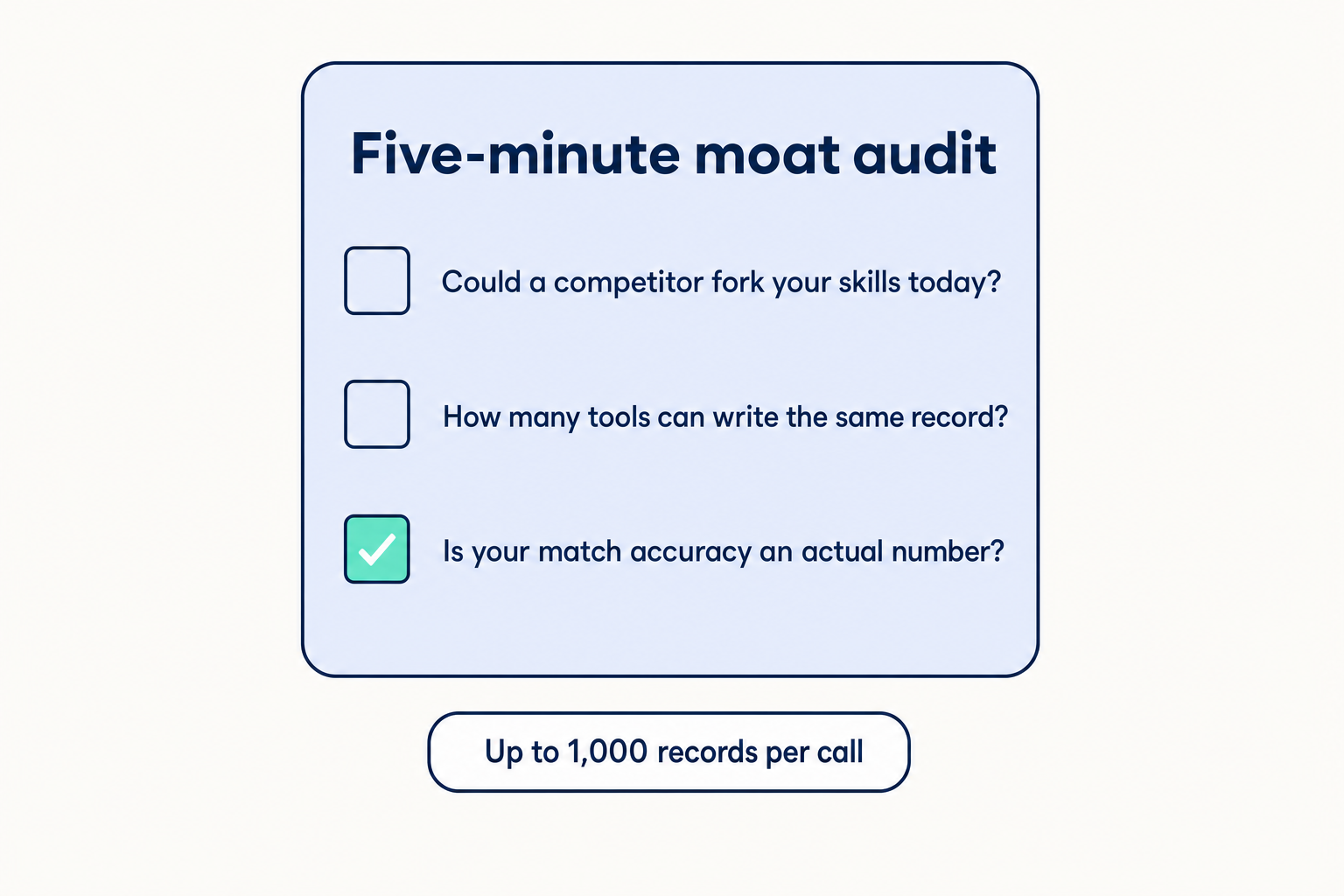
You do not need an architecture review to find out whether your setup is a commodity. Three questions will do it, and you can answer all three before your coffee goes cold.
Question 1: Could a Competitor Fork It Today?
Open your skill library and count how many of those skills also exist in a public repo. If the honest answer is most of them, that layer is not what separates your results from anyone else's, and no amount of prompt polishing will change it.
Question 2: How Many Tools Can Write the Same Record?
Two is already one too many without a written rule. If you cannot say the rule out loud, you do not have one, and the 9:04 overwrite is only a matter of time.
Question 3: Is Your Match Accuracy an Actual Number?
Ask what share of your enrichment calls resolve to the right company. If nobody in the room knows, that is the real state of your moat: unmeasured. A layer quoting 97.8%+ match accuracy and 99.999% uptime at least gives you something to hold it to.
What to Look For in the Layer Underneath
The layer worth building on has to survive a real batch rather than a demo, arrive as one connection rather than three, and let you find out for free whether it works on your own list. Vibe Prospecting is built around those three, in that order.
It Has to Survive a Real Batch
Up to 1,000 records per call, processed on the server rather than loaded into your chat, at 100 requests per second sustained.
Most other enrichment connections work inside the chat window, which caps a useful run near 20-100 prospects before the tokens run out.
97.8%+ company match accuracy and 99.999% uptime hold at that volume, not only on a ten-row test.
It Has to Be One Connection, Not Three
150M+ company profiles, 800M+ people profiles, and 50+ premium sources behind a single connection.
18 buying-signal categories, 80+ signal types, and three-tier intent data in the same place as the enrichment, so there is nothing to reconcile afterwards.
One-click setup from the Claude Connectors Directory or the ChatGPT Connectors Directory, powered by Explorium Enterprise Business Data.
You Have to Be Able to Try It for Free
A free account, no sales call, no seat charge, and no per-endpoint allocation to argue over.
Credits land in one shared pool across every endpoint, which cuts agent-workload spend 30-60% against per-tool or per-seat pricing.
Ask for a preview first and you get 5 representative records plus a cost estimate before a single credit is spent.
Still routing account research through three separate tools? Connect the data layer once and let the skills you already run read from it.
Turn It On in a Chat Window First
Add Vibe Prospecting from the Claude or ChatGPT connector store, ask for a preview against a list you actually care about, then point one skill you already trust at the new connection. If you work in Claude Code, install the plugin instead, from the Vibe Prospecting Plugin repo.
Claude Code
# Claude Code, from the official Anthropic plugin store
/plugin install vibe-prospecting@claude-plugins-official

# Claude Chat, Claude Cowork and ChatGPT
# add Vibe Prospecting from the connector store, no config file to edit
# install guides per host: github.com/explorium-ai/vibeprospecting-plugin
Step 1: Check the Connection Is Live
Claude Code
# confirm the vibeprospecting plugin loaded before you point a skill at it
/plugin

# then, in the same session, ask it to introduce itself
> which Vibe Prospecting tools can you call right now?
Step 2: Preview Before You Spend Anything
Text
Ask in chat:

  "Sample the SaaS companies with 51 to 200 employees that
   raised a round in the last 90 days, and tell me what the
   full list would cost before you build it."

  ->  5 representative records plus a cost estimate
  ->  no credits charged until you say go
Step 3: Run a Real Batch
Text
# once the sample looks right, run the real batch
for batch in chunks(target_accounts, size=1000):
    enrich(batch)     # up to 1,000 records per call, 100 requests/sec

# for contrast: an in-chat connection stalls near 20-100
# records before the context window fills up
Step 4: Point one skill you already trust, account research is the usual first pick, at the new connection and compare what it returns against last week's list.
Step 5: Retire the tools that were covering signal, research, and enrichment separately, and let the shared credit pool absorb what they used to charge you.
What This Looks Like for a Three-Person Sales Team
Picture three AEs sharing one workspace. They pulled their account-research skill out of the same public repo their two closest competitors did, so the prompts are word for word identical. What is not identical is what happens when somebody asks for every company in their category that added a sales leader last quarter with the right contact attached. One team gets 40 accounts out of a single vendor's narrow slice. The other gets the full set out of 150M+ company profiles, matched at 97.8%+, with the hiring activity already sitting on each row.
Same skill, same model, same sentence typed into the same box. The week ends differently because that sentence resolved against a different data layer. If you want to see how the available connections compare on exactly that, the top MCP servers for GTM agents lays out what each one actually covers.
The Short Version
Once the skill layer is free, a defensible GTM agent stack comes down to what those skills read from: one connection instead of three, real volume instead of a demo ceiling, and a price that does not climb with your seat count.
Layer
Ceiling
Can someone else copy it?
Skill layer
Not where the limit is
Yes, it is a published standard with public libraries
Routing layer
Not where the limit is
Mostly, once they have seen how it works
Data layer, three tools stitched together
20-100 records per run
Partly, and the overwrite problem comes along with it
Data layer, one Vibe Prospecting connection
Up to 1,000 records per call
Not without the same coverage and the same match accuracy
Whether you also need a person to own the routing layer is a separate decision, and the GTM engineer versus agent stack breakdown works through that one. The layer to sort out first is the one every skill you already run is quietly depending on.
Ready to stop stitching tools together? Add Vibe Prospecting (vibeprospecting.ai) and run one skill you already use against a five-record preview first.