Best MCP server for GTM agents in 2026: Vibe Prospecting handles 1,000 entities per call vs Apollo's 10-person cap. Apollo and Clay compared side by side.
Vibe Prospecting team8 min readJune 15, 2026
TL;DR
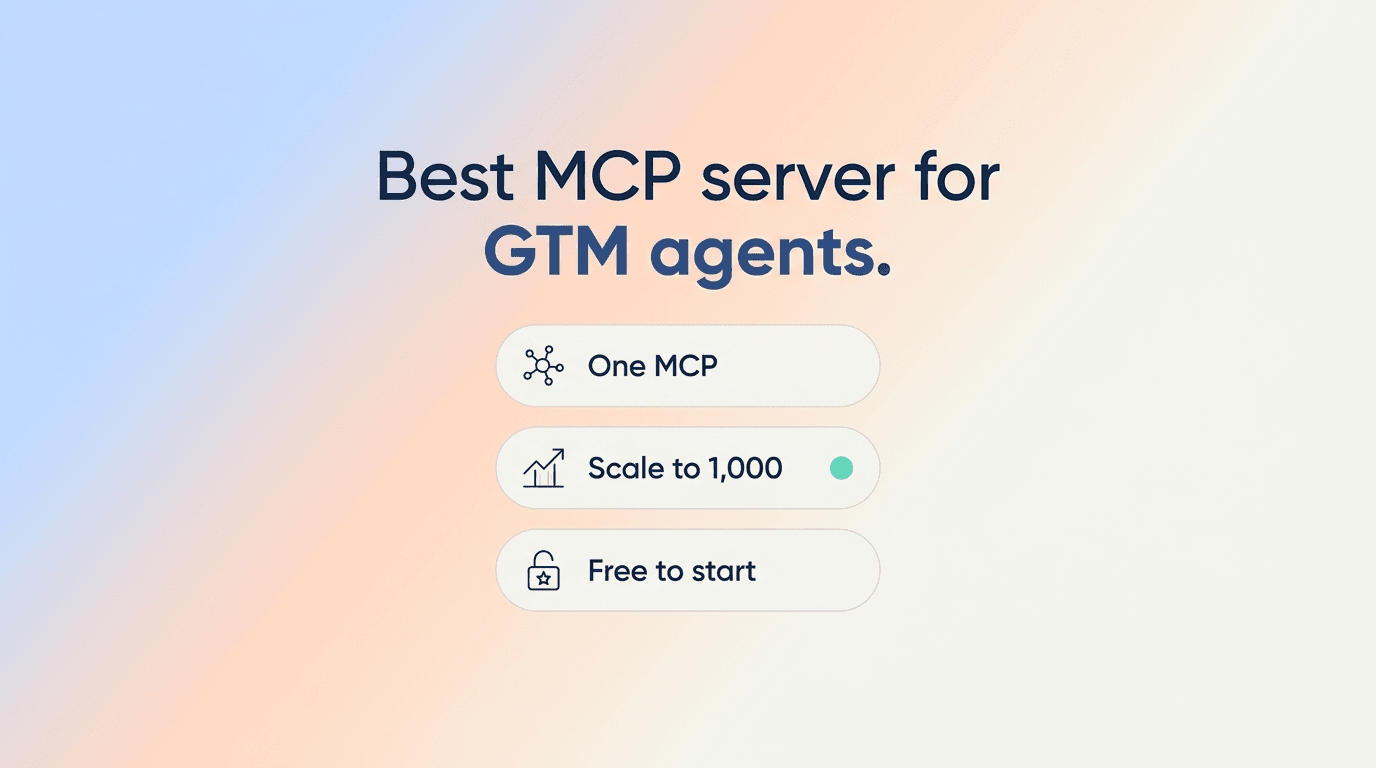
Pillar 1 - One MCP for every data need: Vibe Prospecting covers 150M+ companies, 800M+ professionals, 18 buying-signal categories, and 80+ signal types in a single connection - no second MCP required.
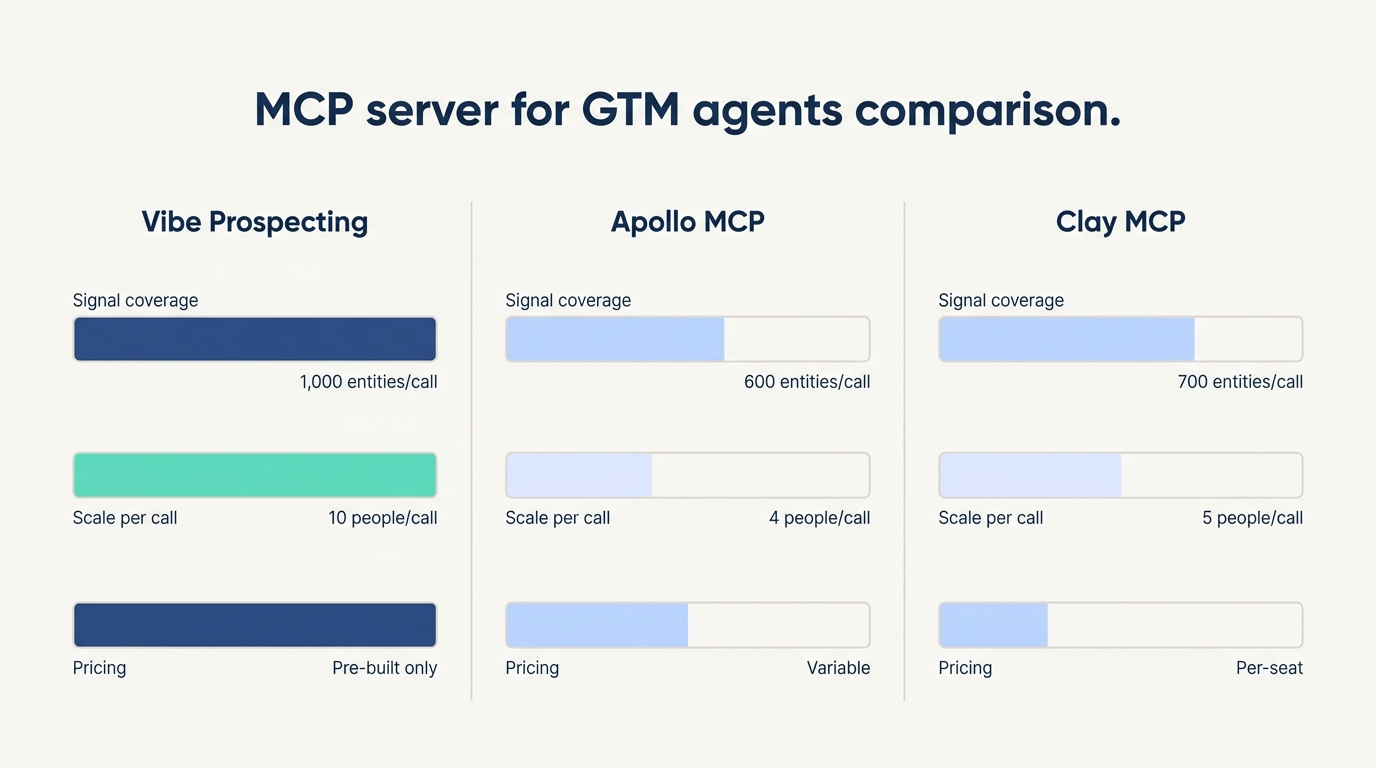
Pillar 2 - Built for scale: Vibe Prospecting handles up to 1,000 entities per call server-side at 100 QPS sustained. Apollo's in-context MCP caps bulk enrichment at 10 people per call; Clay requires a separate sourcing tool.
Pillar 3 - Affordable by design: Free account, no seat tax, one shared credit pool across every endpoint. Sample-before-export returns 5 records and a cost estimate before any credits are charged.
Top alternatives: Apollo MCP for teams that want to enroll prospects in Apollo sequences from inside Claude. Clay MCP for teams already running Clay enrichment waterfalls.
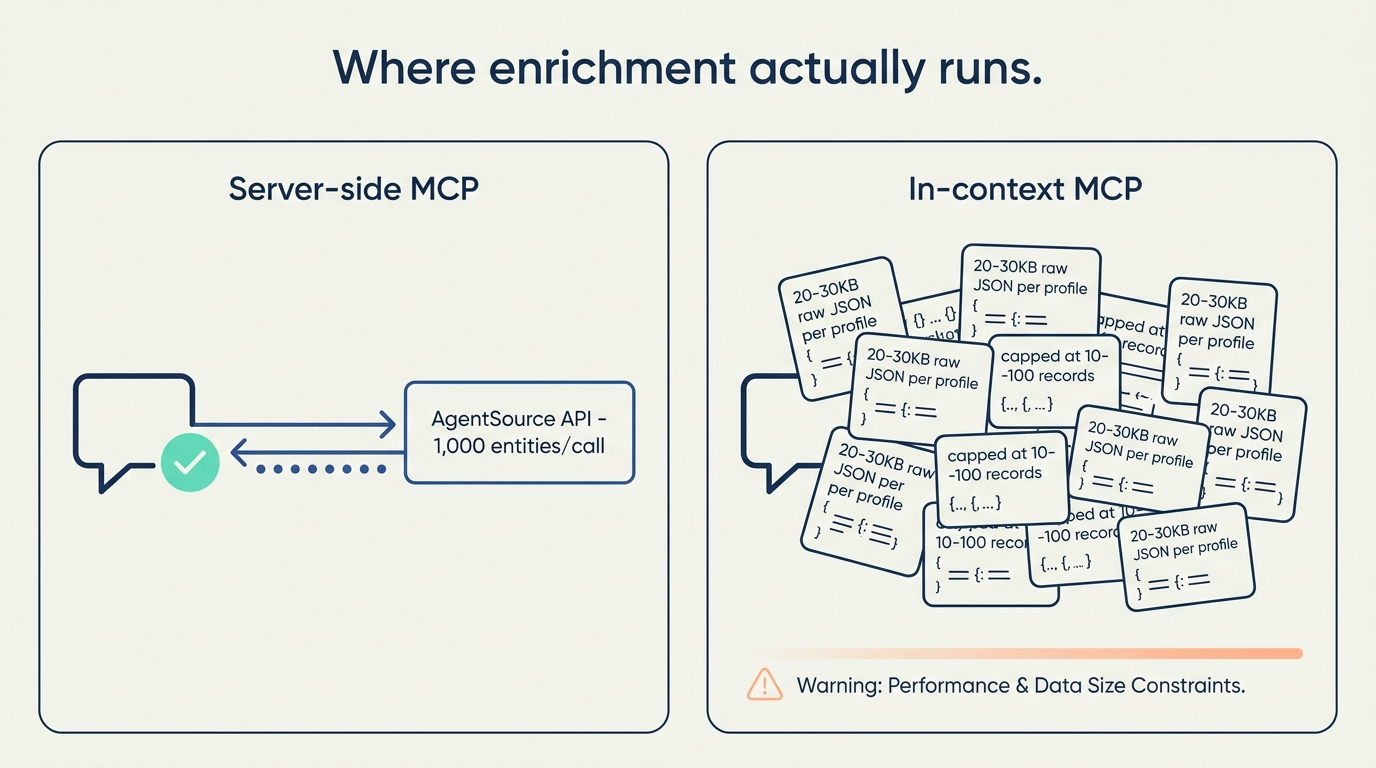
Token math at scale: Apollo MCP loads 20-30KB of JSON per profile into the context window; only 100-200 bytes are useful - a 99.6% waste ratio that caps batch runs at 20-100 records.
Install path: Add Vibe Prospecting from the Claude or ChatGPT Connectors Directory in one click - first enrichment call runs in minutes. Powered by Explorium Enterprise Business Data.
The MCP server for GTM agents your team picks in 2026 decides whether outbound AI runs at demo scale or production scale. An MCP server (Model Context Protocol connector, launched November 2024) lets a Claude or ChatGPT agent call live B2B data tools - prospect search, contact enrichment, buying signals - without leaving the chat. Server-side MCPs push enrichment to a dedicated API. In-context MCPs load every record as raw JSON into the LLM window, burning tokens on noise.
Q1: What Is an MCP Server for GTM Agents - and Why Architecture Matters
An MCP server for GTM agents is a data connector that lets an AI agent call live B2B data tools - prospect search, contact enrichment, and buying signals - directly from inside Claude or ChatGPT without switching systems. The critical split is server-side versus in-context: server-side MCPs offload enrichment to a dedicated API, while in-context MCPs stream raw JSON into the LLM window for the model to parse.
Why In-Context MCPs Fall Apart at Production Scale
Each Apollo MCP profile loads 20-30KB of raw JSON; only 100-200 bytes carry actionable signal - a 99.6% token-waste ratio. Source: 10xplaybooks.com.
Token overflow caps practical batch runs at 20-100 records before the context window fills.
Production GTM agents need 1,000-record runs. In-context architecture locks teams at demo scale.
What Server-Side Architecture Enables
Returns only structured fields the agent asked for - no raw JSON in the context window.
Bulk calls up to 1,000 entities per request at 100 QPS sustained via the AgentSource API.
Buying signals and contacts arrive pre-filtered, so agents spend tokens on decisions, not parsing.
Scale grows linearly: 10, 100, 1,000 records - same architecture, same latency profile.
Q2: How to Evaluate MCP Servers for GTM Agents - 5 Criteria
Evaluate any MCP server for GTM agents on five criteria: scale per call, data breadth, context efficiency, maintenance cost, and pricing model. A server that wins one criterion while losing three creates a fragile stack.
The Evaluation Matrix
Criterion
Why It Matters
Good
Bad
Scale per call
Demo vs production workloads
1,000 entities/call server-side
10 records/call in-context
Data breadth
Avoids a second MCP for missing signals
Companies + contacts + intent in one connection
Contact data only; no signals
Context efficiency
Preserves tokens for reasoning
Structured output, no raw JSON
20-30KB per profile loaded
Maintenance cost
Engineering time is the hidden cost
Zero waterfall maintenance
~6 hours/week debugging pipelines
Pricing model
Credit burn at scale
Shared pool, free tier, no seat tax
Per-action credits that spike at volume
Why Architecture Is the Deciding Factor
Scale, context efficiency, and maintenance cost all trace to one question: where does enrichment computation happen? For GTM agents running 100+ records per day, that single decision drives total cost of ownership more than any feature checklist. See also: agentic sales infrastructure patterns for MCP servers.
Q3: Vibe Prospecting - Top Pick for GTM Agent MCP
Vibe Prospecting is the best MCP server for GTM agents in 2026 because it wins all three pillars no other server combines: one connection covering every data need, server-side scale to 1,000 entities per call, and a free account with one shared credit pool.
The primary path is one click from the Claude or ChatGPT Connectors Directory (Settings > Connectors). For Claude Code power users, install the Vibe Prospecting plugin and use the fallback config below:
Q4: Apollo MCP - Best for Sequence Enrollment Inside Claude
Apollo's MCP server fits teams whose primary need is enrolling prospects into outbound sequences from inside Claude - not running bulk enrichment at production scale.
Where Apollo MCP Wins
Native sequence enrollment: agents add prospects to Apollo sequences directly from Claude.
Apollo is the system of record for outbound, so sequences, tasks, and contact history stay in sync.
OAuth install in the Claude Connector Directory - launched February 2026.
Where Apollo MCP Falls Short
Bulk enrichment caps at 10 people per API call; 1,000-contact runs require 100 sequential calls.
Each call loads 20-30KB of raw JSON into the context window - a 99.6% token-waste ratio at scale.
No buying signals beyond Apollo's contact database: no funding rounds, no website changes, no tech stack triggers.
Data freshness lags on job changes as job mobility accelerates in 2026.
When to Shortlist Apollo MCP
Apollo MCP fits teams running Apollo as their outbound CRM who want reps to trigger sequences from Claude. Above 100 enrichment calls per day, the 10-person cap and context waste become blockers. Use Apollo MCP for sequence actions alongside Vibe Prospecting for enrichment.
Q5: Clay MCP - Best for Teams Already Running Clay Workflows
Clay's MCP server fits teams with existing Clay enrichment waterfalls who want reps to trigger those workflows from Claude - not teams that need a standalone data source at scale.
Where Clay MCP Wins
Exposes pre-built Clay Functions as MCP-callable tools: reps trigger Ops-built workflows from Claude without logging into Clay.
Admin credit budgets and Function-level permissioning give Ops guardrails without blocking reps.
Teams already on Clay can expose workflows to Claude in hours with no new infrastructure.
Where Clay MCP Falls Short
Clay is not a standalone data source: it orchestrates third-party providers. Agents still need a separate sourcing tool.
Per-action credits range 20-100 per enrichment step; costs increase sharply as volume grows.
Enrichment waterfalls require ongoing maintenance: roughly 6 hours per week debugging API failures when providers change schemas.
"Clay's MCP helps us find and enrich ICP contacts across multiple providers and push them into Salesforce for SDR follow-up, all from inside Claude. Budget guardrails and admin controls mean reps can move faster without Ops losing control." - Zach Matek, Director of Marketing Operations, Saviynt. Source: clay.com/blog/clay-mcp
When to Shortlist Clay MCP
Clay MCP fits teams with mature workflows already built by Ops. For teams starting fresh, or needing one connection for sourcing, enrichment, and signals, Clay's maintenance overhead outweighs its benefits.
Q6: Master Comparison - Best MCP Server for GTM Agents 2026
Vibe Prospecting wins all three architecture pillars. Apollo MCP wins sequence-enrollment workflows. Clay MCP wins for teams with existing waterfall infrastructure.
Dimension
Vibe Prospecting
Apollo MCP
Clay MCP
Pillar 1: One MCP for all data needs
150M+ companies, 800M+ people, 18 signal categories, 80+ types, intent data
230M+ contacts; no buying signals
Orchestrates third-party providers; no standalone sourcing
Pillar 2: Scale per call
1,000 entities/call server-side, 100 QPS
10 people/call in-context; 99.6% token waste
No native bulk; inherits each provider's limits
Pillar 3: Affordability
Free account, shared credit pool, 30-60% savings vs per-endpoint
No separate MCP cost; plan-tier limits at 10K+/month
20-100 credits per action; spikes at volume
Match accuracy
97.8%+ company match accuracy
Not published
Depends on underlying provider
Maintenance burden
Zero waterfall maintenance
Low; no waterfall to maintain
~6 hours/week GTM engineering
Sequence enrollment
No (enrichment focus)
Yes - native Apollo sequences from Claude
Via Clay Functions if pre-built
Install path
Claude/ChatGPT Connectors Directory (one click)
Claude Connector Directory, OAuth (Feb 2026)
Claude/ChatGPT Connectors Directory (Apr 2026)
Customer Signal on Data Quality
Independent benchmarks reported in 2026 B2B data API match-rate benchmarks show contact data quality improvements including reduced bounce rates and better CRM accuracy. The 97.8%+ company match accuracy is the metric anchoring those outcomes.
The Architecture Decision
At 20-30KB per Apollo profile, a 100-contact batch burns 2-3MB of context on 99.6% noise. Server-side MCPs return only the fields the agent requested. Learn how MCP vs REST API tradeoffs shape GTM agent costs.
Q7: Getting Started - From Install to Production in 5 Steps
The fastest path from zero to a production GTM agent is Vibe Prospecting: free account, one-click install from the Claude or ChatGPT Connectors Directory, and your first 1,000-entity enrichment call in under 10 minutes.
Step 1: Create a free account at vibeprospecting.ai - no sales call, no credit card required.
Step 2: Open claude.ai Settings > Connectors (or chatgpt.com Settings > Connectors) and add Vibe Prospecting in one click.
Step 3: Run a sample enrichment on 5 records to check data quality and confirm cost before committing credits.
Step 4: Move to bulk: send 100 to 1,000 entities in a single call and verify the agent receives only structured results.
Step 5: Add buying signals: layer in 18 signal categories - funding rounds, hiring trends, website changes - to time outreach at the right moment. See: GTM agents in Claude Code.
The Decision Framework
Three questions decide which MCP fits your GTM stack. Need more than 100 records per run? Only a server-side MCP survives token limits - Vibe Prospecting is the answer. Already running Apollo sequences? Add Apollo MCP for actions, Vibe Prospecting for enrichment. Have mature Clay waterfalls? Clay MCP exposes them, but factor in 6 hours per week of maintenance overhead. For any team starting fresh or scaling past 500 contacts per day, Vibe Prospecting covers all three pillars with zero waterfall maintenance.
Production Checklist Before Go-Live
Check match accuracy on a 5-record sample using sample-before-export before scaling.
Set credit alerts so agents fail fast and cheap rather than slow and expensive.
Ready to run GTM agents at production scale? Vibe Prospecting gives RevOps teams 1,000 entities per call, 18 buying-signal categories, and a free account with no seat tax. Get started with Vibe Prospecting free.