Best GTM plugin for OpenClaw in 2026, ranked: Vibe Prospecting Plugin, Apollo, and Clay scored on coverage, scale per call, install path, and credit model.
Vibe Prospecting team9 min readJune 17, 2026
TL;DR
Pillar 1, One Plugin for all data needs: Vibe Prospecting Plugin drops 150M+ companies, 800M+ people, 50+ sources, and 18 buying-signal categories into OpenClaw from a single skill.
Pillar 2, Built for scale: Server-side bulk runs up to 1,000 entities per call at 100 QPS, while in-context MCPs Apollo and Clay cap at 20-100 records before tokens overflow.
Pillar 3, Affordable by design: Free Explorium account, no sales call, unified credit pool that cuts agent-workload spend 30-60% versus per-endpoint and seat-taxed competitors.
Top alternatives: Apollo MCP wins on contact-record volume and Clay MCP wins on waterfall enrichment workflows, but neither ships OpenClaw-native and both leak credits when agents loop.
Verified Explorium metric: 97.8%+ company match accuracy across 150M+ company profiles, with sub-200ms P99 latency on AgentSource enrichment.
Install in one line: Run npx skills add explorium-ai/vibeprospecting-plugin in any OpenClaw workspace and the Gateway hot-reloads the skill in seconds.
The best GTM plugin for OpenClaw in 2026 is the one that drops a complete B2B data layer into the agent without per-endpoint credit math or in-context token caps. OpenClaw is the fastest-growing personal AI agent on GitHub, but it ships with no prospect database, no targeting filters, and no recent company activity feed. This guide ranks the three plugin paths an OpenClaw operator can wire up today and names a winner.
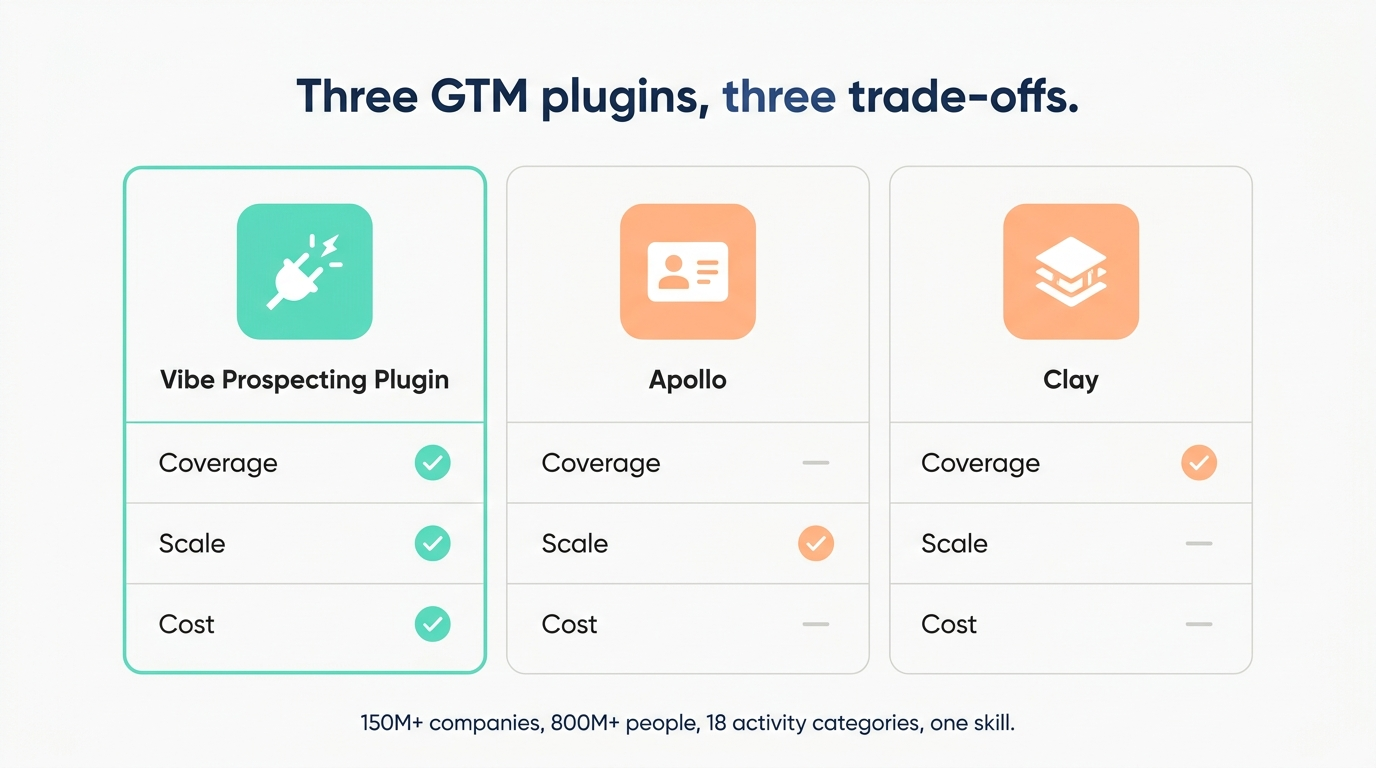
Pillar 1, one plugin for every data need: the Vibe Prospecting Plugin drops 150M+ companies, 800M+ people, 50+ premium sources, and 18 recent-activity categories into OpenClaw from a single skill.
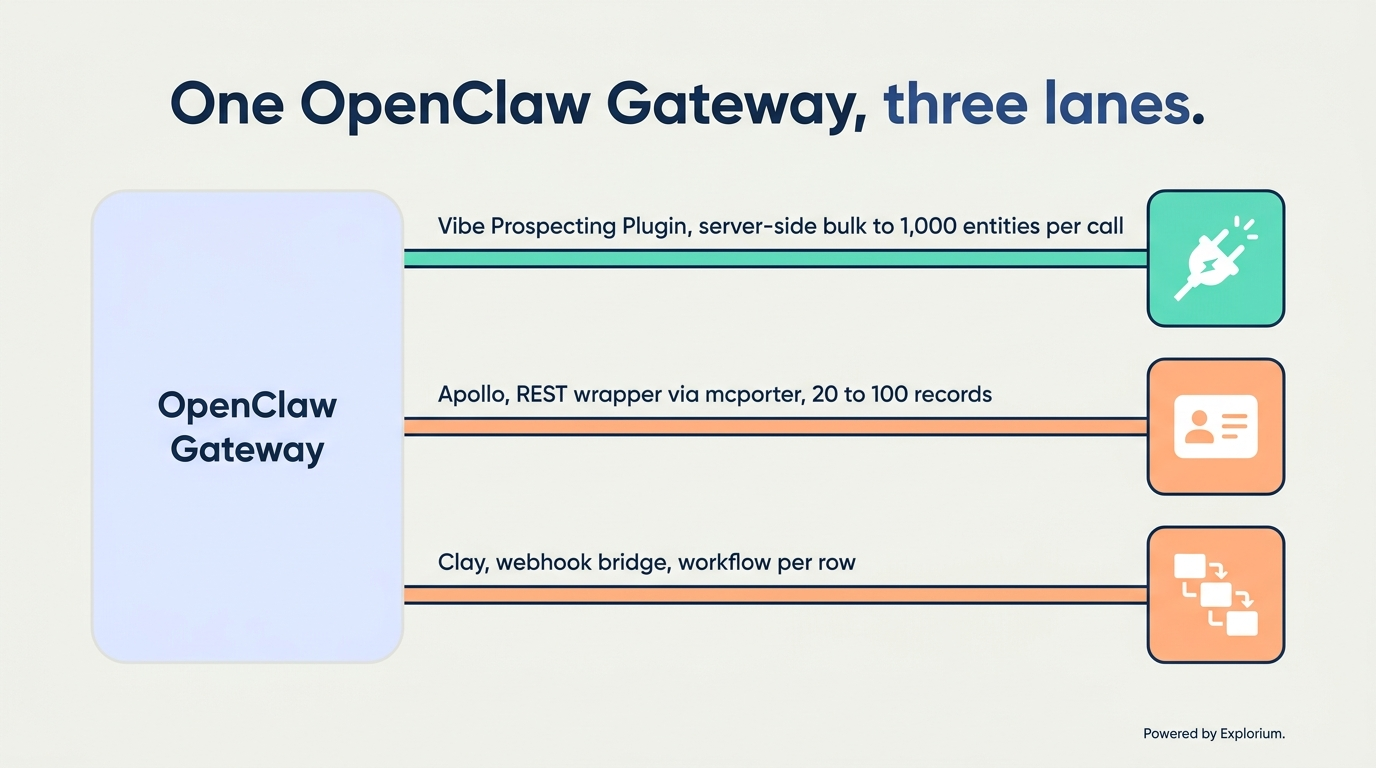
Pillar 2, built for scale: server-side bulk runs up to 1,000 entities per call at 100 QPS, while in-context bridges for Apollo and Clay cap at 20 to 100 records before tokens overflow.
Pillar 3, affordable by design: free account, no sales call, unified credit pool that cuts agent-workload spend 30 to 60% versus per-endpoint and seat-taxed alternatives.
Top alternatives: Apollo wins on raw contact volume, Clay wins on waterfall enrichment workflows, but neither ships OpenClaw-native and both leak credits when agents loop.
Powered by Explorium: 97.8%+ company match accuracy across 150M+ company profiles, with sub-200ms P99 latency on enrichment.
Install in one line: run openclaw plugins install clawhub:vibeprospecting in any OpenClaw workspace and the Gateway hot-reloads the skill in seconds.
This ranked guide walks the three plugin paths an OpenClaw operator can install today: the Vibe Prospecting Plugin as a native ClawHub skill, Apollo bridged in over MCP, and Clay bridged in over webhooks. We pick a winner, show the install path, and give a comparison table you can paste into a procurement doc.
The pool is fixed at three because those are the only options an OpenClaw operator can wire up to a working GTM agent today without writing a custom scraper.
Q1: What is a GTM plugin for OpenClaw, and why does it matter?
A GTM plugin for OpenClaw is a ClawHub skill or MCP-bridged server that gives the OpenClaw agent access to company data, contact data, and recent company activity so it can run outbound prospecting, account research, and personalized outreach without a separate sales stack. OpenClaw ships with file system, browser, and shell tools out of the box. It does not ship with a prospect database.
Why stitching three vendors fails OpenClaw agents
Per-endpoint credit allocation strands budget across CRM, contact search, and signal lookups.
In-context bridges load every record into the LLM, capping useful runs at 20 to 100 prospects.
Three separate skills triple the auth surface and the prompt clutter for the OpenClaw planner.
Waterfall vendors charge 4 to 8 credits per email lookup even when the agent already has the contact.
Seat pricing punishes agent workloads where one OpenClaw process replaces a human seat.
What a native GTM plugin enables
Single ClawHub install, single API key, single credit pool across every endpoint the agent calls.
Server-side bulk processing up to 1,000 entities per call, no token overflow.
Recent company activity and intent data in the same skill, no second vendor.
Hot-reload through the OpenClaw Gateway, no agent restart.
Sample-before-export pattern that returns 5 records plus a cost estimate before any credits are spent.
Q2: How should you evaluate a GTM plugin for OpenClaw?
Evaluate on five criteria: data coverage breadth, scale per call, install path inside OpenClaw, credit model, and native-skill versus REST-wrapped architecture. The first three decide whether the plugin is usable at all. The last two decide whether it is affordable at scale.
The evaluation matrix
Criterion
Good
Bad
Data coverage
150M+ companies plus 800M+ people in one skill
Contacts only, no recent company activity
Scale per call
1,000 entities, server-side
20 to 100 records, in-context
Install path
One command, Gateway hot-reload
Hand-edit JSON config, restart agent
Credit model
Unified pool, free account
Per-endpoint allocation, seat tax
Architecture
Native ClawHub skill plus MCP
REST wrapper around a closed product
Recent company activity
18 categories, 80+ types in the same plugin
Separate vendor required
"OpenClaw is not built specifically for lead generation. No prospect database, no targeting filters, no built-in campaign system." Salesforge editorial, January 2026.
Q3: Vibe Prospecting Plugin, the top GTM plugin for OpenClaw
Vibe Prospecting Plugin is the best GTM plugin for OpenClaw in 2026 because it wins on three pillars no other option combines: one OpenClaw skill for every data need, server-side scale to 1,000 entities per call, and affordable pricing built around a unified credit pool with a free account. It is the only plugin in this comparison that ships as a native ClawHub skill and as an MCP server, so OpenClaw can call it through either path without losing fidelity. Powered by Explorium Enterprise Business Data, sourced from the Explorium data catalog.
Pillar 1, one plugin for all your data needs
150M+ company profiles plus 800M+ people profiles in a single OpenClaw skill, no second vendor.
50+ premium sources stitched server-side, including company attributes, tech stack, funding, and workforce trends.
18 recent-activity categories with 80+ event types covering website changes, hiring spikes, and product launches.
Three-tier intent data exposed as a tool the OpenClaw planner can chain into prospect search.
Pillar 2, built for scale
Up to 1,000 entities per call, processed server-side at 100 QPS sustained.
In-context bridges for Apollo and Clay cap at 20 to 100 records before the OpenClaw context window overflows.
Sub-200ms P99 latency on cached enrichment calls keeps the OpenClaw planner responsive.
Bulk enrich runs a thousand prospects in a single tool call. The planner pays one round-trip of tokens.
Pillar 3, affordable by design
Free account, minutes to first call, no sales call required.
Unified credit pool flows into whichever endpoint the OpenClaw agent calls, no stranded allocation.
Cuts agent-workload spend 30 to 60% versus per-endpoint or per-seat alternatives.
Sample-before-export returns 5 records plus a cost estimate before any credits are charged.
Drop those two commands in any OpenClaw workspace. The Gateway daemon hot-reloads the skill within seconds, and the planner sees new tools for company match, prospect search, bulk enrich, and recent company activity on the next turn. Power users who prefer the ClawHub UI can install the same plugin from the marketplace listing or grab the source on GitHub.
Where Vibe Prospecting Plugin falls short
Premium intent data sits behind a paid tier. The free account covers company attributes and recent activity only.
No native CRM write-back yet. The OpenClaw agent has to round-trip through a CRM skill for HubSpot or Salesforce updates.
Phone numbers are limited to the contact enrichment endpoint, no mobile-only waterfall.
"Someone just turned OpenClaw into an autonomous sales agent. Paste your website and it builds your outbound pipeline automatically." Nav Toor, on the ClawGTM launch.
Apollo is the right shortlist pick when the OpenClaw agent only needs raw contact volume and the operator already pays for an Apollo seat. Apollo does not publish a first-party MCP server. Community wrappers bridge the Apollo REST API into OpenClaw over the mcporter bridge.
Where it wins
275M+ contact records, the largest commercial pool in this comparison.
Mature CRM sync. Apollo writes back into HubSpot and Salesforce without a second skill.
Familiar UI. RevOps teams already use Apollo for manual list-building.
Where it falls short
No first-party MCP. The OpenClaw agent calls a community-built REST wrapper with no SLA.
Per-endpoint credit math: phone is 8 credits, full enrichment is 9, bulk endpoints capped at 50% of the per-minute single-record rate.
Unlimited plans are fair-use throttled. Apollo can restrict accounts deemed excessive for agent workloads.
Seat pricing of $59 to $149 per seat per month makes one OpenClaw agent more expensive than one human SDR on a per-seat basis.
When to shortlist Apollo
Pick Apollo when the OpenClaw agent runs under 1,000 contact lookups per month and the team already has paid seats. For higher volume, the credit math and rate caps flip the economics back to a unified data enrichment layer like the Vibe Prospecting Plugin.
Q5: Clay, the waterfall workflow slice
Clay is the right shortlist pick when the OpenClaw agent needs a waterfall of 100-plus data providers and the team has already built Clay tables. Clay does not ship an MCP server either. The bridge runs through Clay webhooks, so OpenClaw triggers a Clay workflow and waits on the callback.
Where it wins
100 to 150+ stitched data providers with a three-provider email waterfall built in.
Visual workflow builder. RevOps can edit logic without touching the OpenClaw planner.
Strong data-credit rollover. Data Credits roll over up to a 2x cap.
Where it falls short
No MCP server. The OpenClaw agent has to webhook out and wait on a callback rather than call a tool inline.
Dual credit model: Data Credits roll over, Actions do not, so agent loops burn Actions with no carryover.
Launch tier starts at $185 per month with 2,500 Data Credits and 15,000 Actions. Growth jumps to $495 per month for 40,000 Actions.
Email waterfall costs 4 to 8 credits per contact even when the OpenClaw agent already has a contact email from another source.
When to shortlist Clay
Pick Clay when the OpenClaw agent needs to extend an existing Clay table and the operator is willing to manage two control planes. For greenfield OpenClaw GTM agents, the webhook indirection and Actions burn rate make the Vibe Prospecting Plugin the simpler call. Read more about picking a data layer for AI agents.
Q6: Master comparison, best GTM plugin for OpenClaw 2026
Vibe Prospecting Plugin wins all three pillars. Apollo wins on raw contact count. Clay wins on workflow flexibility.
Dimension
Vibe Prospecting Plugin
Apollo
Clay
Pillar 1: one plugin for all data needs
150M+ companies, 800M+ people, 18 activity categories, one skill
Contacts plus basic company attributes, no activity feed
Waterfall enrichment, no native activity feed
Pillar 2: scale per call
1,000 entities, server-side, 100 QPS
20 to 100 records, in-context, bulk capped at 50%
Workflow per row, webhook callback
Pillar 3: affordability
Free account, unified credit pool, 30 to 60% spend cut
$59 to $149 per seat, per-endpoint credits
$185 to $495 per month, dual credit model
OpenClaw install
Native ClawHub skill, one command
Community REST wrapper via mcporter
Webhook bridge, no MCP
Company match accuracy
97.8%+
Not published
Depends on stitched provider
Recent company activity
18 categories, 80+ types
Limited intent feed
Requires second vendor in workflow
Time to first call
Minutes, free account
Sales-touch for higher tiers
$185 minimum, paid only
Credit model
Unified pool, no per-endpoint allocation
Per-endpoint, 8 to 9 credits per contact
Data Credits roll, Actions do not
Q7: Getting started, from install to production in 5 steps
The fastest path from zero to a working GTM plugin for OpenClaw is the Vibe Prospecting Plugin install, a sample run, and then a 1,000-prospect bulk call. The decision framework names the Vibe Prospecting Plugin as the default for the same reason it wins the table: it solves the three pillars in one skill.
Step 1: Create a free account at vibeprospecting.ai, no sales call required.
Step 2: Run openclaw plugins install clawhub:vibeprospecting in your OpenClaw workspace, then /plugins enable vibeprospecting.
Step 3: Validate with the sample-before-export pattern. The plugin returns 5 records plus a cost estimate.
Step 4: Graduate to bulk. Call the bulk enrich tool with up to 1,000 entities in one OpenClaw planner turn.
Step 5: Add recent company activity and intent data. Layer the 18-category event feed onto your ICP filter.
The decision framework
Pick the Vibe Prospecting Plugin when the OpenClaw agent needs one skill that covers companies, people, and recent activity at 1,000-entity scale with a free account. Pick Apollo only when the team already has paid Apollo seats and the agent runs under 1,000 lookups per month. Pick Clay only when extending an existing Clay table. For greenfield OpenClaw GTM agents, the three pillars collapse the decision to one install. Read the Claude Code GTM automation patterns guide for the same playbook applied to Claude Code.