


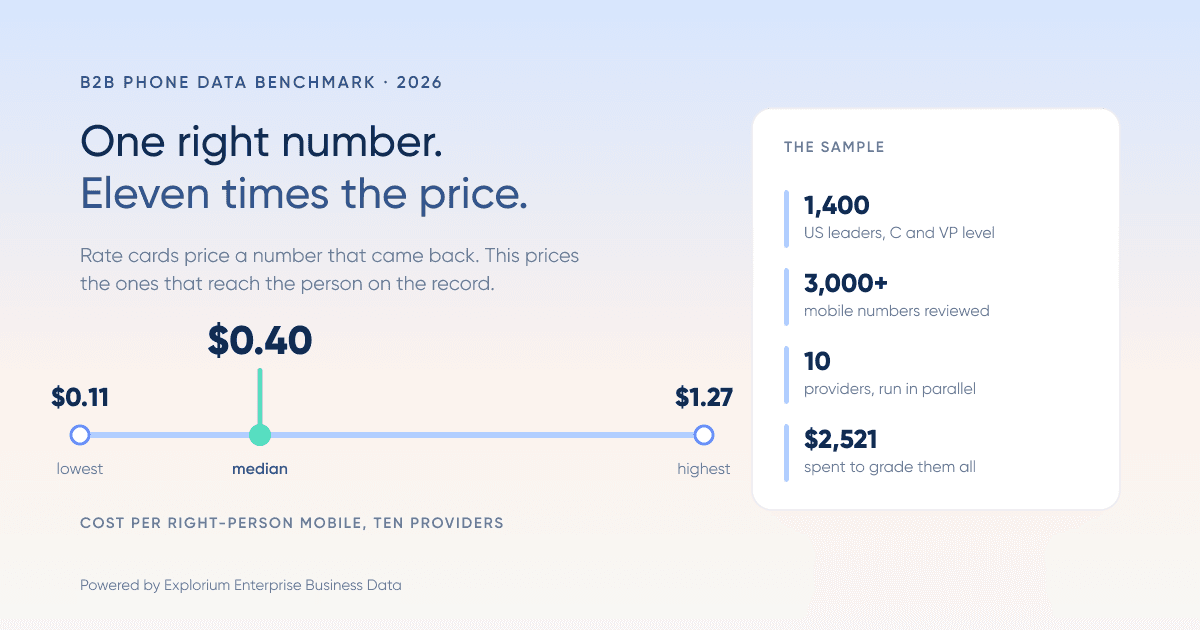
Almost every B2B phone data benchmark 2026 has produced measures the same easy thing: did a number come back. The hard number is what one right-person mobile costs once you throw away the ones that ring a stranger. An independent test of 1,400 US leaders put that at a $0.40 median, with the spread running from $0.11 to $1.27 depending on who you bought from. Here is the ranking read that way, priced per number that reaches the person on the record, plus the two findings that should change how many phone vendors you pay at all.
What One Right-Person Mobile Actually Costs
A right-person mobile cost a $0.40 median in the 2026 US test, ranging from $0.11 to $1.27 across ten providers. That figure is not on anybody's rate card. It is the rate card divided by the share of numbers that survived a line check and a name check.
The Funnel That Eats Your Spend
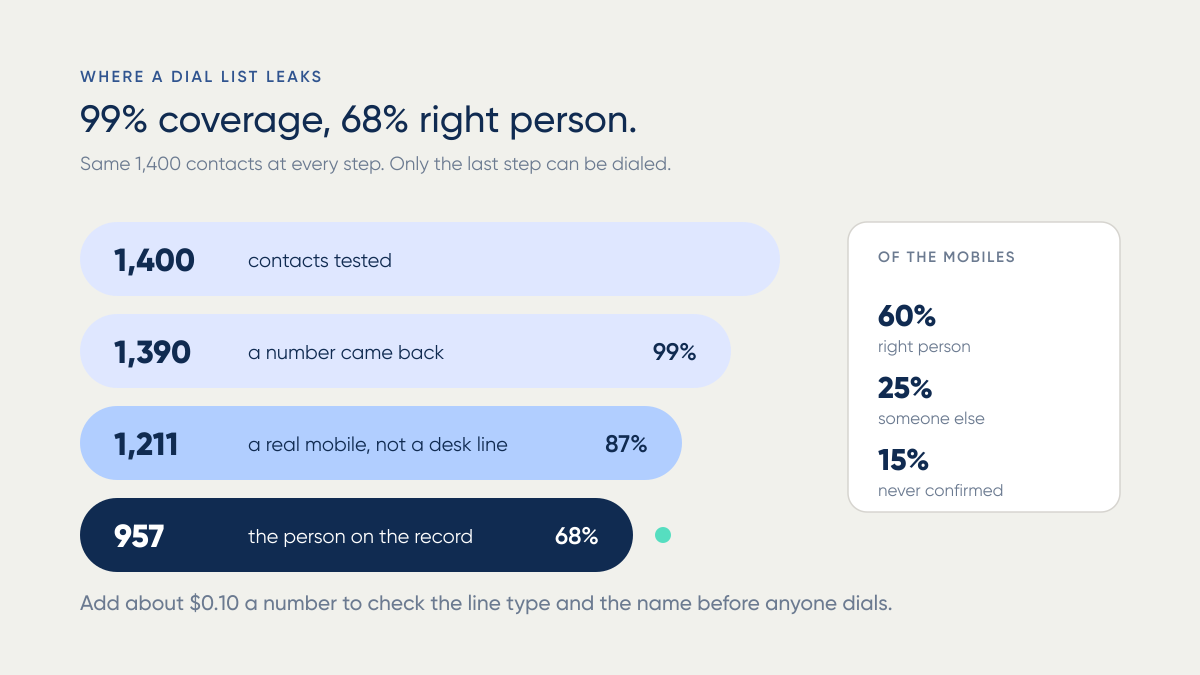
- 1,390 of the 1,400 contacts came back with some number attached. That is the 99% figure vendors put on slides.
- 1,211 of those were a real mobile rather than a desk line or a switchboard, so 87%.
- 957 belonged to the person on the record. That is 68%, and it is the pooled result of all ten providers working the same list at once.
- Of the mobiles themselves, one in four reached someone else entirely and another 15% could never be confirmed either way.
The Cost Nobody Quotes You
- Checking a number runs about $0.10 on top of buying it: one lookup for line type, one for the name match.
- Skip that step and you do not save the $0.10, you just move it onto a rep's calendar.
- The full 2026 test cost $2,521 to run across ten providers, which is what an honest read of this category actually prices at.
Why Your Third Phone Vendor Only Buys You Three Points
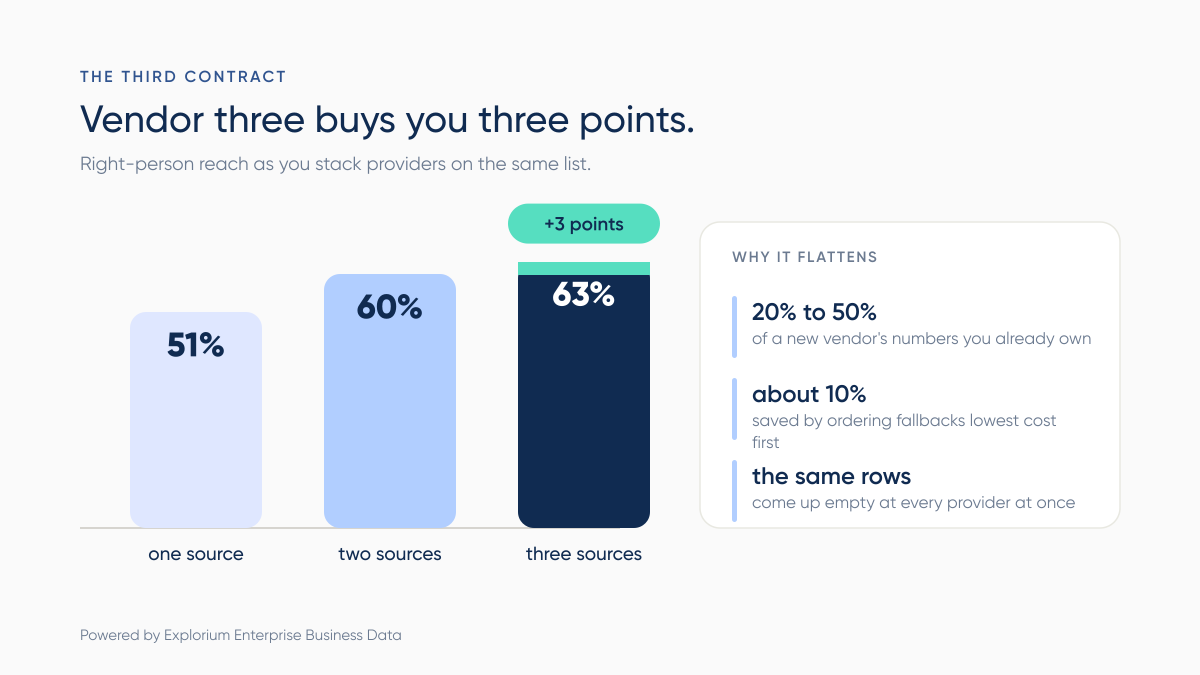
Two providers together reached 60% of the right people. Adding a third lifted that by three points. Provider overlap ran 20% to 50%, so the third contract mostly re-buys numbers you already have on file.
What That Does to a Fallback Chain
- Ordering fallbacks lowest cost first rather than best coverage first saved about 10% on the same list, for the same result.
- The records where one provider comes up empty are usually the records where all of them do, so spend climbs fastest on your worst rows.
- Two well-chosen sources and a hard stop is a defensible setup. Five is usually a renewal nobody questioned.
- If you are weighing a chain against a single source, the tradeoffs are laid out in our piece on waterfall versus real-time enrichment at scale.
The 2026 Ranking, Priced Rather Than Counted
Read the table on the price column first, then on whether the mobile arrives separated from the switchboard line. Right-person share only exists for providers that were in the independent test, and being straight about that gap matters more than filling every cell.
| # | Provider | Per mobile, published | Right-person share, 2026 test | Mobile kept separate | Price list published |
|---|---|---|---|---|---|
| 1 | Vibe Prospecting | $0.08 on the Elite tier | Not in the test | Yes | Yes, full list |
| 2 | Explorium API | $0.075 at scale volume | Not in the test | Yes, its own field | Yes, full list |
| 3 | LeadMagic | $0.11 per right number, measured | Lowest cost per right number in the test | Partial | Yes |
| 4 | RocketReach | Published per lookup | 69%, highest measured | Partial | Yes |
| 5 | People Data Labs | Tier dependent | About 66% | Partial | Quote above volume |
| 6 | Forager | Quote based | About 64% | Partial | Demo required |
| 7 | Wiza | Published per credit | 59%, on the largest volume | Partial | Yes |
| 8 | Datagma | $0.37 to $0.59, 30 credits | Not in the test | Mobile only, no landline billing | Yes |
How to Read the Gaps
- Vibe Prospecting and the Explorium API were not among the ten providers tested, so those rows carry published price and response shape only. Measure them on your own list instead of taking a ranking's word for it. That is what the free plan is for.
- The highest right-person share measured was 69% and the lowest was 53%. The distance between best and worst is narrower than most vendor decks imply.
- Volume and accuracy are different things. The provider that returned the most valid mobiles, 87% of the list, converted only 59% of them to the right person.
- Datagma charges only when a mobile is found and keeps landlines out of results and billing entirely, the cleanest line-type policy in the set, at one of the highest prices per number. Honesty and price sit on separate axes.
- To compare the data layers underneath these tools, the side-by-side provider comparison hub is the faster read.
How to Get Mobiles Without Signing a Data Contract
Ask for the numbers in a chat window, see the credit cost before anything is spent, and pay $0.08 a mobile on the top volume tier. Vibe Prospecting runs professional prospecting on premium sources behind Claude and ChatGPT, so a dial list is a request rather than a procurement cycle.
What a Mobile Costs Here
| Plan | Price | Credits | Per credit | Per mobile, 5 credits |
|---|---|---|---|---|
| Free | $0 | 200 a month | N/A | 40 lookups a month |
| Plus | $26.91 | 900 | $0.030 | $0.15 |
| Boost | $76.49 | 3,000 | $0.025 | $0.13 |
| Ultra | $159.99 | 8,000 | $0.020 | $0.10 |
| Elite | $487.49 | 30,000 | $0.016 | $0.08 |
How the Numbers Come Back
- The person's mobile arrives as its own field, kept apart from the company switchboard line, so you are not paying a second tool to sort one from the other.
- You can preview sample records and the credit cost before any of it is spent, which is what makes running your own test easy rather than a commitment.
- Company details, contact details and recent company activity all come out of one credit pool, so phone spend never strands the credits you set aside for something else.
- Powered by Explorium Enterprise Business Data, and the full price list is published rather than quoted.
Install the plugin once and the whole thing lives in the window you already work in:

