


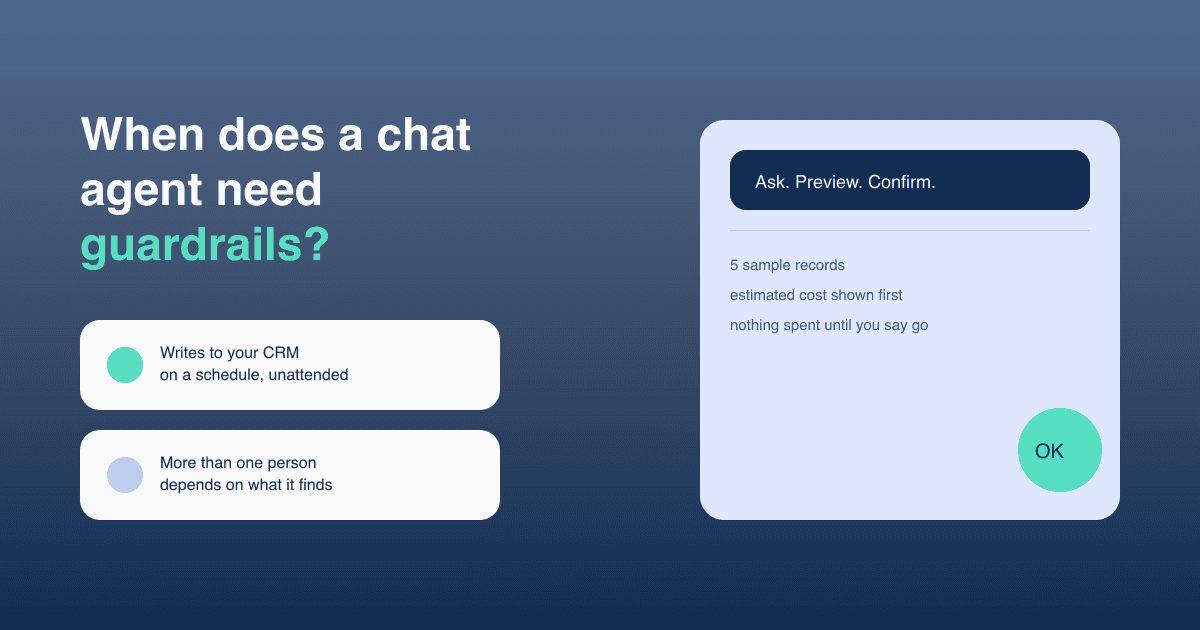
Your Claude Code agent finally works. It pulls company details, drafts the outreach, and drops the result into a CRM field every rep on the team reads. Then one week it writes something wrong, and nobody catches it for four days because nobody was actually watching. That gap between "it works" and "it's safe to leave alone" is what an AI sales agent guardrails checklist is for, and most builders never stop to draw the line between the two.
The Weekend Build vs. the Monday Morning Problem
A DIY agent is the right call for a single list you touch once. It stops being the right call the moment it runs on a schedule, writes somewhere other people read, or nobody can explain why a record changed. Below that line, hand-rolled beats anything else, because you can ship it in an afternoon. Above it, the same script turns into a part-time job.
Where a Hand-Rolled Script Still Wins
- A once-off pull for a 20 to 30 account list ahead of a single campaign, never scheduled to run again.
- A personal prototype nobody else touches, with no write path into a CRM, Slack channel, or outbound tool.
- An experiment to see whether a data category is even worth paying for before you commit to anything.
Where the Line Gets Crossed
- The agent runs unattended on a schedule and writes straight into a field other reps build their day around.
- More than one person now makes a call based on what the agent found.
- The data underneath is a scraper watching an API that can change shape without telling you.
- Nobody on the team can answer "which record changed, when, and why" without opening raw logs.
The Real Cost of Re-Explaining Your Target List Every Morning
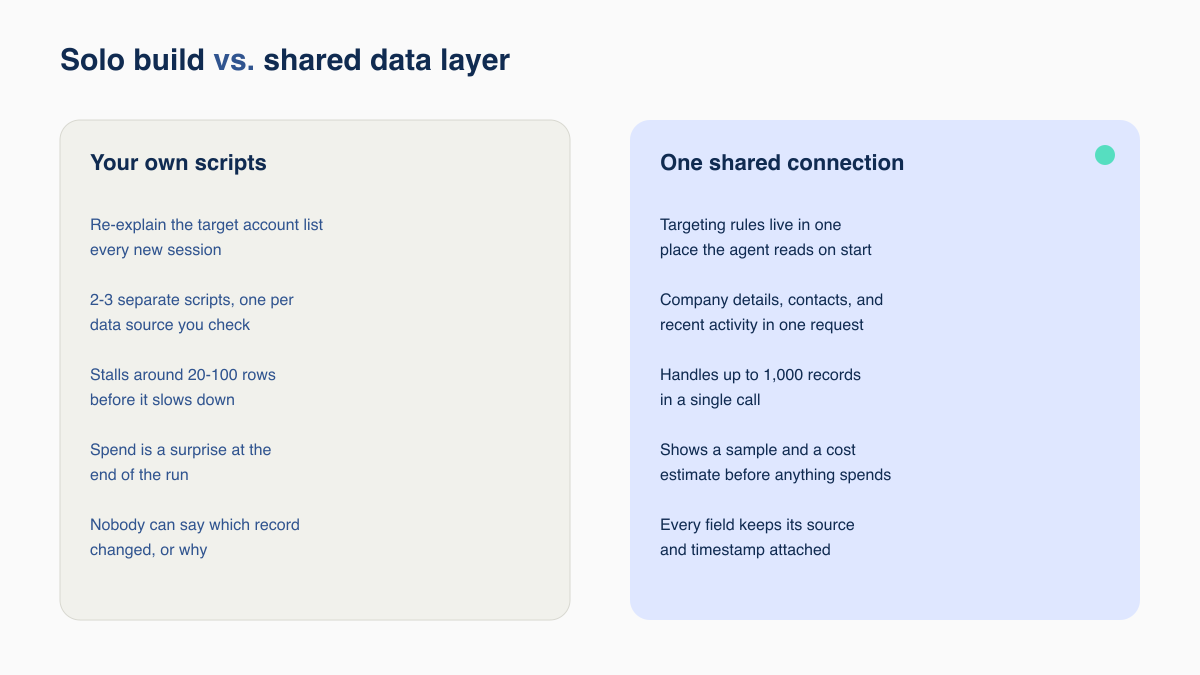
The first thing that breaks in a DIY build isn't the data, it's memory: a new Claude Code chat starts from nothing, so a chunk of every session goes to re-pasting the same targeting rules before the agent does anything useful. Builders describe the identical loop in public: open a new chat, paste the same context for the tenth time, get an answer that almost works, then spend half an hour fixing it by hand.
What That Loop Actually Costs
- The re-pasting alone eats a meaningful share of the time the agent was supposed to save.
- Logic that "almost works" needs a manual pass every single run, so the agent never gets to true unattended operation.
- A silent miss doesn't surface until a report looks wrong days later, and by then the record has already gone out the door.
The Fix Is Somewhere the Rules Live, Not a Longer Prompt
- Put your ideal-customer rules and targeting logic in a file the agent reads at the start of a session, not a block of pasted text.
- Move data retrieval into a connection that persists across sessions instead of a script the agent half-rewrites every time.
- Claude Code now ships a
/usageview, added after builders kept reporting surprise token spend, so you can see per-tool and per-session cost instead of guessing.
Who's Watching When the Agent Is Wrong?
The blast radius of an unsupervised agent is every system downstream that trusts a record nobody reviewed, and it grows every week the agent keeps writing without a human in the loop. One wrong company match can turn into a rep working a dead account or a lead score nobody trusts, and it usually surfaces only when someone happens to audit the pipeline by hand.
Signs the Blast Radius Already Got Away From You
| What you notice | What it actually means |
|---|---|
| More than one team acts on the output with no review step | The blast radius reaches past whoever built the agent |
| The agent has write access to a system other people rely on | A bad record lands in production, not a sandbox |
| Nobody can name the last time someone spot-checked the output | Trust in the agent is assumed, not tested |
Three Questions to Ask Before Your Agent Touches Your CRM
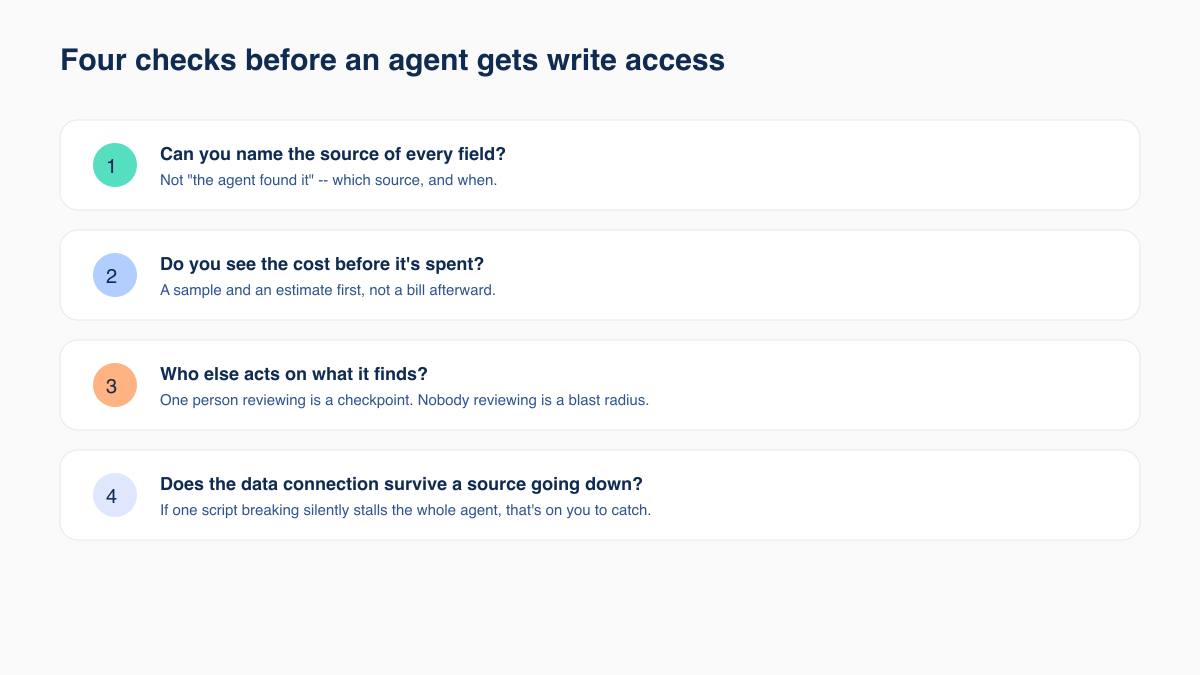
Ask three things before an agent gets write access: can you name the source behind every field, do you see the cost before it spends, and does someone actually review what comes out the other end. A vendor plugin that skips all three has not solved anything your own script didn't already have.
What a Good Answer Looks Like
- Every enriched field carries a source and a timestamp the agent can surface if you ask.
- A record's path from raw source to CRM write can be reconstructed without reading logs line by line.
- Match accuracy is a number the vendor publishes, not a line about "high quality" in a deck.
"Once the agent had a single place to pull company and contact details from, our team stopped arguing about whose spreadsheet was current. The source is just attached to the record now." -- RevOps Lead, Mid-Market, via G2
Why "It Has a Plugin Now" Isn't the Same as "It's Governed"
A vendor shipping a plugin into your coding agent is not the same as that plugin answering the three questions above. "We have a plugin" gets marketed as governance; it only earns that label once it carries a source on every field, shows cost ahead of spend, and doesn't silently drop the connection when a source changes shape.
Build vs. Buy, Compared Honestly
| Criterion | Your own scripts | A shared, governed connection |
|---|---|---|
| Setup time | Days to weeks writing and testing wrapper code | Minutes, no procurement, free to start |
| Records per run before it breaks down | Roughly 20 to 100 before the chat's context fills up | Up to 1,000 per request, handled outside the chat window |
| Cost visibility | Discovered after the run finishes | A sample and an estimate shown before anything is charged |
| What happens when a source changes shape | Your script breaks quietly; you find out when the output looks off | The vendor absorbs the schema change, not you |
| Coverage per connection | A separate script per data type you check | Company details, contacts, and recent activity through one connection |
What Two Named Alternatives Actually Offer
- Coresignal has no native plugin for a coding agent as of this writing; its API still means you write and maintain the connector code yourself.
- Hunter ships a real, free MCP connection, but it's scoped to domain search and email lookups, not the broader company and contact data most GTM agents need.
- Neither one, on its own, answers all three governance questions above in a single connection.
What a Runaway Bill Actually Looks Like
A runaway bill starts with a query that quietly runs at full volume before anyone can catch it, because there was no checkpoint between "asked" and "charged." A hand-rolled script rarely has anywhere to pause; a typo in a filter can spend a chunk of a month's credit allowance before the output even loads.
Where the Checkpoint Belongs
- Ask for a small sample and a cost estimate first, and look at both before confirming the full request.
- A builder reviewing the sample can cancel there instead of after the run finishes.
- Credits pulled from one shared pool mean a canceled request doesn't leave money stranded in a separate, unused allocation.

