Prospects Ghosting Booked Calls? Reminders Only Reach Half of Them
Reminders cut sales meeting no-shows about 28%, then stop. Here is how to sort the two causes apart and screen accounts in chat before you send a time.
Vibe Prospecting team9 min readSeptember 7, 2026
TL;DR
Every empty slot is either a buyer who meant to come or a company that never had the problem you sell into. Only the first one hears a reminder.
The arithmetic: 13.5% typical no-show rate, minus about 28% from a reminder cadence, minus another 10% to 20% from a text, lands at 8.3%. The best teams run 5.5%.
Enterprise sellers disqualify 71.2% of accounts and post the lowest no-show rate at 7.8%. Screening early is what buys the low number.
At $529 a booked meeting, 400 bookings a quarter with a normal miss rate wastes about $28,500 before an AE opens a calendar.
Five checks before you send a time: headcount band, funding stage, the tools they run, open roles on the team that owns the problem, and one change in the last 60 days.
Vibe Prospecting runs all five in one chat: ask in plain words, preview 5 records and the cost, screen up to 1,000 companies per run. Powered by Explorium Enterprise Business Data.
A booked call that nobody joins has quietly become the most expensive thing in outbound. The median cost of booking one B2B meeting reached $529 in 2025, up from $143 in 2020, so 400 bookings a quarter with a normal share of sales meeting no-shows burns roughly $28,500 before an AE ever opens a calendar (RevHeat, 11,744 sellers). The standard fix is more reminders. Reminders do work, right up until they do not, because a real slice of your empty slots were never real meetings to begin with.
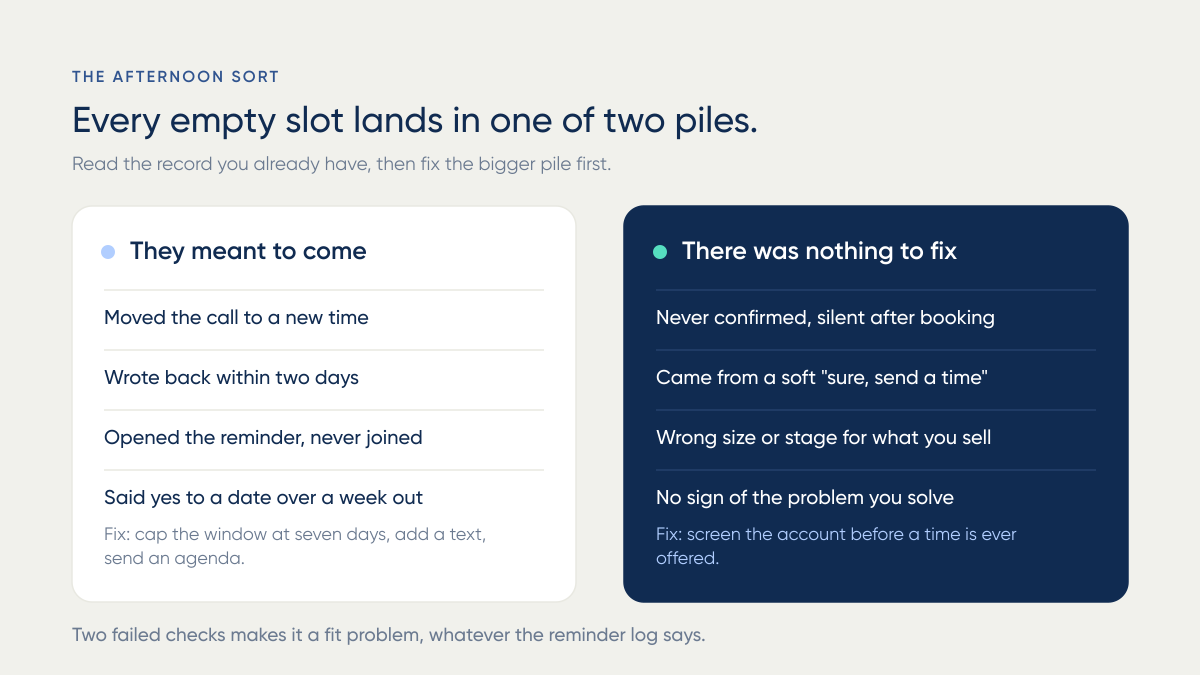
Every empty slot lands in one of two piles
Some buyers meant to be there and lost the thread. Others were never coming, because the company they work for never had the problem you sell into. Reminders only speak to the first group, so telling the two piles apart is the entire job.
The pile a reminder can reach
The call went on the calendar eight or more days out, and by then the week they agreed to no longer existed.
A single email reminder reaches about one person in five, since reminder open rates sit near 20%.
There was no agenda and no one-click way to move the time, so skipping cost the buyer nothing at all.
The pile nothing can reach
The booking came out of a friendly reply, not a problem anyone on that side owns.
Not one thing about the company was checked before a time got offered.
The contact clears your title filter while the company misses on size, stage, tooling, or timing.
"No shows are 95% a targeting and nurturing issue." Practitioner consensus in an r/gtmengineering thread, August 2026
Where reminders stop paying, in plain arithmetic
Take a typical 13.5% no-show rate. A two or three touch reminder cadence shaves about 28% off it, a text message takes another 10% to 20%, and you settle around 8.3%. The strongest teams run at 5.5%. That leaves roughly 2.8 points that no reminder mechanic has ever moved, per 18 weeks of data from teams booking 50 or more meetings a month.
The ladder, result first
Where you land
What got you there
13.5%
Nothing yet, the usual starting point across B2B software
9.7%
A two or three touch reminder cadence, worth about 28%
8.3%
A text message on top of that, worth another 10% to 20%
5.5%
Where the best-performing teams actually sit
2.8 points
The gap reminders have never closed
The catch most write-ups skip
Each of those lifts was measured on its own, so they do not stack neatly one on top of the next.
A fourth and fifth touch start reading as pressure, and they cost you the reschedule you would otherwise have earned.
No message, however well written, hands a company a problem it does not have.
What counts as normal for who you sell to
Mid-market teams average 17.3%, SMB 16.1%, enterprise 7.8%, and meetings routed in from inbound run 6.5% across 6,428 of them. Compare yourself to your own row, because a blended average hides whichever motion is bleeding.
The number that settles the argument
Enterprise sellers throw out 71.2% of accounts before a call and then post the lowest no-show rate of any segment at 7.8%. Harder screening early, fewer wasted slots later. That inversion is the whole thesis in one line.
Your vertical swings wider than your segment does: developer tools sit near 1.2%, education near 18.1%.
Inbound conversion from qualified to booked runs 62% at the median and 78% in the top tenth.
A 12% rate is a fire in developer tools and a good quarter in education.
Sort last quarter's empty slots in an afternoon
Go back 90 days and put every missed call in one pile or the other using evidence you already hold, then fix whichever pile is bigger. The rules are mechanical and the whole pass takes one sitting.
How to read the record
They moved the call, or wrote back inside two days: they meant to come. Shorten your booking window.
They opened a reminder and never joined: they meant to come. Add a text and an agenda.
They never confirmed and went quiet after booking: nothing to fix on that account.
The booking came from a soft "sure, send a time" with no problem stated: nothing to fix.
The company misses on size, stage, tooling, or hiring when you look again: nothing to fix.
The hard part is checking hundreds of companies
The last rule needs current facts about the company, not calendar history, which is why most teams skip it. Ask for all of it in one go instead:
Text
For these 412 companies that no-showed in the last 90 days, give me:
- headcount band and funding stage
- the sales and data tools they run
- open roles on the revenue team
- anything that changed in the 60 days before the booking
Flag every company that misses two or more of those.
Two failed checks makes it a fit problem, whatever the reminder log says. Write the result as a ratio, say 60/40, and spend the quarter on the larger half.
Five things worth knowing before you send a time
Headcount band, funding or revenue stage, the tools that make your problem possible, open roles on the team that owns that problem, and one thing that changed in the last 60 days. Miss two of the five and the account gets a nurture sequence instead of a slot.
Why those five and not fifteen
Size and stage tell you whether the problem is expensive enough for anyone to fund a fix.
Tooling tells you whether the problem can even exist inside that company today.
Open roles and a recent change tell you whether anyone is being paid to care this quarter.
What a polite yes does not tell you
Gartner puts 67% of B2B buyers on record as preferring to buy without a rep, up from 61% a year earlier, and finds buyers spend only 17% of their purchase time meeting every supplier combined. With three vendors in play that is 5% to 6% each. A friendly reply says nothing about any of the five, and the data behind those checks is worth comparing side by side before you pick a source.
"Meetings booked is a local metric. Efficient revenue is the global goal." Scott Brinker on X, July 2026
Run the screen in chat with Vibe Prospecting
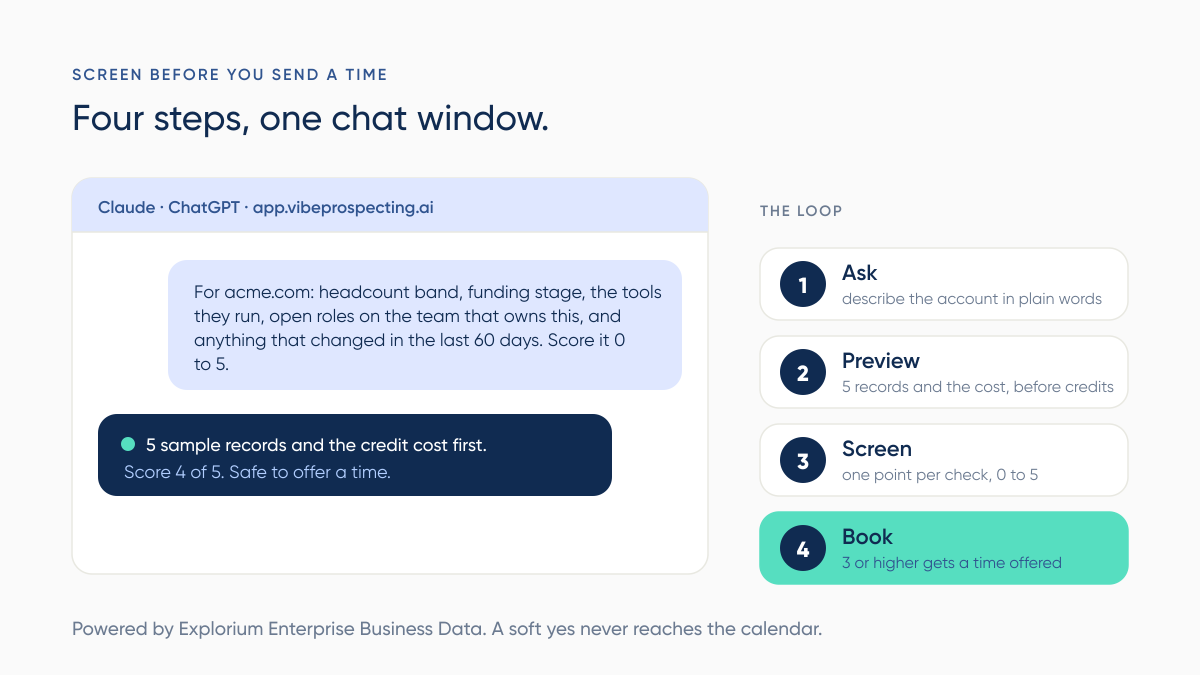
Vibe Prospecting turns the screen into a sentence you type: describe the account in Claude, ChatGPT, or the web app, see 5 sample records and the credit cost before anything is charged, then score the account and decide whether it earns a time. No new dashboard for your reps to learn, and nothing to install if you already have a chat window open.
The data underneath
Powered by Explorium Enterprise Business Data: 150M+ company profiles and 800M+ people profiles pulled from 50+ premium sources, plus 80+ types of recent company activity such as hiring pushes, funding rounds, tool changes, and website changes, at 97.8%+ company match accuracy (explorium.ai). One connection answers all five checks, so nothing has to be stitched together.
Ask for the screen in plain words
Text
Before I offer a time to acme.com, check:
- is headcount between 200 and 2,000
- funding stage and the date of the last round
- which sales and data tools they run
- open revenue roles right now
- any funding, leadership, or tooling change in the last 60 days
Score it out of 5 and preview 5 sample records with the cost first.
Up to 1,000 companies go through a single run, which is what makes the backlog pass above finish in one sitting rather than one quarter. A free account covers the first runs, credits are shared across every kind of request, and there is no call with a rep to sit through. If you would rather script it, install the Vibe Prospecting Plugin for Claude Code, or open the web app and do it there. The same chat habit builds the list in the first place, as in building targeted prospect lists in Claude Code.
What to say when a buyer wants a date three weeks out
Treat a far-off date as information, not a scheduling detail. Same-day demos went empty 6.90% of the time in Reply.io's analysis of its own booked meetings, against 24.50% for anything set eight or more days out. That is a 3.5x swing from calendar distance alone.
Two lines that work
Offer the near slot first: "I have Thursday at 10 or Friday at 2, whichever is easier." A distant date is never on the menu.
If they insist on a date weeks out, ask what they want to have decided by then. A real answer is a real problem, and no answer is your screen result.
Before you blame August
Seasonality is real, small, and unreliable, and it does not explain a slide that has run for four months. A five-year study of 14,500 senders across 86,000 sender-months found no dependable monthly pattern in EMEA at all, and the famous August holiday dip never showed up consistently.
The test that settles it
Compare this August with last August, never with June. Month over month mixes the season up with the trend.
Split by region. In the Americas the one shape that repeats is a bump near 8% over baseline in October and a softer November near 5% under.
Anything running longer than a month is not the calendar. Reply rates also slid about 45% across those five years, which is direction.
When the screen is not worth running
Screening costs something, so there are cases where the honest answer is to skip it. Worth saying out loud, since every guide on this topic pretends otherwise.
Your inbound already runs at 6% and the misses all came back with a reschedule: fix nothing, the pile is empty.
You book fewer than 20 meetings a month, so the ratio is noise and a human read of each account is quicker.
Your deal sizes are small enough that a wasted 30 minutes costs less than the check does.
Anything above that, and you are paying $529 a booking to find out whether the account was real.
Your first two weeks
Sort the backlog, fix the free stuff, then put a screen in front of the calendar and prove it moved something.
Days 1 and 2: Sort 90 days of missed calls into the two piles and write down the ratio.
Days 3 and 4: Cap the booking window at seven days, turn on text reminders, send an agenda that names the problem.
Day 5: Open a free account, connect Vibe Prospecting in Claude or ChatGPT, and screen 5 sample accounts to check the cost.
Week 2: Screen the backlog, set your cutoff, and hold every new booking to it.
The three numbers that tell you it worked
Show rate on its own improves the moment you book fewer meetings, so it cannot be the only number you watch. Run screened and unscreened side by side for 60 days:
Text
Group the last 60 days of bookings by their screen score.
For scores 0 to 2, 3, and 4 to 5, give me show rate, meetings held
against meetings booked, and pipeline per meeting held.
Tell me the score where show rate crosses 90%.
Show rate by group: screened against unscreened, same weeks, same reps.
Held against booked: the usual range is 70% to 80%. Under 70% and the screen is not doing its job.
Pipeline per meeting held: your proof you traded volume for quality rather than losing both.