Visitor Identification vs Contact Enrichment: Two Paths to Pipeline in 2026
Visitor identification vs contact enrichment for 2026. Real match-rate benchmarks, code examples, and pricing for Vibe Prospecting, Coresignal, Hunter.io.
Vibe Prospecting team10 min readJuly 28, 2026
TL;DR
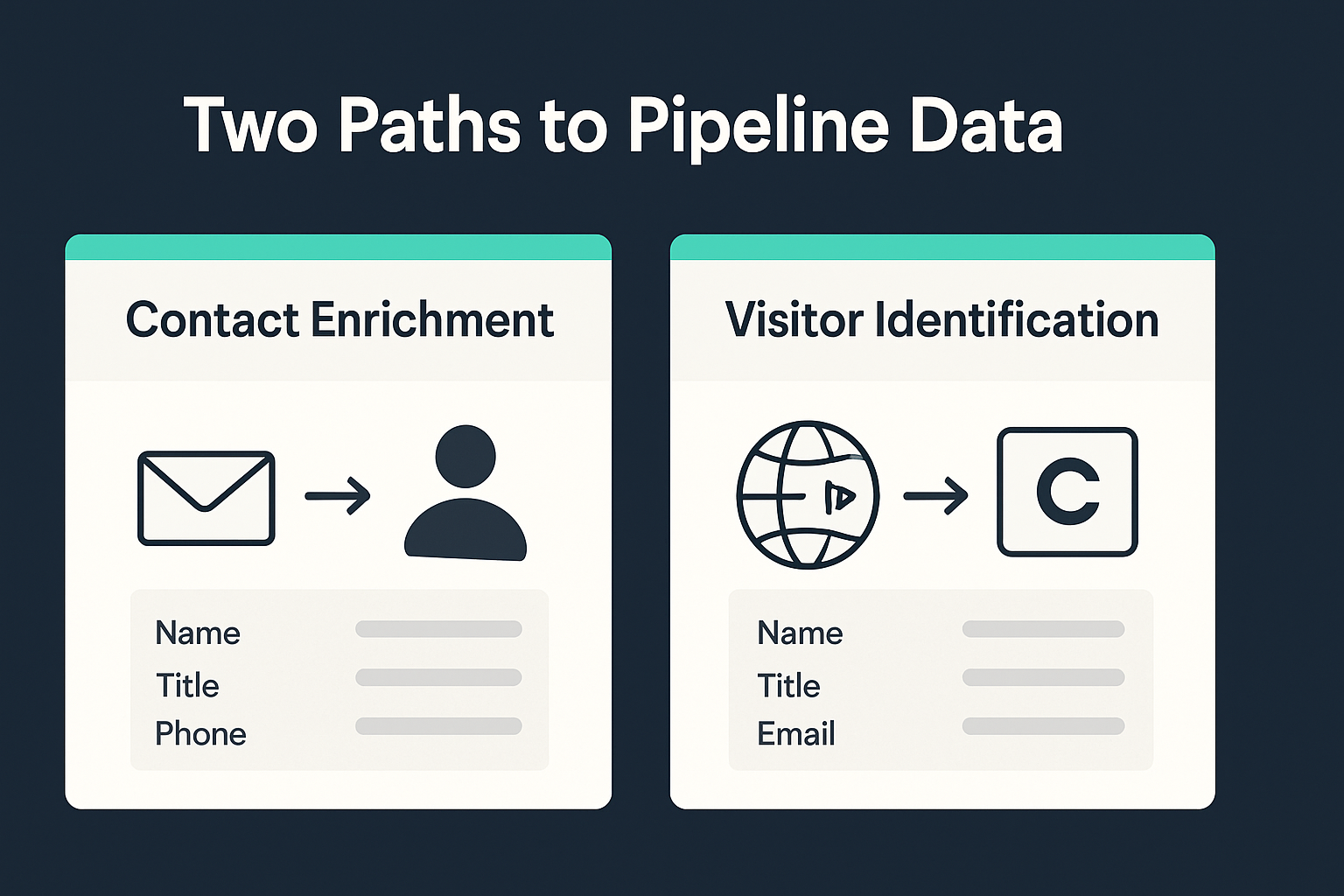
Contact enrichment adds detail to a record you already hold. Visitor identification turns an anonymous website visit into a company or contact record you did not have at all.
Real-world visitor identification match rates in 2026 run 30-65% at the company level and just 5-20% at the person level -- well short of what most vendors advertise.
Google reversed its cookie deprecation plan in April 2025, which means mixed-signal stacks (IP plus surviving cookie data plus company signals) now outperform first-party-only approaches.
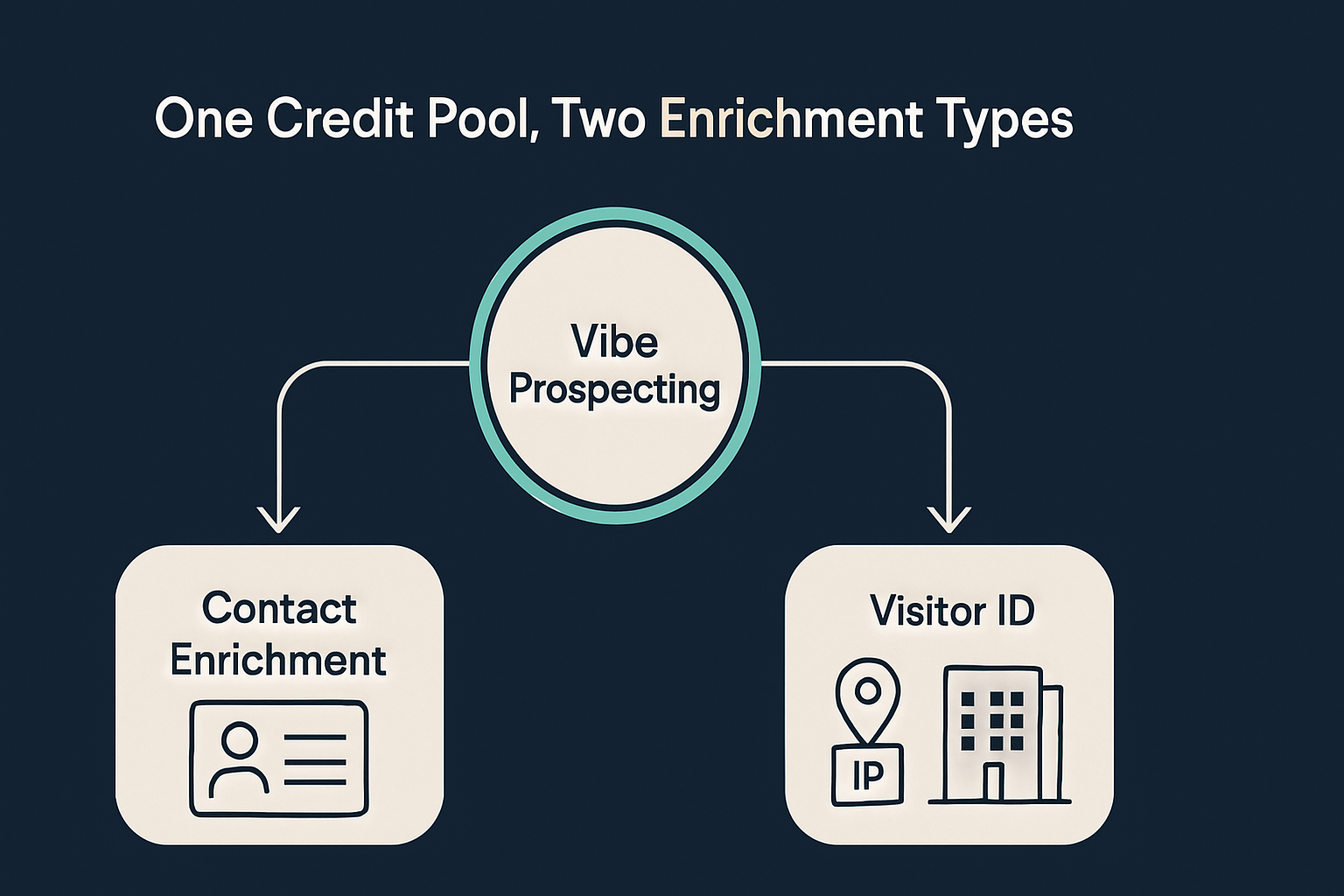
Vibe Prospecting covers both paths from one chat interface, powered by Explorium Enterprise Business Data across 50+ sources and 30 enrichment categories.
Coresignal covers company and employee records well but does not resolve anonymous visitors. Hunter.io handles email lookups only and gates API access to its paid Growth tier.
Start with a free Vibe Prospecting account to test both enrichment paths on real contacts before spending anything.
Someone just hit your pricing page three times this week. No form fill, no chat, no demo request -- just anonymous traffic that almost certainly signals buying intent. If your data stack can only enrich records you already have, that visitor leaves no trace in your pipeline. That gap is where visitor identification and contact enrichment diverge, and understanding the difference can change how much pipeline you build from the same traffic.
These two capabilities share the word "enrichment" in vendor marketing, but they solve opposite problems. Contact enrichment fills in missing fields on a person you already know about. Visitor identification builds a record from scratch starting with an anonymous signal. As of 2026, independent testing puts real visitor identification match rates at 30-65% company-level and just 5-20% person-level -- far below the figures most vendors advertise. This guide explains why, shows you what each path looks like in practice, and covers where Vibe Prospecting, Coresignal, and Hunter.io each fit.
Contact enrichment starts from a record you already hold -- typically an email address, a company domain, or a name -- and appends the fields you are missing. You have the person; you need the phone number, the job title, the company size. The API takes your identifier and returns the gaps filled in.
This is the common case for inbound-heavy teams. Someone submits a demo form with just their work email. Contact enrichment turns that single field into a full profile: title, seniority, mobile number, company headcount, industry. The key constraint is structural -- if you do not have at least one starting identifier, contact enrichment cannot help you.
What a Contact Enrichment Call Looks Like
Here is a literal API example. You send a known email and specify which field groups you want back. The API returns the appended profile for that exact person.
Notice the match_confidence: 0.94 score. Contact enrichment on a valid, active email typically scores well above 0.9 because the identifier already resolves to a known record. The enrichment is filling in fields, not resolving identity from scratch.
What Visitor Identification Actually Does
Visitor identification -- also called discovery enrichment -- runs the opposite direction. You do not have a person. You have an anonymous signal: an IP address, a page path, a session. The API attempts to resolve that signal into a company, and where possible, into named contacts at that company.
This is the right tool for converting anonymous demand into pipeline. That pricing-page visitor with no form fill? Discovery enrichment resolves their IP to a company, returns firmographic data about that company (size, industry, recent funding), and surfaces contacts at the domain you can then reach out to. The structural constraint here is different -- you are doing probabilistic identity resolution, not field appending, which is why the match rates are lower.
What a Visitor Identification Call Looks Like
Here is the second literal example. You send an anonymous IP and page path. The API returns a confidence-scored company match and tells you how many contacts at that domain are retrievable.
The match_confidence: 0.61 score here sits in the middle of the realistic 30-65% company-level range. It is not an error -- it reflects that probabilistic IP resolution genuinely cannot match the confidence level of resolving a known email. The next_call field shows the chain: once you have the company, you scope a contact search to that domain to find names.
Why Person-Level Rates Run So Much Lower
Company resolution maps an IP to a firmographic record. That is a probabilistic match that can correctly identify the organization without linking to any individual. Person-level resolution requires connecting the session or device to a named contact -- which depends on signals that are rarely available for anonymous visitors. The 5-20% ceiling on person-level identification reflects that second step failing in most cases, not any failure in company resolution itself.
Match Rates: What to Actually Plan For in 2026
The gap between advertised and real-world match rates is one of the most common surprises in sales data buying. Vendor marketing frequently cites 60-80%+ company-level match rates. Independent 2026 testing against live traffic samples consistently puts the real range at 30-65% company-level and 5-20% person-level.
Advertised vs Tested Match Rates
Metric
Vendor-advertised
Real-world 2026
Company-level match rate
60-80%+
30-65%
Person-level match rate
Rarely disclosed
5-20%
Contact enrichment on valid email
90%+
90%+ (consistent)
Vibe Prospecting company match accuracy
97.8%+ on confidence-scored resolved matches
Consistent with disclosed figures
The 97.8%+ figure from Vibe Prospecting (powered by Explorium Enterprise Business Data) applies specifically to resolved matches -- records that cleared the confidence threshold. It is not a blanket claim across all queries. See the full data provider comparison before setting a match-rate target for your team.
What Google's Cookie Reversal Changed for Visitor ID
Google reversed its plan to deprecate third-party cookies in Chrome in April 2025 and retired most of Privacy Sandbox that October. This extended cookie-based identity resolution rather than forcing a complete shift to cookieless signals.
The practical effect: vendors that built cookieless-only pipelines to future-proof their positioning lost that argument, while providers running mixed-signal stacks -- IP resolution, surviving cookie data, and company signals together -- now show more stable match rates through 2026. Before trusting any vendor's match-rate figure, ask which signal sources it depends on. A number built on cookie data could shift again; a number built on IP-plus-firmographic will be more durable.
Treat any match-rate figure published before mid-2025 as unverified until confirmed against the post-cookie-reversal signal mix.
How to Decide Which Enrichment Path to Use
The decision rule is straightforward once you separate the two categories. The question is simply: do you already have a record, or are you trying to create one?
The Decision Framework
Inbound form fill with a work email? Contact enrichment appends the rest -- title, phone, company size, seniority.
Anonymous visitor on a high-intent page with no form fill? Visitor identification resolves the company first, then a scoped contact search pulls names from that domain.
ICP target list with zero known contacts? Discovery enrichment from company filters, since there is no existing record to append to.
Stale CRM record from 18+ months ago? Contact enrichment refreshes the title, phone, and any fields that may have changed -- no discovery needed.
Compliance Check Before Turning On Visitor ID
Resolving an anonymous visitor is a separate consent surface from appending data to a record a person already gave you. The visitor never opted in.
Confirm your privacy policy covers IP-based company resolution. Check applicable state-level rules (CCPA, for example) before contacting a resolved person.
Keep discovery-resolved records in a separate CRM stage until a human reviews fit. A resolved company match is not the same as a warm inbound lead.
How Vibe Prospecting, Coresignal, and Hunter.io Each Fit
These three tools cover different slices of the enrichment problem. None of them are interchangeable, and a pricing table that flattens them into one comparison misses the point.
Pricing and Coverage Comparison
What you need
Vibe Prospecting
Coresignal
Hunter.io
Contact enrichment from email or domain
Yes, chat or API, 800M+ people profiles
Yes, employee records via API
Yes, email-focused lookup
Visitor / anonymous IP resolution
Yes, confidence-scored
Not documented
None
Scale per request
Up to 1,000 entities per call
Per-record with separate collection credits
Per-record, 1 credit per email
Pricing model
Single credit pool, free account available
$49/mo to ~$1,500/mo, split credit system
$34/mo to $269/mo, API gated to Growth tier
Company data coverage
150M+ companies
103M+ companies
Not applicable
Chat-first interface
Yes, ChatGPT and Claude plugins available
API only
Web app + API
Where Coresignal Wins a Narrow Slice
Coresignal is a strong choice when a team needs deep employee and company records and does not require visitor identification at all. Its 103M+ company and 792M+ employee dataset is well-regarded. The cost concern is its split credit system: teams running both company and employee lookups in the same workflow burn two credit buckets per enrichment cycle, which can push real spend 30-80% above the base plan figure. See the Coresignal vs Explorium comparison for a full breakdown.
Where Hunter.io Wins a Narrow Slice
Hunter.io is well-suited for teams that only need email lookup and verification at small scale. Its free tier covers basic use, and its paid plans start at $34/month. The practical constraint: programmatic API access is gated behind the Growth tier ($104/month+), so teams on Starter are limited to the web interface. See the 2026 Hunter.io pricing breakdown for tier details. Neither Coresignal nor Hunter.io bridges the gap between contact enrichment and anonymous visitor resolution -- that requires a data provider that covers both paths. See the Explorium vs Hunter.io comparison for more.
"Instead of connecting to multiple data sources and APIs, we only need one connection." - Mirit H., Mid-Market, G2 Verified Review on Explorium
Combining Both Paths Without Creating Duplicate Records
Running contact enrichment and visitor identification together in one pipeline is straightforward as long as you sequence them correctly and de-duplicate on domain before anything reaches your CRM.
Five-Step Implementation Order
Step 1: Set up a free Vibe Prospecting account and test both enrichment paths on a sample of real traffic before scaling.
Step 2: Route anonymous visits through the visitor identification path to resolve company-level matches with confidence scores.
Step 3: For each resolved company above your confidence threshold, run a contact search scoped to that domain to surface names.
Step 4: De-duplicate the output against existing CRM records by company domain before writing any new rows. A company already in your CRM should not generate a duplicate account from the visitor-ID path.
Step 5: Re-run contact enrichment on existing records every quarter to keep job titles and phone numbers current.
Vibe Prospecting handles both the contact enrichment and the visitor identification steps from the same interface, powered by Explorium Enterprise Business Data. You do not need two separate vendors or two credit systems to run the full pipeline. Start free with 100 enrichment credits, no subscription required.