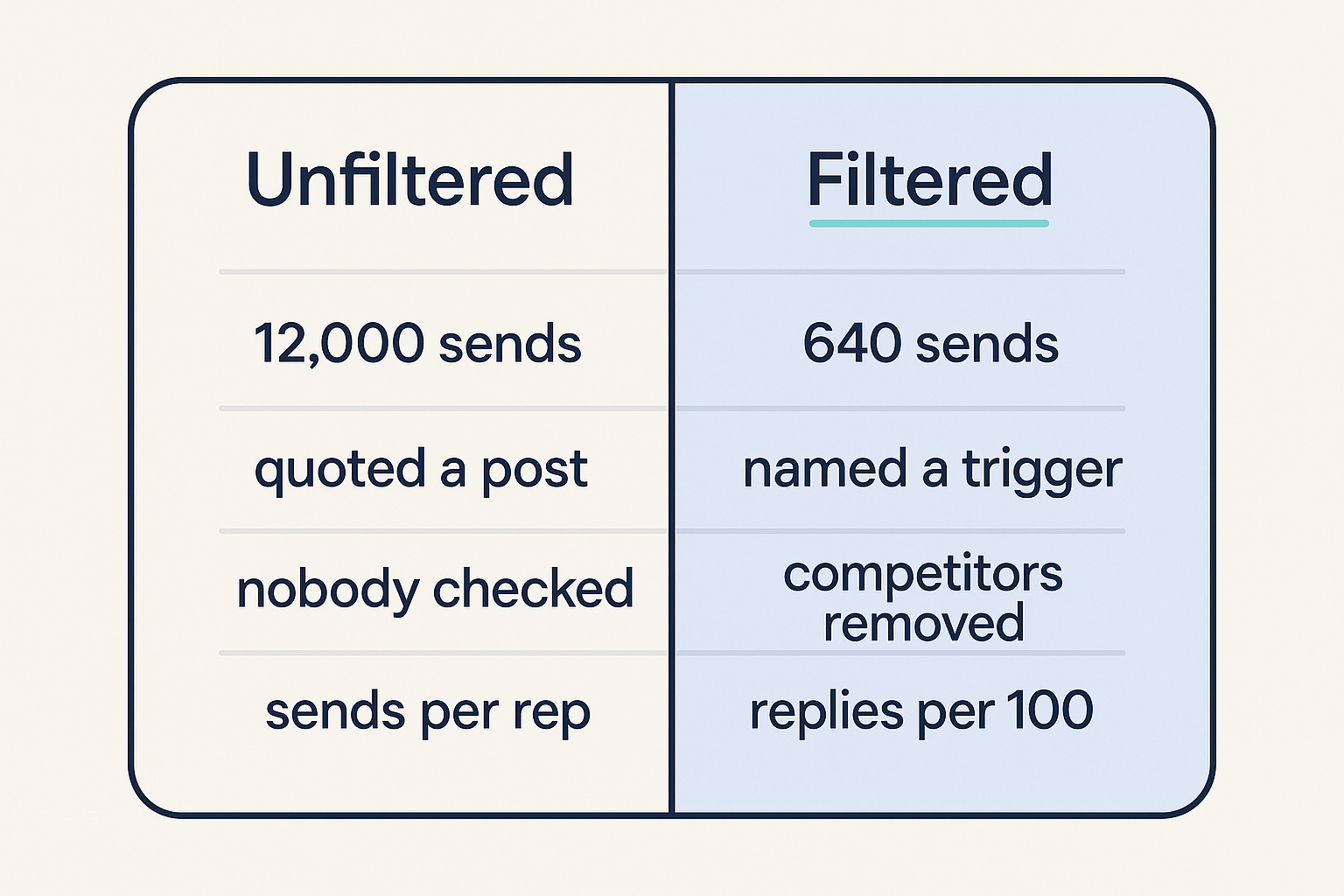


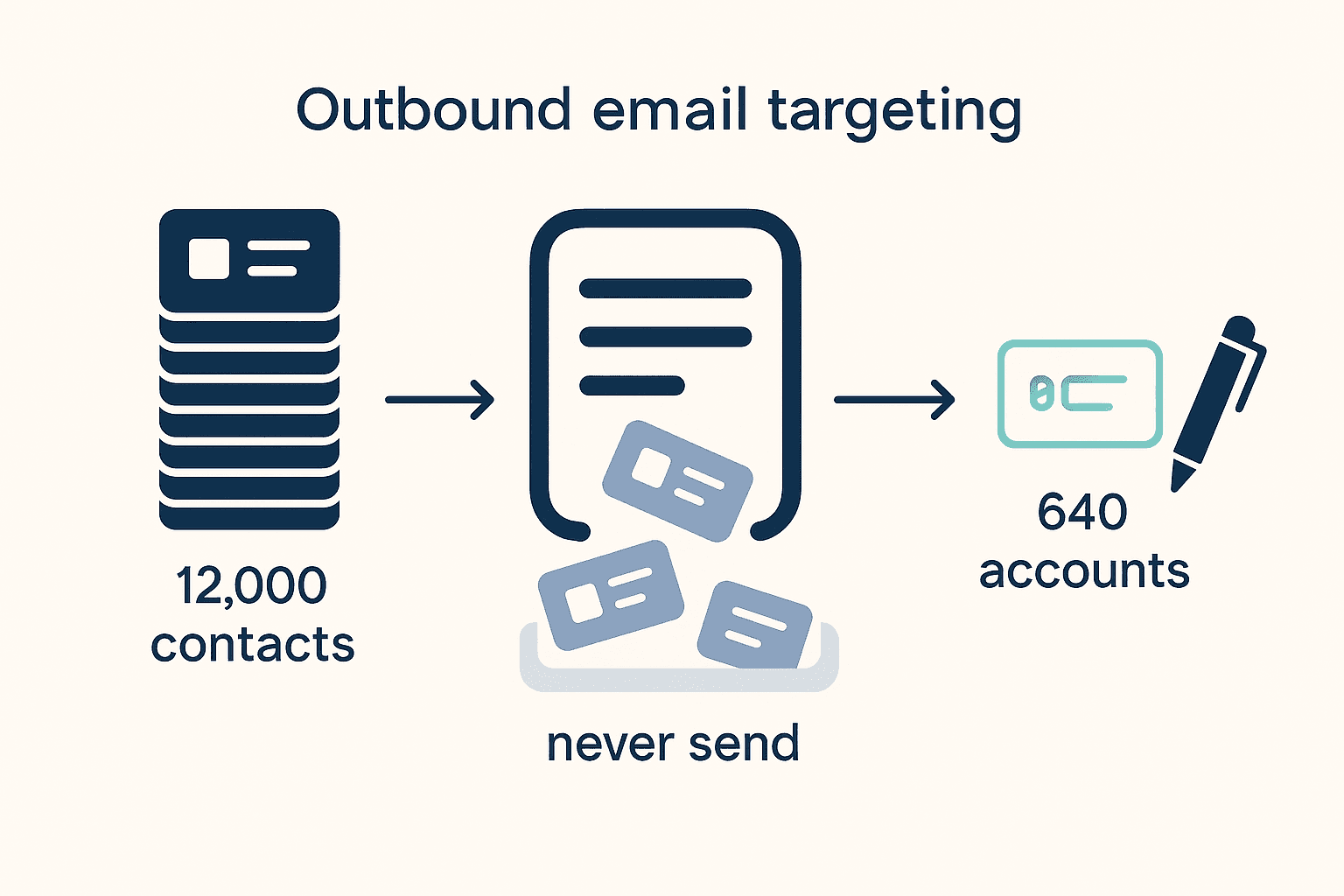
There is a version of this problem that a sharper writing prompt fixes, and it is not the one you have. To stop sending AI slop in outbound, you have to shorten the list rather than polish the sentences, because slop is a fluent message arriving at somebody who was never going to buy. Two numbers set the scene for 2026: cold email now replies at 3.43% on average, and buyers are drowning, with Sopro's State of Prospecting 2026 putting the typical decision-maker at 120 or more sales emails a week.
None of that is a prose problem. It is an aim problem, and the good news is that aim is the part you can fix this afternoon without hiring anyone or changing your writing tool. What follows is the order of operations: who comes out of the list, what earns a message this week, and how to run both in a single chat before a word gets drafted.
Why Good Writing Stopped Rescuing Bad Outreach
Fluency used to be scarce, so it worked as a signal that a human had bothered. In 2026 fluency is free, so the only thing left that separates a welcome message from slop is whether the sender had a reason to pick that account.
What Volume Did to the Inbox
- Sopro found 57% of decision-makers say most of what reaches them feels impersonal and off-target. That is the baseline assumption your message is fighting.
- Pangram Labs scanned 1,002,627 posts and found 40.5% of long-form LinkedIn posts are fully machine-written, more than any other platform.
- Reply rates spread hard: 3.43% on average against 10.7% or better for the top tenth of senders. That spread is mostly about who is on the list.
The Failure Every Team Recognises
A story that went around GTM circles in July 2026: an agent opened its message by referencing something the recipient had posted that week, in accurate detail, and never registered that the recipient was running a rival product. The writing did its job. Nothing upstream of the writing did.
"The personalization technically worked while the judgment failed." Practitioner post, r/gtmengineering, July 2026
Three Tells That Give a Generated Message Away
Recipients are not running a detector. They are running three quick checks, and a message that fails any of them gets filed as slop no matter how clean the grammar is. Read your own last send against these before you touch anything else.
- It opens with something you said in public. Quoting a post back at somebody proves a feed was read. It does not prove the sender knows what the company does or whether it can buy.
- It gives no reason for this week. If the message would have read identically nine months ago, the recipient can tell, and timing is the one thing a busy buyer actually responds to.
- It closes on a generic ask. A fifteen minute chat with no stated subject is the tell that the sender has nothing specific in mind.
Research published in the International Journal of Business Communication in 2025 measured the ceiling on prose alone. Messages built with heavy model assistance came across as sincere to between 40% and 52% of recipients. Lightly assisted messages hit 83%. You can rewrite your way up that gap a little. You cannot rewrite your way out of contacting the wrong company.
What a LinkedIn Slop Report Actually Costs You
On 30 July 2026, LinkedIn put a report option in the three dot menu of every post that lets any reader flag it as apparent AI slop, and those flags feed the classifiers that decide how far a post travels outside your own network. A message that annoys somebody stopped being a private loss.
Why That Is Worse Than Being Ignored
- Being ignored costs you one reply. A reach penalty follows the account and quietly taxes everything it publishes afterwards.
- LinkedIn is also retiring the feature that rewrote your posts for you in favour of one that only proofreads, which tells you which direction the platform is walking.
What to Change on the Social Side
- Apply the same cut to connection requests and comments that you apply to email. An account you removed from the send list should not get touched socially either.
- Post less and post as yourself. The proofreading direction of travel rewards a real voice over a generated one.
The Never-Send List: Who Comes Out Before Anyone Writes
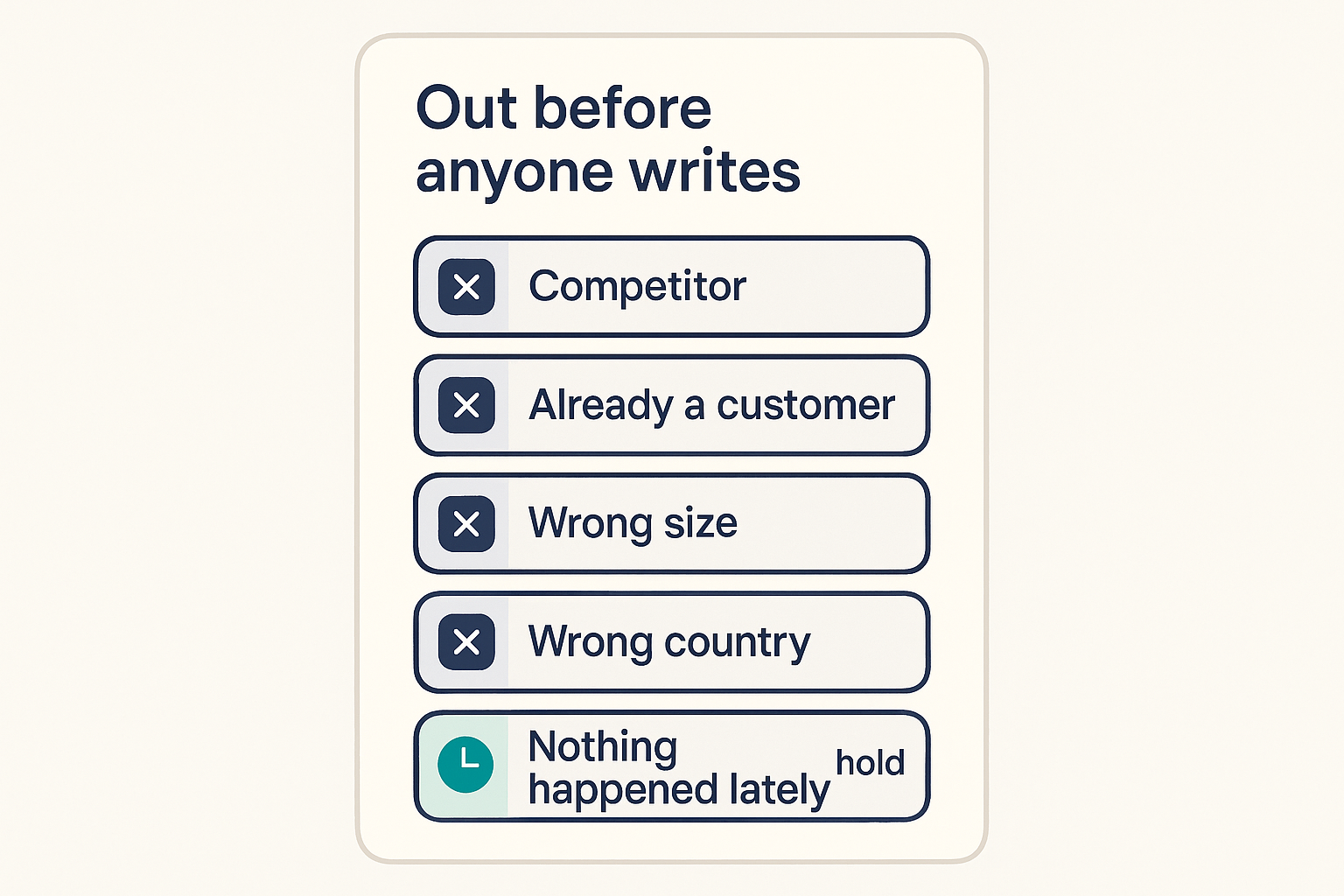
Six groups account for nearly every complaint people post publicly about AI outreach, and all six can be removed mechanically before a single message exists. Four of them are permanent removals. Two are pauses, which matters, because deleting an account that is merely early is how good pipeline gets thrown away.
| Who comes out | How you spot them | What happens next |
|---|---|---|
| Countries you do not sell into | Head office location | Remove, write nothing |
| Companies outside your size band | Employee count, revenue band, industry | Remove for this campaign |
| Competitors and their portfolio | A domain list resolved to stable company records | Remove permanently |
| Accounts a teammate already owns | Your CRM export matched to the same records | Remove, hand to the owner |
| The wrong person at the right company | Job title and level on the contact | Pause, swap in the right role |
| Companies where nothing has happened | No hiring, funding or tooling change in 90 days | Pause, look again next month |
Why Blocking a Domain Is Not Enough
Most teams that email a competitor already had that competitor written down somewhere. The list failed because it was a list of web addresses. Subsidiaries, regional sites, an old name after a rebrand and every brand picked up in an acquisition all slip straight past a text match. Pinning each account to one stable company record first is what turns your removal list into something that actually holds, and it is the same matching step underneath ordinary data enrichment.
Deciding Which Survivors Are Worth This Week
Whatever came through the never-send list is eligible, not urgent. Rank it on three plain questions and message only the top band, then hand the winning answer to whoever writes the message.
| Question | What you look at | Weight | Passing bar |
|---|---|---|---|
| Did something just happen there? | Hiring, funding, a tooling change, a site or pricing change | 40% | At least one event inside 90 days |
| Do they look like your customers? | Employee count, revenue band, industry, the tools they run | 40% | Three of the four inside your range |
| Is there somebody to write to? | A reachable contact at the level that decides | 20% | At least one name |
The Ninety Day Line
- Anything older than three months is history rather than timing. Whoever else was watching has already used it.
- Match the ask to the event. Money raised supports a capacity conversation. A tool swapped out supports a migration one. Recycling the same opener across both is how the message reads generated.
- Re-run the ranking weekly instead of pulling one list in January and working it until March. Explorium keeps a longer primer on what counts as a buying signal if you want the full catalogue.
Running the Whole Cut in One Chat
Vibe Prospecting is the fastest way to do all of this, because the removal pass, the ranking and the drafting happen in the same conversation, on the same set of company records, with nothing charged until you approve a preview. It runs inside Claude and ChatGPT, and it is powered by Explorium Enterprise Business Data, so the company facts behind the cut are the same ones large data teams buy.