

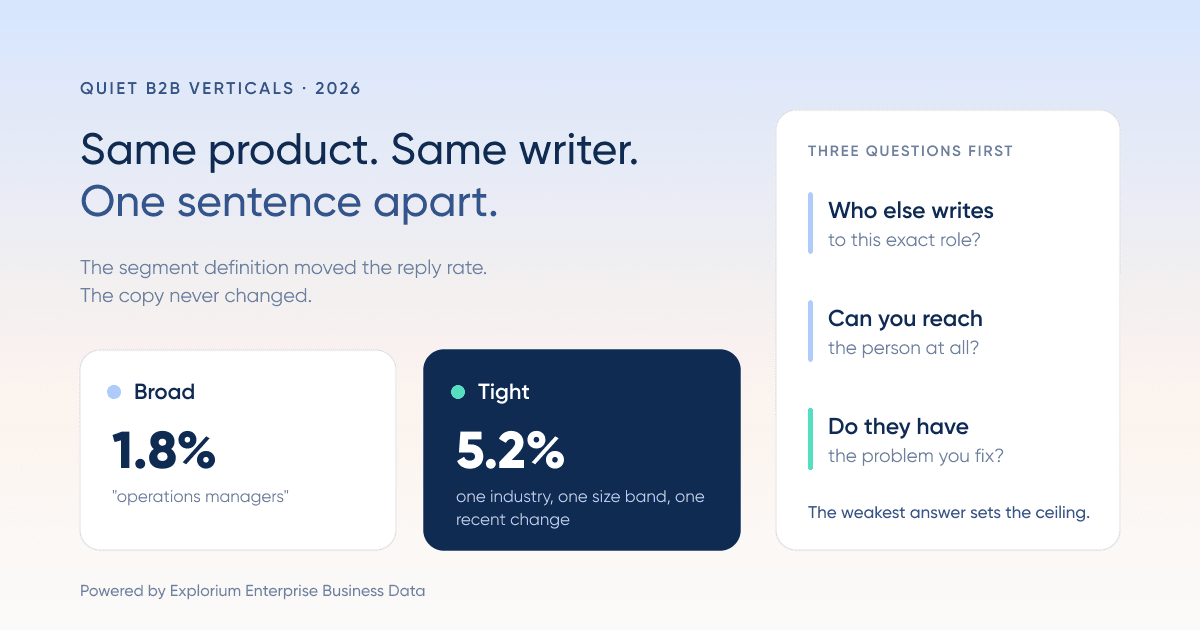
Two campaigns, one product, one writer. The first went out to "operations managers" and came back at a 1.8% reply rate. The second went to "operations managers at food distribution companies with 100 to 250 employees that just opened a new location" and came back at 5.2%. Same offer, same sentences, almost three times the replies. That gap is the whole argument for spending an afternoon on quiet B2B verticals before you spend a quarter sending into a loud one. Three questions tell you which is which, and you can answer all three in a chat window this week.
What "Quiet" Actually Means in a Buyer's Inbox
A vertical is loud when so many sellers write the same pitch to the same job title that replies flatten out around 1% to 2.5% no matter how well the email is written. Loudness is a property of the inbox, not of the industry's size or its budget.
The number everyone quotes, and what it hides
- Across billions of tracked sends, the 2026 platform-wide average sits at 3.43%, down from roughly 7% two years earlier as sending teams picked up AI tooling.
- An average built from every industry at once cannot tell you whether your own 2% is strong work or an early warning.
- The verticals you already know are usually the loud ones, because familiarity mostly tracks where your peers sell.
Where replies still land in 2026
| Segment | Typical reply rate | What that tells you |
|---|---|---|
| Recruitment and staffing | 6% to 8% | Still quiet |
| Mid-market manufacturing and logistics | 5% to 7% | Still quiet |
| IT services | Around 3.5% | Sitting on the average |
| SaaS selling to SaaS | 1% to 3% | Loud |
| Martech | 1% to 2.5% | Loudest room in B2B |
"tech founders and marketing leaders get blasted constantly. theyre fatigued." ... "but construction. logistics. manufacturing. healthcare. these spaces get way less cold email." Practitioner running cold email for 47 companies, r/b2bemailing, August 2026
Question One: Who Else Is Already Writing to This Person?
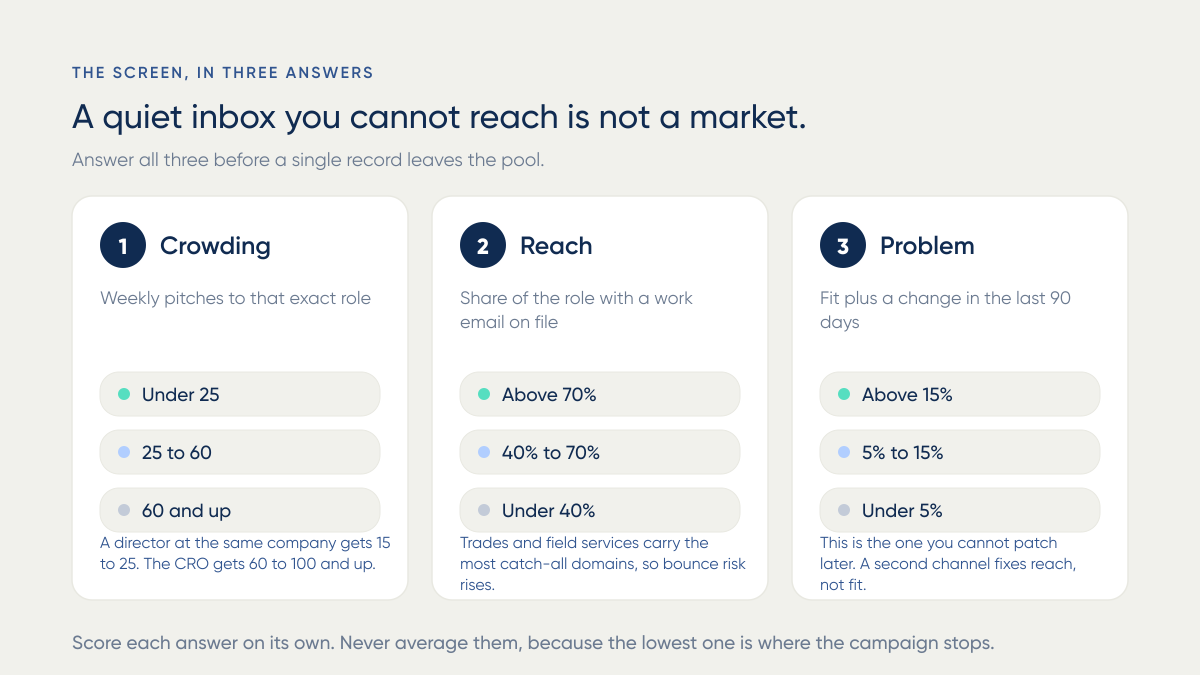
Count the sellers in the category, then count the pitches the exact job title takes in a week: a mid-market CRO fields 60 to 100 and up, while a director inside that same company fields 15 to 25. Crowding lives at the job title as much as the industry.
What you can actually count
- Funded sellers whose own site names that industry as a target market.
- How many companies in the segment already run a competing tool, since install density follows sales attention.
- The pitch load on the exact title you planned to write to, before you commit to writing to it.
Move down a title band before you move industries
The least-pitched person inside a crowded manufacturer is often the operations director, not the executive above them. Dropping one band costs far less than walking away from a vertical you already understand, and recent company activity tells you when that person is in motion.
Question Two: Can You Actually Reach Them?
Ask this one second, because the quietest verticals are usually the hardest to reach: only 86.5% of mail sent to construction firms reaches an inbox where manufacturing gets 89.9%, and catch-all domains cover 12% to 15% of B2B domains while bouncing 3x to 5x more often. At a catch-all domain the receiving server accepts every address handed to it, so nothing you run can confirm a real person is behind the one you have.
The cost of going where nobody goes
- Catch-all, role-based, and shared addresses cluster in trades and field services, which is exactly where the quiet inboxes are.
- Bounce rates several times higher put pressure on the domain carrying your current pipeline.
- A three-point gap in inbox placement quietly costs more replies than most copy edits win back.
Three checks before you build anything
- Email coverage for the exact role you write to, never for the company record, since company-level coverage hides the gaps at role level.
- The share of catch-all domains across a 200-account sample.
- Whether a phone or social path exists as a second channel if coverage comes back thin.
Under roughly 60% coverage on the target role, budget a second channel or pick a different candidate. Keeping the experiment on its own sending domain protects the one your existing pipeline runs through, and there is more detail in Explorium's guide to protecting cold email deliverability at scale.
Question Three: Do They Have the Problem You Fix?
A silent segment means one of two things: nobody has bothered to sell here yet, or nobody here has the problem in the first place. From outside they look the same and they finish very differently, which is why problem density, the share of companies showing the conditions your product exists to fix, is the answer that gates the other two.
Fit says where, a recent change says when
- Fit is structural: how many people, how many sites, which tools they run, which rules they answer to.
- Lists with no recent change behind them reply at 1% to 2%. The same list filtered to a recent change reaches 4% to 8%.
- Explorium's published range for outreach built on recent company activity is 5% to 25% reply against roughly 1.2% for fit-only cold sends.
A free denominator to divide by
The US Census County Business Patterns release counts establishments across roughly 1,000 industries by employee-size band, most recent reference year 2023. Use it as the top of the funnel, count how many of those companies meet your conditions and show a recent change, then divide. The ratio usually lands between 5% and 15%, and it is the number worth arguing about in a planning meeting.
A Worked Example: Food Distribution Against Martech
Run two candidates through the same three questions and the choice stops being a matter of taste.
| What you asked | Food distribution, 100 to 250 people | Martech, 50 to 500 people |
|---|---|---|
| Who else writes to this role | Operations director, 15 to 25 pitches a week | Head of growth, 60 and up |
| Can you reach them | Coverage in the 60% to 70% range, some catch-all risk | Coverage above 90%, almost no bounce risk |
| Do they have the problem | New sites and plant hiring make it visible on roughly 12% | Visible on maybe 4% of accounts |
| Verdict | Send here, budget a phone fallback | Skip, or wait for a better reason |
Why the easier one loses
- Martech wins the reach question outright and loses the two questions that decide revenue.
- Food distribution costs more to reach and still produces the better quarter.
- The pattern repeats across every screen: a reach problem is payable, a problem-density problem is not.
Turning Three Answers Into a Shortlist
Score each answer on its own from 1 to 5, keep only candidates at 4 or higher on problem density and 3 or higher on the other two, and never average the three. The weakest answer is where a campaign stops, so an average hides the exact thing you needed to see.
| Question | Green light | Think twice | Walk away |
|---|---|---|---|
| How crowded is the role | Under 25 pitches a week | 25 to 60 | 60 and up |
| Can you reach them | Coverage above 70% | 40% to 70% | Under 40% |
| Do they have your problem | Above 15% | 5% to 15% | Under 5% |
| How much of it is reachable | Above 3,000 accounts | 500 to 3,000 | Under 500 |
| How recent is the change | Above 10% inside 90 days | 3% to 10% | Under 3% |
Reading the scores without fooling yourself
- A candidate at 4/4/4 beats one at 5/5/2 every single time.
- Thin reach is a budget line. Thin problem density is a dead end.
- Rescore once a quarter, since crowding only ever moves in one direction.
Once the segment is settled, the same three questions work one level down, at the account level, when you build the actual prospect list.
Screening a candidate costs less than one week of sending into the wrong one. Open Vibe Prospecting and size your first segment free
Running the Whole Screen in a Chat Window
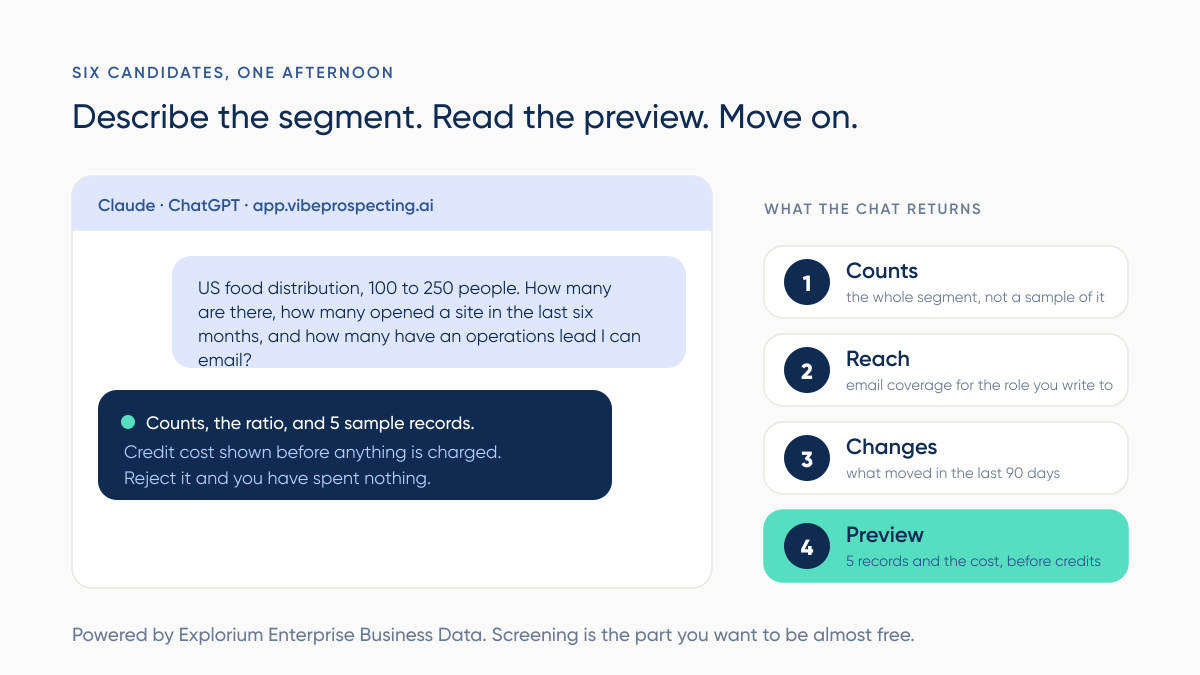
All three questions fit inside one conversation with Vibe Prospecting in Claude or ChatGPT: counts, coverage, and recent activity come back from one connection, with a preview of 5 records and the credit cost before anything is charged. No pipeline to build, no schema to map, no contract to sign first.
One connection covers all three answers
- 150M+ company profiles and 800M+ professional profiles across 50+ premium sources through a single connection.
- Company details, hiring activity, the tools a company runs, funding, and 18 categories of recent company activity across 80+ types, all on one path.
- So questions one, two, and three come back from the same place instead of three vendor trials.
Counts, not samples
- Up to 1,000 companies per call, handled on the server, so a segment gets measured instead of sampled.
- Tools that load every record into the chat context stall at 20 to 100 records per run, which is nowhere near enough to measure a market.
- 97.8%+ company match accuracy keeps the counts steady when you rerun the same question next quarter.
Rejecting five of six should cost almost nothing
- A free account, minutes to the first answer, no sales call in the way.
- One shared credit pool across every call, which is what keeps a six-candidate screen affordable.
- Ask, preview 5 records with the cost attached, then decide whether to build. Rejecting a candidate spends nothing.