


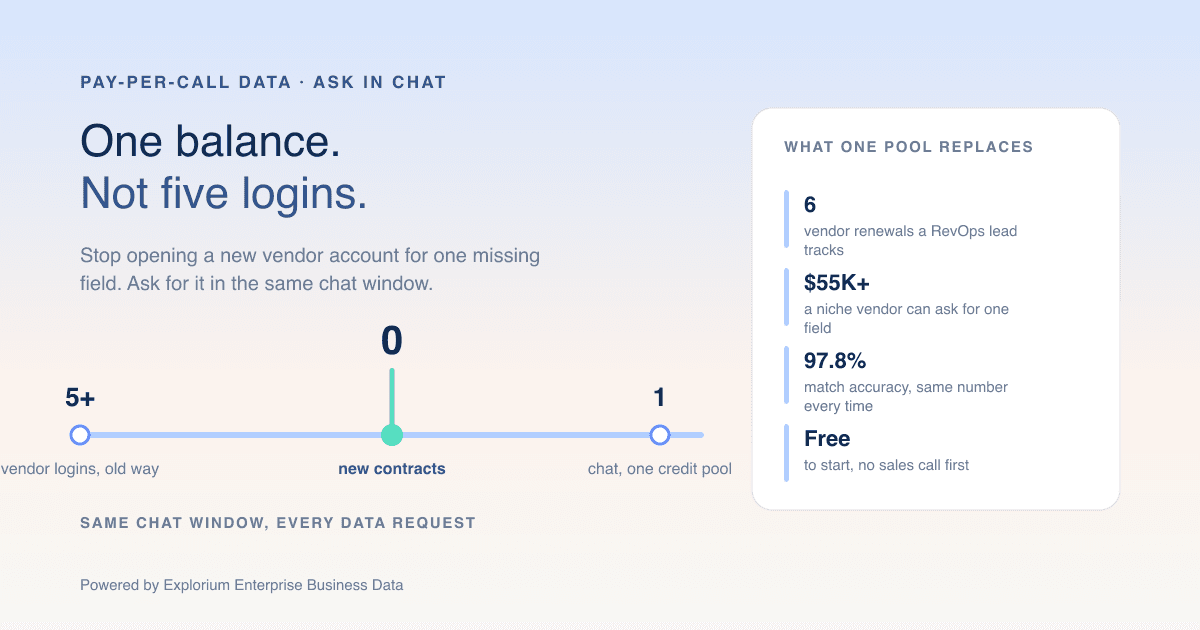
Most sales teams don't realize how many logins it takes to answer one question about a prospect until they count them. Company size from one tool, funding from another, a technology stack from a third, and a buying signal from a fourth, each with its own bill and its own renewal date. Pay-per-call B2B data access flips that: one shared credit balance, asked for in a single chat, covers company details, contact details, and recent activity without a new contract every time the question changes.
This matters most for small teams that don't have a procurement department to absorb the friction. A five-person sales team doesn't have time to evaluate a new vendor every time a gap shows up in a prospect list, and a founder doing their own outbound definitely doesn't. The rest of this guide walks through what changes when the billing unit becomes the chat request instead of the seat, and why a router sitting in front of many vendors is not the same fix as one provider behind a single balance.
What Pay-Per-Call B2B Data Access Actually Means
Pay-per-call access means you spend from one shared credit balance for whatever you ask for, company details, contact details, or recent activity, instead of buying a seat or signing a yearly deal per data type. The unit that gets billed is the request, and the balance covers everything in the account.
Why the Per-Vendor Login Model Breaks Small Teams
- Every new question (company size, funding stage, tech stack, hiring activity) has traditionally meant a new tool, a new login, and a new invoice to track.
- Minimum annual spend punishes a small team that only needs a handful of lookups from a specialty source.
- Copy-pasting between five browser tabs doesn't scale past a couple of prospects a day, let alone a full list.
- Getting a new vendor approved can take weeks, which stalls a campaign that was ready to go out this week.
What One Shared Balance Enables
- One account can be set up per person or per team without a purchase order each time someone needs a new kind of data.
- The same balance covers company search, contact details, and buying signals, so nobody is ever blocked waiting on a second tool.
- A preview shows what you'll get and what it costs before anything is spent, so a bad search doesn't quietly burn the balance.
- One accuracy number applies across every kind of record, not a different confidence level depending on which vendor happened to answer.
Why Teams Are Walking Away From Per-Vendor Contracts
Sales and RevOps teams are consolidating because chasing five vendors for one prospect list wastes hours that should go to actual selling, and a stack of contracts adds coordination work nobody signed up for. Some companies now hire a person whose entire job is untangling this.
The Hidden Cost of Five Separate Logins
"We were stitching exports from three different tools together by hand for every list." RevOps Lead, mid-market SaaS, via LinkedIn
What Consolidating Actually Saves
- Each extra tool means another login, another export format, and another spreadsheet to reconcile before the list is usable.
- Tracking spend gets harder as tools pile up: five separate bills means five places a small overspend can hide.
- Data quality drifts across sources, so a rep pulling company size from one tool and tech stack from another ends up with two records that quietly disagree.
Do You Need a Router in Front of Many Vendors, or One Provider Behind a Single Balance?
A router cuts down the number of bills you get, but it doesn't touch the bigger problem: every vendor behind that router still has its own idea of what counts as a match. One provider behind a single balance solves both the billing problem and the trust problem at once.
What a Router Actually Fixes
- Pay-per-call routers, like Orthogonal, which raised a $4.3M seed in June 2026, connect one integration to 35+ third-party data sources through a single balance.
- That's a real improvement over juggling 35 separate logins and 35 separate invoices by hand.
What a Router Leaves Unsolved
- Each source behind the router still has its own match rate and its own definition of what counts as accurate, so the output you get back is inconsistent.
- Public documentation for these routers doesn't spell out spend limits or who on a team can see what, so cost control is still a manual job.
- Routing purely on price can send a lookup to whichever source costs the least at that moment, not whichever one is most likely to be right.
| What you're comparing | Router (e.g., Orthogonal) | Single provider (Vibe Prospecting) |
|---|---|---|
| Logins to manage | One integration, still 35+ underlying data sources | One chat, one data source behind it |
| Accuracy you can count on | Changes depending which source answered | 97.8%+ company match accuracy, every record |
| Volume per request | Limited by whichever source is routed to | Up to 1,000 records per call, 100 requests/sec sustained |
| Spend visibility | Not publicly documented | One shared balance, spend caps by use case |
A single provider like Vibe Prospecting sidesteps the router problem entirely by pulling from Explorium Enterprise Business Data behind one balance and one accuracy number, instead of passing that inconsistency on to whoever is building the list.
Is a Full Annual Contract Worth It for One Missing Field?
For most specialty data, no. A full-year commitment for one missing field almost never pays off for a small team that only needs it occasionally. Some specialty vendors publish pricing in the $24,000 to $80,000 a year range with a median around $55,000, and no free trial to test it first.
The Real Cost of a Niche Vendor Contract
"If a data point only comes up a few times a month, do you really want a five-figure contract for it, or just the ability to ask for it when you need it?" Founder, seed-stage startup, via LinkedIn
What Credit-Based Access Looks Like Instead
- A $55,000 commitment for one occasional field doesn't make sense when a small team might only need it a few hundred times a year.
- A shared credit balance lets you pull that same field on demand and only pay for the times you actually use it.
- The specialty data point becomes one more thing you can ask for in chat, not a new bill to justify every renewal cycle.
Still juggling three separate logins to build one prospect list? Try Vibe Prospecting free, no sales call required →
Vibe Prospecting: One Balance for Every Data Request
Vibe Prospecting is built to answer this exact tradeoff: one chat and one shared credit balance cover company lookups, contact details, and recent buying activity, running on data built for production scale with no separate allocation to plan around per data type.
One Place for Every Data Need
- One account covers company search, contact lookup, and recent company activity through the same chat you're already using.
- Dozens of buying-signal types come through the same balance, so there's no separate signals subscription to manage on top.
- Data is pulled together from Explorium's Enterprise Business Data, so you get one consistent set of answers instead of reconciling five.
- Company match accuracy holds at 97.8%+ across the board, not just in the categories a vendor happens to specialize in.
Built to Keep Up With a Real List, Not Just a Sample
- Up to 1,000 records can move through one request, so a full list build doesn't take a thousand back-and-forth messages.
- The system sustains up to 100 requests a second, so it isn't the slow part of your workflow even on a busy day.
- Server-side batching means you're not stuck copying results a few dozen at a time.
Affordable From Day One
- A free account gets you a working setup in minutes, no sales call and no procurement form.
- Every request draws from one shared pool, so a busy week of contact lookups doesn't strand credits meant for something else.
- There's no per-seat tax and nothing to over-buy in advance to cover a category you might not even need.
- A preview shows what a search will return and roughly what it costs before anything is spent.

