Find At-Risk Customers Before the Renewal Call: The Chat-First Routine
Renewals turn on things your product cannot see. Here is how to ask in chat what changed at your customers, in one message, and then act inside 48 hours.
Vibe Prospecting team8 min readSeptember 7, 2026
TL;DR
Renewals are decided in the ninety days before the call, and almost every deciding event happens outside your product.
Reach out inside 48 hours of a change and a customer is 33% more likely to renew, so speed matters more than scoring.
A champion leaving carries a 51% chance of churn within a year, and 65% of accounts with an executive change do not renew.
The whole check is now one chat message: paste your customer names, ask what changed in the last quarter, read the three lines that come back.
Ask, preview, copy, book. Twenty minutes on Monday, no scheduled job and no fifth tool for your team to open.
Ship what happened, when it happened, and the question to ask. Never a risk number, and never an automatic message to the customer.
Vibe Prospecting runs in Claude and ChatGPT, powered by Explorium Enterprise Business Data, and starts on a free account.
Most renewals are decided in the ninety days before the call, not on it. Someone signs off on a spending freeze, the person who championed you takes a job somewhere else, a new owner arrives with a vendor it already likes. None of that shows up in your product. If you want to find at-risk customers before the renewal call, you have to look at what changed outside your own four walls, and the fastest way to do that now is to ask in chat.
Three numbers make the case. Reach out inside 48 hours of a change and the customer is 33% more likely to renew. Wait, and you are working against a 51% chance of churn within a year after a champion leaves, plus a 65% non-renewal rate on accounts where an executive changed. Speed is the whole game, and speed is a data-coverage question rather than a platform question.
A Champion Leaving Is the Loudest Signal You Never See
The person who fought for your renewal internally is the single most valuable thing to monitor, and the day they update their job title is the day your clock starts. Nobody sends you an email about it. Your calls just get quieter, and by the time you notice the pattern you are three weeks into a 48-hour window.
Two kinds of move count. Someone leaving for another company is obvious. Someone moving to a different team inside the same company matters just as much, because the person who defended your line item no longer owns it. Both are public facts with a date attached, which is what makes them worth checking on a schedule instead of guessing.
What to Ask When You Only Have Names
You do not need a list of IDs or a data model. Paste the people and the companies they work at, in plain text, and ask what changed. Vibe Prospecting runs in Claude and ChatGPT as a connector, so the whole check is one message.
Text
Here are the main contacts at three of my customers:

Dana Reyes, Northwind Trading
Sam Okafor, Halden Labs
Priya Menon, Corvin Systems

For each person, check whether they changed companies or changed
roles in the last 90 days. If they did, tell me who holds that job
now and when the change happened.
What comes back is a person, a date, and the name of whoever holds that role now. That is enough to open a task the same morning, which is the only part of this that actually protects the renewal.
What You Can Ask in One Chat Message
A customer review that used to need a scheduled script and a warehouse is now a single prompt with your customer names pasted underneath it. This is the part that changed. The company facts behind it, drawn from 150M+ company profiles and 18 categories of company activity, are the same ones data teams have pulled through an API for years. The difference is that you can now ask for them in a sentence.
The Three Asks That Cover Most of It
The people ask: did any of my named contacts change jobs or change roles recently?
The company ask: did anything happen at these companies in the last quarter that affects how much they spend?
The shape ask: is the team we sell into getting bigger or smaller compared with last quarter?
Run all three against the same pasted list and you have a monthly review that takes one coffee. Here is the company ask, written the way you would actually type it.
Text
Here is my customer list, company name and website:

Northwind Trading, northwindtrading.com
Halden Labs, haldenlabs.com
Corvin Systems, corvinsystems.com

Look at the last 90 days for each company and tell me if any of
these happened: an acquisition, cost cutting, an office closing,
a hiring pause, a funding round, or a new office.

Give me one line per company: what happened, the date, and one
question I should ask on my next call. Leave out the companies
where nothing happened.
Note the last instruction. Asking it to leave out the quiet companies is what turns a wall of text into three lines you will actually read, and it is the difference between a habit and an abandoned tab.
Where Product Usage Data Runs Out
Seats, logins and support tickets tell you what already happened; they move after a customer has quietly decided to leave. That is not a flaw in your reporting. Your product simply cannot observe the meeting where someone decided to consolidate vendors next quarter.
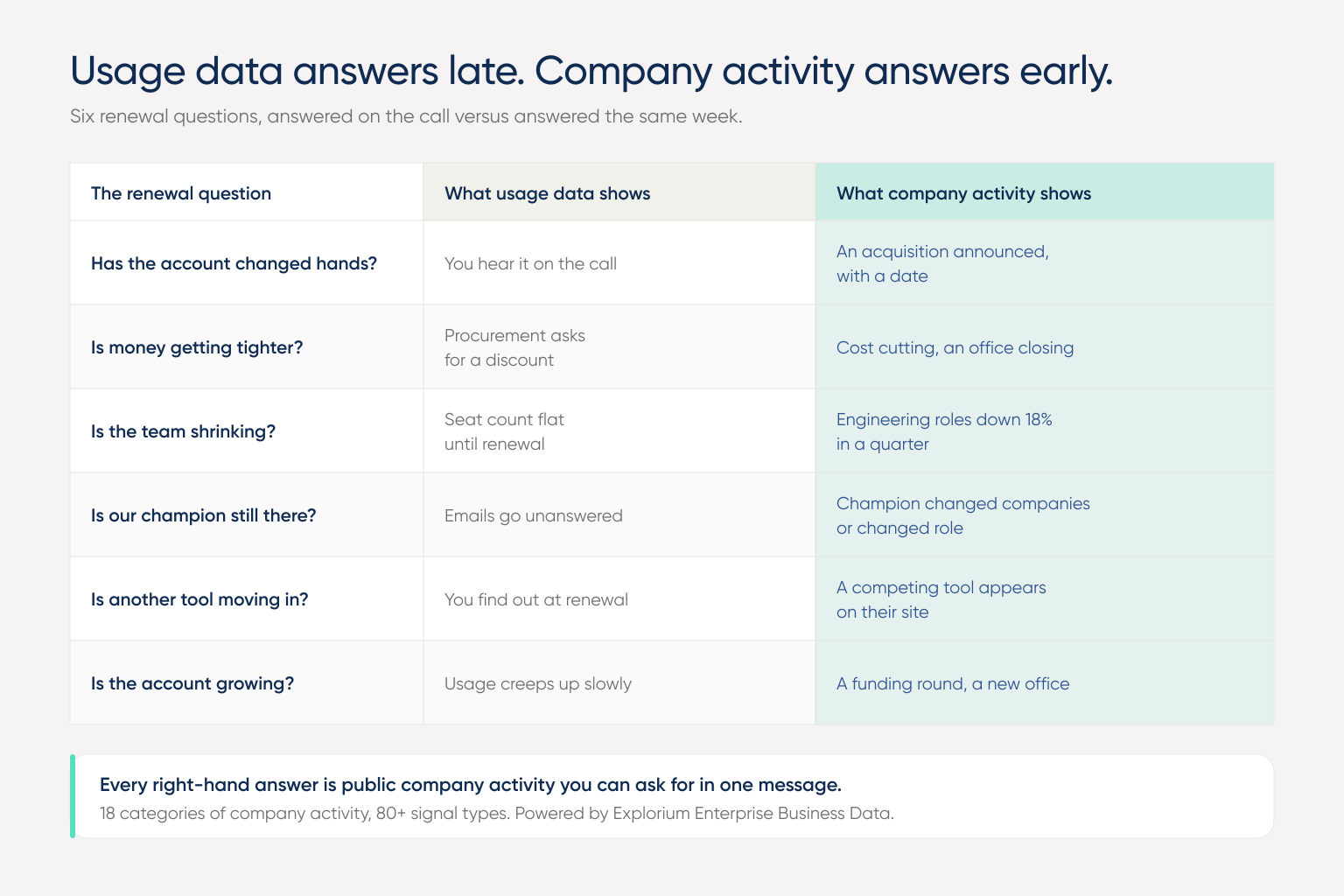
Line the two up side by side and the timing gap is obvious. The left column is what you find out on the call. The right column is what you could have known the same week.
The renewal question
What usage data shows
What company activity shows
Has the account changed hands?
You hear it on the call
An acquisition, with a date
Is money getting tighter?
Procurement asks for a discount
Cost cutting, an office closing
Is the team shrinking?
Seat count flat until renewal
Engineering roles down 18% in a quarter
Is our champion still there?
Emails go unanswered
Champion changed companies or role
Is another tool moving in?
You find out at renewal
A competing tool appears on their site
Is the account growing?
Usage creeps up slowly
A funding round, a new office
Six Kinds of Company Activity Worth a Monthly Look
Six families of company activity carry most of the warning: ownership changes, cost pressure, headcount contraction, people moves, tool swaps, and funding on the upside. They are the same kinds of B2B buying signals new-business teams watch, pointed at the customers you already have.
The Four That Mean Slow Down
A new owner. An acquisition usually arrives with a consolidation mandate and an incumbent supplier on the other side.
Cost pressure. Cost cutting programs and office closings show up publicly well before procurement calls you about your price.
A shrinking team. Roles in the department you serve dropping quarter over quarter while your seat count sits flat is a renegotiation waiting to happen.
Trouble elsewhere. Lawsuits, outages and security incidents move a customer's attention somewhere that is not your product.
The Two That Mean Lean In
New money. A funding round, a new investor or a public listing puts a date on when spending opens up again.
New surface area. Hiring pushes, a new office, a new product or a new partnership each mean a team that could use what you already sell them.
Both directions run through the same ask, which is why building only the churn half is a waste. Companies also burn roughly $21M a year on software nobody opens, up 14.2% year over year, so a customer looking for something to cut is a live risk even when nothing dramatic happened.
Twenty Minutes on Monday: Ask, Preview, Copy, Book
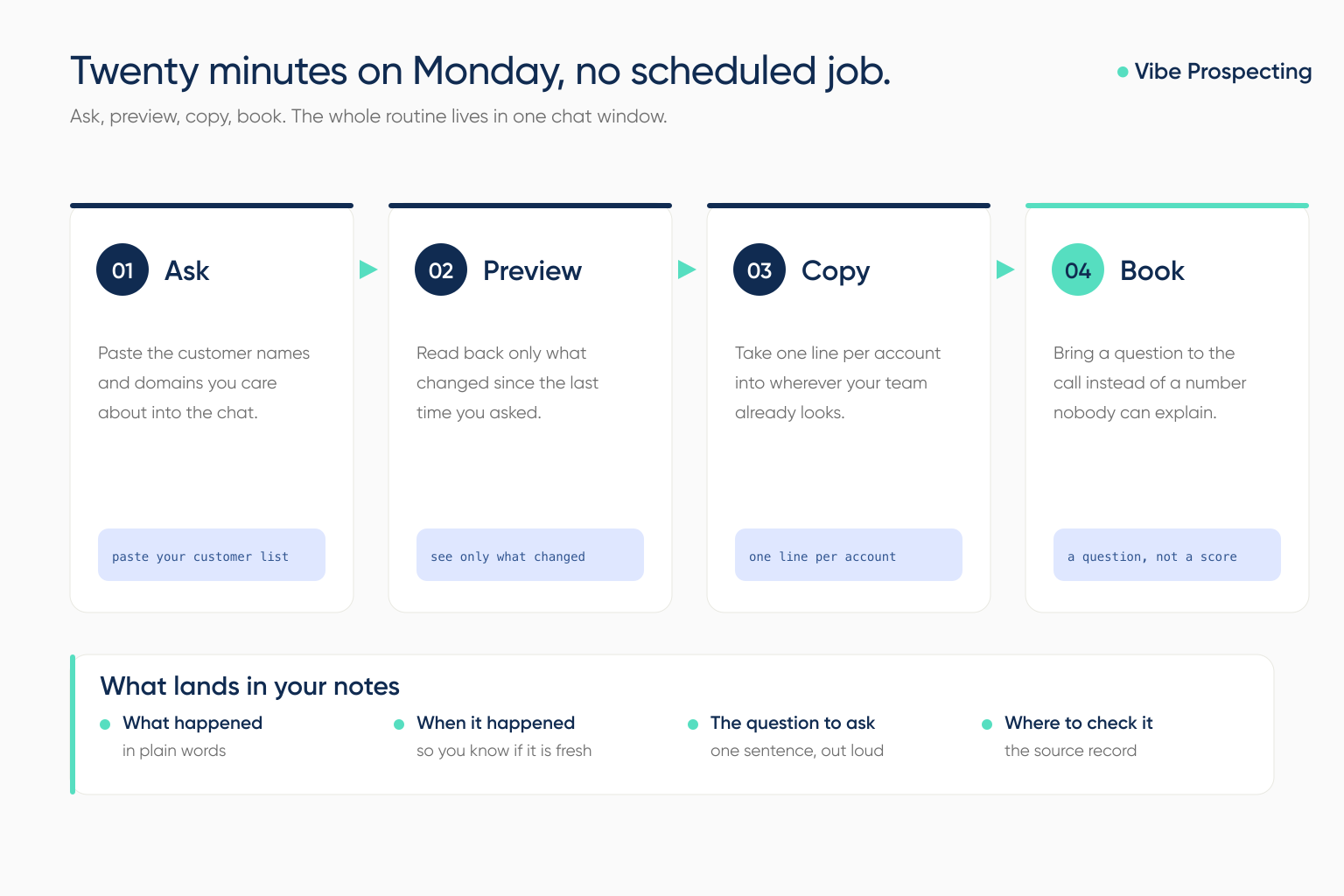
The routine is four moves, all of them inside one chat window: ask what changed, preview only the new stuff, copy the lines that matter, book the calls. No scheduled job, no pipeline to maintain, no fifth tool for your team to remember to open.
Ask. Paste the customer names and websites you care about, with the window you want to look at.
Preview. Read back what is new since the last time you asked, and nothing else.
Copy. Move one line per customer into wherever your team already looks on Monday.
Book. Take the question, not the number, into the call.
When You Want It to Run Itself
Once the habit sticks, the same asks can run from the terminal instead of a chat window. The Vibe Prospecting plugin installs into Claude Code in one command, and from there you can point it at a saved customer file on a schedule you control.
Claude Code
# one-time install in Claude Code
# github.com/explorium-ai/vibeprospecting-plugin
/plugin install vibe-prospecting@claude-plugins-official

# then, on Monday morning, point it at a saved file
Read customers.csv. For every row, check what changed in the last
seven days. Append anything new to renewal-watch.md with the date
and one suggested question. Skip rows with nothing new.
Do not start here, though. Run the chat version by hand for three weeks first, because the thing that breaks these projects is not the setup, it is discovering in month two that nobody was reading the output.
Turning a Signal Into One Line a Human Reads
Ship three fields per customer and stop there: what happened, when it happened, and the one question to ask about it. Resist rolling any of it into a risk number. A score hides its own reasoning, and the reasoning is the only part your team can act on in a conversation.
"health scores often replace real relationships" (@Hyperengageio, August 2026)
Three Things to Keep Manual
The outreach itself. Never fire an automatic message off the back of a company change. The customer lived through it and you did not.
The write-back. Copy the line into your own system yourself, beside whatever score you already keep, so there is a person behind every entry.
The judgement call. One office closing on the far side of the world is a footnote. That same closing plus a shrinking team is a conversation.
This works better without one, not worse, because there is no dashboard competing for the same twenty minutes. A founder with 30 customers, an account executive carrying their own renewals, or a two-person team running post-sale out of a spreadsheet all have the same setup: a list of names, a chat window, and a place to write things down.
Your customer list is the input. A spreadsheet column of company names and websites is a complete starting point.
Your notes are the output. The document you already open before a call beats a tool nobody logs into.
Your calendar is the trigger. Twenty minutes on Monday, or the week you open any renewal, and that is the entire process.
You can also run the same asks in the Vibe Prospecting web app if you would rather keep customer work out of a general chat thread.
What Actually Leaves Your Systems
You send a company name, a website or a person and a company; what comes back is public information about that company. Your contracts, tickets, transcripts and usage records stay exactly where they are, because none of them are part of the ask.
The input is an identifier. A company name, a domain, a contact and where they work.
The output is company-level fact: an acquisition, a funding round, a hiring trend, a job change.
Vibe Prospecting is powered by Explorium Enterprise Business Data, so the source behind an answer is one pipeline you can point your own review at rather than a blend of unnamed suppliers.
Run it through whatever vendor review you normally run. Explorium publishes its security posture for that purpose, and if you want a structured way to interrogate any data supplier, this vendor review checklist is a reasonable starting point.
Start With Your Next Ten Renewals
Take the ten customers with the nearest renewal dates and run one ask against them this week. Ten is small enough to finish in an afternoon and big enough that one saved renewal pays for the habit many times over.
Step 1: Add Vibe Prospecting from the Claude or ChatGPT connector directory, on a free account.
Step 2: Paste ten company names and websites, and ask what happened in the last quarter.
Step 3: Paste the named contact at each one, and ask who changed jobs or roles.
Step 4: Write the survivors into your notes as signal, date and question.
Step 5: Ask again in a month, and only read what is new.
Then judge it on one question: did anyone bring a line from that list into a customer call? If yes, widen it to the whole book. If no, the asks were too broad, not the idea. For the timing logic behind the same signals on the new-business side, see buying signals and outreach timing.
Stop finding out on the renewal call. Ask what changed, get one line per customer, and start on a free account. Try Vibe Prospecting free →