Decide Who Never Gets the Email: Cutting Bad-Fit Leads Before Outbound
Cold outbound fails on the list, not the copy. Cut bad-fit leads in chat before you write, label every removal, and prove the filter is not eating good names.
Vibe Prospecting team8 min readSeptember 8, 2026
TL;DR
Most cold outbound underperforms because of who is on the list, not how the email is written. A person on the wrong team cannot reply well to any copy.
A cut pass is a short sequence of plain-language questions that removes people who cannot buy, before you write anything, with a readable label on every removal.
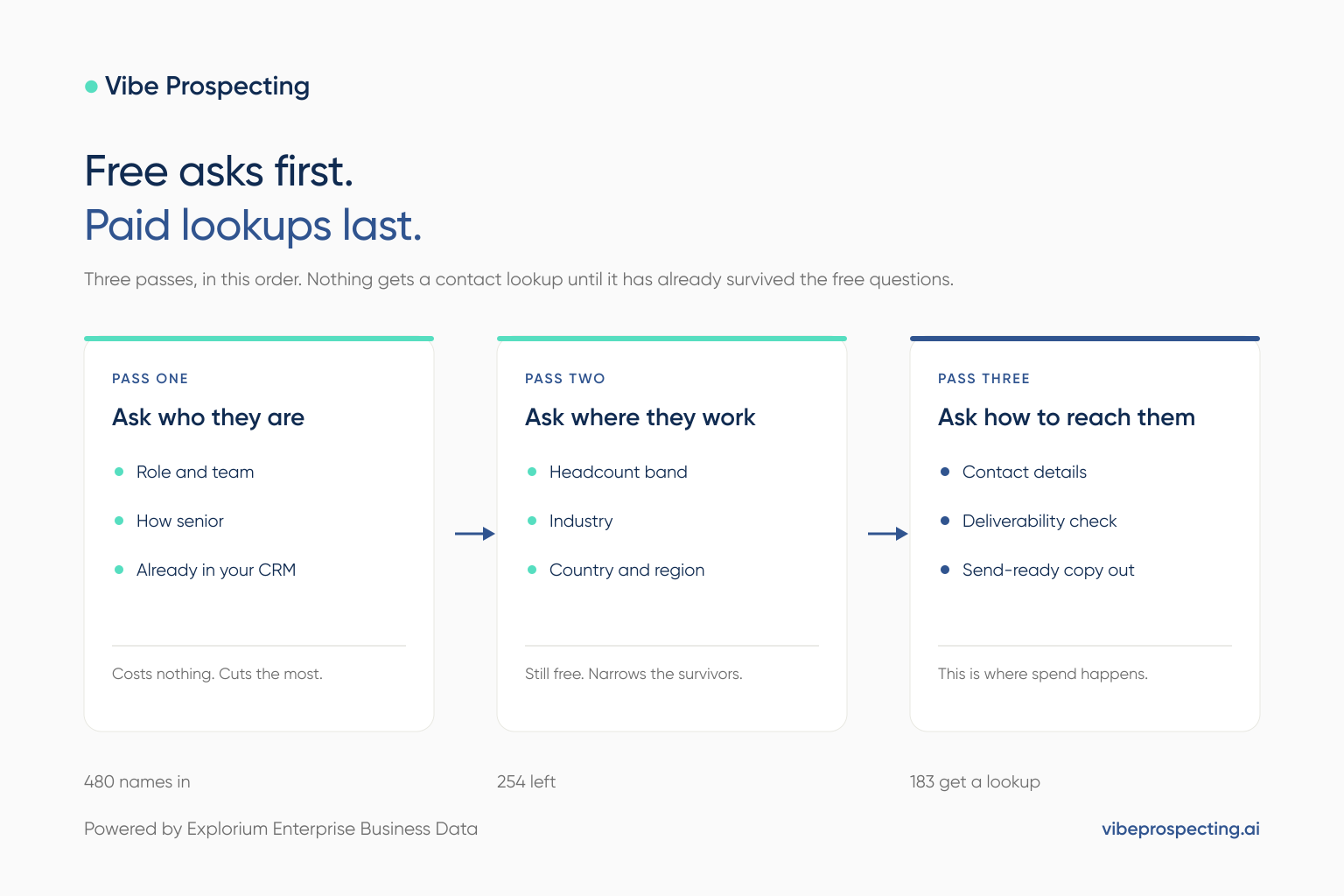
Ask the free questions first: team, seniority, already-contacted, then headcount, industry and region. Contact lookups come last, on survivors only.
On a 480-name example, the free passes remove 297 people who then never trigger a metered lookup at $0.003 to $0.008 per contact.
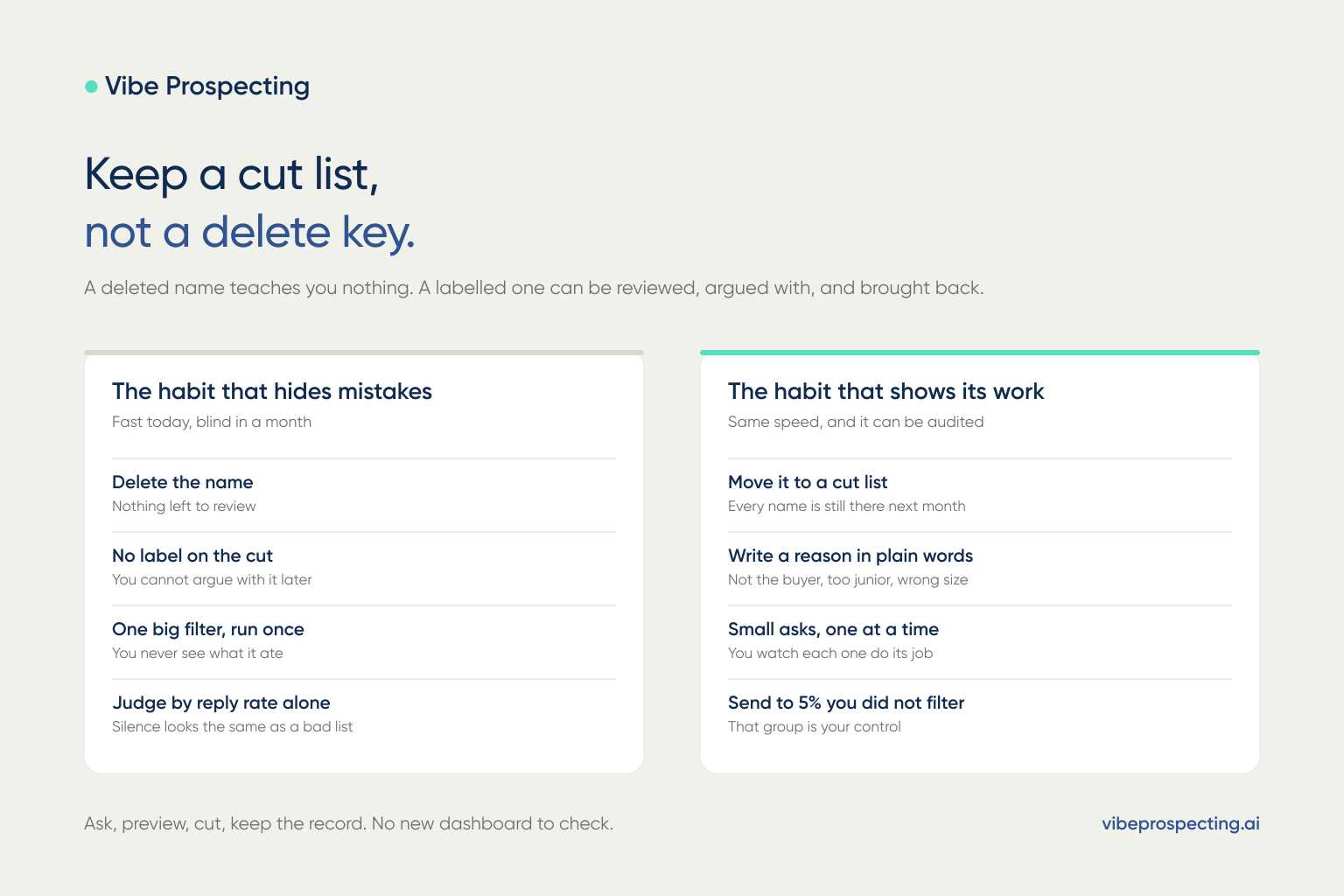
Never delete a removed name. Keep a labelled cut list, read twenty-five of them a week, and hold back one in twenty unfiltered as a control group.
Facts go stale faster than rules: 70.8% of business contacts change within a year, so re-ask the person questions quarterly and re-check your cut list too.
Two hundred emails out, three replies, two of them autoresponders. The instinct is to go rewrite the opening line. The better move is to look at who received it, because most of those two hundred people were never going to answer no matter what you wrote. Cutting bad-fit leads before outbound is the step almost nobody does deliberately, and it is the one that moves your numbers.
The evidence is not subtle. Small, tightly aimed sends reply at about 2.8 times the rate of large loose ones, 5.8% against 2.1%. The platform-wide average has slid to 3.43% in 2026, from 5.1% two years earlier. And once your bounce rate crosses 2% your sending domain starts paying for it in ways that take weeks to repair. Sending to more people is not a neutral choice.
Why your reply rate is a list problem, not a writing problem
Writing better copy raises the odds that someone who could buy from you decides to answer. It does nothing for the person in the wrong department, at the wrong company size, three levels below anyone who signs anything. That person is not a hard prospect. That person is a zero.
What a cut pass is
A cut pass is a short sequence of questions you put to your list before you write anything, each one removing the people who plainly cannot buy, each removal carrying a plain-words label you can read back later. It is subtraction with a receipt. It is not scoring, and it is definitely not personalization.
Why scraped personalization backfires
Anyone who receives cold outbound now recognises a homepage line stitched into an opener. It reads as machine-written, so the effort produces a worse impression than a plain note.
Hundreds sent and only a couple of rejections almost always means nobody with authority opened it.
Hard bounces cluster in the part of your list you never checked, so the unchecked part is what puts your domain at risk.
"Hundreds sent and only 2 no's usually means you're not even getting opened, or you're hitting people who can't say yes." Practitioner, r/EmailProspecting
The ask that cuts your list in one chat message
Here is where the chat surface earns its place. You do not need a script, a schema, or a data engineer to run a cut pass. You paste your names into Vibe Prospecting inside Claude or ChatGPT and describe the person you want in the same words you would use with a colleague.
Vibe Prospecting chat
Here are 480 names I pulled together from a directory export.

Keep only the people who match all of this:
- work in operations or data
- are a director or above
- sit at a software company with 50 to 500 employees
- are based in the US or Canada

Show me the ones you kept. Then show me everyone you removed,
grouped by the one reason each person failed, with counts.
What comes back is two things, and the second one matters more: the people who survived, and the people who did not, grouped by why. Preview it, argue with a group or two, then copy the survivors out when you are happy. Ask, preview, build, copy.
Why plain words beat filter syntax
Small teams abandon filtering because expressing "director or above in operations" usually means learning someone's field names first. Describing it in a sentence removes that whole step, and it makes the rule readable by the one other person on your team. If you want the same ask to run from your terminal or on a schedule, the Vibe Prospecting plugin gives you the identical behaviour in Claude Code.
Who can actually say yes? Start with the person
Company details feel like the natural first filter because they are the easiest to picture. They are the wrong place to start. A perfect-fit company staffed by the wrong contact is still a zero, so the person comes first.
The three person questions
What team are they on? Wrong function is the single largest cut in almost every list, and it is free to check.
How senior are they? Set a floor and hold it. Someone who has to sell your idea internally before anyone talks to you belongs in a different play.
Have I touched them already? Dedupe against your own records and against the last ninety days of sends before anything else.
Then ask about the company
Headcount band, described the way you actually think about it: too small to have the problem, too big to buy without a committee.
Industry, in the words you use, not a code you had to look up.
Country and region, because a great fit you cannot legally or practically sell to is still a removal.
The software they already run, when that genuinely changes the pitch. This is a real answer, drawn from premium sources rather than guessed from a homepage.
All of this rests on Explorium Enterprise Business Data, which is why the answers are company facts and recent company activity rather than scraped text. If you want the underlying view of how that layer is put together, Explorium's introduction to enrichment covers it.
Free questions first, paid lookups last
Order is a money decision before it is a quality decision. Every fit question you ask about role, seniority, size, industry and region costs you nothing to apply. Contact details and deliverability checks are the metered part, benchmarked at $0.003 to $0.008 per contact per month. Spending that on a person you were about to remove for being on the wrong team is pure waste.
Pass
What you ask
What it costs
Typical survivors
One
Team, seniority, already-contacted
Nothing
480 in, 254 out
Two
Headcount, industry, region, tools in use
Nothing
254 in, 183 out
Three
Contact details and deliverability
Metered
183 get a lookup
What this saves on a real list
On the 480-name example, running the free passes first means 297 people never trigger a paid lookup. Reverse the order and you pay for all 480 to learn something two free questions would have told you. That gap is the whole reason ordering deserves a section of its own.
Handle catch-all domains with care
Roughly a third of business addresses sit behind catch-all domains, which accept everything and therefore cannot be confirmed or rejected by any checker. Do not treat unconfirmable as bad fit. Label it separately, send to it at low volume, and read that group first when you review your cuts.
Keep a cut list, not a delete key
The fastest way to make this workflow untrustworthy is to delete as you go. A removed name with no record attached cannot be reviewed, cannot be re-checked next quarter, and cannot tell you your rule was too tight. Keep them.
Label
What it means
Read it back
Not the buyer
Wrong team entirely
Every week
Too junior to sign
Under your seniority floor
Every week
Runs a blocking tool
Their current stack rules you out
Every week
Company too small or too large
Outside your headcount band
Every month
Industry is off
Not a sector you sell into
Every month
Unconfirmable address
Catch-all domain, nobody can confirm it
Every month
Outside your region
Country or region you do not sell to
Every quarter
No reachable contact
Nothing usable came back
Every quarter
Already in your records
Touched inside the last ninety days
Rarely
One label per person, whichever question they failed first. Nine labels is enough to spot a pattern and few enough to hold in your head.
Proving the filter is not eating good names
This is the objection that should stop you from automating any of it blindly, and it is the sharpest thing anyone said about the topic all year.
A wrong keep announces itself: it bounces, or it replies no. A wrong cut announces nothing at all. So you have to go looking, and three habits are enough.
Hold back a control group
Let a random one in twenty skip every question and email them anyway. Random, not the tail of the file, or you have simply measured whatever order your source produced. Their reply rate is the only number that tells you whether the whole pass is worth running.
Read twenty-five cuts a week
Vibe Prospecting chat
Take the 297 names you removed last week.

Pick 25 of them at random, spread evenly across the reason groups,
and give me one line each: name, title, company, headcount, and the
reason you cut them.

Do not re-filter them. I want to read them and decide myself.
Read them yourself. Anything you would have kept is a wrong cut. Count wrong cuts per label, and when one label crosses a share you agreed to in advance, loosen it or drop it. Ten percent is a sensible starting line, written down before you look at results so you cannot negotiate with yourself afterwards.
Expect a large cut rate
Around six in ten names off a directory export or a scrape usually go. That is normal. What is not normal is a cut list dominated by "no reachable contact" rather than "not the buyer". That pattern means your source is bad, and no amount of question tuning repairs a bad source.
A weekly rhythm for a one-person sales team
Solo founders and two-person teams have a specific problem: three hundred names total is nowhere near enough volume to learn anything from split tests. You cannot discover your rules from outcomes, so you have to reason them out in advance and check them by hand. That is workable, on a rhythm.
Monday: run the cut pass on this week's names, in one chat message.
Tuesday: read twenty-five cuts, note anything you would have kept.
Wednesday: adjust one question, never several at once, so you can tell what changed.
Friday: compare the control group's replies against the filtered group's.
One workflow, one role
"Pick one narrow workflow, pick one role that owns it, then send 100 hyper targeted emails." Founder, r/SaaS
That single sentence is a better targeting brief than most ICP documents. Name the job that owns the problem you solve, and let every question in the pass follow from it. If you would rather start from a clean build than from a scrape, our guide to building targeted prospect lists in chat covers the other direction.
What goes stale, and when to ask again
Your rules do not decay. The facts underneath them do. Around 70.8% of business contacts change within a year, with job title the fastest mover at 65.8%, and annual decay across fields runs anywhere from 22.5% to 70.3%. A seniority floor you applied nine months ago is now sorting people by who they used to be.
Claude Code
/plugin install @vibeprospecting/vpai

Every Monday at 8am, re-check the 183 people I kept:
flag anyone who changed job, changed company, or whose
company crossed out of the 50 to 500 band, and tell me which
of last month's cut names now qualify again.
The cadence that holds up
Quarterly: re-ask the person questions. Titles and employers move fastest.
Twice a year: re-ask the company questions. Headcount and tools move slower.
Before each send: re-check addresses you last looked at more than a month ago.
Re-run the cut list too, not just the keepers. Someone you removed as too junior in March may have been promoted in June, and they are the best kind of name to own: the company already fit, and now the person does.
Run your first cut pass this afternoon
Nothing here needs a project plan. Take the messiest list you already have and do this once.
One. Open Vibe Prospecting in Claude or ChatGPT and paste your names in.
Two. Describe your buyer in a sentence: team, seniority, company size, region.
Three. Ask for both the keepers and the removals grouped by reason.
Four. Set aside one in twenty as an unfiltered control before you send.
Five. Only then ask for contact details, and only for the survivors.
You will know inside ten minutes whether your list was ever the problem. It usually was. For the wider argument about why aimed sends are replacing volume sends, read why cold email is dying and what replaced it.