
gtm-engineering

The AI-Native GTM Stack for Small Teams: Four Layers, One Data Connection

Build an AI-native GTM stack in four layers: one data connection, swappable AI reasoning, guarded CRM writes, and a chat interface. A plain-language blueprint.

Vibe Prospecting team9 min readAugust 24, 2026
The AI-Native GTM Stack for Small Teams: Four Layers, One Data Connection

TL;DR

  • Four layers, not forty tools: data at the bottom, AI reasoning above it, guarded actions into your CRM, and a chat window on top that keeps getting thinner.
  • The data layer is the only layer competitors cannot copy, so pick it first and change it least. Prompts and models are copyable in an afternoon; your matched account history is not.
  • Vibe Prospecting is the data layer you set up in one click: ask for prospects in plain language inside Claude or ChatGPT, preview 5 sample records, then build the full list.
  • One connection covers 150M+ company profiles, 800M+ professional profiles, and 18 categories of buying signals, powered by Explorium Enterprise Business Data. Free to start, no sales call.
  • Big runs happen on the server, up to 1,000 records per request, so your chat window never chokes and scheduled jobs handle real volume.
  • Move over 90 days, absorb-then-delete: connect the data layer in week one, reroute one workflow, then cancel each old subscription at its renewal date.

Gartner expects over 40% of agentic AI projects to be scrapped by the end of 2027. Most will not die because the AI was weak. They will die because someone bolted an agent onto a pile of disconnected sales tools and hoped. An AI-native GTM stack is the design that survives that shakeout, and it is simpler than the pitch decks make it sound: four layers, each with one job, with a single data connection at the bottom. You do not need to be an engineer to build one. This guide walks founders, AEs, and small sales teams through the whole blueprint in plain language, including the part where prospecting moves into a chat window.

Why most AI sales stacks collapse within a year

The failure pattern is always the same: a team buys one AI tool per job title, and each tool arrives with its own data subscription, its own billing meter, and its own opinion about which accounts matter. The marketing technology landscape now counts 15,384 tools, and roughly three quarters of the newcomers describe themselves as AI-native. Buying five of them does not make your stack AI-native. It makes it the old sprawl with chat windows.

Three things go wrong fast:

  • Your AI assistant for outreach and your AI assistant for research each hold a different version of the same company, so they disagree about who to contact and when.
  • You pay for the same company record two or three times across overlapping subscriptions.
  • Every new tool adds a connection someone has to maintain, and in a small team that someone is you.

The fix is not another purchase. It is an architecture: decide what each layer of your stack does, give each layer exactly one owner, and stop buying anything that does not slot cleanly into a layer.

The four layers, in plain language

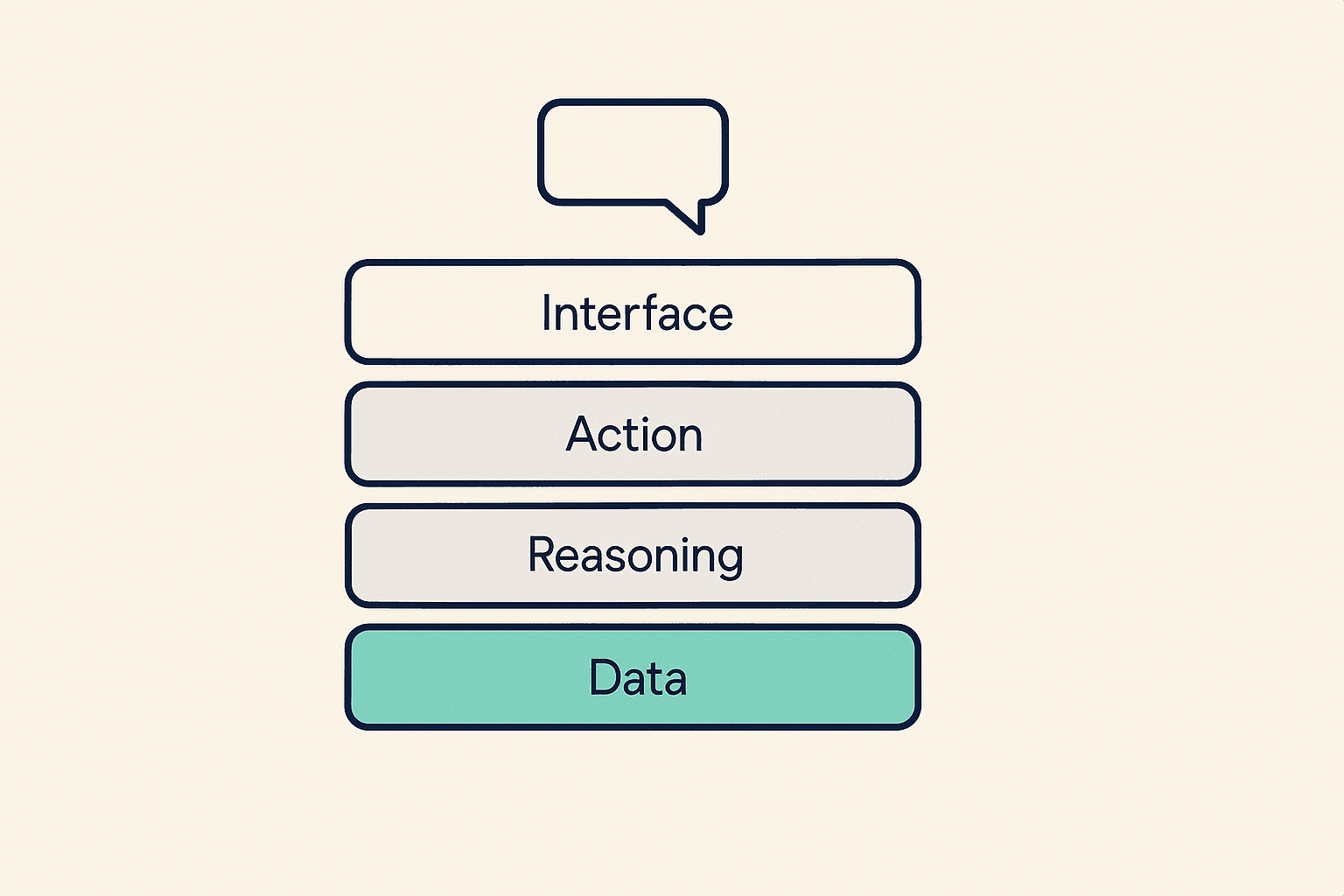
Read the stack top-down to understand it, then build it bottom-up. At the top sits the interface, the part humans touch, and it is shrinking toward a chat box. Below that, actions: the writes into your CRM and your sending tool. Below that, reasoning: the AI that plans and decides. And at the bottom, the data every other layer depends on. This is the same layered thinking behind a B2B data layer, translated for people who would rather sell than integrate.

LayerPlain-language jobWhat it looks like day to dayRule of thumb
InterfaceWhere humans check inA chat window, an approval queue, one dashboardKeep it thin; expect it to keep shrinking
ActionChanges that actually happenRecords added to the CRM, messages queued to sendEvery write goes through one guarded path
ReasoningPlanning and judgmentClaude or ChatGPT deciding which accounts fit and what to do nextSwappable; never marry a model
DataThe facts about companies and peopleCompany details, the right contacts, evidence an account is ready to buyOne connection, chosen first, changed least

The ordering rule matters more than any tool choice. Model prices keep falling and frameworks come and go, but the shape of your data, which companies you matched, which contacts you pulled, which buying activity you acted on, stays useful across every one of those changes. So the data layer is the decision you make first.
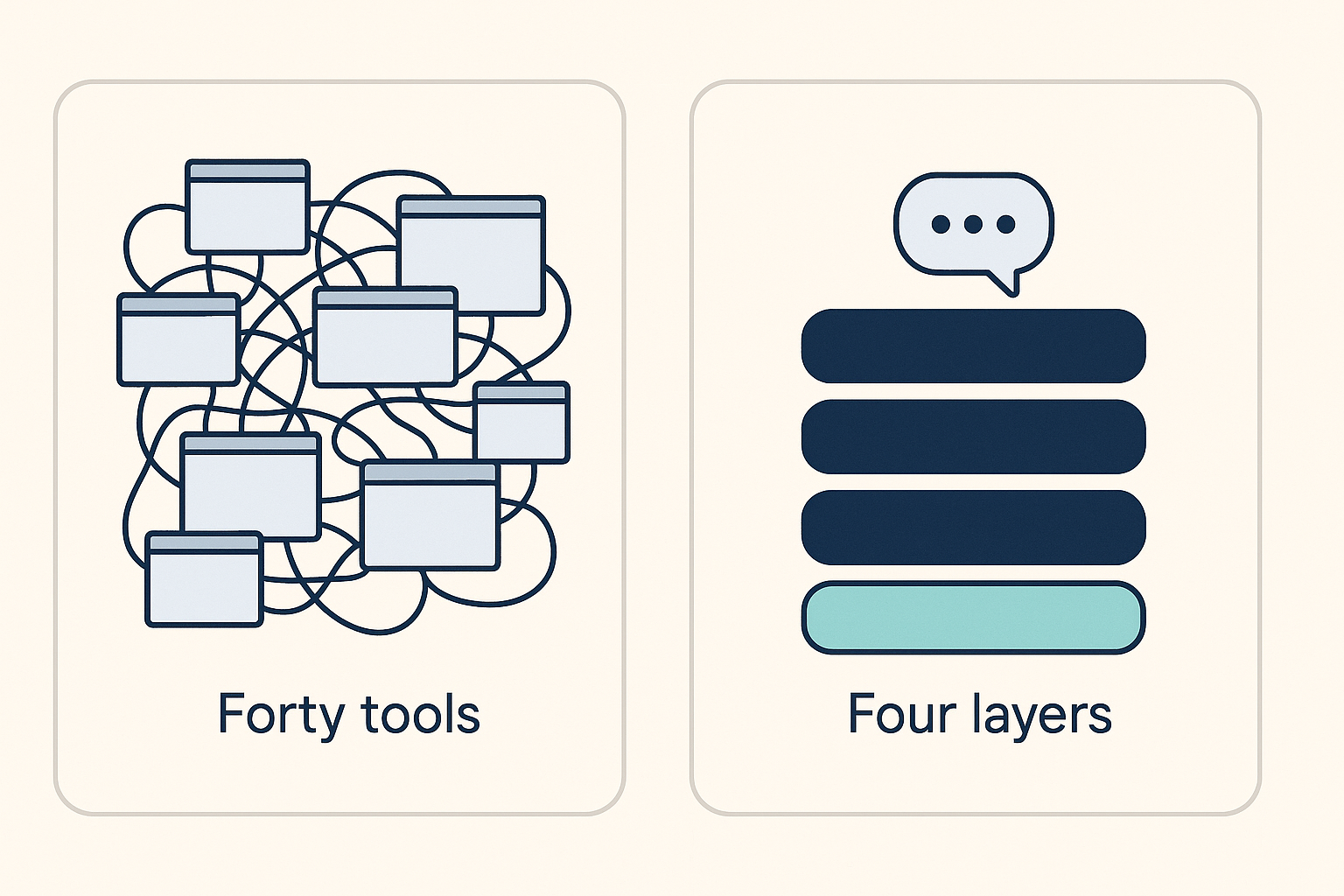
Forty scattered sales tools on one side versus a tidy four-layer AI-native GTM stack with a chat window on top

The layer you cannot copy

Here is the uncomfortable truth about AI sales tooling: the AI part is the commodity. Any competitor can run the same model you run. A clever prompt is copyable in an afternoon. What nobody can copy is the record you build up over time: which accounts matched your ideal customer, which buying activity showed up before your best deals, which contacts actually replied.

That record only compounds if it lives in one place. Split it across three subscriptions and you get three half-histories that disagree with each other. Keep it behind one connection and every workflow you add inherits the same account universe, the same contact records, and the same activity feed. Teams building on a shared GTM data platform report the same thing from different directions: the wins came from consistency, not from any single model upgrade.

Two properties decide whether a data layer holds up:

  • Matching accuracy. Every downstream decision inherits it. Vibe Prospecting results are matched against 50+ premium sources at 97.8%+ company match accuracy, so two different requests about the same company return the same company.
  • Breadth of buying activity. Timing is the difference between a warm conversation and a cold one. 18 categories of buying signals, over 80 types, cover funding rounds, hiring pushes, website changes, and more, so timing questions and company questions get answered by the same connection.

Make Vibe Prospecting your data layer

Vibe Prospecting collapses the entire bottom layer into one connection you talk to in plain language: ask for the companies and people you want, preview a sample, then build the full list, inside Claude or ChatGPT. It is powered by Explorium Enterprise Business Data, and it fits the four-layer model on all three dimensions that matter.

One connection, full coverage

  • 150M+ company profiles and 800M+ professional profiles behind a single setup: company details, funding history, the tools a company runs, and work contact details for the right people.
  • Buying activity flows through the same connection, so "which of these accounts raised money this quarter" is just another question, not another subscription.
  • One place to govern access, one bill, one thing to cancel if you ever leave.

Scale without a choking chat window

  • Big requests run on Explorium's servers through the AgentSource connection, up to 1,000 records per request at 100 requests per second, documented at explorium.ai/mcp.
  • Setups that stuff every record into the chat context stall somewhere between 20 and 100 prospects. Server-side execution is what makes a thousand-account run finish while you make coffee.

A price a small team can say yes to

  • Free account, no sales call, first targeted prospect list in minutes.
  • One credit pool covers every request type, which typically cuts spend 30 to 60% versus stacking per-seat subscriptions.
  • Every build starts with a preview: 5 sample records plus a cost estimate before a single credit is spent, so a badly scoped request costs you a sample, not an invoice.

Setup in one click or one config file

Add Vibe Prospecting from the Claude Connectors Directory (claude.ai, Settings, Connectors) or the ChatGPT equivalent. Claude Code users can register it in a config file instead:
Claude Code
{
  "mcpServers": {
    "vibe-prospecting": {
      "command": "npx",
      "args": ["-y", "@explorium-ai/vibeprospecting-mcp"],
      "env": { "EXPLORIUM_API_KEY": "your_api_key_here" }
    }
  }
}

If you are wiring Vibe Prospecting into a custom agent or a Claude Skill, the open-source Vibe Prospecting Plugin is the canonical reference, and the engineering-flavored version of this pattern is covered in building a B2B data layer for Claude Code agents.

Audit what you already pay for

Before adding anything, list every sales and marketing subscription you carry, place each one in exactly one layer, and give it a verdict: keep, absorb, or delete. The goal is one owner per layer, not one tool per job title.

What you probably haveVerdictWhere it goes
Spreadsheets of manually researched accountsDeleteReplaced by ask, preview, build in chat
A dashboard tool nobody opensThin outInterface layer, approvals only
Your CRMKeepAction layer, the record of truth
A separate intent or signals add-onAbsorbData layer, same connection as everything else
Two or three data subscriptionsAbsorbData layer, one connection
Your sending toolKeepAction layer, the delivery rail

Two rules make the audit honest. First, a tool only earns "keep" if it is the sole owner of its layer. Second, every "absorb" gets a deletion date pinned to its renewal, not to a vague someday. Run each candidate through a side-by-side data provider comparison before you renew anything.

Guard the actions, thin the interface

The action layer is where AI stops suggesting and starts doing, so it is the layer that needs guardrails in writing. The pattern that works for small teams is boring on purpose: everything an AI builds lands in a staging file first, and a human moves it into the CRM after a quick review. Every record carries where it came from and when. Outreach volume is capped per account per week so one enthusiastic run cannot burn your sender reputation.

Write the guardrails as a short plain-text file your assistant reads before every run:

Text
# action-guardrails.md - read before every run
- Preview first, always: 5 sample records + a cost estimate
  before any full build.
- Stop if one run would cost more than 300 credits.
- New records go to staging/new-accounts.csv, never straight
  into the CRM.
- Max 3 outbound touches per account per week.
- On any error: stop, write the log, do not retry.

The interface layer needs the opposite treatment: subtraction. MCP, the open standard that connects assistants like Claude to tools and data, is steadily replacing the dashboard-per-tool world, and Gartner sees a $58 billion shake-up of productivity software through 2027 riding on that shift. Practically: when you feel the urge to build a dashboard, set up an alert in chat instead. The scheduling mechanics for runs that happen while you sleep are in outbound automation with Claude Code scheduled jobs.

Ninety days from tool pile to layers

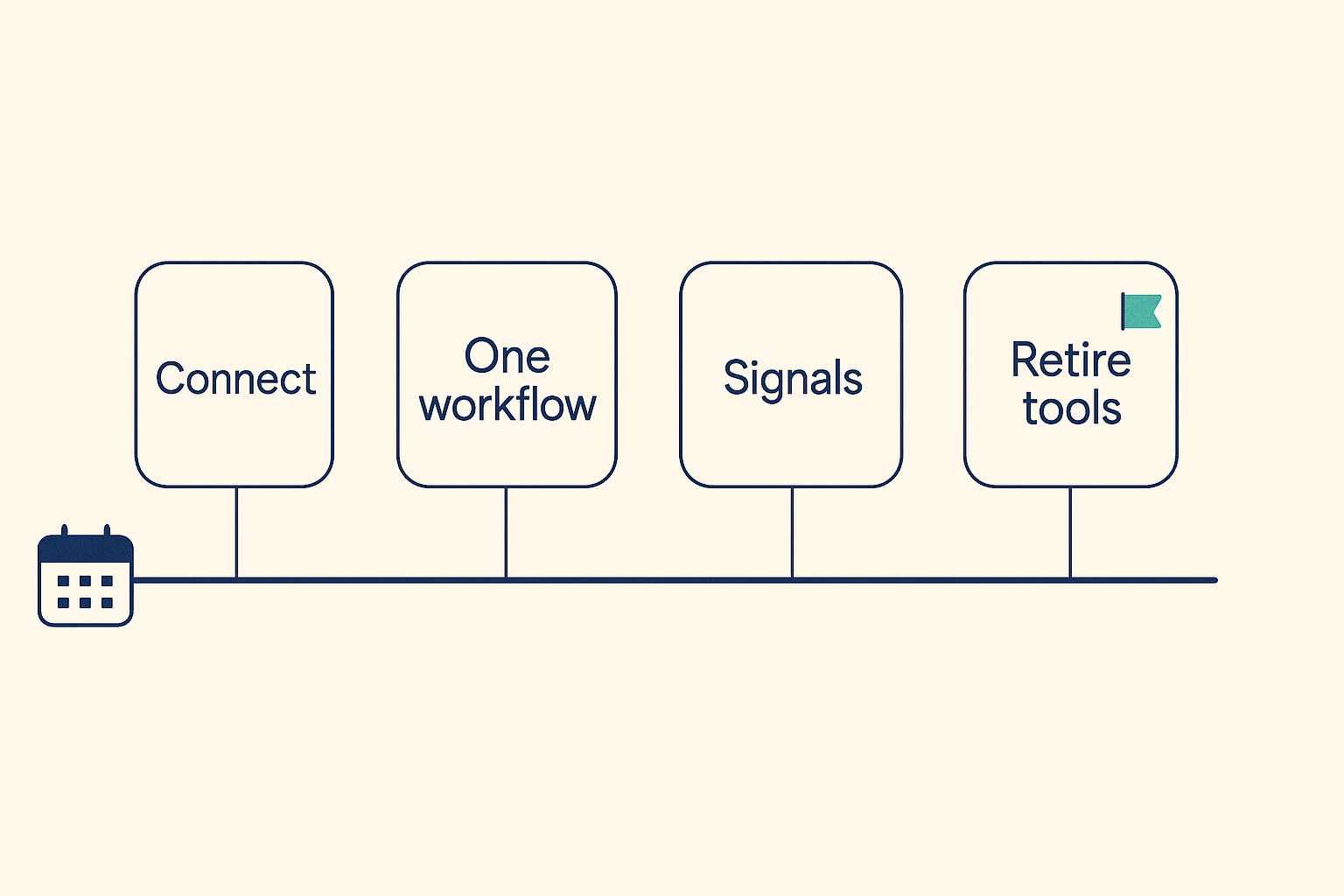
Migrate absorb-then-delete, one layer at a time, and never turn anything off before its replacement has run clean for two weeks.

  1. Week 1: connect. Create a free Vibe Prospecting account, add it from the Connectors Directory, and ask it to match your existing customer list. Write down the match rate; that number is your baseline.
  2. Weeks 2 to 3: reroute one workflow. Pick something low-risk, usually filling in missing details on inbound leads, and run it through chat while the old subscription keeps running. Compare the results side by side.
  3. Weeks 4 to 6: move timing onto the same connection. Set up buying-activity watching for your target accounts, then cancel the standalone signals add-on once the chat version has caught everything the old one did for two straight weeks.
  4. Weeks 7 to 10: guard the writes. Route AI-built records through staging files with review, then promote to the CRM.
  5. Ongoing: delete on renewal dates. Each absorbed subscription dies when its contract does, per the audit table above.
Ninety-day migration timeline from tool sprawl to a four-layer AI-native GTM stack: connect, reroute one workflow, move signals, retire tools

Agencies running this playbook at production scale are profiled in Claude Code for GTM automation in production; the shape is identical for a two-person team, just with smaller numbers.

How you will know it worked

Track three numbers monthly, and expect all three to move within one quarter.

  • Cost per account you can actually work: your unified credit spend divided by usable accounts, compared against the sum of the subscriptions you absorbed.
  • Time from activity to first touch: hours between a funding round or hiring push showing up and your first message going out. This is the number the four-layer design exists to shrink.
  • Subscriptions deleted: the sprawl metric. Count them. Frame every deletion in the renewal email as architecture, not penny-pinching.

If those numbers move while your tool count falls, you built an AI-native GTM stack rather than a taller tool pile. Start at the bottom layer this week: get started with Vibe Prospecting, match your customer list, and let the baseline number tell you what to fix next. A start-to-finish walkthrough of the ask, preview, build loop lives in building targeted prospect lists in chat.

FAQs

Frequently Asked Questions

Get Started Banner

Get Started for free

Sign Up
AI-Native GTM Stack: 4 Layers, One Connection (2026)