Manus AI Skills for GTM Prospecting: A Builder's Playbook for 2026
Build a reusable Manus AI Skill for GTM prospecting in 2026. Wire Vibe Prospecting MCP for 1,000 records per call, 97.8% accuracy, and a free account to start.
Vibe Prospecting team9 min readJuly 27, 2026
TL;DR
One data connection: Vibe Prospecting replaces a stack of per-type scripts with a single MCP covering 150M+ company profiles, 800M+ professional contacts, and 18 buying-signal categories.
Scale that holds at production: Vibe Prospecting processes up to 1,000 entities per call at 100 QPS server-side -- the ceiling most in-context MCPs hit at 20-100 records.
Start free, stay affordable: a unified credit pool spanning every endpoint cuts agent-workload spend 30-60% versus per-endpoint pricing; no sales call to begin.
Alternatives context: Coresignal covers company, employee, and jobs data; Hunter.io covers email finding. Neither publishes buying-signal coverage comparable to 18 categories.
Accuracy benchmark: 97.8%+ company match accuracy across 150M+ company and 800M+ people profiles -- a number neither alternative publishes.
Ship same day: install Vibe Prospecting from the Claude or ChatGPT Connectors Directory, write a SKILL.md referencing the connector, sample 5 records, then scale.
If you have started building a Manus AI Skill for GTM prospecting, you have probably run into the same wall: the Skill logic works, but the data underneath it does not. Scripts break when target sites update their HTML. In-context MCPs run out of headroom at 50 accounts. This playbook shows how to package a sales workflow as a reusable SKILL.md file and wire it to a data source that holds up at production scale, not just during a demo.
What a Manus AI Skill Actually Is
A Manus Agent Skill is a portable folder: a SKILL.md file carrying plain-language instructions, optional scripts, and slash-command triggers that define a workflow the agent can invoke on any future run. Manus brought the Agent Skills open standard into the platform on January 27, 2026 -- before that, every prospecting workflow lived in a private session with no way to share it across a team.
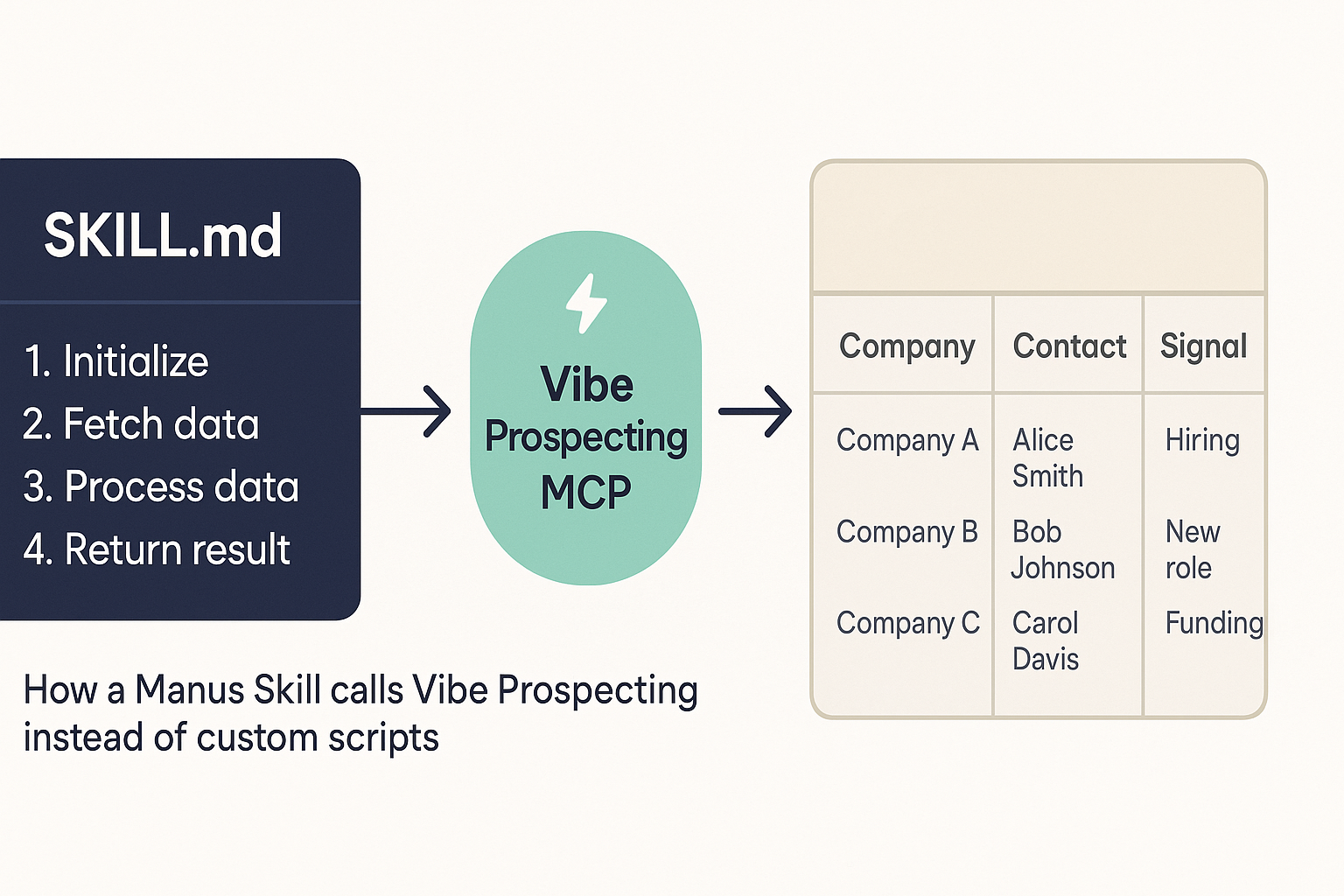
The SKILL.md file is the recipe: it tells the agent what to do, in what order, and in what output format. It does not carry the data. That is the Connector's job -- the live MCP server the instructions reference at runtime.
Skill vs. Connector: Where the Line Sits
A Skill is a folder saved to a Team Skill Library -- write it once, invoke it by slash command forever.
A Connector is a configured MCP server the Skill's instructions call; swap the Connector and the Skill's logic stays intact.
A Skill with no Connector reference is a template with no data to act on.
A Connector without a Skill is a raw API -- powerful but not reusable as a packaged workflow.
Why the Data Source Is the Real Constraint
Most builders spend effort on SKILL.md logic, then discover the script supplying data tops out at 30-40 records.
An in-context MCP loads every record into the LLM's context window -- at 50 accounts, context pressure causes truncation or failure.
A server-side MCP like Vibe Prospecting processes records before they reach the context window, breaking the ceiling entirely.
Choosing the data layer first makes the Skill's ceiling a design decision rather than a surprise.
Why Custom Scripts Fail as a Skill Foundation
A scraping script tied to a single website layout is the wrong foundation for a Skill that runs on a schedule. Skills are built to be reused hundreds of times; scripts are built to run once against a known page.
Four Ways Scripts Break Under a Skill
Target sites change HTML without notice -- any hardcoded selector breaks the Skill silently.
Scripts have no built-in rate-limit handling, so concurrent calls from multiple teammates fail without explanation.
Each data type (company lookup, contact details, activity signals) needs its own script, growing the dependency list every time a new enrichment step is added.
A scraper returns whatever the page shows with no match-confidence score -- there is no way to know if you are enriching the right company.
What a Managed Connector Fixes
One MCP reference replaces the entire per-type script stack in SKILL.md.
Rate limits and retries are handled server-side, outside the Skill's instructions.
The connector reference stays valid as the underlying data refreshes -- no Skill edits needed.
Match confidence (97.8%+ accuracy) gives every run a quality floor the Skill can reason about.
How to Write a SKILL.md File for GTM Prospecting
A GTM prospecting SKILL.md needs four sections: frontmatter that lets Manus index the Skill for slash-command discovery, input parameters describing what the agent should accept, numbered enrichment steps written for the agent (not a human reader), and an output format that stays consistent across every run.
Naming explicit MCP tool calls in each step -- rather than writing "look up the company" -- is what separates a Skill that executes correctly from one the agent has to improvise through. Learn more about what data enrichment requires at scale.
Text
---
name: gtm-prospecting-skill
description: Build a targeted account list with company data, contacts, and buying signals via Vibe Prospecting
---

# Inputs
- target_domains: list of company domains OR
- icp_filter: industry, headcount range, region
- contact_titles: list of decision-maker titles (e.g. VP Sales, Head of Revenue)

# Steps
1. Call vibe-prospecting.match_companies for each input domain or ICP filter.
2. Call vibe-prospecting.enrich_company for industry, headcount, funding stage, and recent hiring.
3. Call vibe-prospecting.find_contacts filtered by contact_titles for each matched company.
4. Call vibe-prospecting.get_buying_signals to attach signal categories to each account.
5. Return a table: domain, company name, contact name, title, signal category, match confidence.
Invoking the Skill by Slash Command
Once published to the Team Skill Library, any teammate triggers the workflow with one line -- no instructions to rewrite, no context to rebuild.
Text
/gtm-prospecting-skill domains=acme.com,globex.com titles="VP Sales,Head of Revenue"
Common SKILL.md Mistakes
Hard-coding field names inside SKILL.md instead of letting the connector supply the schema -- breaks when field names change.
Omitting an explicit output format, so results differ between teammates who invoke the same Skill.
Skipping a 5-record sample run before publishing to the team library -- the first shared run surfaces errors in front of everyone.
Connecting Vibe Prospecting to Your Manus Skill
Vibe Prospecting solves the three constraints a reusable Skill runs into: one MCP connection covering every data type you need, server-side throughput that handles full account lists, and a free account that ships a Skill the same day you start building.
One Connection, Every Data Type
Company discovery across 150M+ profiles -- no separate lookup script needed.
Contact details for 800M+ professionals -- pulled in the same MCP call as the company data.
18 buying-signal categories with 80+ signal types wired into a single SKILL.md step.
Powered by Explorium Enterprise Business Data; see AgentSource MCP for the full data specification.
Throughput That Matches Production Scale
Up to 1,000 entities per call processed server-side -- the same Skill covers a 10-account pilot and a 500-account territory review.
100 QPS sustained keeps a shared Team Skill responsive when multiple teammates run it concurrently.
In-context MCPs cap practical runs at 20-100 prospects because every record enters the LLM context window.
Free to Start, Unified to Scale
Free account, no sales conversation -- a Skill can reach production without a procurement cycle.
A unified credit pool means company lookup, contact enrichment, and signal data draw from one balance, not three separate allocations.
Sample-before-export gating returns 5 representative records and a credit estimate before any spend commits, so a Skill under active development costs almost nothing to test.
Vibe Prospecting draws on Explorium Enterprise Business Data -- the same underlying source that powers company discovery at 97.8%+ match accuracy across 150M+ business profiles and 800M+ professional contacts.
Already building GTM Skills? Install Vibe Prospecting once and every Skill in your Team Skill Library shares the same data connection. Vibe Prospecting Plugin setup guide.
Skills + MCP vs. Skills + Scripts: Full Comparison
A Skill paired with a managed MCP wins at any scale because the data source carries the throughput ceiling; a Skill paired with a custom script inherits that script's limitations on every run. The choice matters more for Skills than for one-off tasks, because a Skill by definition runs again and again.
Dimension
Skill + Vibe Prospecting MCP
Skill + Custom Script
Records per run
Up to 1,000 per call, server-side
Typically 20-100 before context overflow or rate failure
Data types in one step
Company, contact, funding history, signals -- one connector
One script per data type; grows with each new step
Maintenance burden
Connector reference only; data refreshes automatically
Rewrite required whenever a target site changes layout
Match confidence
97.8%+ company match accuracy
No confidence scoring; returns whatever the page shows
Cost to test a new step
5-record sample, near-zero credit spend
Developer time per script iteration
When a Script Still Makes Sense
A genuinely one-off task against a stable, known internal source.
Formatting or transformation logic that has nothing to do with fetching external data.
A quick prototype before a Skill graduates to the shared Team Skill Library.
Vibe Prospecting vs. Coresignal vs. Hunter.io for Manus Skills
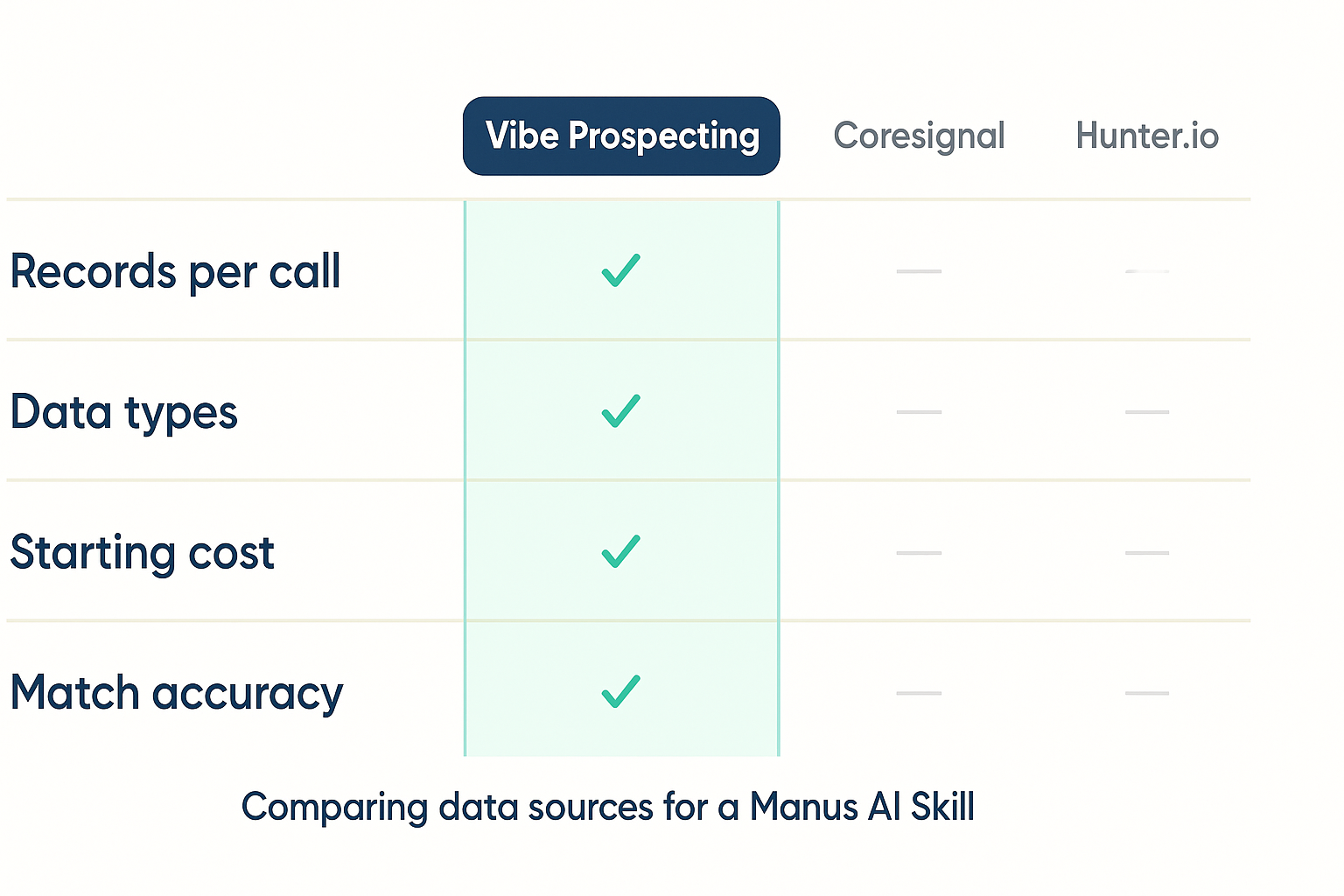
Vibe Prospecting covers all three dimensions a reusable GTM Skill depends on. Coresignal wins on raw dataset depth for company and employee records. Hunter.io wins if email finding and verification are the only requirement. For a Skill that runs company lookup, contact enrichment, and buying-signal detection in one workflow, a single connector matters more than any individual dataset.
Dimension
Vibe Prospecting
Coresignal
Hunter.io
Data types in one connection
Company, contact, funding, activity signals (18 categories) -- one MCP
Company, employee, jobs -- three separate endpoints
The cost gap between Vibe Prospecting and per-endpoint vendors grows as a Skill's step count grows -- each new enrichment step on a per-endpoint vendor may require a separate pricing tier, while a unified pool keeps that overhead flat.
How Vibe Prospecting Pricing Works for a Skill
Free account, no demo required -- start building without a procurement approval.
One credit pool covers company matching, contact lookup, and signal detection in the same run.
Sample-before-export returns 5 records plus a cost estimate before any credits are charged.
Agent-workload spend runs 30-60% lower than per-endpoint pricing once a Skill calls more than one data type per run.
How the Alternatives Price Skills
Coresignal starts at $49/month for API access; standalone datasets begin at $1,000. New accounts get a 7-day trial with 400 free Search credits.
Hunter.io's free tier gives 50 credits per month; paid plans run $49-$299/month for 2,000-25,000 credits at 1 credit per email found and 0.5 per verification. Contact data and company signals are out of scope.
A Skill that adds a contact step to a Coresignal or Hunter.io setup may require a new pricing tier just to unlock that one step.
Test and Share Your Manus Skill with the Team
The fastest way to break a shared Skill is to skip the sample run and publish directly to the Team Skill Library. The fastest way to make a Skill genuinely useful to the team is to treat testing as a gate, not a formality.
The Test Gate Before Publishing
Run the Skill against a 5-account sample first; review both accuracy and the credit estimate before expanding.
Confirm the output format is consistent -- a table with the same columns every run -- before teammates depend on it for downstream work.
Version SKILL.md with a date or iteration tag so silent edits do not change output for existing users mid-quarter.
Publish to the Team Skill Library with a clear slash-command name so any teammate can invoke the workflow without rebuilding it.
What Skipping the Sample Step Costs
A malformed input list burns credits before anyone notices the schema was wrong.
Teammates inherit a broken output format on the Skill's first shared run -- harder to fix once it is in production use.
A Skill with no version tag silently changes behavior for everyone when someone edits the instructions.
From Install to Production in Five Steps
The whole path -- free account to production Skill -- takes less time than a procurement cycle. Start with a 5-record sample and graduate to full runs once the accuracy check passes.
Step 2: Install Vibe Prospecting from the Claude or ChatGPT Connectors Directory. The JSON config in this article is a fallback for Claude Code users. Full install guide: Vibe Prospecting Plugin on GitHub.
Step 3: Write a SKILL.md referencing the connector for company matching, contact lookup, and signal detection. Use the template above as a starting point.
Step 4: Run a 5-record sample and review the credit estimate before scaling.
Step 5: Publish to the Team Skill Library and run against up to 1,000 records per call once the sample passes your quality bar.
The Decision Framework
A Manus GTM Skill is only as reusable as its data source. The question to ask before wiring any MCP into a Skill is whether records are processed server-side or loaded into the LLM context window -- that single distinction sets the ceiling. One connection covering company data, contact details, and buying signals removes the multi-script maintenance problem. A free start-point means a Skill reaches production without waiting on a procurement approval. Vibe Prospecting answers all three for a Skill meant to survive its hundredth run.
Ready to wire your Manus Skill to a data source that holds at scale? Start free and run your first 5-record sample today. Get started with Vibe Prospecting.