


Every extra step in a Zapier enrichment chain is a bill, a potential failure, and a delay between the moment your agent decides it needs data and the moment that data arrives. As of August 2026, founders and sales teams running enrichment inside Claude or ChatGPT can skip the chain entirely: one Vibe Prospecting MCP tool call returns company profiles, contact details, and buying signals from 150M+ companies and 800M+ professionals, all in the same message thread where you are already working.
The shift matters because data enrichment has changed shape since most Zapier guides were written. The Model Context Protocol (MCP) became an open, vendor-neutral standard under the Linux Foundation on December 9, 2025. That single governance shift is what made chat-first enrichment a production-grade option rather than a prototype.
Why Zap Chains Break Under Agent Workloads
When a sales agent decides mid-conversation that it needs company data, it should not have to wait for a polling interval, a webhook handoff, or a filter step to fire. But that is exactly what a Zapier enrichment chain requires.
The Four Friction Points No One Talks About
- Each new data field you need -- headcount, funding round, tech stack, recent job postings -- requires a new Zap step. Coverage growth multiplies maintenance work.
- Zaps run on schedules and webhooks, not inside an agent's reasoning loop. The data arrives after the agent has already moved on.
- Every connected app is a separate auth token and a separate place for silent failures to hide.
- Zapier's base plan costs $19.99/month before you add even one enrichment vendor on top.
What the Agent Actually Experiences
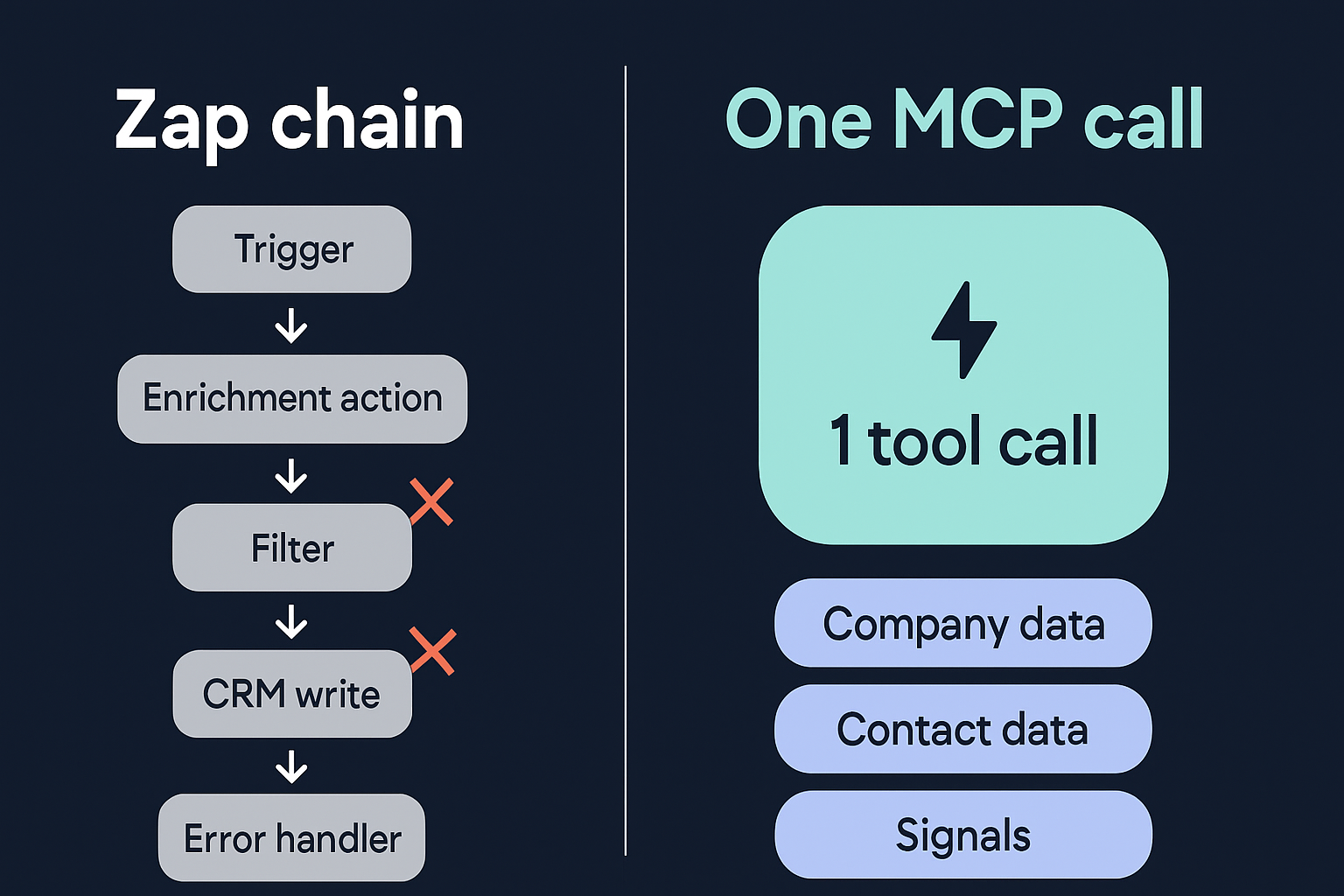
- With Zapier: decide it needs data, fire a trigger, wait for the Zap to execute, receive the result, continue -- multiple round trips across separate systems.
- With Vibe Prospecting MCP: decide it needs data, call the tool directly in the same reasoning step, continue -- no handoff, no wait.
What MCP-Native Enrichment Actually Means in Practice
MCP-native enrichment means the tool lives inside your chat session, not outside it. When you ask Claude or ChatGPT to research a company, the assistant calls the Vibe Prospecting tool on your behalf, gets the data, and folds it directly into the response. You never leave the conversation to check a Zap log.
For Founders and AEs: This Is the Important Part
- You type a plain-language request -- "Pull the company profile and recent hiring activity for Acme Corp" -- and Vibe Prospecting returns structured data immediately.
- No config file required. Add Vibe Prospecting from the Claude or ChatGPT Connectors Directory in one click.
- The data is powered by Explorium Enterprise Business Data, covering 150M+ company profiles and 800M+ professional records worldwide.
How Many Steps Does a Zapier Enrichment Workflow Actually Need?
Count the steps in a standard lead-enrichment Zap and you will typically land between three and five, all of which collapse into a single tool call with Vibe Prospecting.
Step-Count Breakdown
| Stage | Vibe Prospecting MCP | Zapier Zap chain |
|---|---|---|
| Trigger detection | Handled inside agent reasoning | Step 1: Trigger app (form or CRM webhook) |
| Data lookup | 1 tool call covers all fields below | Step 2: Enrichment vendor action |
| Routing logic | Not a separate step | Step 3 (often): Filter or path branch |
| Record update | Not a separate step | Step 4: CRM write action |
| Error handling | Not a separate step | Step 5 (common): Retry or notify step |
| Total per record | 1 tool call | 3 to 5 steps |
Why the Step Gap Matters More at Volume
- A 5-step Zap enriching 1,000 leads generates roughly 5,000 individual step executions, each billed separately.
- Vibe Prospecting batches up to 1,000 records in a single server-side call at 100 QPS, keeping the execution count minimal.
- At scale, one billing relationship (Vibe Prospecting) replaces two or three (Zapier plan plus enrichment vendor plus optional CRM connector).
Where Zapier Still Makes Sense -- and Where It Does Not
This is not a blanket case against Zapier. It is a specific case about enrichment inside an agent workflow.
Zapier Fits These Scenarios
- Pure app-to-app automation with no reasoning loop involved: send a Slack message when a form submits, for example.
- Teams that have no AI agent in the stack yet and rely entirely on Zap triggers for workflow logic.
Vibe Prospecting MCP Replaces Zapier Here
- Any scenario where an agent is already in the loop and needs company or contact data to continue its reasoning.
- Bulk enrichment runs where per-step billing stacks up fast.
- Real-time prospecting research during an active sales conversation.
Zapier's own docs confirm the shift: in MCP mode, "the AI executes a specific instruction in real time" -- on demand, inside the client. That is the same pattern Vibe Prospecting uses natively, minus the extra Zapier hop, the second bill, and the second failure point.
Vibe Prospecting vs. Coresignal vs. Hunter.io: MCP Comparison
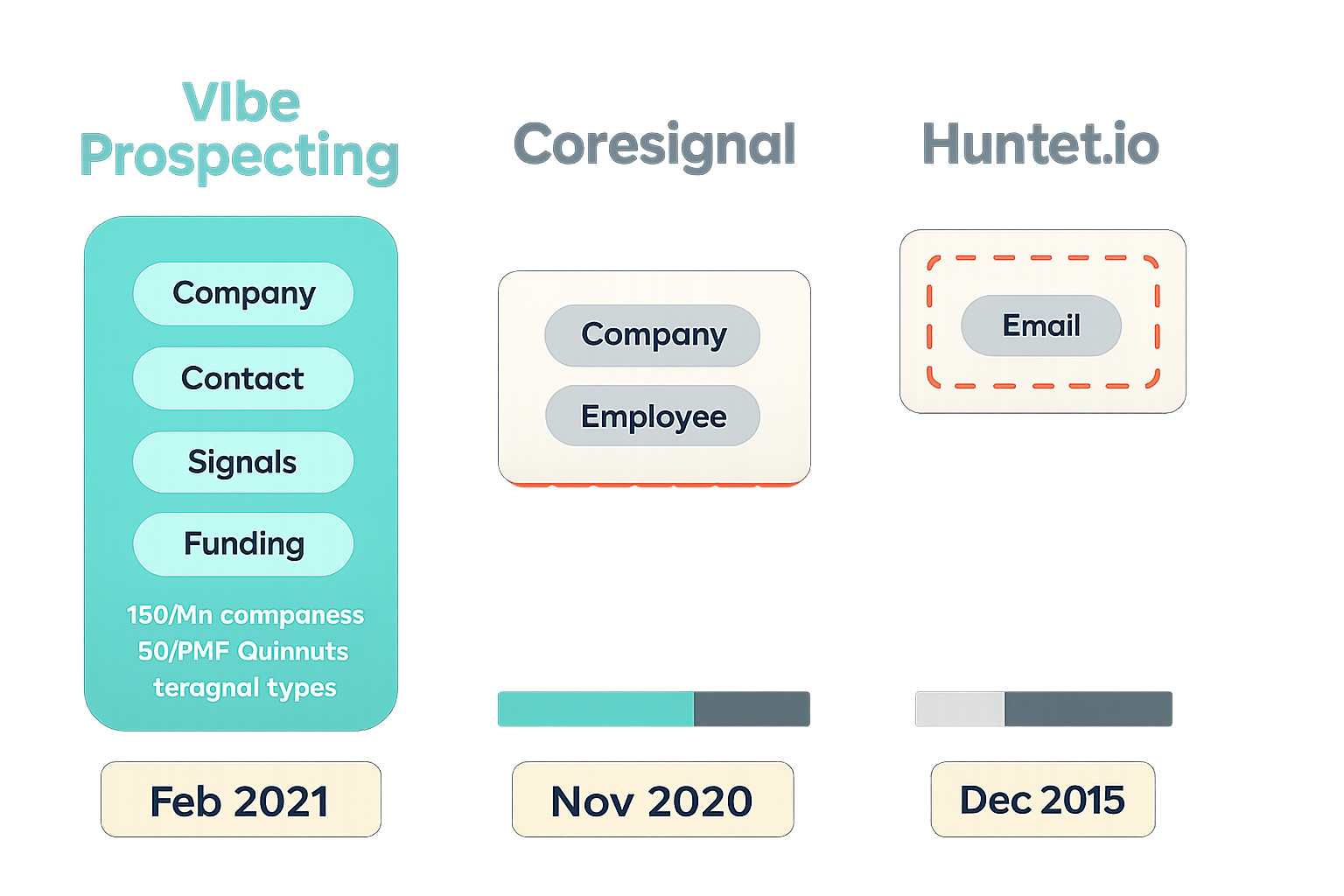
Three enrichment tools now have MCP servers. They cover very different ground. Coresignal launched its server on May 26, 2025. Hunter.io followed on July 22, 2025. Vibe Prospecting covers the widest range of data types and is the only one with documented bulk-call capacity.
MCP Server Comparison Table
| Dimension | Vibe Prospecting | Hunter.io | Coresignal |
|---|---|---|---|
| Best fit | Full enrichment plus buying signals | Email discovery and verification only | Historical workforce and headcount data |
| Company profiles | 150M+ | Not primary use case | 39M+ (per PulseMCP) |
| Contact data | 800M+ professional profiles | 70-85% hit rate on business domains | No contact data |
| Buying signals | 18 categories, 80+ signal types | None | None |
| Bulk call capacity | Up to 1,000 entities per call at 100 QPS | Single email lookups only | Credit-metered per record, no bulk mode documented |
| Pricing entry point | Free account, unified credit pool | $49/month (Starter) | $49/month (Starter), jumps to $800 at Pro tier |
| MCP server available | Yes (2026) | Yes (July 22, 2025) | Yes (May 26, 2025) |
When Coresignal or Hunter.io Might Fit
- Coresignal: the right choice for deep historical employee headcount analysis when verified contact data is not in scope.
- Hunter.io: works well when the only requirement is confirming whether an email address is deliverable on a known business domain.
"It doesn't give you a single verified email or phone number, a massive gap if you're building outbound pipelines." ProxyLook, Coresignal provider review
Adding Vibe Prospecting to Claude or ChatGPT
Most people add Vibe Prospecting in under two minutes from the Connectors Directory -- no sales call, no config file. The data behind every lookup is powered by Explorium Enterprise Business Data. See the B2B data provider comparison for a full breakdown of what the underlying data covers.
Connector Directory Path (One Click)
- Open Claude or ChatGPT.
- Search the Connectors Directory for Vibe Prospecting.
- Click Add. Done.
Advanced Path: Direct MCP Config
Power users running Claude Code or a self-hosted agent can add Vibe Prospecting directly. Add this block to your MCP config:

