


A founder posted a version of this question in a GTM Slack community this month: three tools, one spreadsheet holding it all together, and a growing sense that something needed to change. The replies split down the middle. Half said hire a GTM engineer. Half said fix the setup first, see what is actually still missing, and decide from there. Both answers can be right, depending on one thing: how many separate systems someone is stitching together by hand just to answer a simple question about an account.
This guide is that decision, laid out as a checklist instead of a debate. It covers what a GTM engineer actually does when the role is scoped correctly, when a chat-first prospecting setup already covers the same ground, and the 90-day plan to run either way.
Do You Need a GTM Engineer, or Just a Cleaner Prospecting Setup?
A dedicated GTM engineer earns its keep once a team is stitching three or more tools together by hand, has no one owning buying-signal logic, and outbound workflows break often enough to eat more time than building would. Below that line, a chat-first setup with one connected data source usually closes the gap without a new hire.
Signs a Chat-First Setup Already Covers It
- One person runs the whole prospecting motion: build a list, look up the right contacts, hand it to sales.
- Target volume sits under roughly 500 accounts a quarter, well inside what a chat session can handle directly.
- There is no custom scoring model yet, just a target list and a next step.
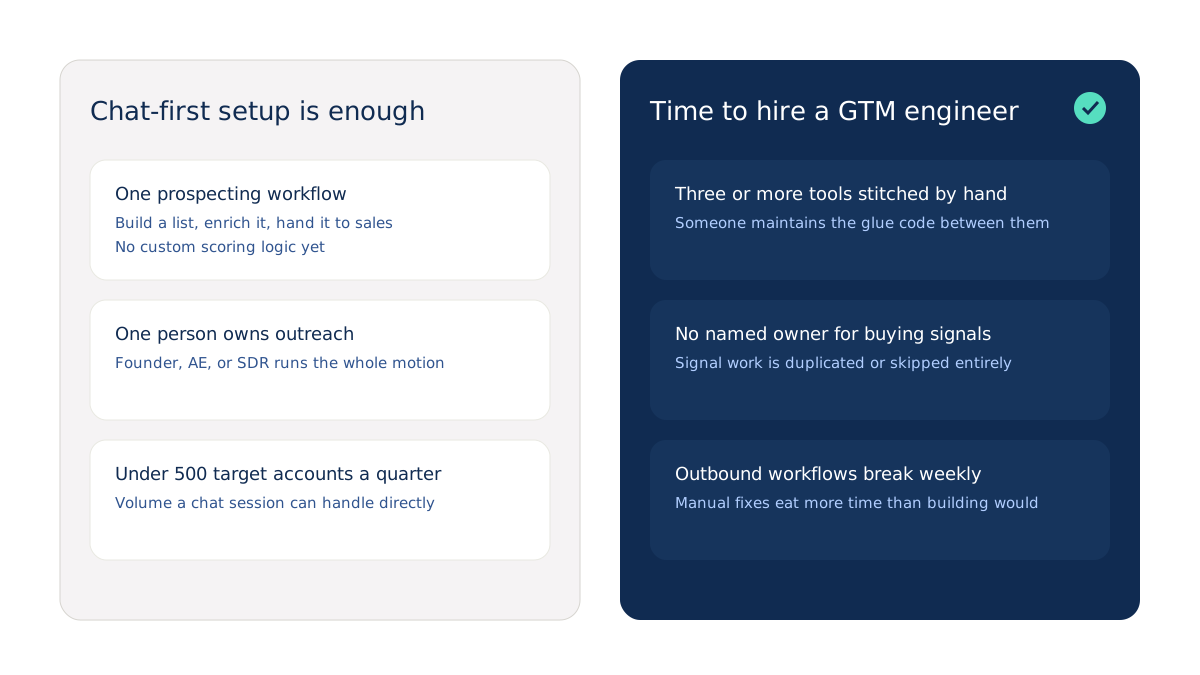
Signs It Is Time to Hire
- Three or more separate tools are stitched together by hand, and someone is quietly maintaining the glue between them.
- No one owns buying-signal logic, so it either does not happen or two people duplicate it.
- Outbound workflows break weekly and the fixes eat more time than a proper build would.
What a GTM Engineer Actually Builds, Day to Day
A GTM engineer owns the data foundation and automation layer connecting the CRM, enrichment, scoring, and outreach systems, distinct from a RevOps admin (who maintains systems that already exist) and a growth or demand-gen hire (who drives campaign volume). A typical day includes writing the logic that matches a lead to the right company record, wiring a scoring model to live company and contact data, and shipping a workflow that moves a qualified account into outreach without a manual handoff.
Why Undefined Versions of This Role Fail
Practitioners circulating hiring frameworks this year report roughly 90% of new GTM engineer hires failing to show impact in their first 90 days, and the pattern is consistent: the job description asks for a full-stack engineer, a data architect, a RevOps admin, an SDR lead, and an evangelist, then measures one person against all five. A correctly scoped req names exactly one of those functions as the primary deliverable.
GTM Engineer, RevOps, or Growth: Who Owns What
A GTM engineer builds net-new systems, a RevOps admin governs the systems that already exist, and a growth or demand-gen hire drives pipeline volume through campaigns that consume what those systems produce. Job boards frequently list GTM Engineer and RevOps Engineer as interchangeable titles, which is exactly where a req inherits governance duties without ever shedding the build mandate.
"GTM engineering still has no standard playbook. Ask any team how they're doing it, and you'll get a different answer." - Thomas Allgeyer, LinkedIn
The Three-Way Split, Plainly
- GTM Engineer: builds the data foundation, entity matching, and automation layer everyone else runs on.
- RevOps admin: keeps CRM records clean, manages approvals, and owns reporting.
- Growth or demand-gen: runs the campaigns and consumes the data the GTM engineer's systems produce.
The Skills Worth Screening For, and the One Everyone Skips
Screen for data architecture sense, comfort wiring APIs and workflows together, entity matching, buying-signal logic, evaluating tools against building them, and enough GTM fluency to turn a sales objection into a data requirement. The table below consolidates the overlapping practitioner frameworks circulating this year.
The Checklist
| Skill | What it looks like | How to tell if a candidate has it |
|---|---|---|
| Data architecture | Designs how CRM, enrichment, and signal data join without duplicate records | Explains their approach to matching a lead to the right company in one sentence |
| Workflow wiring | Connects enrichment and scoring calls into CRM triggers | Has shipped one production workflow, not just a demo |
| Signal logic | Decides which buying signals actually matter for the ICP | Names the signals they would drop, not just the ones they would add |
| Build vs. buy judgment | Chooses one connected data source over a stack of point tools at scale | Cites accuracy or reliability numbers, not marketing copy |
| GTM fluency | Maps ICP and pipeline stages to the data model | Turns a sales objection into a concrete data requirement |
The One Almost Every Job Post Skips
Build vs. buy judgment is the most commonly missing line item, because job descriptions assume the hire will just figure out the tools. A candidate who defaults to stitching four or five point tools together is solving the wrong problem before they have even started. The stronger candidate asks first whether one connected source of company and contact data replaces that stack.
How a Lean Team Structures Around One GTM Engineer
A lean structure pairs one GTM engineer with a content person, an SDR, and one or two AEs, with the GTM engineer as the infrastructure everyone else runs on top of. Reporting works differently depending on the mandate: RevOps when the focus is internal systems and CRM data quality, Sales when the focus is outbound pipeline infrastructure, Engineering when the role ships production code touching the core product.
The Real Signal Is Tool Count, Not Team Size
Practitioner reporting this year describes teams collapsing three separate hires and fifteen disconnected tools into one GTM engineer running twelve tools for under $2,000 a month, once the underlying data foundation stops being assembled from scratch by hand.
Who Owns Buying Signals When You Do Not Have a Data Team?
On a small team without a dedicated data function, whoever owns the scoring model should own signal logic by default, usually RevOps or the founder, because that is where signal-to-score mapping already lives. Teams that skip naming an owner end up duplicating the same signal work or dropping it entirely.
Where Default Ownership Works
- Signal-to-score mapping and CRM fields live in the same system as the owner.
- One person is accountable when a signal category stops firing correctly.
Where It Breaks Down
- An owner without any GTM engineering support cannot maintain the pipeline the signals depend on.
- Signal logic owned by a pure sales function tends to optimize for volume over precision.
Already scoping a GTM engineer req or trying to figure out if you even need one? Start with the data layer before the headcount decision. Try a free Explorium account
The First 90 Days: A Build Sprint, Not a Cleanup Project
Days 1-30 should confirm the ideal customer profile and audit what data already exists, days 31-60 should build the scoring and messaging logic, and days 61-90 should ship a working automated workflow, not spend two months on cleanup. The most common onboarding failure documented by practitioners is handing a new hire cleanup tasks for the first 30 days instead of a build mandate.
The 30/60/90 Checklist
- Days 1-30: Confirm the ICP, audit current data sources, and decide between one connected data source and a hand-built stack.
- Days 31-60: Build the scoring model and signal-to-message mapping on live company and contact data.
- Days 61-90: Ship the first automated workflow end to end and measure it against a pipeline metric.
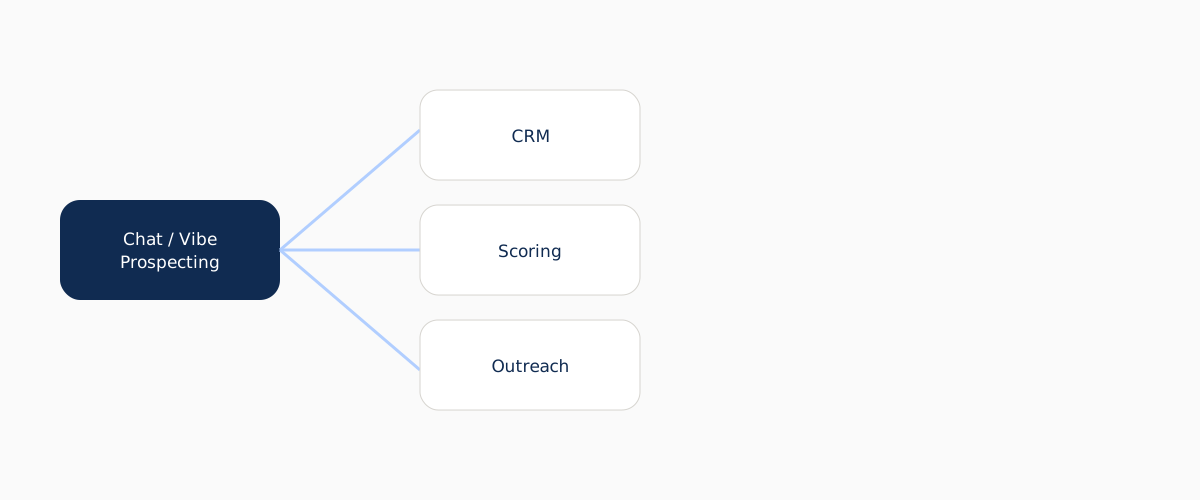
Why the Day 1-30 Decision Determines Day 90
A hire who settles the connected-data-versus-hand-built question during the audit phase has a working foundation ready by day 31. This is exactly where a chat-first setup shortens the timeline: Vibe Prospecting works inside Claude or ChatGPT, so pulling premium company and contact data, checking recent company activity, and building a first targeted prospect list takes one conversation, not a procurement cycle.

