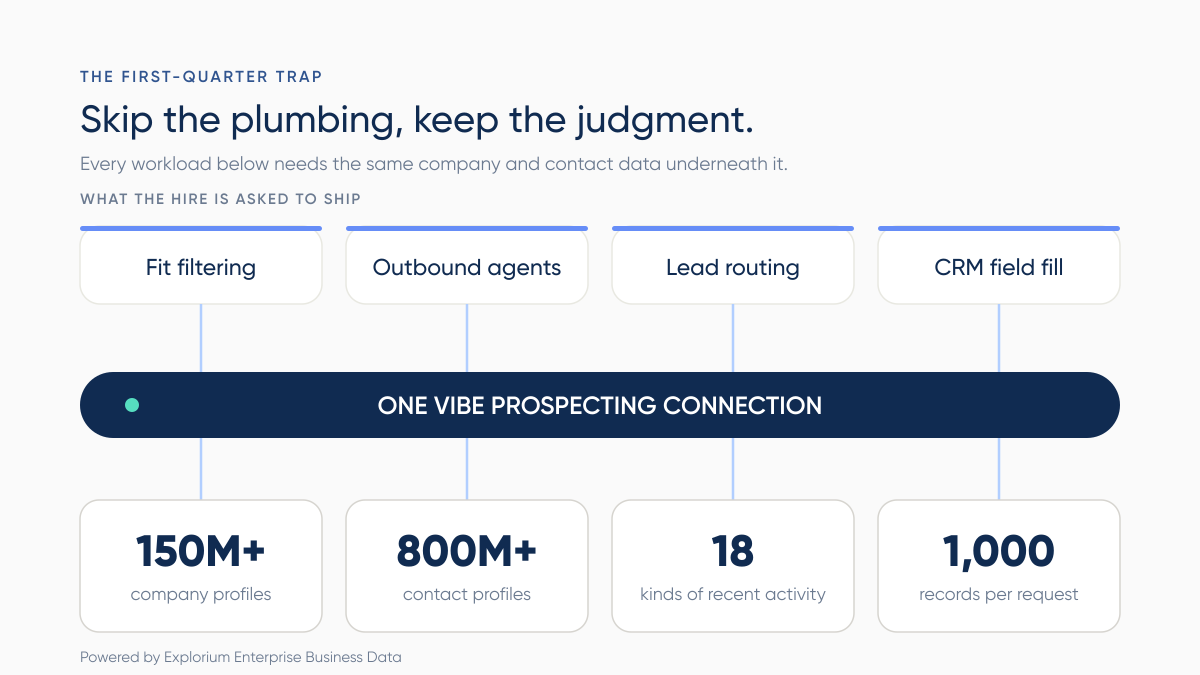


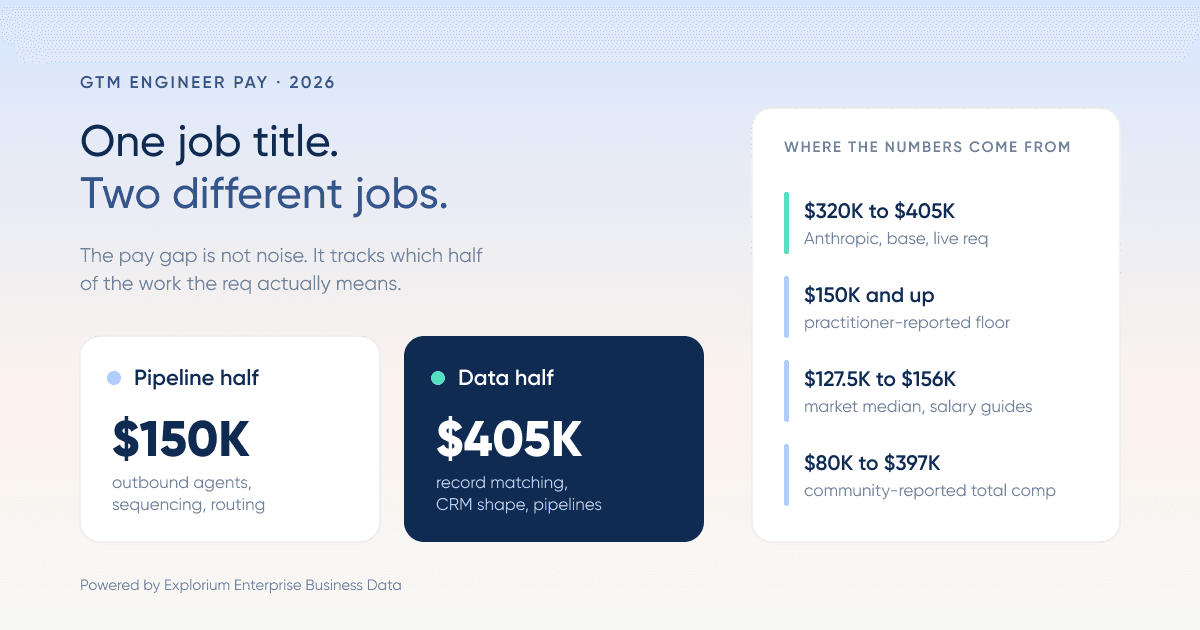
Post one GTM engineer req and you will get two completely different candidates. One of them automates your outbound over a weekend. The other spends a month straightening out your company records before touching a single sequence. Both answer to the same job title, and in 2026 the second one costs roughly twice the first. That is why GTM engineer pay in 2026 looks broken from the outside: a $150,000 floor that practitioners quote openly, next to $320,000 to $405,000 base sitting on a live Anthropic posting. Here is how to work out which of those two jobs you are actually hiring for, and what each one is worth.
Why the Median Is the Worst Number to Anchor On
Published salary guides put the GTM engineer median near $127,500 to $156,000, and close to nobody is paid it. That figure averages two different jobs into one number, so the middle of the range describes a role that does not exist on anybody's org chart.
How wide the spread really is
- Community-reported total comp on Levels.fyi spans $80,000 at the bottom decile to $397,000 at the top, across only 18 samples.
- Adam Schoenfeld, the founder who put the Anthropic band in front of a wide audience in late August 2026, pointed at similar reqs opening at Gusto, Customer.io and Vanta in the same stretch.
- Around a dozen companies posted some version of this job inside a single seven-day window, and hardly any two used the same title.
"Titles vary between AI Engineer, Applied AI, GTM Eng, Marketing Eng." Practitioner comment, LinkedIn, August 2026
One Title, Two Jobs
The people doing this work split it into a pipeline half and a data half, and the two halves attract different candidates at different prices. The pipeline half ships the outreach. The data half ships the thing the outreach runs on.
The split in practice
| Question | Pipeline half | Data half |
|---|---|---|
| What ships first? | An outbound agent, a sequence, a routing rule | Matched company records, dedupe logic, a CRM field map |
| What does it feel like when it is missing? | Volume stalls and sequences go stale | Every agent runs on duplicated, unreliable records |
| Who keeps it running afterwards? | An AE or an ops coordinator, comfortably | Whoever built it, because nobody else can rebuild it |
| Where does pay land? | Near the $150,000 floor | The $320,000 to $405,000 end |
Why the data half costs more
"Most non technical GTM Engineers can support this work, but not stand it up." Practitioner framing, LinkedIn, August 2026
That sentence is the entire pay gap in one line. Keeping a record-matching setup alive is a job many capable operators can hold; building one from nothing is not. The premium buys the person who can create the thing, not the person who can maintain it.
There is a fair objection from the operations side, and it deserves an airing: a reviewer who read 100 GTM engineer job ads found responsibilities that look a lot like revenue operations wearing a newer badge. Both things hold at once. Title inflation is real, and so is the gap in what the two halves demand.
The 2026 Pay Range, Highest Band First
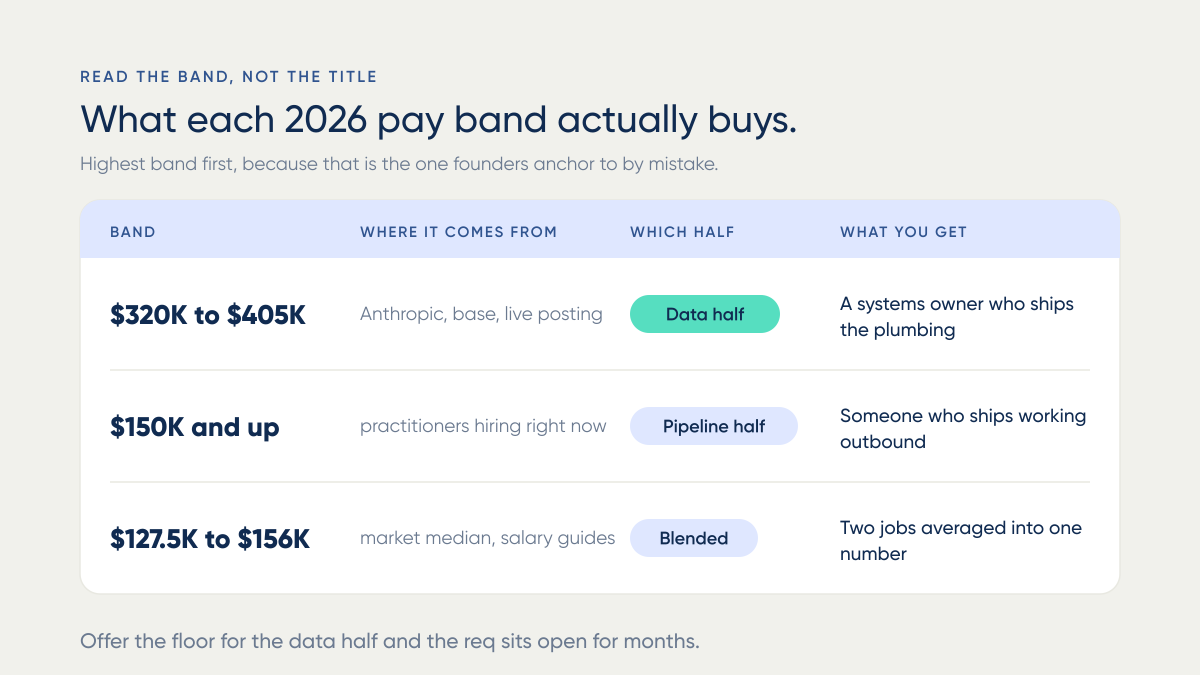
Start at the ceiling, because it is the number founders anchor to by accident and then quietly panic about.
- $320,000 to $405,000 base: Anthropic's "AI Engineer, GTM Claudification" role, on its public job board.
- $150,000 and up: the working floor that operators like Shawn Tenam of clearbox describe for people who are both technical and commercially fluent.
- $127,500 to $156,000: the blended median across published guides, useful only as evidence that blending is a mistake.
- $80,000 to $397,000: the reported total-comp spread, which is what a market with no shared definition looks like.
The two anchoring mistakes
- Offering the floor for data-half scope: the req sits open for months and you blame the market.
- Offering the ceiling for pipeline-half scope: you pay staff-engineer money for work a part-time hire already covers.
What the Top of the Band Actually Buys
Anthropic's band buys someone who ships the tooling everyone else builds on, plus the guardrails around anything an agent does to revenue data. The posting names approval gates and escalation paths as deliverables. Reqs down at the floor almost never mention either.
- Judgment about which agents are worth building at all, and which data sits underneath them.
- Controls that stop an agent from writing something wrong to a customer record at scale.
- The authority to set a standard the rest of the revenue team then builds against.
Which Half Should You Hire First?
Hire the data half first if your customer records are a mess, and the pipeline half first if the records are clean and nothing is going out the door. Almost every team gets one of these two answers, not both.
- Duplicate accounts, empty fields, owners who left last year: start with the data half, or everything you build on top inherits the mess.
- Tidy records and no outbound motion: start with the pipeline half, and let them borrow a data layer rather than build one.
- Both broken, one headcount to spend: buy the data half as a product and hire for the pipeline half. For most teams under 50 people that is the better trade by a wide margin.
Why Every Req Now Asks for Claude Code
Reqs gate on Claude Code or something like it because the job now includes building agent workflows, not configuring point tools. ColdIQ's 2026 opening lists hands-on experience with Claude Code or comparable automation as non-negotiable, and that one line shrinks the candidate pool faster than any salary band does.
What "demonstrable" means to whoever reads the resumes
- An install and configuration history somebody can look at, not a bullet point.
- One workflow a reviewer can watch run from prompt to output without help.
The Vibe Prospecting Plugin installs inside Claude Code, which makes it a straightforward way for a candidate to produce exactly that evidence. Add Vibe Prospecting from the Connectors Directory in Claude or ChatGPT first; the line below is the Claude Code path for people who prefer the terminal. Setup steps live in the plugin repository.