


Every time you ask Claude or ChatGPT to enrich a prospect list, someone has to own the legal basis for the data that comes back. If your setup pulls from five different enrichment providers, that someone has to own five separate agreements, five data-protection reviews, and five ongoing re-verification cycles. Most founders and sales leaders building AI-assisted prospecting workflows have not done that math. This compliance checklist helps you do it -- before a regulator does it for you.
Why Compliance Starts at the Provider, Not the CRM
Most prospecting guides treat compliance as a CRM or outreach problem: unsubscribe links, opt-out mechanisms, suppression lists. Those matter, but they do not protect you from the upstream question: where did this data come from, and does the source have the right to share it?
Under GDPR Article 28, every entity that processes personal data on your behalf must sign a data-processing agreement. That applies to enrichment providers the same way it applies to a CRM vendor. Under GDPR Article 5(2), you are accountable for demonstrating that every field in a record has a documented legal basis. Under California's CPRA, any provider that sells or shares California residents' data without a direct relationship must register as a state data broker -- a per-provider check, not a one-time clearance.
None of these requirements scale with the number of providers. They multiply. Adding a tenth enrichment source to your Claude workflow does not add ten percent more risk. It adds a tenth full compliance review.
The Four Questions Every Provider Must Answer
Before any enrichment source touches a prospect record that ends up in a sales conversation, a compliant setup needs clear answers to these four questions:
- Legal basis: Does the provider document its Article 6 basis for processing? Legitimate interest is the most common claim, but it requires a completed Legitimate Interest Assessment, not just a badge on a website.
- Data-processing agreement: Is there a signed DPA naming the specific categories of data in scope? A generic privacy policy is not a DPA.
- CCPA broker status: For any provider handling data on California residents, has its registration with the state data-broker registry been verified? Registries are public but not automatic.
- Re-verification cadence: How often does the provider confirm that its legal basis and source mix have not changed? A provider that quietly shifts from public-record collection to scraped data breaks the legal basis you reviewed at onboarding.
Completing this review once per provider is feasible. Repeating it quarterly across fifteen providers is not, which is why most teams skip re-verification entirely and carry the liability without knowing it.
How Provider Count Translates to Audit Surface
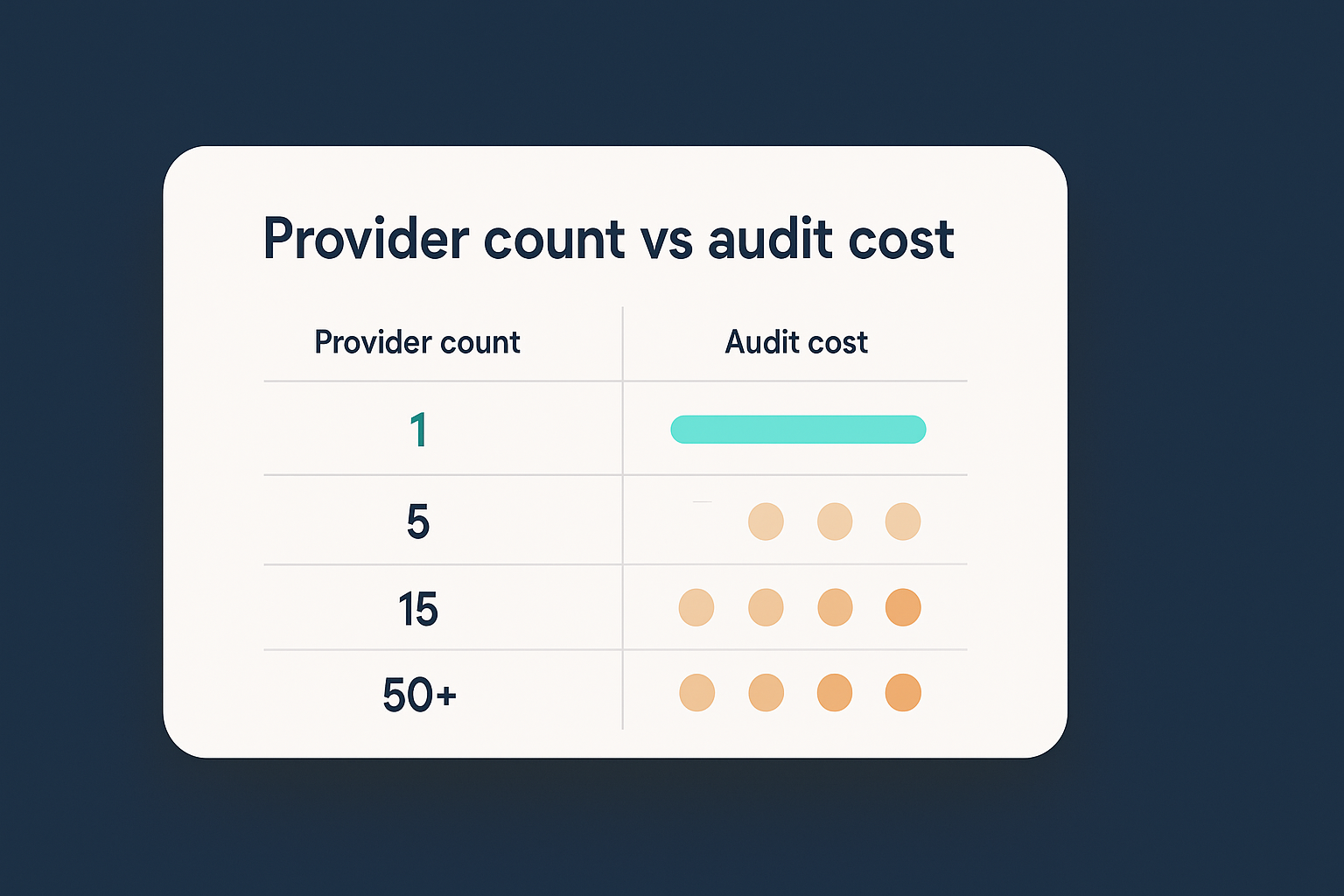
The table below maps provider count to practical audit outcomes based on how compliance teams actually operate, not how they plan to operate at initial setup.
| Provider count | Agreements to track | Legal basis reviews completed in practice | Re-verification frequency | Audit readiness |
|---|---|---|---|---|
| 1 | 1 | 1 | Vendor-managed, continuous | Fully documented |
| 2 to 4 | 2 to 4 | 2 to 4, sometimes slips | Quarterly | Mostly documented |
| 5 to 10 | 5 to 10 | Rarely past number 4 | Ad hoc | Gaps likely |
| 11 to 30 | 11 to 30 | Effectively incomplete | Rare | Audit failure risk |
| 30 or more | 30 or more | Not completed | None observed | High liability |
The pattern is consistent: initial setup involves good intentions and a short provider list. Incremental additions over six to twelve months bring the count past the practical review threshold without anyone deciding to stop reviewing. The result is a stack that looks like a coverage win and functions like an undocumented audit exposure.
What Data Provenance Means and Why It Matters More Than Match Rate
Match rate -- the percentage of records that came back with a complete field -- is the metric enrichment vendors lead with. It is not the metric a compliance review asks about.
A compliance review asks: for this specific field on this specific record, what was the source, what legal basis covered that source, and when was that basis last verified? That chain -- source, basis, verification date -- is data provenance. Without it, a GDPR data subject access request cannot be answered accurately, and a GDPR Article 30 processing record cannot be completed.
When a record passes through multiple enrichment layers, each layer typically overwrites the previous source tag. By the time the record reaches a CRM, only the last provider touched is visible. The first nine providers are invisible in the audit trail, even though each one contributed fields and each one needs its own legal basis documented.
What Coresignal and Hunter.io Actually Disclose
Both vendors publish compliance documentation that is better than average for the category. Neither resolves the core issue of adding a provider to a mixed stack.
Coresignal states it collects only business data available through public sources, holds GDPR and CCPA compliance positions, and has achieved SOC 2 certification. It is also a member of the Ethical Web Data Collection Initiative. Its dataset covers 4.5 billion records across more than 15 public sources, which makes it genuinely useful for deep historical employment data. The gaps are on the commercial side: resale and white-label licensing terms require direct negotiation and are not published, and the dataset pricing structure starts high enough that per-call use in a chat agent is not the intended model.
Hunter.io sources contact information directly from public business websites and provides both an opt-out mechanism and a data-processing agreement. It states compliance with GDPR, CAN-SPAM, and CASL. The documented limitation is pattern-guessing: when a direct public source does not exist for an email address, Hunter infers the format from company patterns and returns a confidence score rather than a confirmed source. Community-built MCP wrappers for Hunter exist but operate outside its service agreement, which matters for provenance documentation.
Adding either vendor to a multi-provider workflow does not simplify the compliance picture. It adds one more provider requiring its own documented review alongside every other provider in the stack. A side-by-side look at how different data providers handle these questions is at explorium.ai/compare.
How Vibe Prospecting Handles This in One Connection
Vibe Prospecting is built for use directly in Claude, ChatGPT, or a Claude Code agent. The compliance design starts with the data layer: 150 million company profiles, 800 million people profiles, and more than 50 underlying sources unified behind a single data-processing agreement and a single licensing chain. Powered by Explorium Enterprise Business Data, the provenance chain traces to named sources rather than an opaque merged record.

