

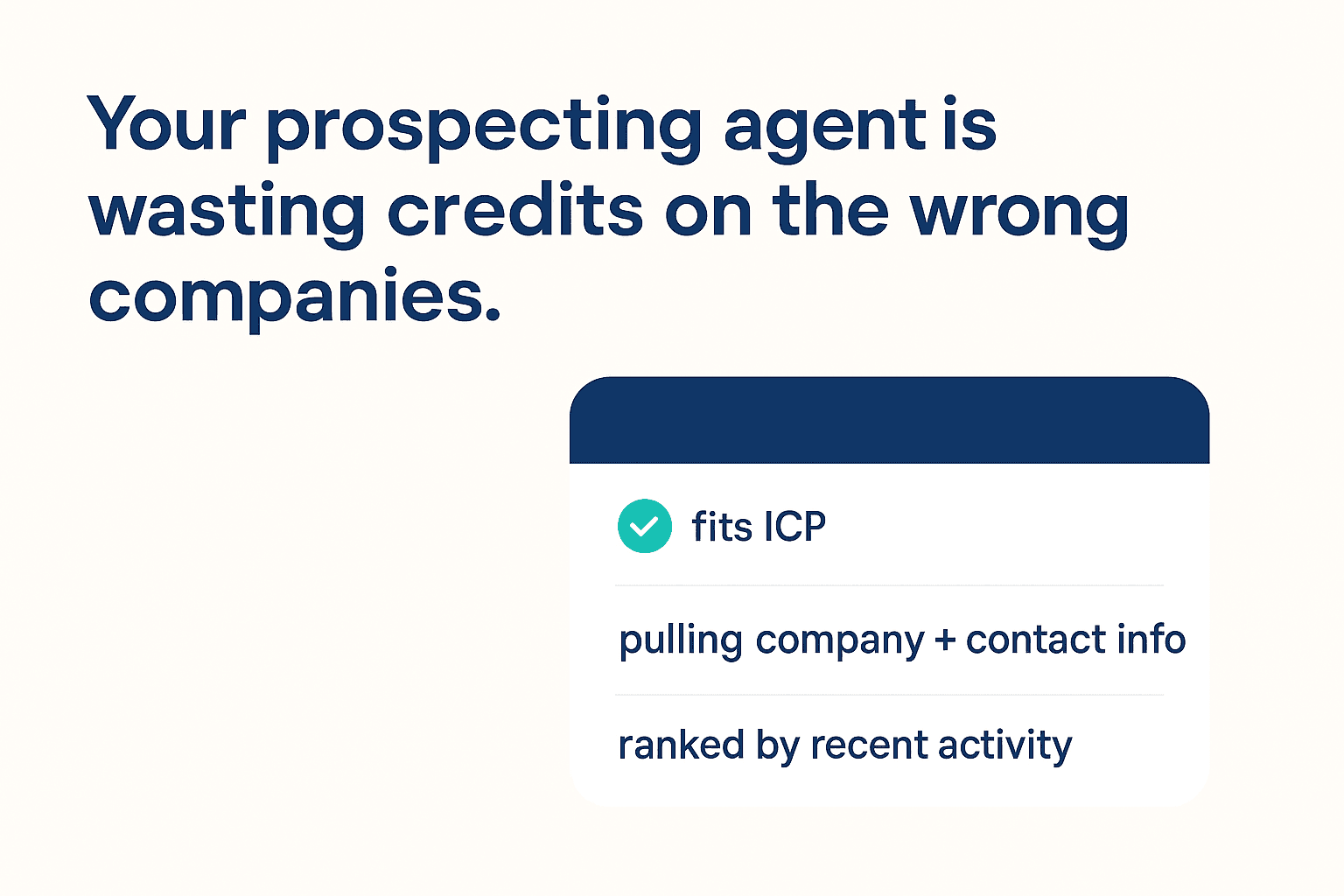
Ask Claude or ChatGPT to "research these 50 companies and tell me who to contact" and most of the time it will try, tab through search results, guess at a contact name, and hand you a list that looks finished. What it will not tell you is which of those 50 companies were never going to buy from you in the first place. That check has to happen before the research starts, not after, or you are just automating the wrong order faster.
This is the gap between a generic chat agent and a chat-first AI research agent for prospecting: the second one asks "does this company fit" before it spends a single lookup on it. Below is the order that actually holds up, what a research agent needs to know about a prospect in plain terms, and how to wire it into Claude or ChatGPT without stitching together three separate data tools.
The Time Sink in Prospecting Isn't Writing the Message, It's Finding Who to Message
A rep spends most of a prospecting day confirming who is even worth messaging, not writing the message itself. That confirmation step means checking a company's size, its industry, whether the right person still works there, and whether anything recent makes this a good moment to reach out -- across three or four browser tabs, one company at a time.
What Actually Eats the Day
- Opening a prospect list and re-checking basic company details one tab at a time because nothing was pre-qualified.
- No standing rule for what counts as "a fit," so the same judgment call gets made differently every time.
- Personalizing a message before confirming the company was ever worth messaging.
Automating the Wrong Order Just Moves Faster
Plugging an AI agent into that same workflow without fixing the order does not fix the problem, it just runs the wrong process at higher speed. The fix is sequencing: qualify first, then everything downstream costs less and comes out more accurate.
A Research Agent and a Sales Agent Are Not the Same Tool
A research agent decides who belongs on the list. A sales or outreach agent writes and sends the message once that list is ready. An outreach agent that skips the research step will still send messages, just to the wrong people, faster than a person could.
- A research agent checks company fit, then pulls contact and activity details, before anything gets drafted.
- A sales agent takes a qualified, evidenced record and turns it into a personalized message.
- Treating them as one step is the most common reason a homegrown prospecting agent produces a fast list that a rep still has to re-check by hand.
Where Telling Your Agent to "Just Search the Web" Falls Apart
A generic chat agent that searches the open web has no way to tell a real company match from a coincidental name overlap, and no way to know if a signal is recent or three years old. It treats every company the same way it would treat a trivia question.
Three Specific Ways It Breaks
- No confidence score on a company match, so a wrong result looks exactly as credible as a right one.
- No consistent set of fields, because every public page lists company details in a different format.
- No sense of what changed recently at a company, like a new round of funding or a hiring push, so nothing gets prioritized.
For more on why real data enrichment is a different problem than web search, Explorium's introduction to the topic is a useful primer.
Qualify First, Everything Else Second
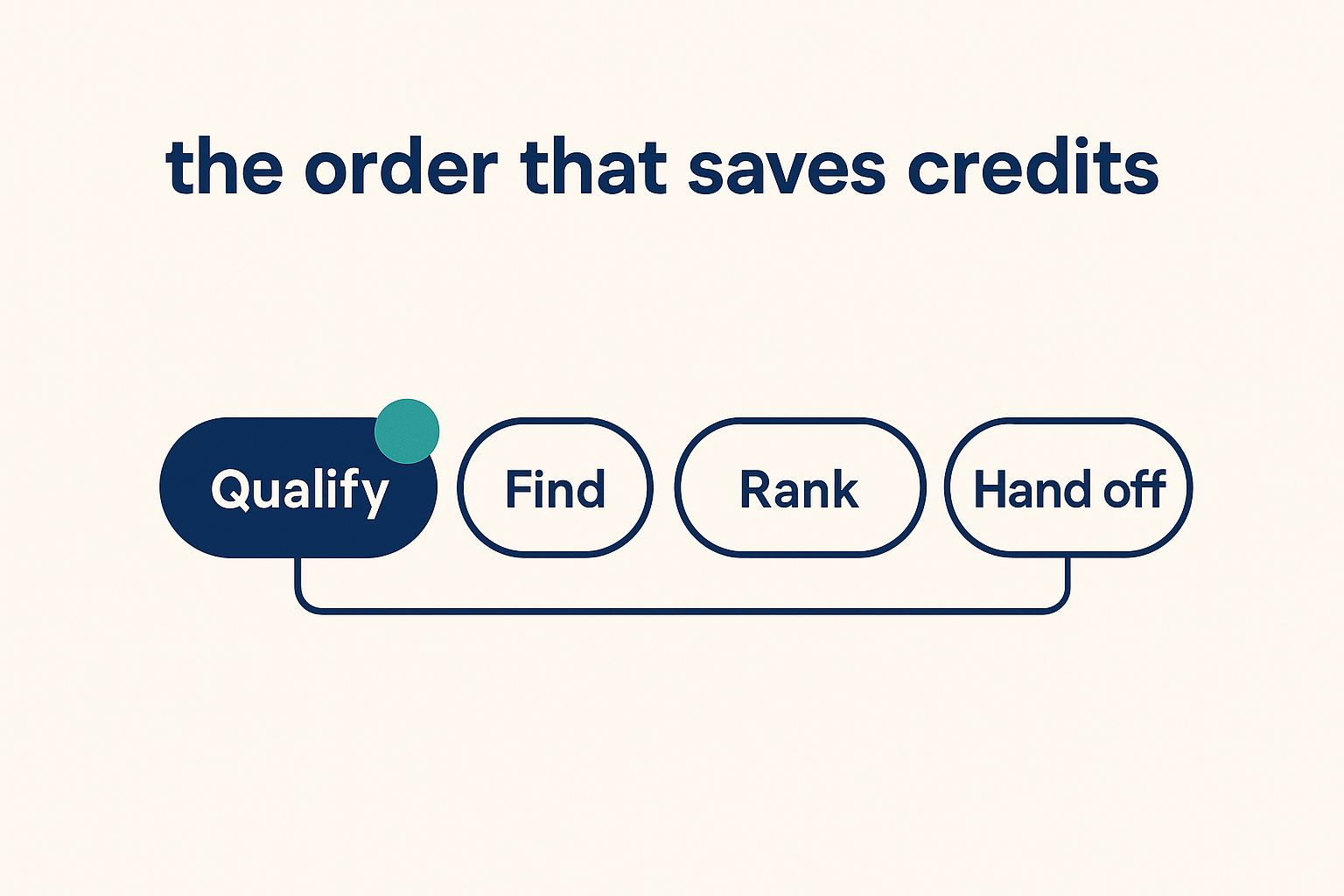
The agents that hold up in production check fit before they source a single contact, then rank, then check who else is already talking to that account, then hand off to outreach. Reversing any of those steps wastes the ones that come after it.
The Five-Step Order
- Qualify: does this company match your target profile at all.
- Find: pull the company and the right contact from a connected data source.
- Rank: sort the qualified list by how strong the recent activity is.
- Check the field: flag accounts already using a tool you compete with.
- Hand off: pass the ranked, evidenced record to whoever writes the outreach.
Skip step one and the agent spends real credits ranking and cross-checking companies that should have been filtered out first.
What "Fits Your ICP" Actually Means in Plain Terms
A fit check is a short, specific rule, not a vague sense of "good companies." It usually comes down to three or four things: the industry the company is in, roughly how many people work there, and sometimes how much revenue it brings in. Ask your agent to hold every company against that rule before it looks up anything else.
- A company that fails the check gets dropped before any contact lookup runs, so nothing is spent finding a person at a company you were never going to reach out to.
- A tight, specific rule keeps the ranked list small enough that the recent-activity step stays useful instead of noisy.
- The rule should live in the agent's instructions, not in a spreadsheet a rep has to remember to check.
The Five Things Your Agent Needs to Know About Every Prospect
A useful prospect record covers company basics, who the right contact is, how to reach them, what's changed recently, and how confident the match is -- pulled from one place instead of assembled by hand.
What a Complete Record Looks Like
| What's needed | Plain description | Vibe Prospecting coverage |
|---|---|---|
| Company basics | Industry, size, and revenue band | 150M+ company profiles |
| Who to contact | The right title and reporting line | 800M+ people profiles |
| How to reach them | Business email and contact details | Contact enrichment in the same call |
| What's changed recently | Funding, hiring, or a leadership change | 18 activity categories, 80+ signal types |
| Match confidence | How sure the agent is this is the right company | 97.8%+ company match accuracy |
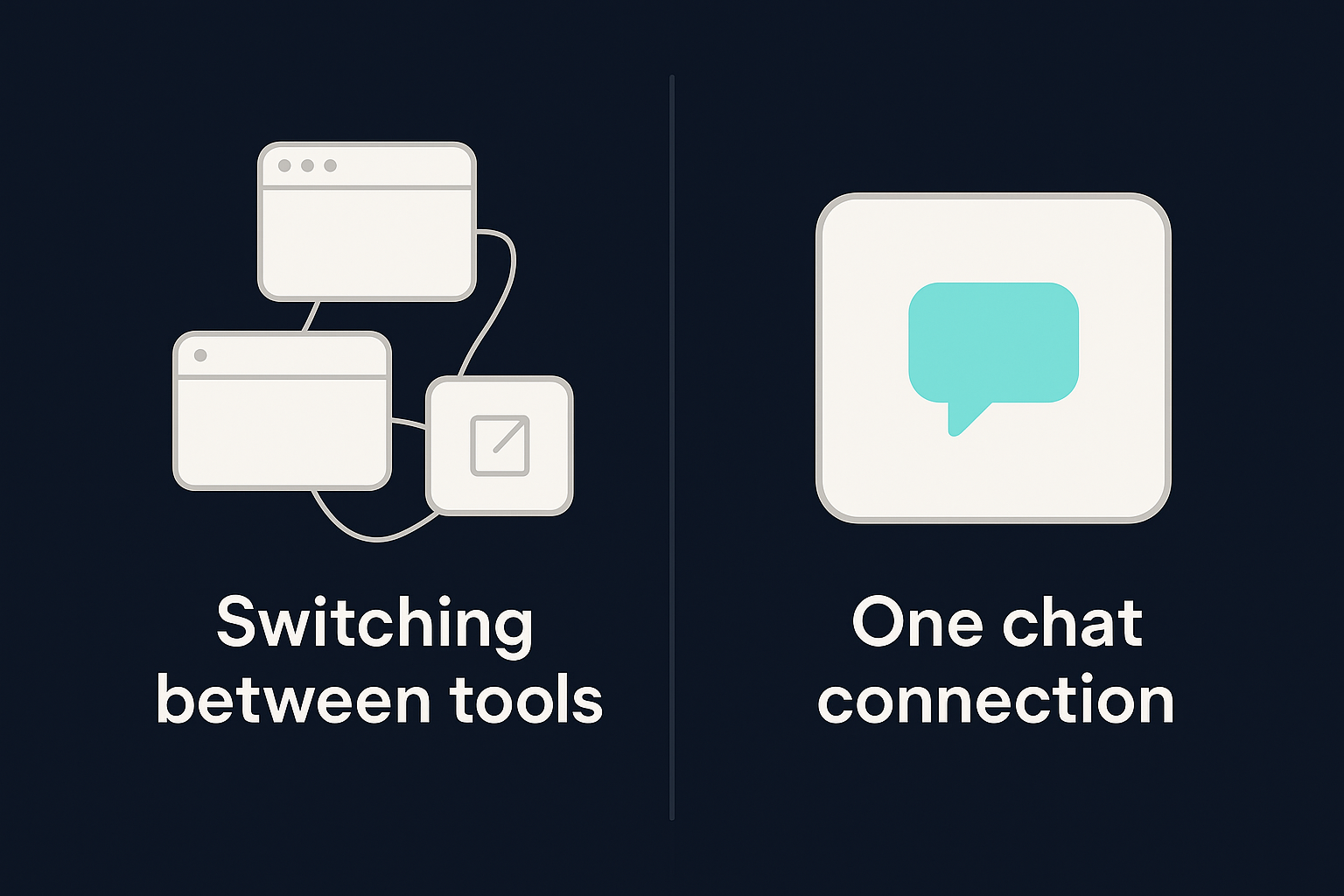
Pulling all five from one connection means the agent is not calling a second and then a third data tool mid-conversation, which is where most of the added delay and mismatched records come from.
One Chat Connection Beats Stitching Three Tools Together
Vibe Prospecting connects company lookup, contact details, and recent-activity data through a single chat connection, works from a free account, and handles up to 1,000 companies in one call. Instead of asking Claude or ChatGPT to check one tool for company size, a second for an email address, and a third for recent news, you ask once.
What One Connection Covers
- 150M+ company profiles and 800M+ people profiles pulled from 50+ sources, so the coverage does not thin out on smaller or less-known companies.
- 18 categories of recent activity and 80+ specific signal types, covering funding, hiring, and other changes worth acting on.
- 97.8%+ company match accuracy, so the fit check is filtering on results you can actually trust.
Built Not to Stall Partway Through a List
A chat agent that loads every record straight into the conversation runs out of room fast, usually somewhere between 20 and 100 companies. Vibe Prospecting processes records on its own servers instead, so a 500-company list does not need to be split into five separate conversations, and the connection holds up at 99.999% uptime.
Connect It to Claude or ChatGPT
For most people, installing from the Claude or ChatGPT connectors directory is a one-click step. Power users working in Claude Code can wire it in directly: