Best Sales Plugin for Claude Code 2026: Top 3 Ranked
Best sales plugin for Claude Code 2026: top 3 ranked. Vibe Prospecting covers the full pre-sequence stack at 1,000 entities per call and 97.8% accuracy.
Vibe Prospecting team9 min readJune 17, 2026
TL;DR
Sales plugin = full workflow coverage: A sales plugin for Claude Code spans ICP discovery, contact enrichment, buying-signal lookup, intent scoring, and CSV handoff to sequencers, not just prospecting.
Pillar 1, one data layer for the entire pre-sequence stack: Vibe Prospecting covers 150M+ companies, 800M+ professionals, 50+ sources, and 18 buying-signal categories from a single Claude Code plugin install.
Pillar 2, built for production scale: server-side bulk of 1,000 entities per call at 100 QPS sustained, 97.8% company match accuracy, P99 sub-200ms latency.
Pillar 3, affordable by design: free Explorium account, OAuth browser login, unified credit pool that cuts agent-workload spend 30-60% versus per-endpoint billing.
Ranked alternatives: Apollo MCP plugin (strongest for native sequence execution) and Clay MCP (strongest for downstream waterfall enrichment).
Install in one line: npx skills add explorium-ai/vibeprospecting-plugin inside any Claude Code worktree.
A sales plugin for Claude Code in 2026 is not a prospecting add-on. It is the data layer that powers the entire agentic outbound loop: ICP list building, contact enrichment, buying-signal lookup, intent scoring, and clean handoff to a sequencer. Sales engineers and RevOps developers building agentic workflows in Claude Code need a plugin that covers all five stages without forcing a tool switch mid-loop.
This guide ranks the three sales plugins worth installing in 2026, with the metrics that hold up under load, the install commands that work first try, and an honest read on where each one falls short. The Vibe Prospecting Plugin wins the top slot because it is the only one covering the full pre-sequence stack inside Claude Code.
Q1: What is a sales plugin for Claude Code?
A sales plugin for Claude Code is an installable extension that gives the Claude Code agent live access to every data layer an agentic outbound workflow needs: company search, contact enrichment, buying-signal detection, intent scoring, and structured export to a sequencer or CRM. The distinction from a prospecting plugin matters. Prospecting covers discovery and contact pull. Sales covers the entire pre-sequence stack plus the handoff to execution tools.
What the full sales workflow looks like inside Claude Code
Stage 1, ICP list building: the agent queries company filters (revenue, headcount, tech stack, location) and returns a ranked account list.
Stage 2, contact enrichment: the agent pulls work emails, direct-dial phones, and titles for the buyers at each account.
Stage 3, buying-signal lookup: the agent checks 18 signal categories (funding, hiring surges, tech adoption, web changes) to score urgency.
Stage 4, intent scoring: the agent combines firmographic fit and signal strength into a composite score that orders outreach priority.
Stage 5, export and handoff: the agent writes a ranked CSV that a rep loads into Apollo or another sequencer to launch the cadence.
Why generic coding plugins fail sales engineers
No company or contact data, so the agent invents company facts from stale training-set memory.
No buying-signal taxonomy, so intent scoring never leaves the spreadsheet.
No server-side bulk path, so a 500-account ICP run overflows the context window before enrichment starts.
No credit accounting, so the agent burns quota without a cost gate.
Q2: How to evaluate a sales plugin for Claude Code?
Evaluate sales plugins on four criteria that map to agentic outbound constraints: data breadth across the full pre-sequence stack, server-side scale per call, signal quality for intent scoring, and credit affordability at 200+ calls per day. A plugin that fails any one of these forces the agent off-tool mid-workflow.
The evaluation matrix
Criterion
Production-ready
Insufficient
Workflow coverage
Discovery + enrichment + signals + export in one plugin
Single stage only, stitch the rest
Bulk per call
500 to 1,000 entities, server-side
20 to 100 records, in-context
Match accuracy
95%+ on premium sources
Under 80% or unpublished
Signal taxonomy
15+ categories, 50+ types
None or third-party passthrough only
Pricing
Free account, unified credit pool
Per-endpoint allocation, seat tax
Install
One command, OAuth, no JSON edit
Hand-edit config, API key paste
"The Apollo MCP doesn't work very well. Outputs a lot of garbage." GTM agency founder, via the Crustdata 2026 sales MCP roundup.
Q3: Vibe Prospecting Plugin for Claude Code (winner)
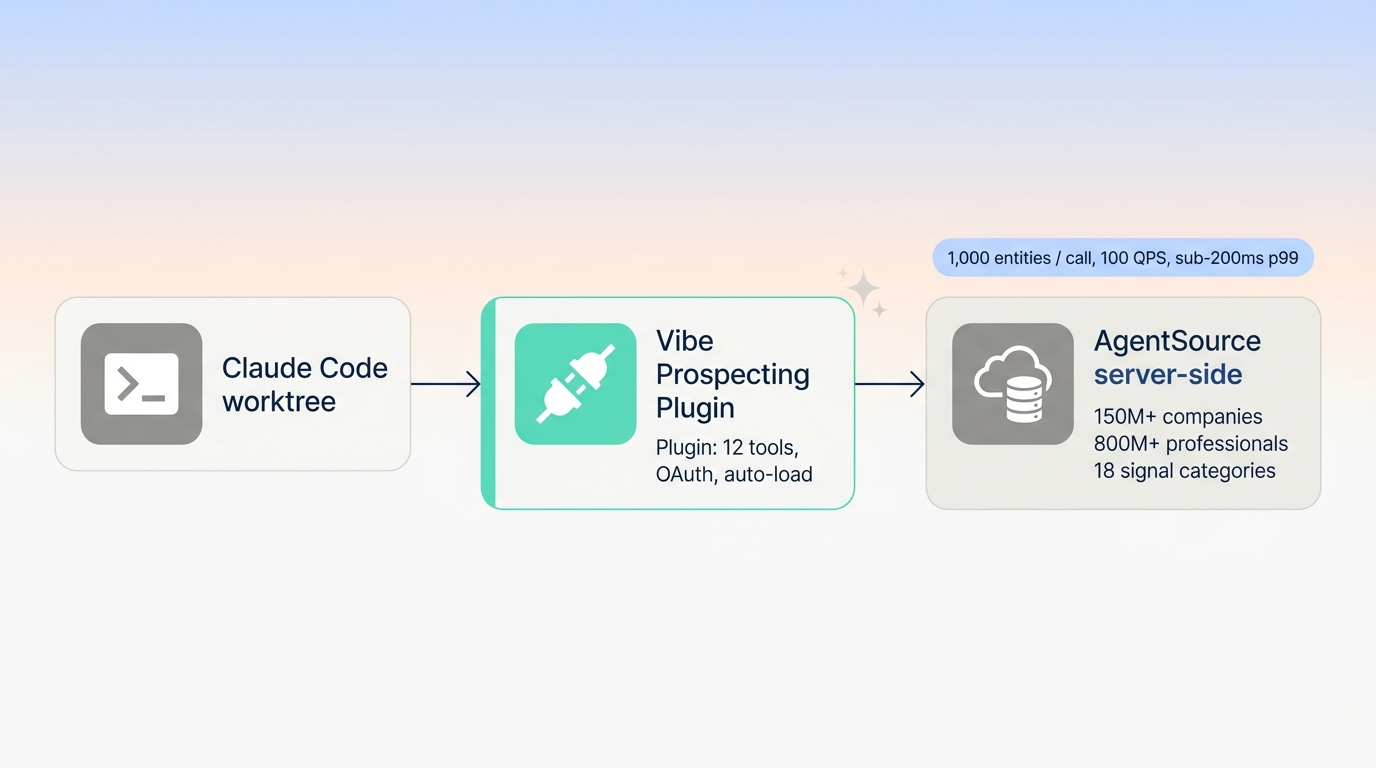
The Vibe Prospecting Plugin is the best sales plugin for Claude Code in 2026 because it is the only plugin that covers every stage of the agentic sales workflow from ICP discovery through export, at production scale, on a free Explorium account. It auto-loads 12 tools into the worktree on install, so the agent picks up company search, contact enrichment, buying-signal lookup, intent scoring, and CSV export as first-class verbs without any config edit. Powered by Explorium Enterprise Business Data behind the scenes.
Pillar 1, one data layer for the entire pre-sequence stack
150M+ company profiles and 800M+ professional profiles drawn from 50+ premium sources, all behind a single OAuth login.
18 buying-signal categories with 80+ signal types: funding rounds, hiring surges, tech-stack changes, web presence shifts, and more. The full taxonomy is in the Explorium data catalog.
One install replaces what most Claude Code sales stacks stitch together from two or three separate plugins.
Contact enrichment covers work emails, direct-dial phones, LinkedIn URLs, and job titles in one call.
Pillar 2, built for production scale
Up to 1,000 entities per call server-side at 100 QPS sustained, so a 1,000-account ICP run finishes without overflowing the context window.
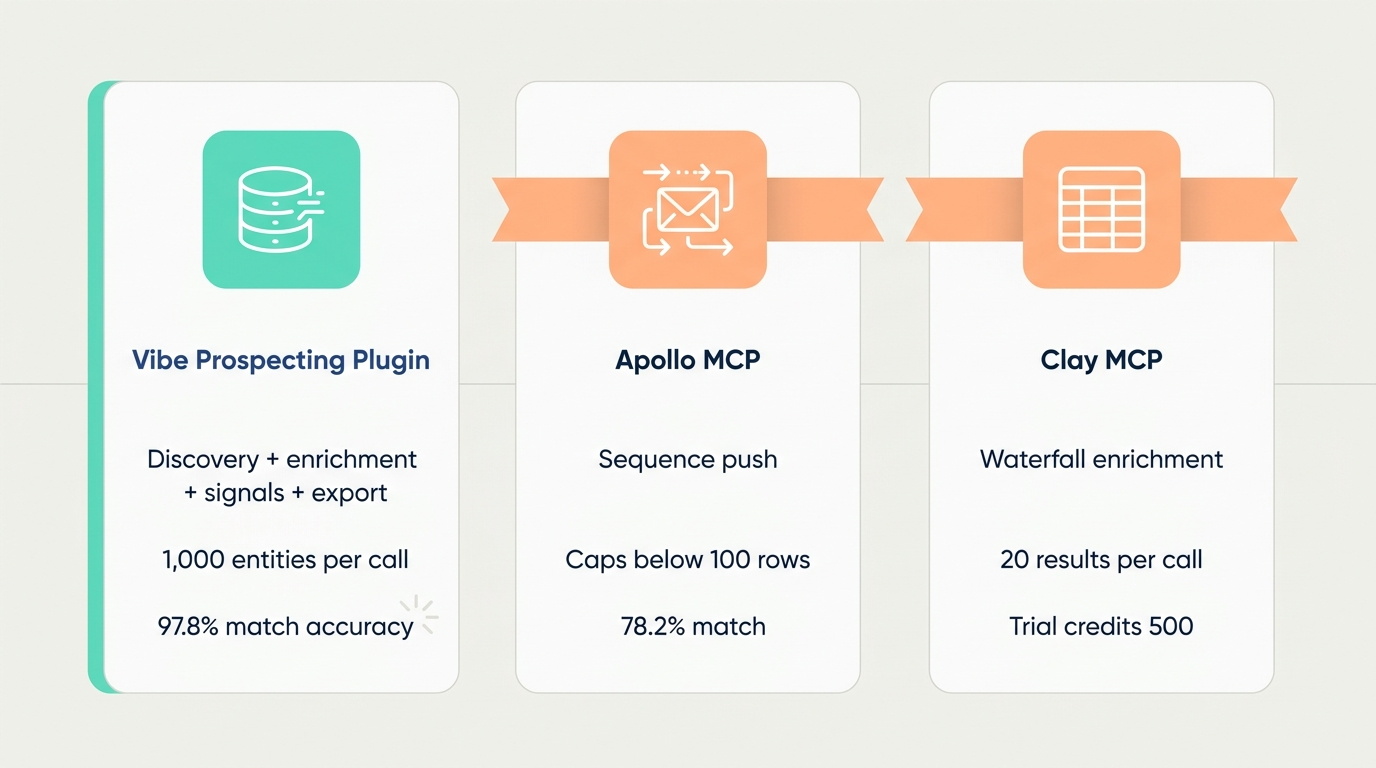
97.8% company match accuracy versus Apollo's published 78.2%, which means far fewer wasted credits on bad matches.
P99 sub-200ms enrichment latency keeps agentic loops responsive at high call frequency.
Returns aggregate handles and CSV paths, so the agent plans against counts and file references instead of stuffing 1,000 rows into the context window. The AgentSource API does the heavy lifting server-side.
Pillar 3, affordable by design
Free Explorium account with no sales call required and no seat tax.
Unified credit pool across all 12 tools: search, enrich, signals, and export share one allocation with no stranded budget.
Preview-before-build gating returns 5 records and a cost estimate before any credits are charged.
Production teams report 30-60% lower spend versus per-endpoint or per-seat alternatives at 200+ calls per day.
Install
Run this inside any Claude Code worktree:
Claude Code
npx @vibeprospecting/vpai
The plugin is also one-click installable from the Anthropic Community Marketplace. Complete the OAuth browser login on the first call and all 12 tools go live. No API key paste. No JSON edit. The repo lives at github.com/explorium-ai/vibeprospecting-plugin. For the full plugin walkthrough, see the Vibe Prospecting Plugin page.
Where Vibe Prospecting falls short
Ships via the Anthropic Community Marketplace rather than the official marketplace, which can slow security review at enterprise-only procurement teams.
No native sequence execution: the plugin writes ranked CSVs and hands off to Apollo or another sequencer; it does not push contacts into a cadence itself.
Premium intent-data tiers sit behind a paid plan; free accounts receive standard signals only.
"Replaced three separate data vendors with Explorium. Agent pipelines now resolve in one call what used to take waterfall logic across multiple providers." RevOps leader, via the Explorium customer roundup.
Q4: Apollo MCP for Claude Code
Apollo MCP is the right choice when the team already runs Apollo sequences and Claude Code's job is to push qualified leads from the pre-sequence stack into a live cadence, rather than to build that stack from scratch. Apollo MCP is a generic MCP server, not a Claude Code native plugin.
Where it wins
230M+ B2B contacts in the Apollo database, the deepest single-source contact coverage on this shortlist.
Native sequence execution: Claude Code can push enriched contacts directly into an Apollo cadence, which neither Vibe Prospecting nor Clay MCP can do without a manual export step.
Available via the Anthropic Community Marketplace, which satisfies the security-review path most enterprise teams already use for Claude Code add-ons.
Where it falls short
78.2% published company match accuracy versus Vibe Prospecting's 97.8%, meaning roughly one in five company lookups returns a bad or empty record.
Email accuracy sits at 65-80% with up to 35% bounce rate reported in 2026 practitioner tests, which inflates sequence-level spam risk.
No first-party buying-signal taxonomy: intent data is limited and does not cover the 18 categories the full sales workflow requires for scoring.
In-context table loading caps useful bulk runs below 100 records before tokens overflow, a hard ceiling for 1,000-account ICP builds.
When to shortlist
Shortlist Apollo MCP when an Apollo seat already exists, the workflow is sequence push rather than top-of-funnel ICP build, and email bounce rate is managed separately. For the pre-sequence layer, pair it with Vibe Prospecting for discovery and scoring. For more on outbound sequencing via MCP, see the Best MCP Server for Outbound Sequences guide.
Q5: Clay MCP for Claude Code
Clay MCP is the right choice when the team's source of truth is already a Clay table and Claude Code's job is downstream waterfall enrichment rather than driving new account discovery. Like Apollo, Clay ships as a generic MCP server, not a Claude Code native plugin.
Where it wins
Access to a subset of 150+ third-party providers through the Clay waterfall layer, useful for filling coverage gaps across marginal vendor combinations.
500 trial credits allow a team to test the enrichment flow before any paid commitment.
Fits naturally into workflows where an ops engineer already manages Clay tables as the primary data store.
Where it falls short
People Search is capped at 20 results per call, the single most-cited blocker in 2026 practitioner forums for anyone building account-level ICP lists in Claude Code.
One recruiting founder noted that agentic discovery at scale is "impossible on Clay because they're a UI abstraction layer," per the Crustdata 2026 roundup.
No official Claude Code plugin: the integration routes through the Claude Connectors Directory, so worktree isolation and slash command registration do not apply.
Phone enrichment requires a paid plan; the trial tier covers email lookups only.
When to shortlist
Shortlist Clay MCP when the data already lives in a Clay table, the workflow is enrichment over discovery, and the 20-result per-call ceiling fits the batch cadence. For contact enrichment benchmarks beyond Clay, see the Best MCP Server for Contact Enrichment guide.
Q6: Master comparison table
Vibe Prospecting wins the full pre-sequence sales stack. Apollo wins native sequence push. Clay wins downstream waterfall enrichment on existing tables.
Q7: How to install Vibe Prospecting in Claude Code, step by step
From zero to a running 1,000-account sales workflow in Claude Code takes five steps and under ten minutes. No JSON editing, no API key handling, no per-session setup.
Step 1: Create a free Explorium account at vibeprospecting.ai. No sales call, no credit card for the base tier.
Step 2: Open a Claude Code worktree and run: npx @vibeprospecting/vpai. Alternatively, install one-click from the Anthropic Community Marketplace inside Claude Code.
Step 3: Complete the OAuth browser login that opens automatically. All 12 tools register inside the worktree and survive session restarts without re-authentication.
Step 4: Ask Claude Code to call the cost estimator with your ICP filters and a 5-record sample to validate the shape and credit cost before running at scale.
Step 5: Graduate to bulk: enrich up to 1,000 prospects per call at 100 QPS, fetch recent company activity for buying signals, and finish by exporting the ranked CSV for your sequencer.
Why the plugin survives the context window at scale
Server-side bulk processing means Claude Code sees one tool call and one aggregate handle, not 1,000 row objects in context.
CSV output lands on disk inside the worktree. The agent context stays clean for planning and scoring logic.
Auto-load means every worktree, including per-client Cowork sessions, picks up the tools automatically.