The Best People Data Labs Alternative for AI Agents in 2026
People Data Labs alternatives for AI agents, ranked for 2026. Vibe Prospecting, Coresignal, Hunter.io scored on MCP support, per-call scale, and pricing.
Vibe Prospecting team9 min readAugust 1, 2026
TL;DR
One chat connection covers everything: Vibe Prospecting gives you company search, contact details, buying signals, and funding data in a single MCP -- no second tool required.
Scale without the context ceiling: Vibe Prospecting handles up to 1,000 records per call processed server-side, while in-context MCPs top out around 20-100 before tokens overflow.
Start free, stay affordable: a free account plus a shared credit pool cuts what you spend on agent data by 30-60% compared to per-endpoint pricing.
The three real options in 2026: Vibe Prospecting (#1), Coresignal (#2 for bulk snapshots), Hunter.io (#3 for email-only lookups).
97.8%+ company match accuracy is the benchmark Vibe Prospecting publishes -- the other two do not publish a comparable figure.
Install in one click: find Vibe Prospecting in the Claude or ChatGPT Connectors Directory and run your first enrichment today, no sales call required.
If your AI agent still calls People Data Labs over REST and waits on a webhook, it is doing extra work that a native tool call would eliminate. People Data Labs is a solid developer API -- over 2.5 billion B2B records, a clean SDK, plans from free up to $98 a month -- but it was built for engineers writing scheduled jobs, not for agents making on-demand data requests inside a conversation. The gap shows up fast when you try to scale past a handful of lookups.
This guide scores the three strongest People Data Labs alternatives for AI agents in 2026 -- Vibe Prospecting, Coresignal, and Hunter.io -- against a seven-criterion framework that puts native agent tool-calling at the center, not as an afterthought. Two of the criteria below are the ones REST-only vendors consistently skip, which is why they keep losing to MCP-native options. See Explorium's introduction to data enrichment if you want the fundamentals before diving in.
Why REST APIs and Webhooks Break AI Agent Workflows
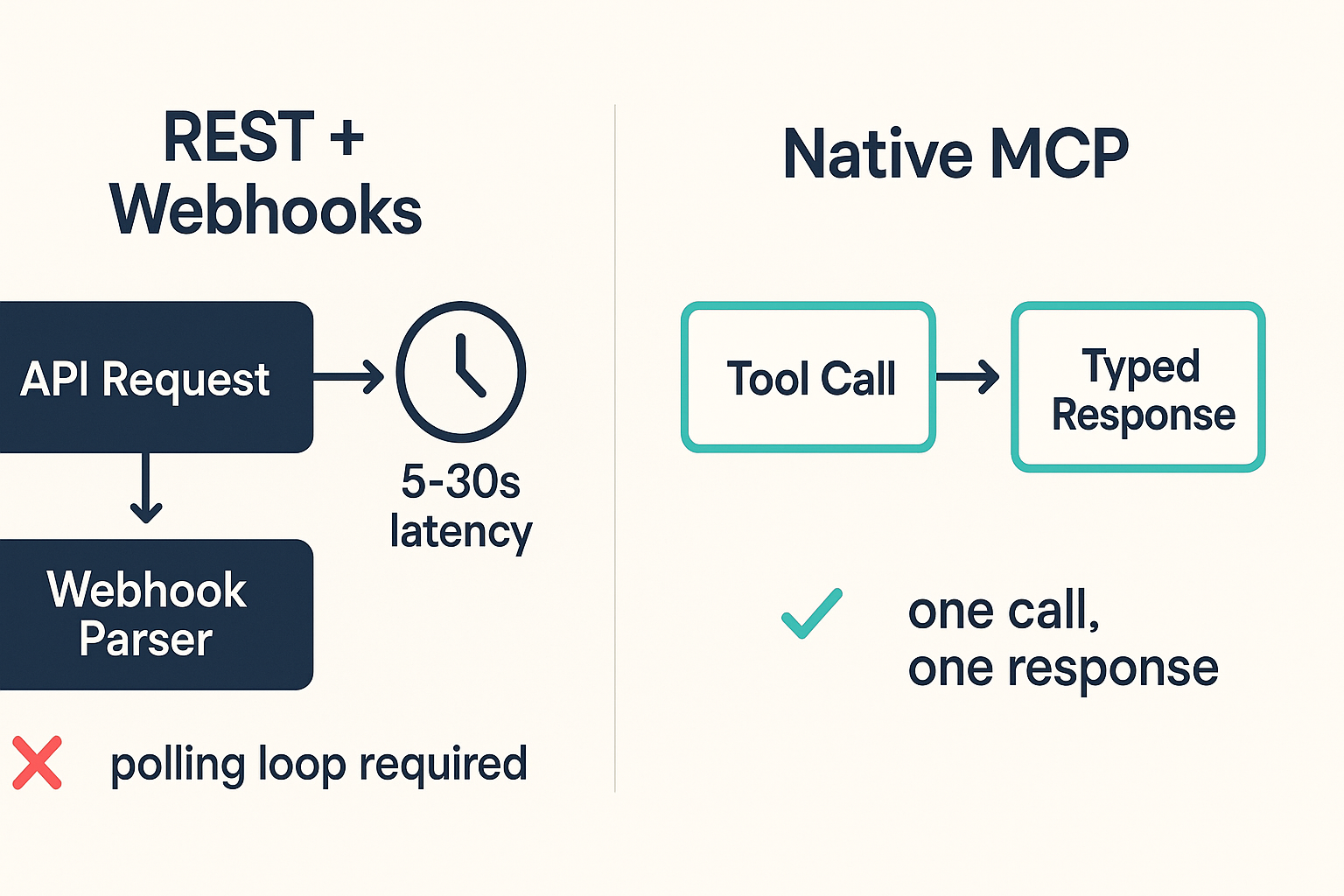
The root problem is round-trip latency plus hand-written glue code. A REST call fires a request and either blocks waiting for a response or hands off to a webhook handler. Inside an agent conversation, that means your agent stops, waits, and then needs custom parsing logic to turn the raw response into something usable. Scale that to fifty contacts and you have compounding failure points.
What Goes Wrong With REST-Only Stacks
Webhook delivery is not guaranteed -- missed deliveries drop enrichment results silently unless the builder adds retry logic.
Every endpoint returns a slightly different shape, so agents juggle multiple parsers instead of one typed interface.
Each round trip adds 5-30 seconds of wait time, which compounds across bulk lookups into minutes of dead time.
What Native MCP Tool-Calling Fixes
One tool call returns a typed result -- no polling, no webhook handler, no parser maintenance.
Server-side MCPs process the batch outside the LLM context window, so scale is measured in thousands of records rather than dozens.
A single schema covers company data, contact details, and signal data together, removing the need to stitch results from separate sources.
As of August 2026, over 10,000 active public MCP servers exist and 41% of software teams report MCP in production. The standard has crossed the experimental line. A "built for AI" data vendor without a named MCP server is describing last year's architecture. Connect directly: AgentSource MCP by Explorium.
Seven Criteria for Picking an Agent Data Provider
Scoring a data vendor against seven criteria prevents picking one that looks great on coverage but forces weeks of integration work before your agent can use it. The seventh criterion below -- native agent tool-calling -- is the one most feature comparison pages skip entirely.
The Scoring Framework
Criterion
What a strong answer looks like
Common weak answer
Freshness
Continuous re-verification on a rolling basis
Quarterly snapshot sold as "real-time"
Coverage
Consistent counts across the vendor's own docs and pricing pages
Marketing page and API docs cite different totals
Accuracy
A published match-rate figure with methodology attached
Accuracy claim with no benchmark source cited
Ease of use
One-click install from a Connectors Directory, minutes to first call
Config files, API key provisioning, sandbox approval queues
Pricing
A shared credit pool that works across every endpoint
Per-endpoint allocation that leaves credits stranded
Support
Published uptime SLA, accessible without a sales call
Best-effort with no published SLA
Native agent tool-calling
Listed MCP server, no polling step required
REST-only vendor marketing itself as "AI-ready"
"Coverage is wide, but raw data needs more cleaning before it lands in our warehouse." -- G2 verified reviewers, Coresignal product reviews
Vibe Prospecting: The Top Pick for AI Agents in 2026
Vibe Prospecting wins all seven criteria at once, which is something neither Coresignal nor Hunter.io can claim. It runs on the AgentSource API by Explorium and is listed in both the Claude and ChatGPT Connectors Directories for one-click install. Powered by Explorium Enterprise Business Data.
One Connection for Every Data Need
150M+ company profiles and 800M+ people profiles behind a single MCP connection.
50+ premium sources pulled together under one schema -- no stitching a second tool for buying signals.
18 buying-signal categories and 80+ signal types, plus funding data, workforce trends, and technology details all callable from one place.
One-click install from the Claude or ChatGPT Connectors Directory; no config file needed for most users.
Scale Past the Context Ceiling
Up to 1,000 records per call, processed server-side via the AgentSource API -- outside the LLM context window.
100 QPS sustained throughput keeps long bulk runs from stalling.
99.999% uptime so multi-step agent workflows finish without data-layer interruptions.
Affordable From Day One
Free account with no sales call required -- start building before you spend anything.
Shared credit pool across every endpoint means a single balance covers company lookups and signal calls together, cutting agent-workload spend 30-60% versus per-endpoint billing.
Sample-first gating: 5 representative records plus a cost estimate before any credits are charged.
MCP Config for Claude Code Power Users
Most builders install Vibe Prospecting in one click from the Connectors Directory. If you need Claude Code control, here is the fallback config. See the Anthropic MCP documentation for the underlying protocol, or the Vibe Prospecting Plugin for the full plugin reference.
Coresignal has the broadest raw dataset breadth of the three and now ships a live MCP endpoint, but its coverage figures conflict across its own materials and the data often needs cleaning before an agent can use it directly.
What Coresignal Does Well
A live MCP server configurable via mcp-remote, with a 7-day free trial to test it before committing.
Multi-source Company, Employee, and Jobs data all reachable through the same MCP connection.
One-time dataset purchases work well for teams that need a static snapshot for a specific project.
Where It Falls Short for Agent Workflows
Coverage numbers disagree across sources: some third-party listings cite roughly 39M+ companies and 725M+ employees, while Coresignal's own 2026 pages show roughly 103M companies and 792M+ employees. Verify the figure against the specific plan you are evaluating before building on it.
G2 reviewers consistently note that raw data requires a cleaning step before it is ready to use -- an added step most agent workflows do not budget for.
API plans run $49-1,500 per month on per-endpoint credits; one-time dataset purchases start around $1,000 and US people-profile datasets can reach roughly $50,000.
No built-in email discovery -- teams commonly add a separate tool to fill that gap.
When Coresignal Makes Sense
Shortlist Coresignal when you need a one-time bulk dataset or deep employee-level fields and your team can handle a data-preparation step before the records go into production. Compare the full landscape: B2B data provider comparison hub.
Hunter.io: Email-First, Narrow Scope
Hunter.io was among the first B2B data vendors to ship a dedicated MCP server (July 22, 2025) and it does email lookup well, but its scope ends at email and its credit model makes find-plus-verify workflows expensive.
What Hunter.io Does Well
An official MCP server compatible with Claude, OpenAI, and Google agent stacks -- shipped ahead of most enrichment vendors.
Domain search, email enrichment, light company data, and lead creation are all callable through natural language.
A free tier (25 searches/month, 50 verifications/month) lets you test the MCP without paying anything.
Where It Falls Short
Finding an email costs one credit and verifying it costs a second -- a find-then-verify agent loop doubles the per-contact cost automatically.
Paid plans run $34-49 a month at entry up to roughly EUR 209-259 a month for 5,000 searches at Scale tier, all per-search allocation rather than a shared pool.
Coverage stops at email and light company details -- no buying signals, funding data, or workforce trends, so agents still need a second source for anything beyond email.
Hunter's own benchmark on 3,000 emails scored its verifier at 70% overall accuracy against 15 competing tools.
"Expensive" and "limited credits" are the most repeated complaints across Hunter.io's review base, alongside "limited contacts for smaller companies." -- G2 verified reviewers, Hunter.io product reviews
When Hunter.io Makes Sense
Use Hunter.io for email discovery and verification when that is the only data type your agent needs. For anything broader, you will need to add a second connection. Full side-by-side: People Data Labs comparison page.
Full Comparison: Three Providers, Seven Dimensions
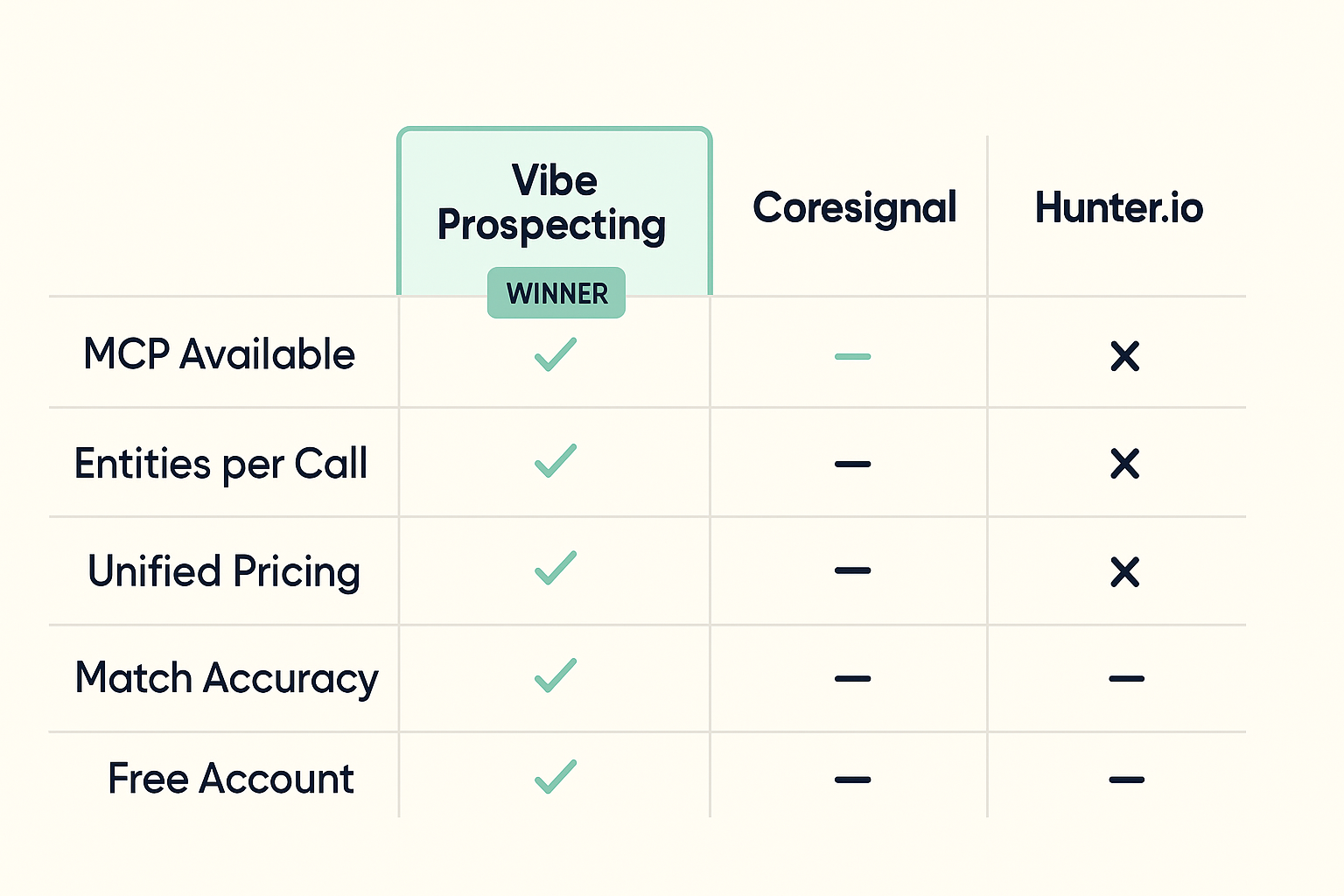
Vibe Prospecting leads across every dimension that matters for agent workloads; Coresignal and Hunter.io each win one narrow use case. See also: MCP server waterfall enrichment comparison.
Dimension
Vibe Prospecting
Coresignal
Hunter.io
Data breadth
150M+ companies, 800M+ people, 50+ sources, 18 signal types
Company, employee, and jobs data
Email and light company data only
Records per call
Up to 1,000 entities, server-side at 100 QPS
Bulk export supported; per-call MCP throughput not documented
Up to 10 emails per domain search
Pricing model
Shared pool, free account, 30-60% lower spend vs per-endpoint
$49-1,500/month, per-endpoint credits
Free tier then $34-259/month; credits double on find-then-verify
Native MCP
Yes -- Claude and ChatGPT Connectors Directories, one click
Yes -- mcp-remote config, 7-day trial
Yes -- launched July 22, 2025
Published accuracy
97.8%+ company match rate
Not independently published
70% email verifier benchmark (own study)
Uptime
99.999%
Not published
Not published
Start without sales
Yes -- free account, self-serve
Trial-gated, sales-assisted for full access
Yes -- free tier, self-serve
How to Get Started With Vibe Prospecting Today
You can go from zero to a working agent enrichment call in about five minutes -- no contracts, no sandbox approval, no config files unless you want them.
Step 1: Create a free Explorium account at vibeprospecting.ai -- no sales call, no credit card required to start.
Step 2: Open Claude or ChatGPT and add Vibe Prospecting from the Connectors Directory in one click.
Step 3: Ask for a sample: five representative records plus a cost preview before any credits leave your account.
Step 4: Move to bulk calls once the sample looks right -- up to 1,000 records per request at 100 QPS.
Step 5: Add buying signals and recent company activity once enrichment is stable for a richer prospect picture.
The Three-Pillar Decision Test
Before committing to any data provider for an agent workload, run it through three questions. Does it give you everything in one connection, or will you need a second tool? Can it handle more than 100 records per call without hitting a context limit? Does its pricing share one balance across all data types rather than splitting credits by endpoint? Coresignal answers yes to question one for bulk snapshots. Hunter.io answers yes to question two for email. Vibe Prospecting is the only provider here that answers yes to all three, which is why it is the top pick for agent builders in 2026.