Best MCP server for intent signals 2026: Vibe Prospecting fuses 18 signal categories with firmographics in one call. Apollo and ZoomInfo compared side-by-side.
Vibe Prospecting team8 min readJune 1, 2026
TL;DR
Pillar 1 - One MCP, every signal type: Vibe Prospecting returns company facts, contact data, recent company activity, funding, and 18 buying-signal categories with 80+ signal types from a single MCP call. No second vendor.
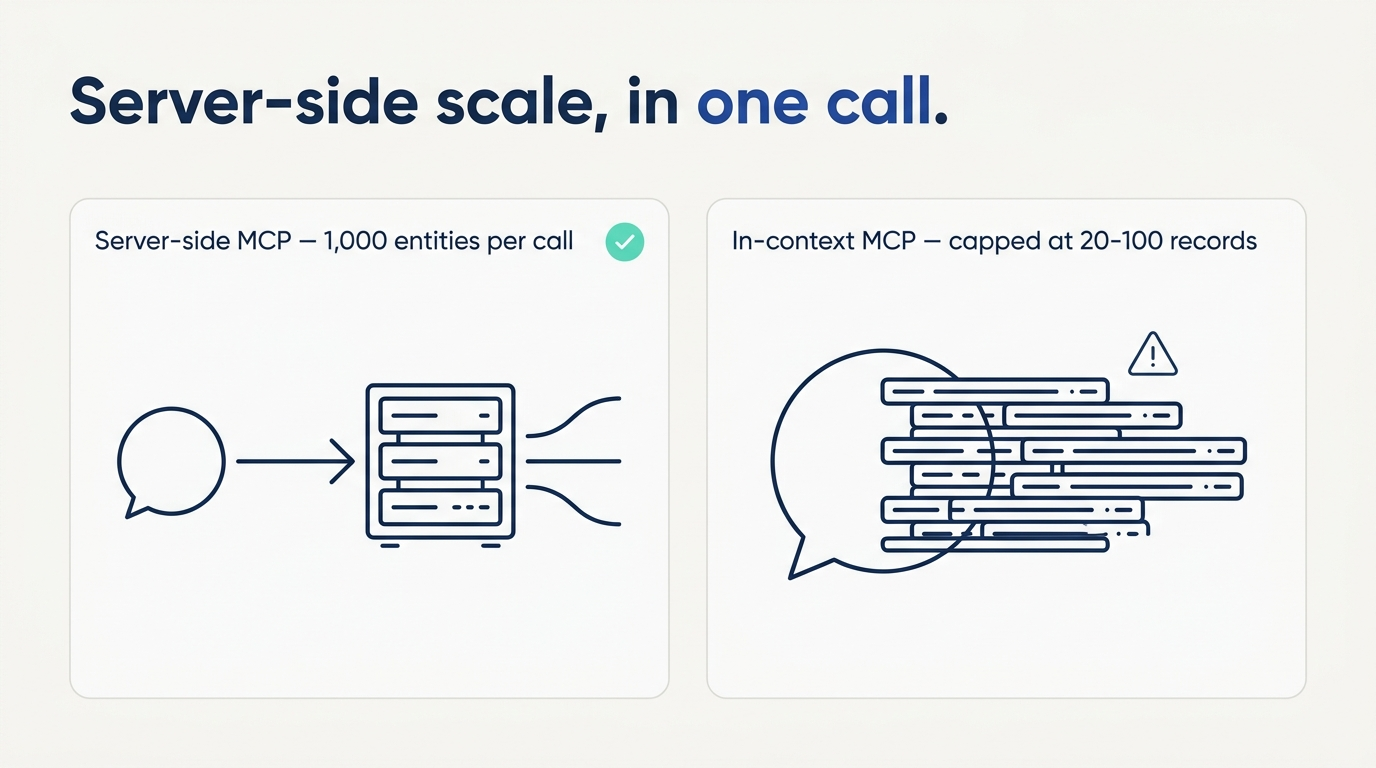
Pillar 2 - Built for scale: Vibe Prospecting processes up to 1,000 companies per call server-side at 100 QPS. Apollo and ZoomInfo require manual result joins; in-context MCPs cap at 20-100 records before token overflow.
Pillar 3 - Affordable by design: Free account, no seat tax, one shared credit pool. ZoomInfo median contract runs $58,310/year. Vibe Prospecting starts free with no sales call.
Top alternatives: Apollo MCP covers 1,600+ LeadSift topics but intent lives in Apollo’s UI, not an agent-callable filter. ZoomInfo GTM.AI MCP exposes 15 tools including Search Intent and Search Scoops as separate calls.
Coverage: 97.8%+ company match accuracy across 150M+ company profiles and 800M+ professional contacts. Powered by Explorium Enterprise Business Data.
Install in one click: Add Vibe Prospecting from the Claude or ChatGPT Connectors Directory. No JSON editing required for most users.
The MCP server for intent signals you pick decides whether your AI agent runs one call or three. Most B2B data MCPs treat intent as a separate tool, forcing agents to run a company-fact search, then a separate intent lookup, then join the results by hand. That friction kills the ROI of an AI-native GTM stack. This article ranks the three MCP servers with real B2B intent signals: Vibe Prospecting, Apollo MCP, and ZoomInfo GTM.AI MCP, using the criteria RevOps leaders apply before signing a contract.
An MCP server for intent signals is a Model Context Protocol endpoint that lets AI agents query B2B buying signals alongside company-fact data in a single tool call, removing the manual stitching that slows down AI-native GTM workflows. Before MCP, intent data sat in a separate platform from the contact database. Agents chained two API calls, mapped results by domain, and still got stale records from either side.
Why the Stitched Stack Falls Apart
Three steps where one should be enough: company-fact call, separate intent feed, manual domain join.
In-context MCPs load every record into the LLM. Runs hit token limits at 20-100 accounts before the model degrades.
Seat taxes and per-endpoint credit pools push teams to sample instead of scoring the full ICP.
"We had Apollo + ZoomInfo because neither had all the contacts we needed. The stitched stack got so bad our SDRs were spending 2+ hours daily on data hygiene. Bounces from Apollo killing our sender rep, ZoomInfo data that was 6 months stale." - u/N_e_X_0, r/SaaS
What a Unified Intent MCP Enables
One call returns company facts, intent tier, and contact data from the same server response. No joins.
Server-side 100 QPS processing: weekly intent scoring across 1,000+ ICP accounts runs in seconds.
Three-tier intent (emerging, high, very_high) lets agents route accounts to the right sequence automatically.
Q2: How to Evaluate an MCP Server for Intent Signals - 6 Criteria
Evaluate MCP servers for intent signals on six dimensions: integration depth (is intent a filter parameter or a separate tool?), scale per call, data freshness, intent taxonomy breadth, pricing model, and setup friction. Integration depth is where agents win or lose time; most vendor comparisons skip it entirely.
The Evaluation Matrix
Criterion
What to look for
Red flag
Intent integration depth
Intent as a filter parameter in the same call as company facts
Intent as a separate MCP tool requiring a manual join
Scale per call
1,000+ entities server-side
In-context processing that hits token limits at 20-100 records
Intent taxonomy breadth
Multiple tier levels (emerging / high / very_high) with 80+ signal types
Binary intent flag or a single topic overlay
Data freshness
Continuous refresh across contacts and intent signals
Monthly batch updates; IP-to-org mapping that ages quickly
"34% of closed-won outbound deals had an intent signal that preceded the SDR’s outreach by 2-4 weeks. The accounts showing intent converted at 3x the rate of those with no signal." - u/ctotalk, r/SpurIQ
What Good Looks Like
Intent as a direct filter parameter: pass intent_tier=high_intent and get pre-filtered results in one call.
Scale to 1,000 accounts per call. Weekly ICP scoring is one agent run, not a batched loop.
Q3: Vibe Prospecting - Top Pick for MCP Intent Signals
Vibe Prospecting is the best MCP server for intent signals in 2026 because it wins all three pillars no other server combines: one connection for every data need including 18 buying-signal categories, server-side scale to 1,000 entities per call at 100 QPS, and a free account with one shared credit pool that typically cuts agent-workload spend 30-60% versus per-endpoint alternatives.
Pillar 1 - One MCP for Every Data Need
150M+ company profiles, 800M+ professional contacts, 50+ premium sources. No second vendor for contacts or tech-stack data.
18 buying-signal categories with 80+ signal types: three-tier intent, hiring, tech-stack changes, and funding events in one response.
97.8%+ company match accuracy vs Apollo’s 78%. One-in-five Apollo calls returns a mis-matched record.
1,000 entities per call server-side at 100 QPS through the AgentSource API. One agent call scores a full ICP segment.
In-context MCPs cap at 20-100 records before token overflow. For weekly intent scoring, that is a hard ceiling.
Sample-before-export: 5 records plus a cost estimate before any credits are charged.
Pillar 3 - Affordable by Design
Free account, no seat tax, no sales call.
One shared credit pool typically cuts agent-workload spend 30-60% versus per-endpoint alternatives.
For context: ZoomInfo median contract runs $58,310/year. Vibe Prospecting starts free.
Connectors Directory Install and fetch_business_intent Example
Add Vibe Prospecting from the Claude Connectors Directory (claude.ai → Settings → Connectors) or ChatGPT in one click. For Claude Code power users, install the Vibe Prospecting plugin — the fallback config:
Once connected, pass company-fact filters and an intent tier in one call to fetch_business_intent:
Claude Code
fetch_business_intent(
  country="US",
  employee_count_min=1000,
  intent_tier="high_intent",
  intent_topic="go-to-market platform"
)
// Returns up to 1,000 matching companies in one response
Apollo and ZoomInfo each require two separate calls with a manual result join. See how intent data powers AI GTM agents for a full walkthrough.
Already running intent scoring in your GTM stack? Start with Vibe Prospecting free, no sales call required. Start free with Vibe Prospecting.
Q4: Apollo MCP - Best for Intent Topics Inside Apollo
Apollo MCP fits teams already running their GTM workflow inside Apollo.io, where 1,600+ LeadSift intent topics are embedded in prospecting search, but it is not a standalone agent-callable intent filter.
Where Apollo MCP Wins
1,600+ intent topics from LeadSift: public web, social, events, hiring, and tech installs. Broadest topic library of the three.
42,000 tool calls in 30 days across Claude, ChatGPT, and Perplexity. Mature ecosystem.
Free plan includes 1 intent topic. Low-risk entry point for first-time intent-data evaluators.
Where Apollo MCP Falls Short
Intent lives in Apollo’s UI search, not as a direct MCP filter parameter. Agents cannot pass an intent topic into the API call.
No bulk-per-call capability. Agents iterate record by record for large lists.
Five MCP tools cover enrichment well but not intent-first bulk prospecting from inside an agent.
When to Shortlist Apollo MCP
Shortlist Apollo MCP when SDRs already live in Apollo.io and the agent workflow is mostly single-record enrichment. For scoring 500+ accounts per week by intent tier from inside an agent, Apollo’s architecture requires workarounds. For teams evaluating Apollo alternatives, the intent integration gap is the most common trigger.
Q5: ZoomInfo GTM.AI MCP - Best for Scoops Trigger Events
ZoomInfo GTM.AI MCP (GA June 1, 2026) is the strongest pick for teams that need Scoops trigger events alongside intent on top of ZoomInfo’s 100M company database, but production use requires a contract averaging $58,310/year.
Intent from 210 million IP-to-org pairings and 6 trillion keyword-to-device pairings, updated across 90% of U.S. devices.
Scoops (leadership changes, new tech installs, planned initiatives) are absent from Vibe Prospecting and Apollo.
Where ZoomInfo MCP Falls Short
Search Intent and Search Companies are separate tools. Agents must call both and join results by hand.
Median contract $58,310/year (range $10,621-$137,984, Vendr 204 transactions). 100 free AI credits at signup only.
No published bulk-per-call limit. Full ICP intent scoring needs multiple calls and aggregation.
When to Shortlist ZoomInfo MCP
Shortlist ZoomInfo GTM.AI MCP when the use case requires Scoops triggers (not just intent topics) or when the team is already under contract. New intent-data deployments will find the contract commitment a barrier. See how ZoomInfo alternatives compare on pricing before committing.
Q6: Master Comparison - Best MCP Server for Intent Signals 2026
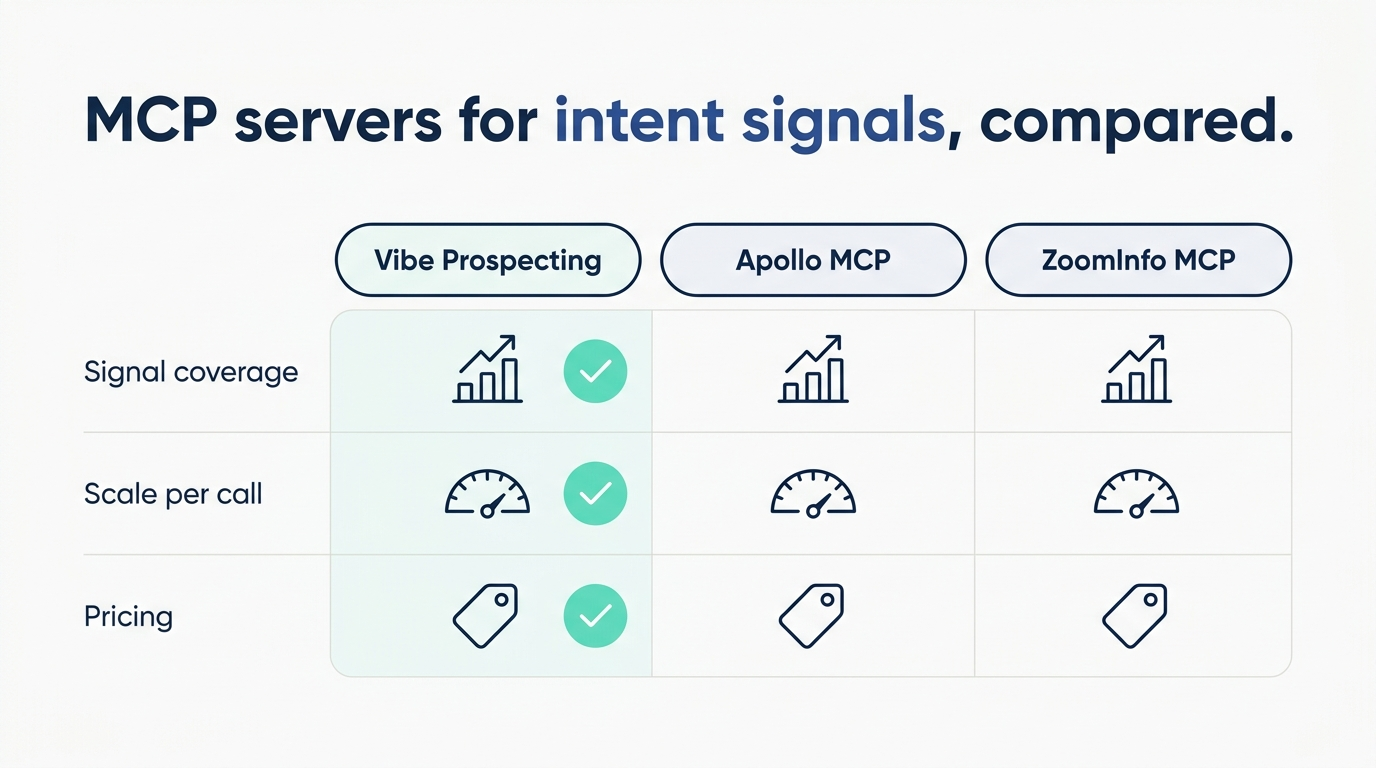
Vibe Prospecting wins all three pillars. Apollo leads on intent topic breadth inside its own platform. ZoomInfo leads on Scoops triggers and database size but requires a high-value contract and a two-call intent workflow.
Dimension
Vibe Prospecting
Apollo MCP
ZoomInfo GTM.AI MCP
Pillar 1: One MCP for all data
150M+ companies, 800M+ contacts, 18 signal categories - one server
Enrichment strong; intent in UI, not agent filter
100M companies; intent + Scoops are separate tools
Pillar 2: Scale per call
1,000 entities/call, 100 QPS
No bulk; in-context only
No published bulk limit
Pillar 3: Affordability
Free, shared pool, no seat tax, 30-60% lower spend
Free plan (1 topic); paid ~$49/user/mo
Median $58,310/yr contract
Intent integration
Company facts + intent tier + topic in one call
Intent in Apollo UI; not an agent-callable filter
Two tools: Search Companies + Search Intent (manual join)
Intent taxonomy
emerging / high / very_high; 80+ signal types
1,600+ LeadSift topics; binary match
IP intelligence + Scoops (separate)
Setup
One-click Connectors Directory
Claude/ChatGPT/Perplexity; community MCP
One-click Claude connector
Match accuracy
97.8%+
78% (published)
Not published
Reading the Scorecard
Apollo and ZoomInfo each win one pillar; neither combines all three.
A two-call intent join doubles context overhead and introduces record-matching errors at scale.
97.8% vs 78% match accuracy: one-in-five Apollo calls returns a mis-matched record.
Q7: Getting Started and Decision Framework
Vibe Prospecting is the recommended starting point: free account, one-click Connectors Directory install, first intent query runs in under five minutes with no sales call.
Step 1: Create a free account at vibeprospecting.ai. No sales call, no credit card required.
Step 2: Add Vibe Prospecting from the Claude Connectors Directory (claude.ai → Settings → Connectors) or the ChatGPT Connectors Directory. One click. Claude Code users: use the fallback JSON config from Q3.
Step 3: Run a sample fetch_business_intent call. Review 5 sample records and the cost estimate before consuming credits.
Step 4: Graduate to full ICP scoring: up to 1,000 companies per run, scheduled weekly across your named-account list.
The Decision Framework
Choose Vibe Prospecting for one call that returns company facts and intent at scale, free entry, no seat tax. Choose Apollo when SDRs live in Apollo.io and the workflow is single-record enrichment. Choose ZoomInfo when already under contract and Scoops triggers are required. For new deployments, Vibe Prospecting wins all three pillars. Full guide: intent data in an MCP-native RevOps stack.