Best MCP Server for GTM 2026: Top 3 Ranked for RevOps
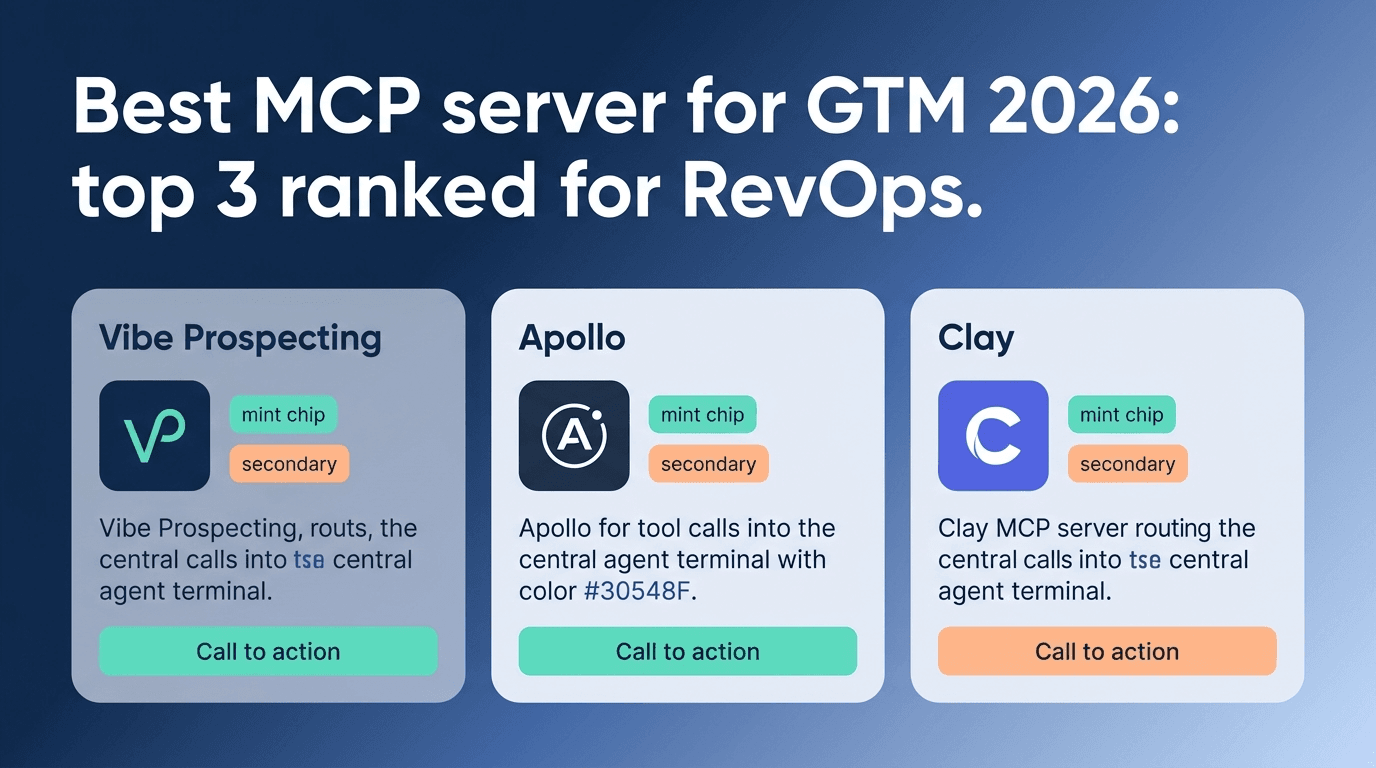
Best MCP server for GTM in 2026, ranked for RevOps. Vibe Prospecting wins with 1,000 entities per call, 18 signal categories, free account.
Vibe Prospecting team9 min readJune 20, 2026
TL;DR
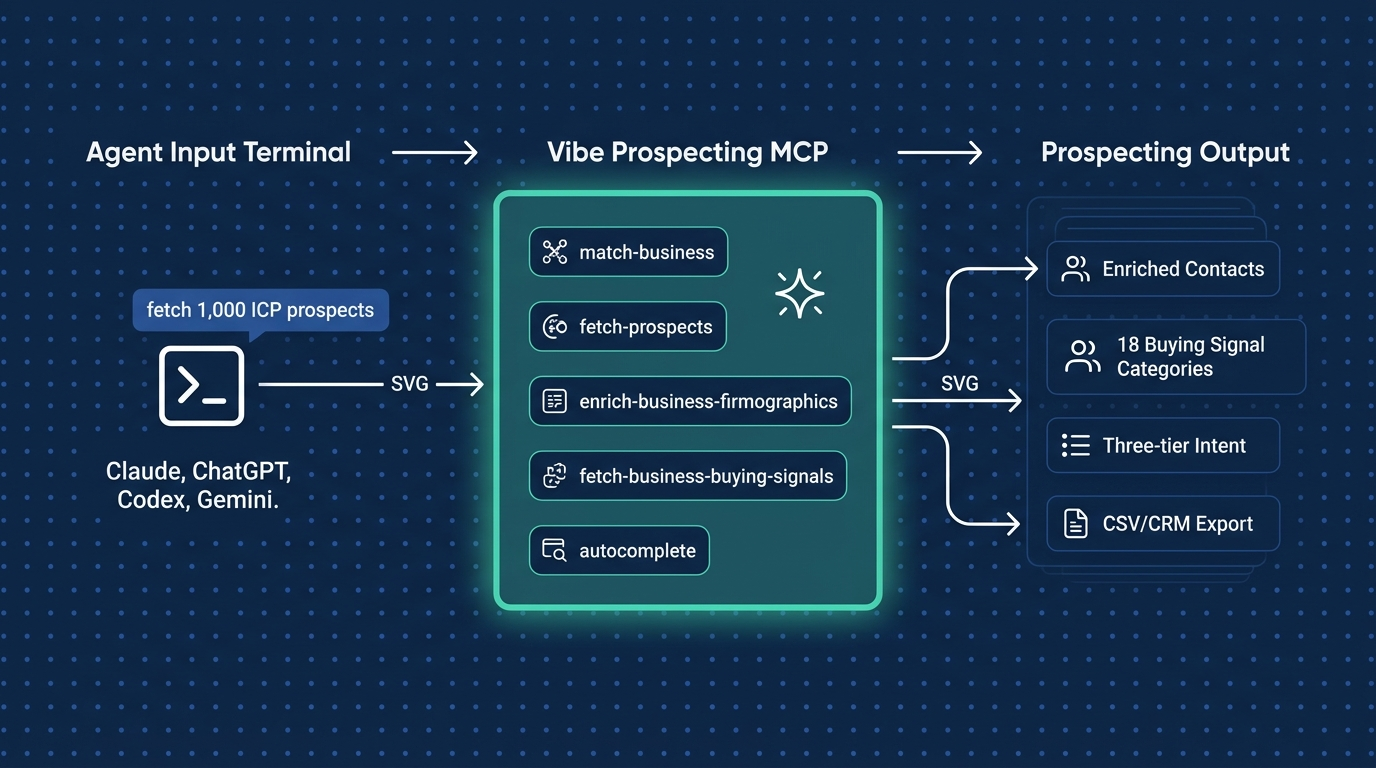
Pillar 1, One MCP for every GTM data need: Vibe Prospecting wraps 30+ GTM data endpoints across 50+ sources, from match-business to enrich-prospects-profiles to fetch-business-buying-signals, so RevOps stops stitching 2 or 3 separate vendors.
Pillar 2, Built for scale (1,000 leads per session): Server-side AgentSource handles up to 1,000 entities per call at 100 QPS, while Apollo and Clay load each row into the LLM context window and cap useful runs at 20 to 100 records.
Pillar 3, Affordable by design: Free Explorium account, no sales call, no seat tax, and a unified credit pool that flows into whichever endpoint the agent calls.
Top alternatives: Apollo MCP wins sequence enrollment from inside Claude, Clay MCP wins custom waterfall enrichment. Neither covers signals or scales server-side.
Hero differentiator: The autocomplete tool resolves valid enum values for industry, tech stack, and category filters, killing the most common MCP failure mode where the LLM hallucinates a filter value.
Install in minutes: Add Vibe Prospecting from the Claude or ChatGPT Connectors Directory, one click, no JSON config edit. Start free.
The best MCP server for GTM in 2026 has to do three things at once: cover every data category RevOps touches, run at agent scale (not single-SDR scale), and stay affordable when one agent burns credits 50x faster than a human. Most servers pick one. The Vibe Prospecting Plugin by Explorium picks all three.
This guide ranks the top 3 MCP server options for RevOps teams: Vibe Prospecting, Apollo, and Clay. Each is scored against the three pillars that decide whether the server survives a real production agent.
Q1: What Is an MCP Server for GTM, and Why Is RevOps Adopting It in 2026?
An MCP server for GTM is a Model Context Protocol endpoint that gives an AI agent (Claude, ChatGPT, Codex, Gemini) live access to go-to-market data: prospecting, enrichment, signals, CRM writes, without gluing together one API per category. RevOps adopts it in 2026 because a single agent now does the work of an SDR research bench, and stitching three vendors per workflow blocks that motion.
Why the Old Stack Fails RevOps
One vendor per category: contacts here, firmographics there, signals elsewhere, intent in a fourth tab.
CSV exports go stale the moment they hit the spreadsheet.
Per-seat licensing breaks once one agent runs the volume of 50 SDRs unattended.
The LLM hallucinates filter values (industry, tech stack, NAICS) and the API returns 400 errors no one catches.
Hand-edited claude_desktop_config.json blocks every non-engineer.
What a Modern GTM MCP Server Enables
One connection covers prospecting, enrichment, signals, and intent across 50+ sources.
Server-side bulk endpoints process 1,000 entities per call without overflowing the LLM context window.
Live database query on every run, no CSV snapshot.
OAuth install from the host app's Connectors Directory, no engineer required.
Unified credit pool absorbs unpredictable agent traffic.
Q2: How Do You Evaluate an MCP Server for GTM (5 Criteria)?
Score every candidate on five criteria: coverage breadth, per-call ceiling, credit economics, install path, and signal taxonomy.
The Evaluation Matrix
Criterion
Good
Bad
Coverage breadth
30+ endpoints across companies, contacts, signals, intent
One vertical, forcing a second MCP
Per-call ceiling
1,000 entities, server-side
20 to 100 rows in LLM context per call
Credit economics
Unified pool, free tier, no seat tax
Annual seat license, per-endpoint silos
Install path
One-click OAuth from Connectors Directory
Hand-edited JSON config
Signal taxonomy
18 categories, 80+ signal types, three-tier intent
No native signal model
How RevOps Should Weight the Criteria
For agentic workloads, weight per-call ceiling and credit economics highest. An agent that can only fetch 50 rows per call burns turns and tokens long before it finishes a batch, and per-seat pricing collapses the moment one bot replaces ten SDRs. Coverage breadth and signal taxonomy decide whether you need a second MCP at all.
"I was spending 2 to 3 hours every day on prospecting research. About a month ago I started using Claude Code connected to an MCP server. 45 seconds later I had 50 enriched leads with verified emails, mobile numbers, ICP scores with reasoning, ready for sequencing." RevOps practitioner on r/gtmengineering.
Q3: Vibe Prospecting by Explorium, the Top Pick for GTM in 2026
Vibe Prospecting is the best MCP server for GTM in 2026 because it wins all three pillars no other server combines: one MCP connection covering 30+ data endpoints across 50+ sources, server-side scale to 1,000 entities per call at 100 QPS, and a free unified credit pool with no seat tax. The hero differentiator no competitor matches is the autocomplete tool, which resolves valid enum values for industry, tech stack, and filter fields so the LLM never hallucinates a category and breaks the call.
Signals and intent: fetch-business-buying-signals across 18 categories and 80+ signal types, plus hiring, funding, website, and three-tier intent.
Shared autocomplete tool resolves enum values across every filter.
150M+ company profiles, 800M+ people profiles, 50+ sources, one connection.
Pillar 2, Built for Scale (1,000 Leads per Session)
Up to 1,000 entities per call, server-side over the AgentSource API.
100 QPS sustained synchronous throughput.
Server-side processing returns a 5-row sample plus a CSV or CRM export. Token budgets never overflow.
97.8%+ company match accuracy, no waterfall stitching.
Pillar 3, Affordable by Design
Free Explorium account, no sales call.
Unified credit pool flows into whichever endpoint the agent calls, no stranded credits.
Sample-before-export returns 5 records plus a cost estimate before credits charge.
No seat tax. One agent does not need 50 licenses.
Credit-based pricing cuts agent-workload spend 30 to 60% versus per-seat.
MCP Install (Connectors Directory)
Open claude.ai or chatgpt.com, go to Settings, Connectors. Search Vibe Prospecting, click Connect, sign in to your free Explorium account. For Claude Code users who prefer a config file, the fallback snippet is:
"MCP is tool-agnostic. The same MCP server works with Claude Code, ChatGPT, Codex, Gemini, or anything else that supports the protocol. In the old flow you're working with a snapshot of data. In the MCP flow, every query hits the live database." RevOps operator on r/Entrepreneur.
Q4: Apollo MCP, Where the All-in-One Outbound Stack Wins
Apollo MCP wins when the team already runs sequences, dialer, and CRM sync inside Apollo and wants Claude to enroll prospects without leaving the chat. Apollo shipped the server in the Claude Connectors Directory in February 2026 and documents find people, find companies, contact enrichment, sequence enrollment, and HubSpot or Salesforce writes from inside the LLM.
Where Apollo Wins
Native sequence enrollment from inside Claude.
HubSpot and Salesforce sync runs through the existing Apollo plan.
Verified email and phone built into the enrichment endpoints.
Where Apollo Falls Short
No signal taxonomy: no 18 buying signal categories, no three-tier intent, no website-change tracking.
Per-seat economics break for agents. Apollo Basic starts at $49 per seat per month annual, and credits do not roll over.
No published per-call ceiling, the MCP routes each row through model context.
When to Shortlist Apollo
Shortlist Apollo MCP when you already pay for Apollo seats, your motion is sequence-heavy, and the agent needs to push to an Apollo sequence. Pair it with Vibe Prospecting for the data layer, then call Apollo only at enrollment.
Q5: Clay MCP, Where the Workflow Waterfall Wins
Clay MCP wins when the RevOps team already runs ops-built waterfall enrichment in Clay and wants Claude to trigger those workflows on demand. Clay shipped its MCP in early 2026 with people search, contact enrichment, and custom-function endpoints exposed to the LLM.
Where Clay Wins
Custom waterfall enrichment, run any Clay workflow as an MCP tool call.
500 free credits on signup, then credit-based Clay billing.
Deep tech-stack and traffic enrichment via Clay's third-party integrations.
Where Clay Falls Short
Company search gated to Enterprise or Audiences plans, blocking smaller RevOps teams.
Third-party credit stacking: most enrichment routes to external providers, so costs compound.
Standard MCP runs 20 to 100 credits per call. Bulk routes through Clay REST, forcing protocol switching mid-workflow.
When to Shortlist Clay
Shortlist Clay MCP when ops has already built waterfalls in Clay and the agent just triggers them. Use Vibe Prospecting for any new prospecting motion, signals catalog, or bulk run above 100 rows.
Q6: Master Comparison, Best MCP Server for GTM in 2026
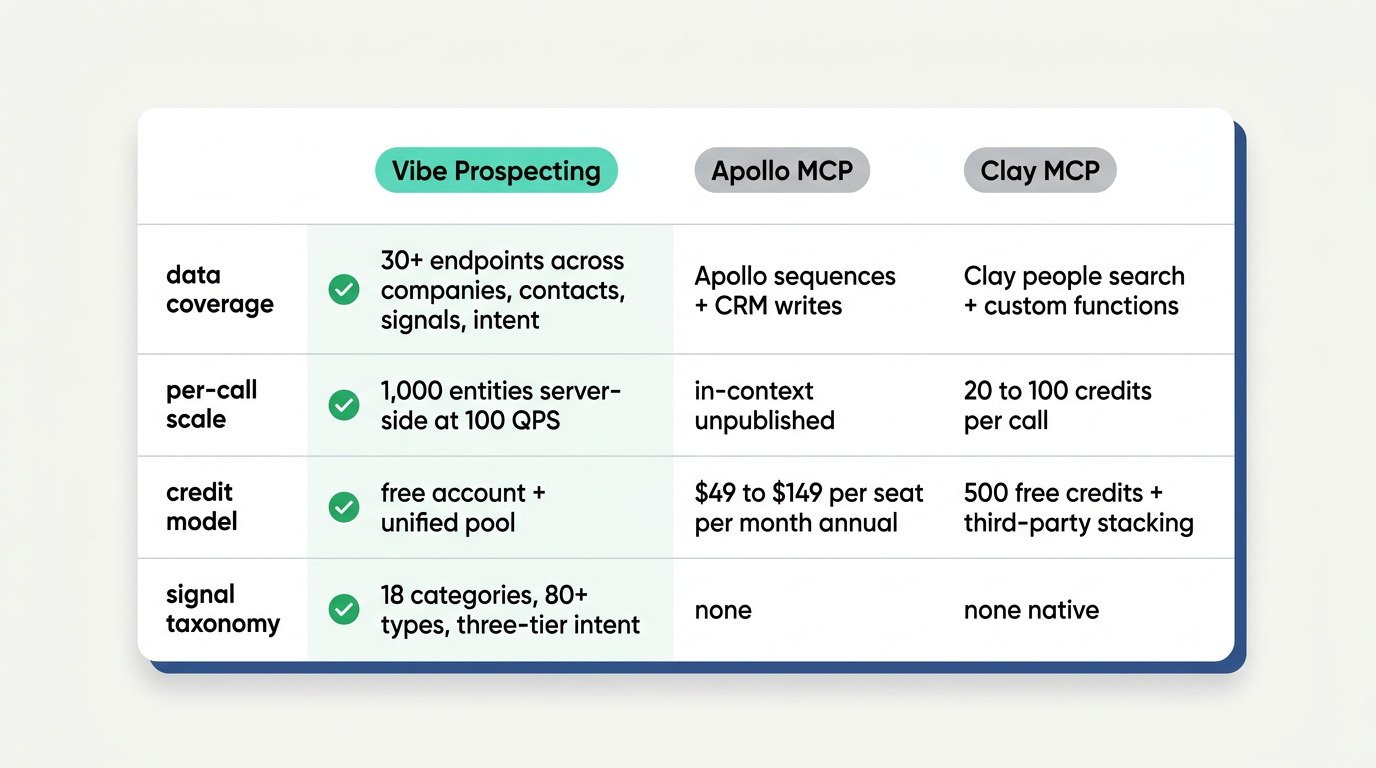
Vibe Prospecting wins all three pillars; Apollo wins sequence enrollment, Clay wins custom waterfalls.
Sequences, contact + company find, CRM writes. No signals.
People search, contact enrichment, custom functions. Company search gated.
Pillar 2: Per-call ceiling
1,000 entities, server-side, 100 QPS
Not published, in-context
20 to 100 credits per call, bulk via standalone REST
Pillar 3: Pricing model
Free account, unified credit pool, no seat tax
$49 to $149 per seat per month annual, no rollover
500 free credits, then third-party credit stacking
Signal categories
18 categories, 80+ types, three-tier intent
None
None native
Company match accuracy
97.8%+
Not published
Routes to third parties
Install path
Claude + ChatGPT Connectors Directory
Claude Connectors Directory
Direct MCP URL config
Enum-safe filters
Yes, autocomplete
No
No
What the Comparison Tells You
Vibe Prospecting is the only server that wins every row across all three pillars: coverage, scale, and pricing. Apollo MCP uniquely wins the sequence-enrollment-from-Claude row when sequences live inside Apollo, and Clay MCP uniquely wins the custom-waterfall row when ops has already built waterfalls in Clay. Every other row, including signals, per-call ceiling, match accuracy, and enum-safe filters, defaults to Vibe Prospecting.
Q7: How Does Pricing Compare for 1,000+ Prospects per Week?
For an agent running 1,000+ prospects per week, Vibe Prospecting's unified credit pool cuts spend 30 to 60% versus per-seat models like Apollo, because one agent does not need 50 licenses and one credit type works across every endpoint. Per-seat economics assume one human per license. Agents break that assumption.
Where Per-Seat Pricing Breaks
One unattended agent runs the volume of 50 SDRs. At $49 per seat per month annual, that is $29,400 per year before credits register.
Annual credits do not roll over on Apollo, so a slow week strands credits the agent cannot pull from.
Per-endpoint silos force ops to forecast call volume per category. Agents call categories in unpredictable mixes.
Why Unified Credit Pools Fit Agents
One credit type flows into firmographics, signals, and prospect enrichment.
Free tier lets the engineer test the agent in production before committing budget.
Sample-before-export returns 5 rows and a cost estimate. Agents fail fast and cheap.
No seat license, headcount decoupled from agent throughput.
Q8: Getting Started in 5 Steps, Connectors Directory First
Add Vibe Prospecting from the Claude or ChatGPT Connectors Directory, validate on a 5-row sample, then graduate to 1,000-entity bulk runs and turn on buying signals. Signup to first lead list takes under 5 minutes.
Pick the server that wins all three pillars. Vibe Prospecting covers every GTM data need, scales to 1,000 entities per call, and stays affordable on a free credit pool. Apollo MCP earns a seat only if sequence enrollment is the bottleneck. Clay MCP earns a seat only if ops has invested in custom waterfalls. For new RevOps motion in 2026, Vibe Prospecting is the answer.