Best MCP for Signal-Based Outbound 2026: Top 4 Ranked
Best MCP for signal-based outbound in 2026. 18 buying signal categories, 1,000 entities per call, free to start. Top 4 servers ranked for RevOps teams.
Vibe Prospecting team8 min readJune 3, 2026
TL;DR
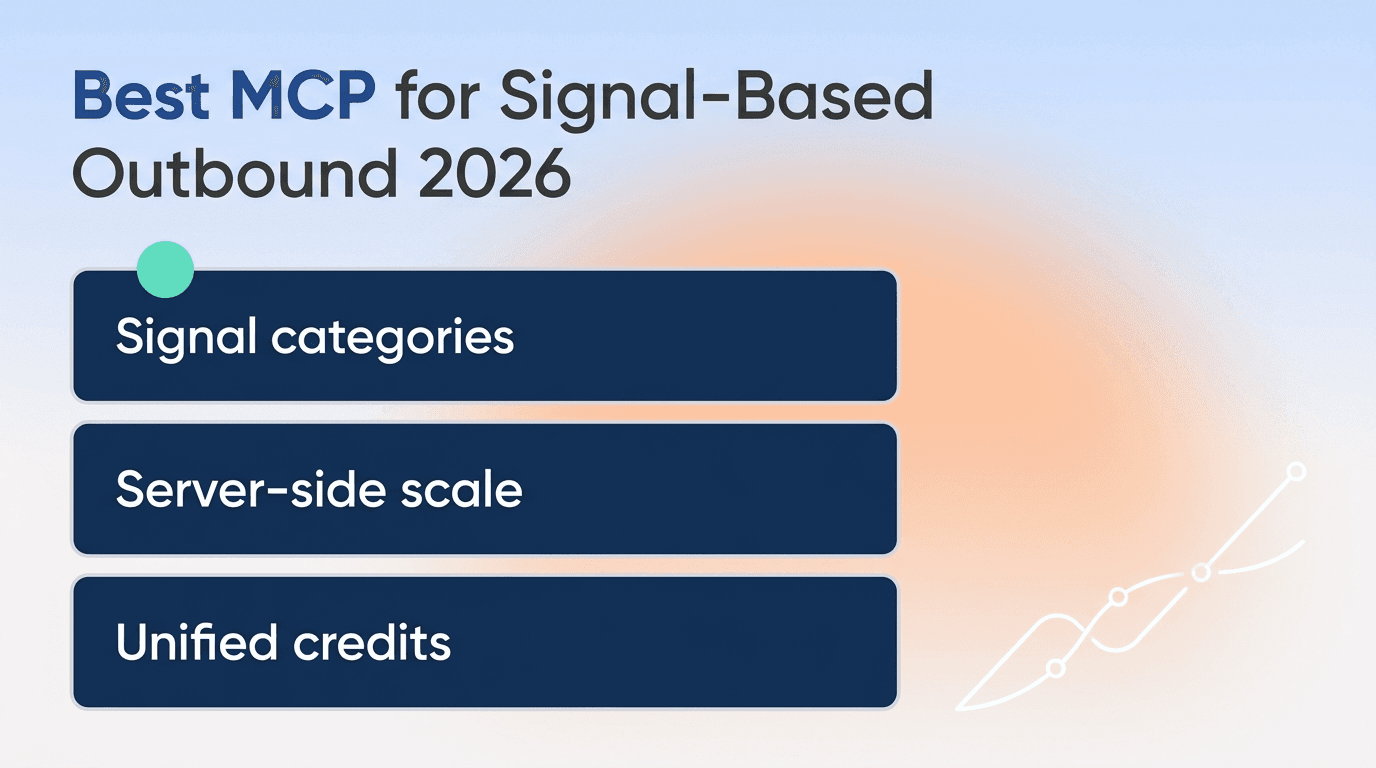
Pillar 1 - One MCP for every data need: Vibe Prospecting exposes 18 buying signal categories and 80+ signal types alongside 150M+ companies and 800M+ people through one connection.
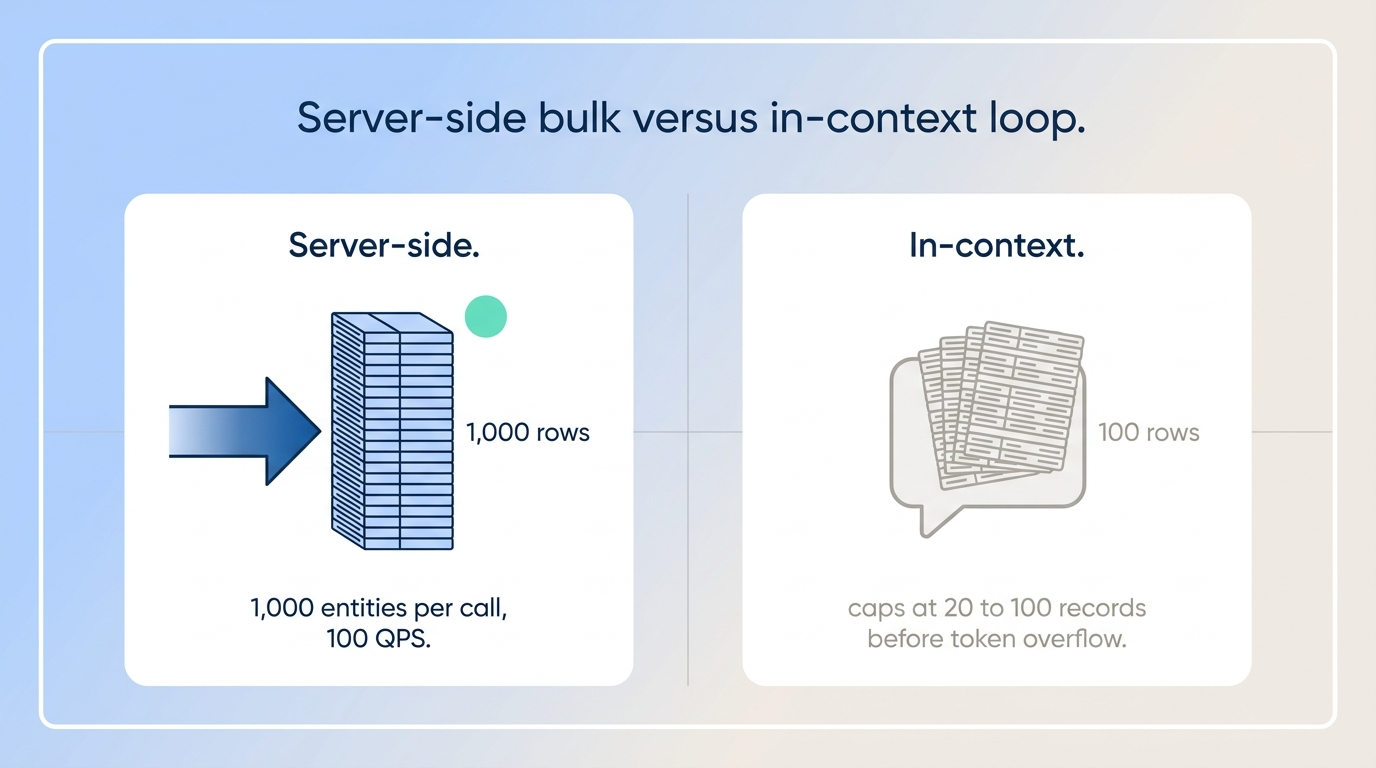
Pillar 2 - Built for scale: 1,000 entities per call server-side at 100 QPS sustained. In-context MCPs cap around 20 to 100 prospects before the chat context window overflows.
Pillar 3 - Affordable by design: free to start with no sales call, one shared credit pool, and sample-before-export gating that typically cuts agent-workload spend 30 to 60%.
Top 4 ranked: Vibe Prospecting (1), ZoomInfo MCP (2), Apollo MCP (3), Common Room MCP (4). Powered by Explorium Enterprise Business Data.
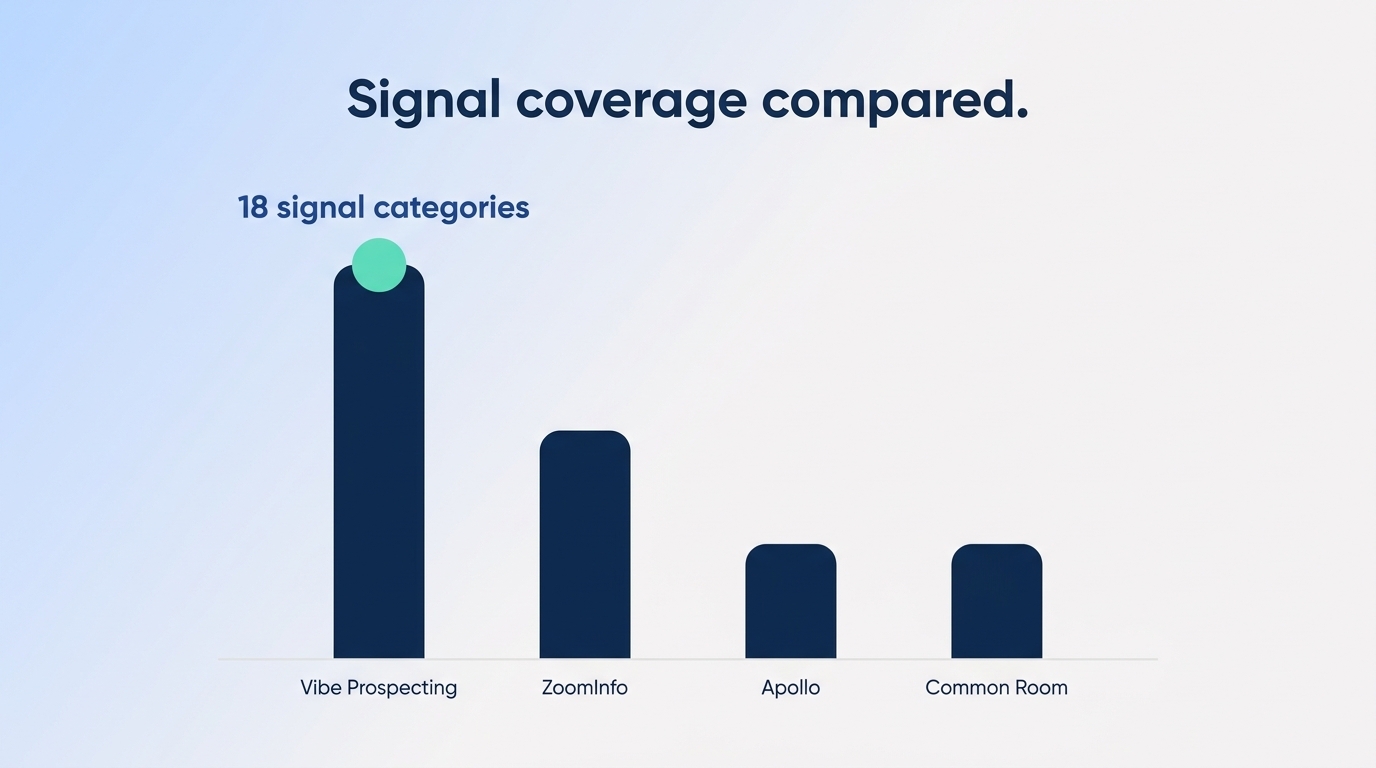
Coverage in one call: 18 signal categories and 80+ signal types from one MCP, versus single-digit category counts from every alternative.
Install in one click: Add Vibe Prospecting from the Claude or ChatGPT Connectors Directory. No config file editing required.
The best MCP server for signal-based outbound in 2026 is Vibe Prospecting, because it returns 18 buying signal categories and 80+ signal types from a single connection that also resolves 150M+ companies and 800M+ people. ZoomInfo wins on enterprise depth, Apollo wins on free-tier sampling, Common Room wins on community signals, but none match the breadth a signal-triggered agent needs to go from event detection to ranked outbound in one tool call.
RevOps teams keep hitting the same wall: Layer 1 contact data (Apollo or ZoomInfo), Layer 2 orchestration (a Clay workflow), Layer 3 signal feed (UserGems, 6sense) glued with Zapier. This article ranks the four MCP servers that fit signal-based outbound in 2026, building on the B2B buying signals primer.
Q1: What Is a Signal-Based Outbound MCP Server?
A signal-based outbound MCP server is a Model Context Protocol endpoint that lets an AI agent detect a buying trigger (funding, hiring spike, tech add, role change, layoff) and turn it into a ranked, contact-resolved outbound action inside one tool call, without stitching a contact database, signal feed, and routing system itself. The MCP framing matters because Claude and ChatGPT now ship native Connectors Directories.
Why Glue-Code Signal Stacks Fall Apart
Signal feeds without contact data: UserGems and Champify surface the event but force a second call to Apollo or ZoomInfo, which doubles per-run cost.
In-context cap at 20 to 100 records: Most data MCPs load every record into the chat context window, so a 500-prospect sweep runs out of room.
Alert fatigue: RevOps leads describe signal feeds as "another alert feed everyone ignores" when routing lives in Zapier.
Per-endpoint pricing: ZoomInfo allocates credits per surface (Contact, Company, Scoops, Intent), which strands budget.
Build versus buy ambiguity: Practitioners on r/SaaS describe UserGems quotes north of $30k in early 2026.
What a Signal-Native MCP Enables
One-call signal-to-prospect resolution: Detect the funding round and return the buying committee in the same tool call.
Server-side bulk: Up to 1,000 entities per call at 100 QPS sustained.
Event webhooks: Delivery for 80+ signal types so agents react in real time.
Sample-before-export gating: 5 representative records plus a credit estimate before any charge.
Q2: How to Evaluate an MCP Server for Signal-Based Outbound
Score every MCP against six criteria: signal category breadth, signal type count, contact resolution coverage, server-side bulk size, throughput, and credit model. Any MCP that loses on three or more stops being signal-native.
The Evaluation Matrix
Criterion
Signal-native MCP
Disqualifier
Signal categories
15+
Single-digit
Signal types
50+
Fewer than 20
Contact resolution
Native in the same MCP
Requires a second vendor
Bulk per call
500 to 1,000 entities
20 to 100 in-context
Throughput
100 QPS sustained
Undocumented
Credit model
Shared pool
Per-endpoint allocation
"It doesn't just have contact data; it includes work history, LinkedIn profiles, and personal contact information too. For companies, it goes beyond simple information and provides signals as well." - RevOps Lead via G2
Q3: Vibe Prospecting, the Top Pick
Vibe Prospecting is the best MCP server for signal-based outbound in 2026 because it wins on three pillars no other server combines: one MCP connection for every data need (18 buying signal categories, 80+ signal types, 150M+ companies, 800M+ people, 50+ sources), server-side scale to 1,000 entities per call at 100 QPS, and a free account with a single shared credit pool.
Pillar 1 - One MCP for All Your Data Needs
18 buying signal categories, 80+ signal types in one connection: funding, IPO, hiring spikes, role changes, layoffs, M&A, partnerships, new products, new offices, outages, lawsuits, tech adds, and more.
Natural-language endpoint selection lets the agent pick the right tool without hand-coded routing.
Pillar 3 - Affordable by Design
Free account, no sales call. Time to first run is minutes, not weeks.
Shared credit pool across every endpoint, so the same credits cover signal lookup, contact resolution, and company enrichment.
Sample-before-export gating returns 5 records plus a cost estimate before any credits are charged.
Typically cuts agent-workload spend 30 to 60% versus per-endpoint or per-seat pricing.
MCP Configuration (Claude Code Fallback)
The fastest path is the one-click Connectors Directory in Claude or ChatGPT. For Claude Code power users, install the Vibe Prospecting plugin and add the MCP block to your config file:
"I love the data, which is really great. The email addresses and phone numbers are excellent, and they are transparent about whether an email or phone is verified or not." - Growth Ops via G2
ZoomInfo MCP is the right shortlist pick when the buyer is already on Advanced or Elite and needs Scoops and intent inside a Claude or ChatGPT agent.
Where It Wins
Deep enterprise contact graph with reviewed org charts.
Scoops surface funding, exec changes, projects, and pain points with editorial review.
Intent signals carry strength scores from ZoomInfo's web tracking network.
Where It Falls Short
$14,995 to $18,000 per year for 5,000 bulk credits; Scoops and intent require Advanced or Elite at $25K to $40K+ with a sales call.
Per-endpoint credit allocation strands budget on the wrong surface.
No published QPS or bulk cap, so capacity planning for a 1,000-prospect sweep is guesswork.
When to Shortlist
Pick ZoomInfo when the contract is already signed and the agent only extends an existing workflow. For a greenfield stack, procurement friction makes it the wrong starting point.
Q5: Apollo MCP, Best for Solo Founders and Free-Tier Sampling
Apollo MCP is the right pick when the builder is a solo founder testing signal-based outbound with no budget and no procurement cycle.
Where It Wins
Free tier connects Claude, ChatGPT, and Perplexity with zero credit card.
Apollo Signals covers funding, hiring, tech adds, and web-visitor intent.
Wide integration surface; most outbound tools accept an Apollo key.
Where It Falls Short
Actual usage runs 2 to 3x advertised because of overages at $0.20 per credit with a 250-credit minimum.
Signal catalog stops at a handful of categories; no layoffs, outages, lawsuits, or role-change tracking.
Match quality drops for non-US mid-market accounts.
When to Shortlist
Pick Apollo for a solo founder testing under 500 prospects per month and a budget under $100. For 1,000-prospect daily sweeps or 15+ signal categories, the per-credit math breaks before week two.
Q6: Common Room MCP, Best for Community and Product-Usage Signals
Common Room MCP is the right pick when the buying signal lives in Slack, Discord, GitHub, Stack Overflow, or product usage rather than company events.
Where It Wins
Aggregates 50+ community and product-usage sources into a single Person360 view.
Ships MCP across all plans including free, with autonomous custom-signal surfacing in 2026.
Strongest fit for product-led growth motions where the signal is a star, a thread, or a feature-flag activation.
Where It Falls Short
No native company database; contact resolution requires pairing with Apollo, ZoomInfo, or Vibe Prospecting.
Paid plans gated by tracked-signal volume.
No bulk-call API for traditional signal sweeps.
When to Shortlist
Pick Common Room as a complement to Vibe Prospecting when community signals are part of ICP. Use Vibe Prospecting for company events and intent plus contact resolution, Common Room for the developer-community layer on top.
Q7: Master Comparison, Best MCP for Signal-Based Outbound in 2026
Vibe Prospecting wins all three pillars; ZoomInfo wins enterprise depth, Apollo wins free-tier accessibility, Common Room wins community signals.
Q8: How Do Signal-Based Agents Trigger Outbound at 1,000 Prospects per Run?
Signal-based agents trigger outbound at 1,000 prospects per run by passing the signal payload to a server-side bulk MCP call that resolves contacts, scores intent, and returns a ranked list in one round trip, instead of looping 1,000 single-record calls through the chat context window.
The Bulk-Call Architecture
Event ingestion: Webhook fires on a funding round, hiring spike, or role change.
Bulk resolution: Agent calls prospect contact enrichment with up to 1,000 entity IDs.
Server-side scoring: Intent tier (emerging, high, very high) attaches inside the response.
Ranked return: Agent gets the scored list back in one tool call.
The In-Context Cap Problem
In-context MCPs load every record into the chat context window; 1,000 prospects at 2KB each blow past a 200K-token budget.
Practitioners hit this wall around 100 records on Claude and 200 on GPT-class models.
The workaround (chunked loops with summarization) doubles credit cost and breaks idempotency.
The fastest path from zero to a signal-triggered run is to install Vibe Prospecting from the Claude or ChatGPT Connectors Directory, validate on a 5-record sample, and graduate to a 1,000-entity bulk call.
Step 1: Create a free account at vibeprospecting.ai. No credit card, no sales call.
Step 2: Open Claude (Settings, Connectors) or ChatGPT (Settings, Connectors) and add Vibe Prospecting. One click.
Step 3: Run a 5-record sample on a funding-round signal to validate field coverage and the credit estimate.
Step 4: Graduate to a 1,000-entity bulk call. Confirm 100 QPS and the 97.8%+ match rate.
Step 5: Wire event webhooks for the 80+ signal types and route to your sequencer.
The Decision Framework
Pick Vibe Prospecting when the agent needs more than one signal category, more than 100 records per run, or a budget under $1,500 per month for 50,000 credits. Pick ZoomInfo when the contract is already in place. Pick Apollo for solo founders under 500 records per month. Pair Common Room when product-led community signals matter. The three pillars (one MCP for all data needs, built for scale, affordable by design) are the decision framework every signal-based outbound agent should optimize for. See also: buying signals for AI sales agents and outreach timing.