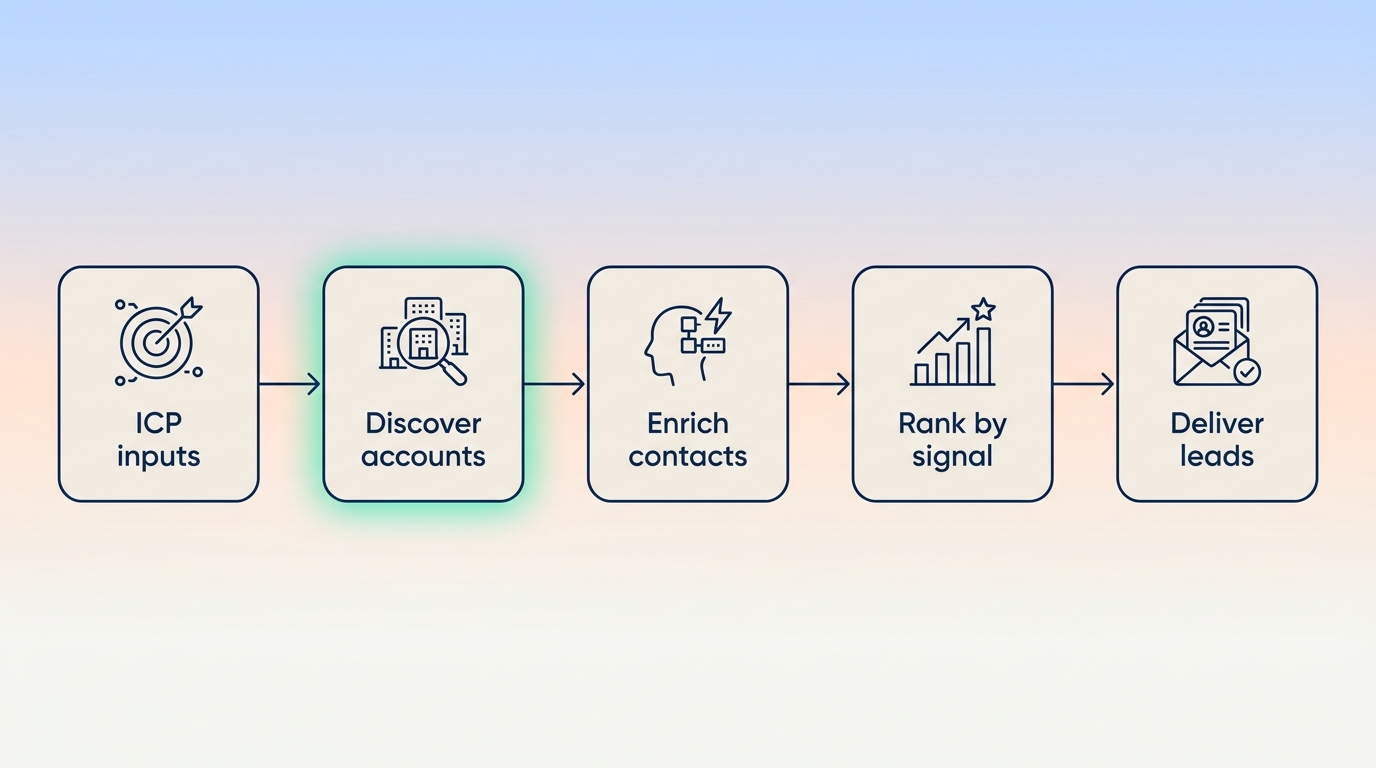


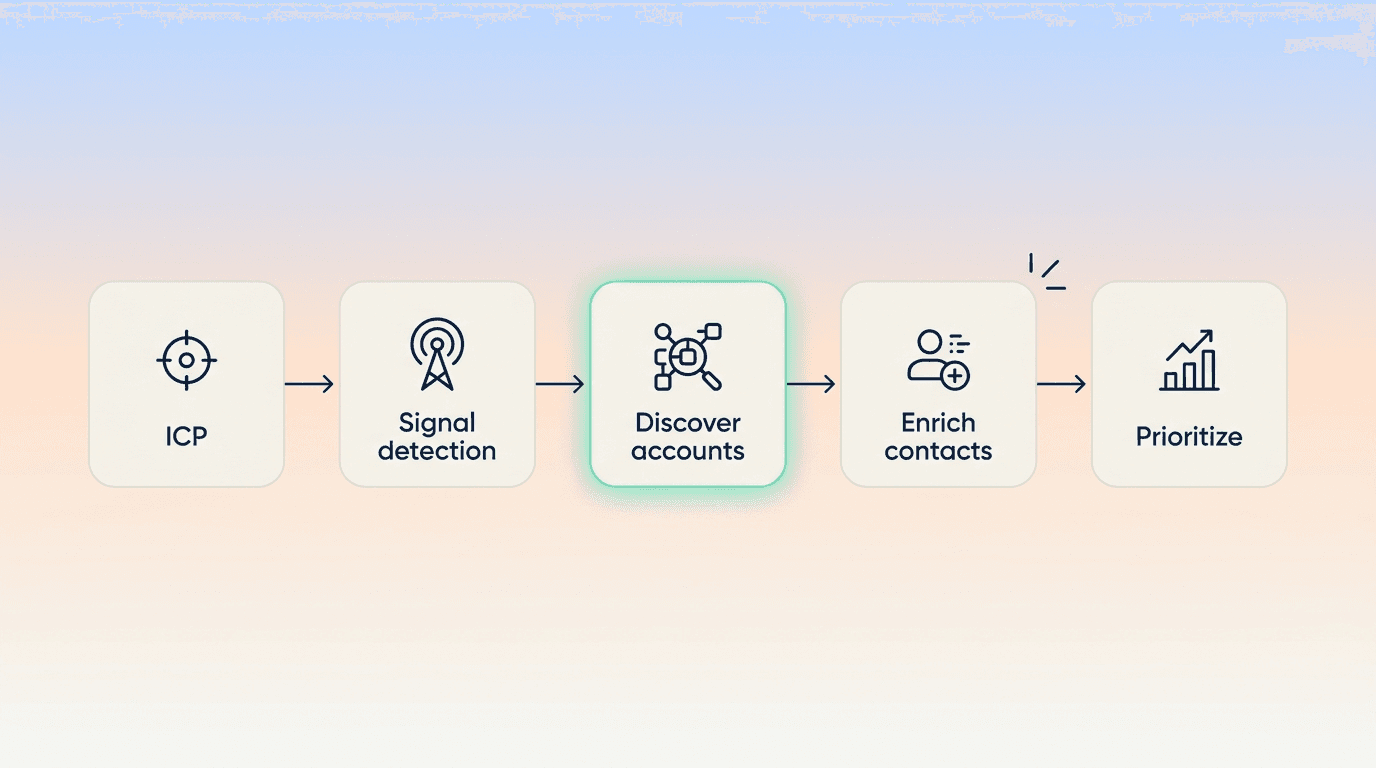
The best lead generation skill in 2026 runs end-to-end inside an AI agent: ICP filter, account discovery, contacts, email verification, buying signals, and handoff to outbound, all from a single Claude, ChatGPT, Codex, or n8n install.
Most so-called AI lead generation pitches are still chat wrappers around a CSV rather than a real data layer. This article ranks the top three host-agnostic lead generation skills for 2026: Vibe Prospecting first, Coresignal second, Hunter.io third. Vibe Prospecting is powered by Explorium Enterprise Business Data.
What Is a Lead Generation Skill, and Why Install One in 2026
A lead generation skill is an installable AI-agent surface that turns a Claude, ChatGPT, Codex, or n8n agent into an end-to-end pipeline runner for ICP filtering, discovery, contacts, email verification, and signal-triggered outbound. RevOps teams stopped buying lead generation tools and started installing lead generation skills.
Why the dashboard SaaS model falls short for agents
- Per-seat tax: dashboards charge per user, but the agent is the user and seats explode.
- UI-locked workflows: integration is a webhook bolt-on, not a first-class agent surface.
- Per-endpoint allocation: credits buy one API at a time, stranding enrichment budget.
- No bulk: row-by-row calls force 1,000 prompts for a 1,000-account run.
- Closed signal feeds: the dashboard owns buying signals, the agent sees only company fields.
What a real lead generation skill enables
- Host-agnostic install: one surface served to Claude, ChatGPT, Codex, and n8n.
- Server-side execution: the agent sends a filter, the skill returns a summary, no context overflow.
- Bulk by default: 1,000 entities per call collapses a 10,000-account run into ten calls.
- Preview-before-build: a small sample plus cost estimate before any credit is charged.
- CSV or webhook handoff: the skill ends at the outbound tool, not at the dashboard.
How a Lead Generation Skill Differs From a Single-Slice Connector
A lead generation skill covers the full pipeline, discovery through export, while a single-slice connector covers one step and leaves the rest for the agent to stitch. The difference shows up the moment an agent needs both an account list and verified emails on that list.
The lead generation pipeline an agent has to run
- ICP filter: company fields, tech stack, geography, headcount band.
- Account discovery: match the filter to a real company list.
- Contact resolution: map decision-makers and titles to each account.
- Email find and verify: get a deliverable address per contact.
- Signal trigger: hiring, funding, leadership move, tech-stack change.
- Handoff: CSV, CRM, or outbound webhook.
Where single-slice connectors break the flow
An email-only connector forces the agent to source the account list from a second skill. A firmographic-only connector forces a second skill for contact emails. The agent now juggles two credit pools, two rate limits, and two failure modes per run, the exact stitching teams installed a skill to avoid.
How to Evaluate a Lead Generation Skill in 2026
Score each candidate on six dimensions: pipeline coverage, scale per call, host coverage, credit model, match accuracy, and handoff pattern. Anything that fails scale or pipeline coverage will not survive a real motion above 200 contacts per week.
The evaluation matrix
| Dimension | What good looks like | Failure mode |
|---|---|---|
| Pipeline coverage | Discovery, enrichment, signals, email in one skill | Stitching a second connector per run |
| Scale per call | Bulk capacity at sustained QPS | Context overflow at 200+ records |
| Host coverage | Same skill in Claude, ChatGPT, Codex, n8n | Host-locked integrations |
| Pricing | Unified pool, free tier, no seat tax | Stranded per-endpoint credits |
| Match accuracy | 1,000-row bulk resolution rate | Multiple cleanup passes |
| Handoff | CSV plus webhook or CRM push | Manual download and re-upload |
Reviewers consistently flag credit-pool fragmentation as the top operational pain in agent-driven lead generation stacks. Vibe Prospecting collapses that into one pool, powered by the Explorium data catalog.
Vibe Prospecting, the Top Lead Generation Skill for RevOps in 2026
Vibe Prospecting is the best lead generation skill in 2026 because it wins on three pillars no other skill combines: one chat connection for every step of the pipeline, server-side scale to 1,000 entities per call at 100 QPS, and a unified credit pool with a free Explorium account and preview-before-build gating. It installs from the Claude or ChatGPT Connectors Directory in one click.
Pillar 1, one connection for all your data needs
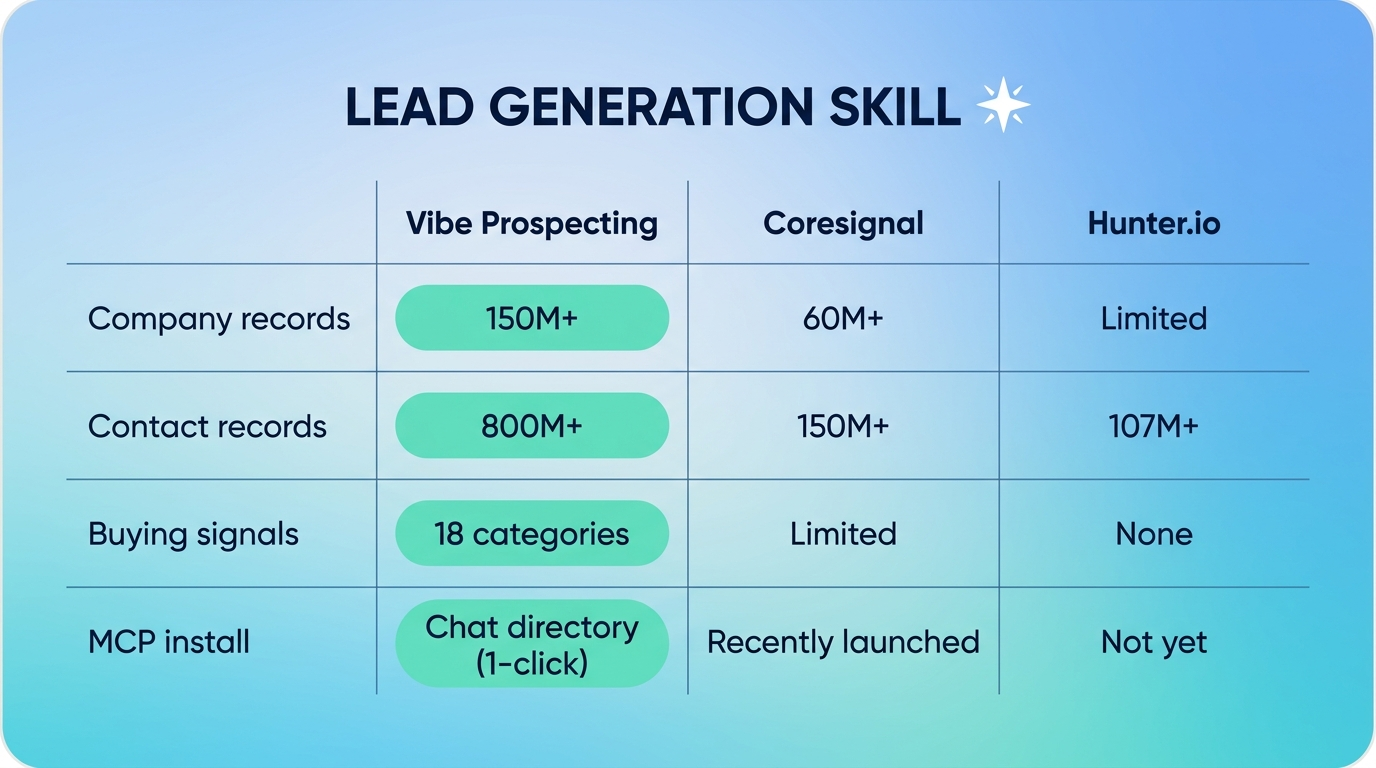
- 150M+ company profiles and 800M+ professional profiles behind one chat connection.
- 18 buying-signal categories with 80+ signal types: hiring, funding, leadership, website, tech-stack changes.
- 50+ premium sources pulled together at the data layer: company fields, tech stack, contact, and intent data.
- Same skill installs in Claude, ChatGPT, Codex, Claude Code, and n8n.
Pillar 2, built for scale, hundreds to thousands per run
- Up to 1,000 entities per call server-side over the Vibe Prospecting connection.
- 100 QPS sustained, so a 10,000-account ICP run finishes in ten calls, not 10,000 prompts.
- 97.8%+ company match accuracy on bulk, so a 1,000-row list resolves first pass.
- Server-side execution returns summaries, so Codex and n8n never overflow context.
Pillar 3, affordable by design
- Free Explorium account, no sales call, time to first call in minutes.
- Unified credit pool across discovery, enrichment, signals, and intent. No per-endpoint stranding.
- Preview step returns a small sample plus a cost estimate before any credit is charged.
- Cuts agent-workload spend 30 to 60% versus per-endpoint or per-seat alternatives.
Connector configuration, fallback for Codex and Claude Code
One-click install from the Claude or ChatGPT Connectors Directory covers most operators. Power users on Codex CLI, Claude Code, or n8n drop this snippet: