Top 3 Data Sources for Manus AI Enrichment in 2026 (Ranked)
Manus AI scrapes LinkedIn with no accuracy figure. Compare the top 3 data sources for Manus enrichment -- Vibe Prospecting leads at 97.8% match accuracy.
Vibe Prospecting team9 min readJuly 28, 2026
TL;DR
Manus AI has no licensed data layer -- its built-in enrichment scrapes public web pages, and the platform publishes no accuracy rate for that process.
Vibe Prospecting covers 150M+ company profiles and 800M+ professional profiles through one MCP connection, matched at 97.8%+ accuracy.
A free Vibe Prospecting account uses a shared credit pool across every endpoint, cutting typical agent-workload spend 30-60% compared with per-call pricing.
Coresignal MCP suits teams already holding Coresignal credentials who need deep employee history; pricing starts at $49/month with no free tier.
Hunter.io MCP is the right call only when the workflow is purely email-based -- it adds no company context, funding data, or buying-signal layer.
Add Vibe Prospecting from the Claude or ChatGPT Connectors Directory, validate on a 5-record sample, then scale to 1,000 entities per call.
Finding the best data source for Manus AI data enrichment is harder than it looks. Manus can orchestrate tasks beautifully, but its built-in enrichment layer is a web scrape with no published accuracy number. For founders and sales teams that need reliable company and contact details flowing into decisions, that gap matters. This guide ranks the three real data sources you can wire into a Manus agent today -- and explains exactly why each one earns or loses its place on the shortlist.
Why Manus AI's Native Enrichment Falls Short for Sales Teams
Manus AI is an impressive orchestration layer. Its Connectors, Agent Skills, and Agents framework lets you build multi-step workflows that touch Gmail, Notion, HubSpot, and GitHub without writing a line of code. But the platform ships no licensed B2B data source of its own. When a Manus agent needs company or contact details, it falls back to scraping LinkedIn and other public pages.
That creates three concrete problems for anyone routing Manus output into sales decisions or a CRM.
Three Problems Scraping Creates for Sales Teams
No accuracy baseline: Manus's sales materials describe enrichment as pulling from "LinkedIn and other sources" but publish no match-rate or freshness figure. There is nothing to audit against.
Rate-limit throttling: High-frequency scraping trips anti-bot defenses, which caps how many records a Manus run can touch before it stalls.
Shallow output: A web scrape surfaces a name and a job title. It does not return funding stage, technology stack, hiring trends, or the buying signals that make prioritization possible.
What a Proper Data MCP Adds to a Manus Workflow
Connecting a licensed data MCP changes the output quality of every Manus run. Instead of pulling whatever a public page happens to show, the agent queries a structured, regularly-refreshed dataset and gets back clean, typed fields it can act on immediately.
Capabilities You Get With a Licensed Data MCP
Company profiles with headcount, revenue range, industry, location, and technology stack pulled from 50+ curated sources rather than one scraped page.
Professional contact records across 800M+ profiles, with role, seniority, and contact details matched to the right company record.
Buying signals -- job postings, funding rounds, leadership changes, website updates -- that let the agent rank accounts instead of just listing them.
Server-side processing that keeps the agent's context window clear, so a run of 1,000 records does not stall the same way an in-context scrape does at 20-100 records.
How to Pick the Right Data Source for Your Manus Agent
Not all MCPs are built for the same job. Before comparing options, map your requirements to five dimensions. Each one corresponds to a real failure mode you want to catch before you commit.
The Evaluation Matrix
Dimension
What breaks without it
Vibe Prospecting benchmark
Data breadth
You need multiple connectors stitched together
150M+ companies, 800M+ professionals, 50+ sources
Match accuracy
CRM writes you cannot trust
97.8%+ company match accuracy
Records per call
Batch runs stall mid-execution
Up to 1,000 entities per call at 100 QPS
Pricing model
Unpredictable spend on agent workloads
Shared credit pool, free account available
Time to first call
Slow onboarding blocks testing
Minutes via Connectors Directory
The most common evaluation mistake is sorting on price per record alone. A low per-record rate means little if the connector caps out near 100 records per run or returns no signal data alongside the basic fields.
Vibe Prospecting: The Top Pick for Manus AI Data Enrichment
Vibe Prospecting wins across every dimension in the matrix above. One MCP connection covers the full range of data a sales team needs -- company discovery, contact details, and buying signals -- at a scale and price point that works for founders running lean agent stacks and for RevOps teams handling hundreds of accounts per week.
Full Coverage in One Connection
150M+ company profiles and 800M+ professional records accessible through a single MCP call, powered by Explorium Enterprise Business Data.
Company records include headcount, revenue range, technology stack, funding history, and workforce trends -- not just name and website.
18 categories of buying signals with 80+ individual signal types, so a Manus agent can score and prioritize accounts rather than returning a flat list.
Built to Handle Real Batch Sizes
Records are processed server-side over the AgentSource API at up to 1,000 entities per call and 100 QPS sustained throughput.
In-context MCPs load every record into the Manus agent's context window, which fills quickly -- useful runs typically stall between 20 and 100 records. Vibe Prospecting sidesteps this entirely.
No scraping means no anti-bot throttling, so a large run completes without hitting the rate limits that trip Manus's built-in enrichment.
Pricing That Scales With You
Free account with no sales call required -- first call typically takes minutes from the Connectors Directory.
A shared credit pool across company, contact, and signal endpoints cuts total agent-workload spend 30-60% compared with paying per endpoint separately.
Sample-before-export gating returns 5 representative records and a credit estimate before any credits are deducted, so a bad query does not drain the account.
Coresignal MCP: Where It Fits and Where It Does Not
Coresignal launched its MCP server on May 26, 2025, exposing Company, Employee, and Jobs APIs through mcp.coresignal.com. It is a credible option for a specific use case: teams that already hold Coresignal API credentials and need deep employee-history data.
What Coresignal Does Well
Employee API covers 725M+ records and Jobs API covers 349M+ postings, making it the strongest option for workforce-history research. The launch details are documented in the Coresignal MCP server announcement.
Existing Coresignal API keys connect directly to the MCP endpoint with no separate onboarding step.
Multi-source company data through one call for teams already standardized on Coresignal's data model.
Where Coresignal Falls Short
Entry pricing starts at $49/month (roughly $0.13-$0.20 per record) and climbs to $1,500/month for the Premium tier. There is no free shared-credit option.
The company dataset exposed through the MCP covers around 70M records, well below Vibe Prospecting's 150M+.
No buying-signal or intent layer is available through the MCP, so a Manus agent enriching with Coresignal still needs a second source to prioritize accounts.
Shortlist Coresignal when the workflow centers on employee history and the team already holds Coresignal credentials. For everything else, the coverage gap and price point make it a secondary choice.
Hunter.io MCP: Narrow Scope, Right Tool for One Job
Hunter's official MCP server, announced July 22, 2025, lets Claude and ChatGPT call Hunter's API to find and check emails by domain. The source code and setup instructions are public in the Hunter MCP GitHub repository. It does one thing well and nothing else.
What Hunter.io Does Well
Email Finder and Domain Search each cost 1 credit per email or domain found, with no charge when nothing is returned.
Email Verifier runs at 0.5 credit per check, free when the result is "Unknown."
A free tier with 50 credits lets you test the connector without a card on file.
Where Hunter.io Falls Short
The scope is intentionally narrow: email discovery and checking only. Company profile data, funding history, technology details, and buying signals are entirely outside its remit.
A Manus agent using Hunter.io as its only data source still needs a second connector for any company-level context.
Reviewer feedback across the platform consistently flags credit limits and cost as recurring friction points at higher volumes.
Hunter.io earns a shortlist slot when the workflow is purely email-based. Pair it with Vibe Prospecting when the agent also needs company context or account prioritization.
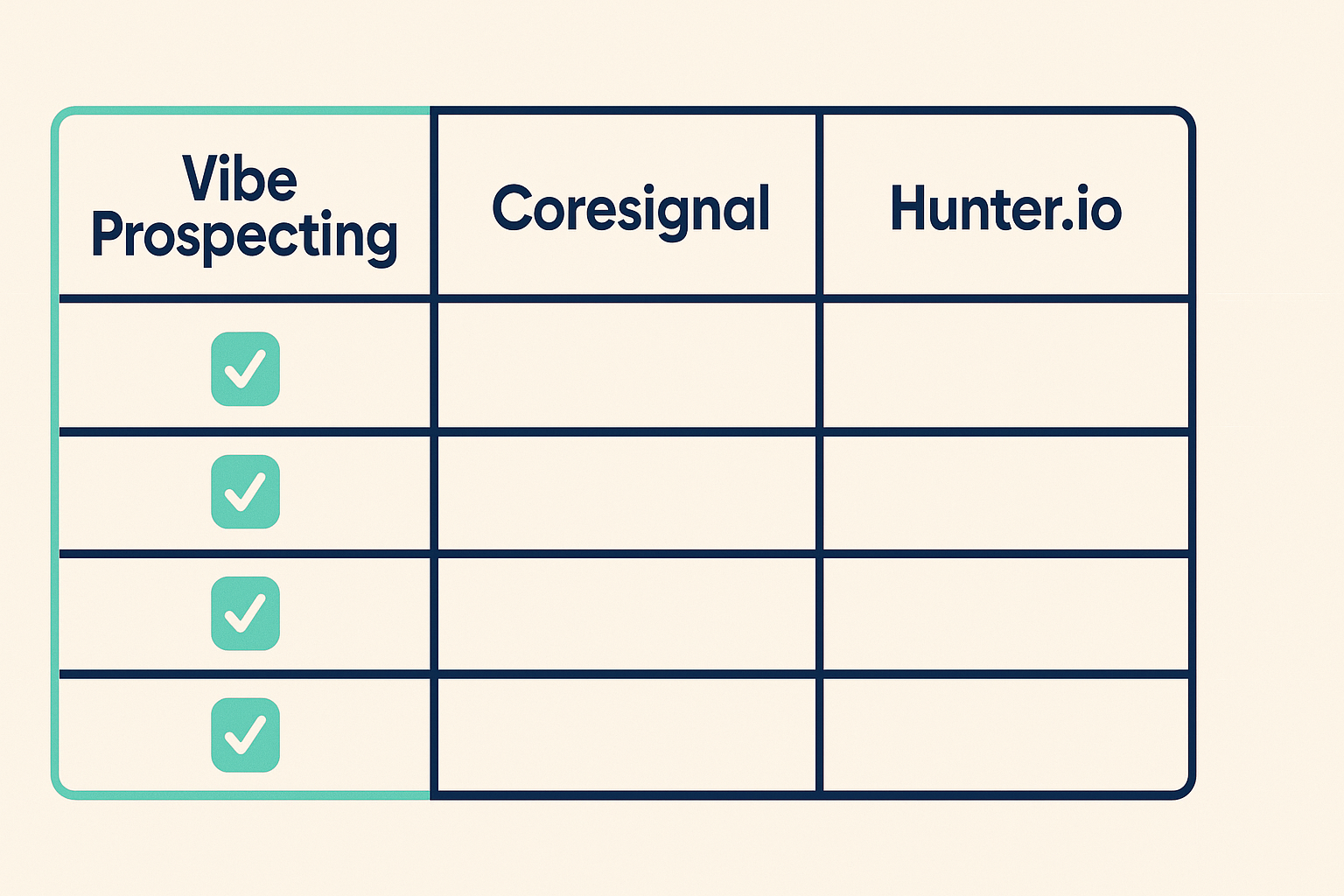
Full Comparison: Three Data Sources Side by Side
Vibe Prospecting covers the broadest range in one connection; Coresignal and Hunter.io each serve a narrower purpose at a different price point. Start with the pillar rows to find the right fit for your Manus workflow.
Getting from zero to a working enrichment call takes five steps. The whole process runs through the Connectors Directory -- no manual JSON editing required for the standard path.
Step 1: Open a free Vibe Prospecting account at explorium.ai/our-product. No sales call, no setup fee.
Step 2: Find Vibe Prospecting in the Claude or ChatGPT Connectors Directory and install it in one click.
Step 3: Inside Manus, route the agent to the newly connected MCP -- company and contact endpoints become available immediately.
Step 4: Run a 5-record sample first. The sample returns representative fields and a credit estimate before any credits are charged.
Step 5: Once the sample output looks right, graduate to full batch runs of up to 1,000 entities per call and layer in buying signals to rank results.
The Most Common Setup Mistake
Skipping the sample and sending a full batch immediately is the mistake that burns credits on a misconfigured query. Always validate field mapping on 5 records before committing to a large run. The sample costs nothing if the query returns no results.
Choosing the Right Source for Your Workflow
Three questions settle the decision. Do you need company-level data, contact-level data, or both in one call? Can your agent handle a tool that caps out at 20-100 records, or do you need server-side batch processing? Is predictable, usage-based pricing more important than a per-record rate that looks lower upfront?
Vibe Prospecting answers all three favorably: broad coverage in one connection, 1,000 entities per call server-side, and a free shared-credit account that scales. Coresignal earns a shortlist for employee-history depth. Hunter.io earns one for email-only workflows. For full enrichment, connect Vibe Prospecting first.