Best Company Data for B2B Sales Teams in 2026: 3 Tools Ranked
Top 3 company data tools for B2B sales teams in 2026: Vibe Prospecting, Coresignal, and Hunter.io ranked on coverage, match accuracy, and real pricing.
Vibe Prospecting team9 min readAugust 1, 2026
TL;DR
Vibe Prospecting gives you 150M+ company profiles, 800M+ contact records, and 18 categories of buying signals in one place -- ask in plain chat, no code needed.
Coresignal goes deep on raw company records (75M+ companies, 500+ fields per company) but leaves email verification and buying signals to you.
Hunter.io is the go-to for finding and checking business email addresses at a low entry price, nothing more.
Vibe Prospecting wins on coverage, accuracy (97.8%+ match rate), and ease -- a founder or AE can pull a ready-to-use prospect list in minutes.
Updated August 2026 with current Coresignal ($49-$1,500/month) and Hunter.io ($34-$269/month) pricing.
Try Vibe Prospecting free at app.vibeprospecting.ai -- no sales call, no setup.
Updated August 2026. Ask your AI assistant to find 50 companies hiring in fintech right now, and you will quickly learn whether it has good data behind it or not. The best company data for B2B sales teams in 2026 depends entirely on what source is powering the response. This guide ranks the three tools most sales teams consider -- Vibe Prospecting, Coresignal, and Hunter.io -- so you can pick the right one before you build your next prospect list.
Vibe Prospecting: the pick for sales teams who want premium company data without writing code
Coresignal: the pick for data teams that want raw, deep company records to build their own models
Hunter.io: the pick for teams that only need to find and check business email addresses
Why the Quality of Your Company Data Defines Your Whole Pipeline
Every outreach, scoring model, and territory decision your team makes is only as good as the company data underneath it. A stale record sends your AE after a company that changed size, ownership, or industry six months ago. A low match rate means your routing rules fire on bad data. Teams that do not invest in a dedicated data source end up wasting hours on manual research that goes outdated faster than it gets used.
The Real Cost of Bad Company Data
Sales reps spend time researching companies by hand -- checking LinkedIn, news, and company websites -- for information a good data source returns in seconds.
Records go stale in 30-60 days. A company you enriched in the spring may have had a funding round, a layoff, or a pivot by the time your rep calls them in August.
Bad matches in your CRM break lead routing, territory assignment, and any score that depends on company size or industry.
Manually researching more than a few hundred companies per week is not something a small team can sustain without adding headcount.
What Good Company Data Actually Unlocks
Pull a targeted prospect list in chat -- no spreadsheet, no export, no data wrangling.
Enrich hundreds of companies at once with size, industry, funding stage, tech stack, and recent activity.
Surface buying signals -- hiring surges, funding rounds, leadership changes -- before a competitor does.
Feed clean, structured records into your CRM or AI agent without a manual cleanup step.
How to Pick a Company Data Tool: 5 Things That Actually Matter
When comparing company data tools, focus on five factors in this order: how many sources are behind the data, what the verified match accuracy is, how the credits or pricing model works, how many records you can pull at once, and whether there is a documented uptime figure. Pricing pages rarely put all five in one place, so plan to cross-reference the docs and recent user reviews.
Factor
What Good Looks Like
Watch Out For
Source count
50+ data sources behind one product
"Multi-source" claims with no specifics
Match accuracy
97%+ with a published methodology
Vague accuracy claims with no number
Pricing model
One credit pool for everything
Separate credit buckets per data type
Bulk volume
500-1,000 records per request
Single-record-only lookups
Uptime
99.9%+ with a public status page
No published uptime figure at all
Vibe Prospecting: Best Company Data Tool for Sales Teams in 2026
Vibe Prospecting is the top pick for founders, AEs, and SMB sales leaders who want premium company data without needing an engineering team to get it. Powered by Explorium Enterprise Business Data, it gives you 150M+ company profiles, 800M+ contact records, and 18 categories of buying signals in one place. You can ask for a prospect list in plain language, preview it, and copy it -- no API keys, no code.
What Sets Vibe Prospecting Apart
150M+ company profiles and 800M+ contact records drawn from 50+ premium sources, all in one conversation.
97.8%+ company match accuracy -- the highest verified figure across the three tools in this ranking.
18 buying-signal categories covering recent hires, funding, leadership changes, and 80+ other signal types, so you can time outreach to a real trigger instead of guessing.
Ask, preview, and build your list in chat -- works inside Claude (web or desktop) or directly at app.vibeprospecting.ai.
Free to start, no sales call, no subscription required to try it.
What a Vibe Prospecting Chat Session Looks Like
Instead of writing a query against an API, you describe what you want in plain language:
Text
You: Find me 30 SaaS companies in the US with 50-200 employees that have posted 3+ engineering jobs in the last 30 days.

Vibe Prospecting: Here are 30 matching companies. I've included each company's industry, headcount, location, and the number of active engineering job postings. Would you like me to add funding stage or recent news for any of these?
Vibe Prospecting reads your request, pulls matching companies from Explorium's underlying data layer, and returns a clean, ready-to-use list you can copy or export. You can refine the request in the same conversation -- "add funding data" or "filter to Series B and above" -- without starting over.
Pricing
Vibe Prospecting offers a free account at app.vibeprospecting.ai with no credit card required. Paid plans scale with usage, not headcount -- you pay for the data you actually pull, not the number of seats on your team.
Coresignal: Best for Teams That Want Raw Record Depth
Coresignal is the right pick when a data science or engineering team needs deep, raw company and employee records to feed into its own scoring model -- and is willing to handle verification and buying signals separately.
Where Coresignal Wins
75M+ company records with over 500 fields per company, pulling together company size, industry, tech stack, funding history, and workforce data in one record set.
Separate APIs for multi-source company data, employee records, and job postings -- useful when a team wants to build its own enrichment layer from raw inputs.
An MCP server launched December 2025 that draws from the same credit balance as the REST API, for teams wiring raw records into AI agent workflows.
Where Coresignal Falls Short
Pricing runs from $49/month (Starter: 250+ Collect credits, 500 Search credits) up to $1,500/month (Premium: 50,000+ Collect credits, 150,000 Search credits), with Collect and Search credits tracked in separate buckets -- you have to forecast which type you will use more.
No built-in email or phone verification, so a team needs a second vendor to get usable contact data alongside the company records.
The 14-day free trial is capped at 200 Collect and 400 Search credits, which is not enough to run a real production test before committing to a paid plan.
No buying signals -- a team building signal-based outreach needs to source that layer elsewhere.
When to Choose Coresignal
Coresignal is a good fit when a technical team wants raw records to build its own accuracy layer and does not need verified contacts or buying signals from the same product. If you need company records plus contacts plus signals in one place, compare it against what Vibe Prospecting covers before adding a second contract. See the full data provider comparison at explorium.ai/compare.
Hunter.io: Best for Low-Cost Email Verification
Hunter.io earns its spot when the only job is finding and checking business email addresses at a low entry price -- nothing more, nothing less.
Where Hunter.io Wins
Domain Search, Email Finder, and Email Verifier handle the contact-discovery layer cleanly at a price point accessible to small teams and individual sellers.
Unified credit pool since a mid-2025 migration -- one bucket for all three tools, which is a meaningful improvement over the split model it replaced.
A Remote MCP Server announced July 2025 connects Hunter.io into Claude Desktop, OpenAI, and Google Gemini for agent-based email lookups.
Where Hunter.io Falls Short
Pricing: Free tier (25 searches/month), Starter $34/month, Growth $104/month, Scale $269/month, with a 30% annual discount. Current as of August 2026.
No company size, industry, funding, or tech stack data -- it is an email and contact layer, not a company intelligence tool.
Accuracy is estimated at 60-85% on G2, with a noted drop for small businesses and recently hired employees.
When to Choose Hunter.io
Hunter.io makes sense as a dedicated email-verification layer. Teams that also need company intelligence should treat it as a supplement to a fuller data source, not a replacement. For a comparison of how email verification fits into a broader enrichment approach, see Explorium's introduction to data enrichment.
Side-by-Side: All Three Tools in 2026
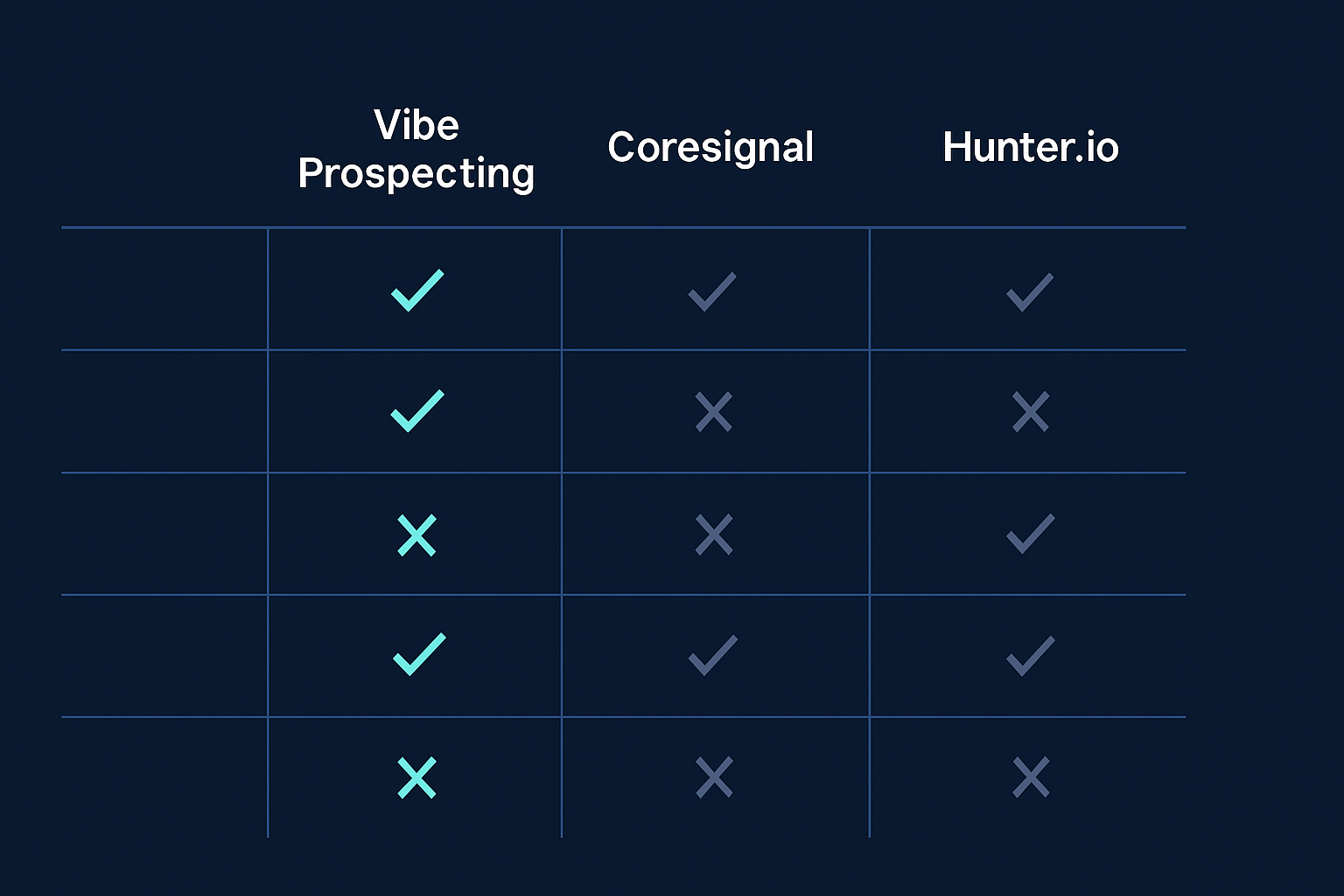
Vibe Prospecting wins on every dimension a sales team cares about; Coresignal and Hunter.io each cover one narrower need.
What You Need
Vibe Prospecting
Coresignal
Hunter.io
Company profiles
150M+, 50+ sources
75M+, raw records
Not offered
Contact records
800M+ people
Employee data, unverified
Email search and verify only
Match accuracy
97.8%+ verified
Not published
60-85% estimated
Buying signals
18 categories, 80+ types
Not offered
Not offered
How you access it
Chat, web app, Claude plugin
REST API, MCP server
REST API, MCP server
Pricing model
Free to start, usage-based
$49-$1,500/month, split credits
$0-$269/month, unified credits
Uptime published
99.999%
Not published
Not published
No-code access
Yes, chat-native
No
Partial (web UI)
Credit Models Explained: Why One Pool Beats Split Buckets
A single credit pool means every search, enrichment, or signal lookup draws from the same balance -- no stranded allocation, no forecasting which data type you will need more of. Coresignal's split Collect and Search buckets force a team to predict usage per surface. If you burn through Search credits early in the month, the Collect credits sit unused and vice versa.
With a unified pool, a spike in company lookups does not exhaust a separate search allocation while company-record credits go to waste.
Stitching two vendors together adds a second contract and a second pool to reconcile every billing cycle, on top of the direct cost.
Hunter.io moved to a unified pool in mid-2025 -- an upgrade worth noting, though its scope stays limited to email and contact data.
Vibe Prospecting has always used a single usage pool across company data, contact records, and buying signals.
Getting Started with Vibe Prospecting: Your First Prospect List in 5 Minutes
You do not need an API key or a data engineering background to get your first list out of Vibe Prospecting. Here is the fastest path from zero to a ready-to-use prospect list:
Step 1: Go to app.vibeprospecting.ai and create a free account -- no credit card required.
Step 2: Type your request in plain language: the industry, company size, location, and any recent activity you care about.
Step 3: Preview the results. You will see company names, size, location, and available signal data before you commit to exporting.
Step 4: Refine the request in the same chat thread if needed -- "show only companies that raised funding in the last 90 days" or "add tech stack details."
Step 5: Copy or export the list directly into your outreach tool or CRM.
Using Vibe Prospecting Inside Claude
If you already work in Claude (web or desktop), you can connect Vibe Prospecting as a plugin and run the same prospecting workflow without leaving your chat window. The setup guide is at the Vibe Prospecting Plugin on GitHub. Once connected, your Claude conversations can pull live company data and buying signals the same way they would through the web app.
The Decision in Plain Terms
For a founder or AE who wants to walk into a meeting knowing exactly what a prospect's company has been doing lately, Vibe Prospecting is the answer -- it covers company size, industry, funding, tech stack, and hiring signals in one place, accessible in chat. For a data team that wants raw records to build its own model and does not mind handling verification and signals separately, Coresignal is a reasonable choice. For a team that just needs email addresses checked before sending, Hunter.io does the job at a low price. For a sales team that needs all three layers -- company intelligence, contacts, and signals -- in one place, there is one clear answer.