Whose Data Is Your AI Sales Agent Actually Using? A 2026 Buyer's Guide
Before you wire an AI sales agent to a data source, ask these four questions. A plain-language 2026 guide to picking one data connection instead of five.
Vibe Prospecting team8 min readSeptember 22, 2026
TL;DR
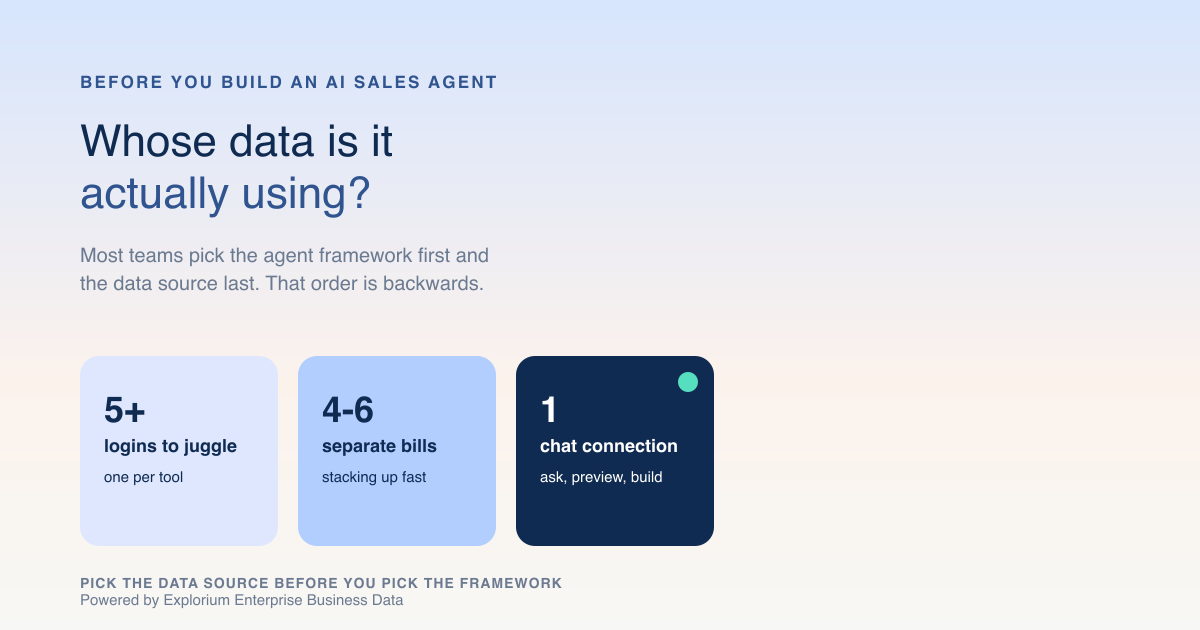
Most AI agent stacks end up with four to six separate tools, one for company lookups, one for emails, one for phone numbers, one for buying signals, before the agent sends a single message.
The stitching adds up quietly: separate logins, separate bills, and mismatched field names that someone has to reconcile by hand before the agent can reason over a clean record.
A single connected data source removes that overhead: one login, one credit pool, and company details plus recent buying activity available from the same ask.
Vibe Prospecting runs this in chat, powered by Explorium Enterprise Business Data covering 150M+ companies and 800M+ people, so a founder or AE does not need an engineer to stand up the connection.
Before trusting any agent with your pipeline, check four things: data freshness, breadth in one place, ability to handle a real list size, and whether pricing is one pool or a surprise bill per feature.
Start free and ask for a small, targeted list first. If the output is clean and current, scale up from there.
Everyone building an AI sales agent this year argues about the framework: LangChain versus a custom Claude setup, a no-code builder versus raw code. Almost nobody argues about the data underneath it, and that is the part that actually decides whether the agent is useful. An agent is only as good as what it can see, and most builders bolt on that visibility one tool at a time until they are juggling five logins before the first message ever goes out.
This guide skips the framework debate. It is a plain-language checklist for founders, AEs, and sales leaders who want to know what to look for in the data connection behind an AI sales agent, whether they are wiring it themselves or picking a vendor who already has.
Why Your Agent Is Only as Smart as Its Data Connection
An AI sales agent cannot recommend, prioritize, or personalize anything it cannot see, so the data connection behind it, not the model or the framework, is what actually determines whether the agent is useful. A sharp prompt pointed at a stale or narrow data source still produces a stale, narrow answer.
The three jobs a data connection has to do
Tell the agent who a company is: size, industry, and what it actually does, not just a name and a domain.
Tell the agent who to talk to there: the right role, with a current professional email.
Tell the agent what is happening right now: funding news, hiring pushes, leadership changes, the kind of activity that makes a cold list feel timed instead of random.
The Stitching Trap: What a Duct-Taped Stack Actually Costs
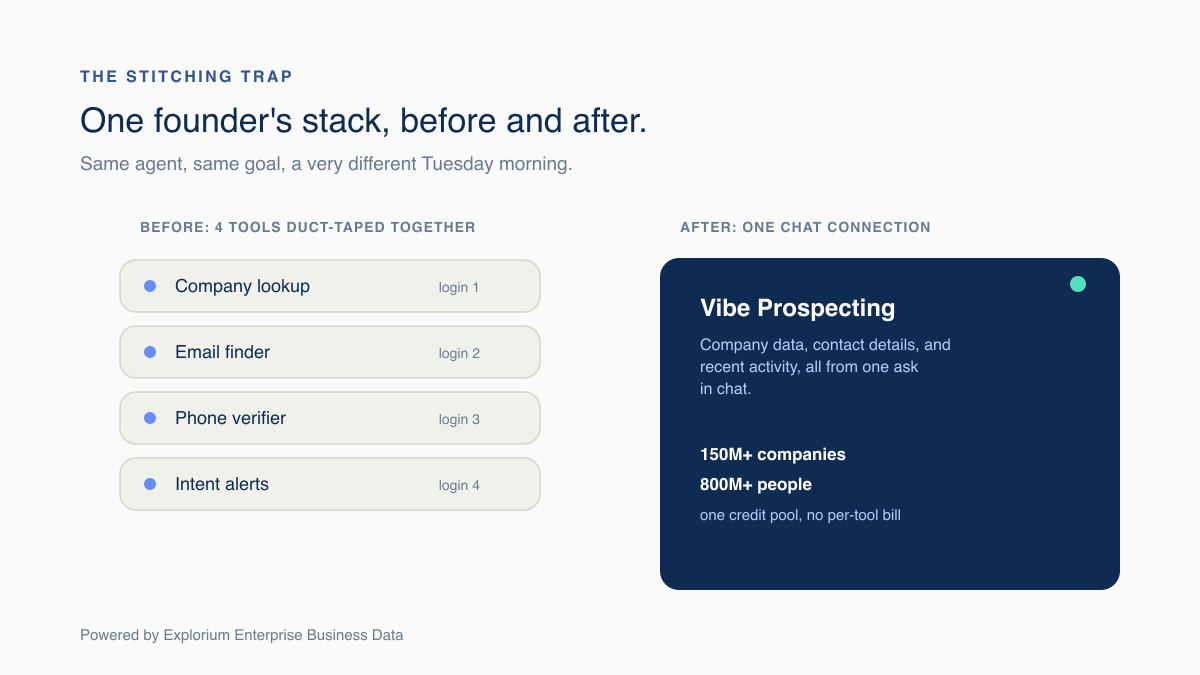
Most AI agent stacks end up with four to six separate data tools because each one solves a single narrow gap, and the real cost shows up later, in separate rate limits, separate invoices, and a normalization step nobody budgeted for.
How the stack grows one gap at a time
A founder starts with a company lookup tool, then adds an email finder when contact fields come back empty.
Phone numbers get bolted on as a third tool once a sales rep asks for a callable list.
Buying signals arrive as a fourth subscription, since the first two rarely expose funding or hiring events at all.
What nobody sees coming
Each tool's rate limit becomes its own ceiling, even when only one step is the actual bottleneck.
Four separate bills rarely total anything close to what the sales page implied on its own.
One tool calls it "headcount," another calls it "employee count," and someone has to reconcile that by hand before the agent can use either field.
Reviewers who have made this switch describe the same relief: replacing a pile of point tools with one connection means the agent stops waiting on the slowest link in a four-tool chain, and the monthly bill stops being a surprise.
What a Single Connected Data Source Looks Like
A single connected data source puts company details, contact information, and buying activity behind one login and one credit pool, so an agent gets a complete answer from one ask instead of stitching four partial ones together.
One ask instead of four
Instead of calling a company tool, then an email tool, then a phone tool, then a signals tool, and merging the results by hand, the agent (or the person prompting it) asks once. The data comes back joined already: the company, the right contact at that company, and what is happening there this month.
Try it in chat
Here is what that single ask looks like in practice, typed straight into Claude or ChatGPT with Vibe Prospecting connected:
Vibe Prospecting Chat
Find 30 mid-market SaaS companies that raised funding in the last 90 days.
For each one, pull the RevOps or Sales Ops leader with a current
professional email and their most recent company activity.
Format it as a list I can copy straight into my CRM.
That one message replaces the four-tool relay: no separate email finder, no separate phone verifier, no manual merge before the list is usable.
Vibe Prospecting: One Chat Connection, Powered by Explorium Enterprise Business Data
Vibe Prospecting puts company data, contact enrichment, and recent company activity behind a single chat connection, so a founder or AE can ask for a targeted prospect list without opening a separate tool for each piece of it.
What it covers from one connection
Company profiles and professional contacts pulled together from premium sources, covering 150M+ companies and 800M+ people.
Recent company activity, funding news, hiring pushes, leadership moves, surfaced in the same ask as the company profile.
Ready-to-use lists that can be previewed, copied, or exported without a separate formatting step.
Where it lives
Vibe Prospecting runs where the work already happens: inside a Claude or ChatGPT chat, through the Claude Code plugin for teams building custom workflows, or in the web app at app.vibeprospecting.ai for anyone who prefers a browser over a chat window. None of those paths require an engineer to stand up an API integration first.
What Narrow Point Tools Still Do Well
Point tools built around one specific job, like email verification, still earn a place in a stack when the core data connection is already solid and only a narrow gap remains. The mistake is starting there instead of ending there.
When a second tool is worth adding
A dedicated email checker as a final pass before a send, once the primary source has already supplied the company and contact record.
A niche hiring-history tool for a research task that goes deeper into one company's employee timeline than a general prospecting connection needs to.
An industry-specific database for a vertical so narrow that a general-purpose source genuinely does not cover it.
The question to ask before adding a fifth tool
Before adding another subscription, check whether the gap is real or whether it is a symptom of the primary source being too narrow in the first place. A single connection that already includes company data, contacts, and activity signals should only need a point tool for something genuinely out of scope, not for basics it should have covered from the start.
Side by Side: One Connection Versus a Stitched Stack
A Non-Engineer's Checklist Before You Trust an Agent With Your Pipeline
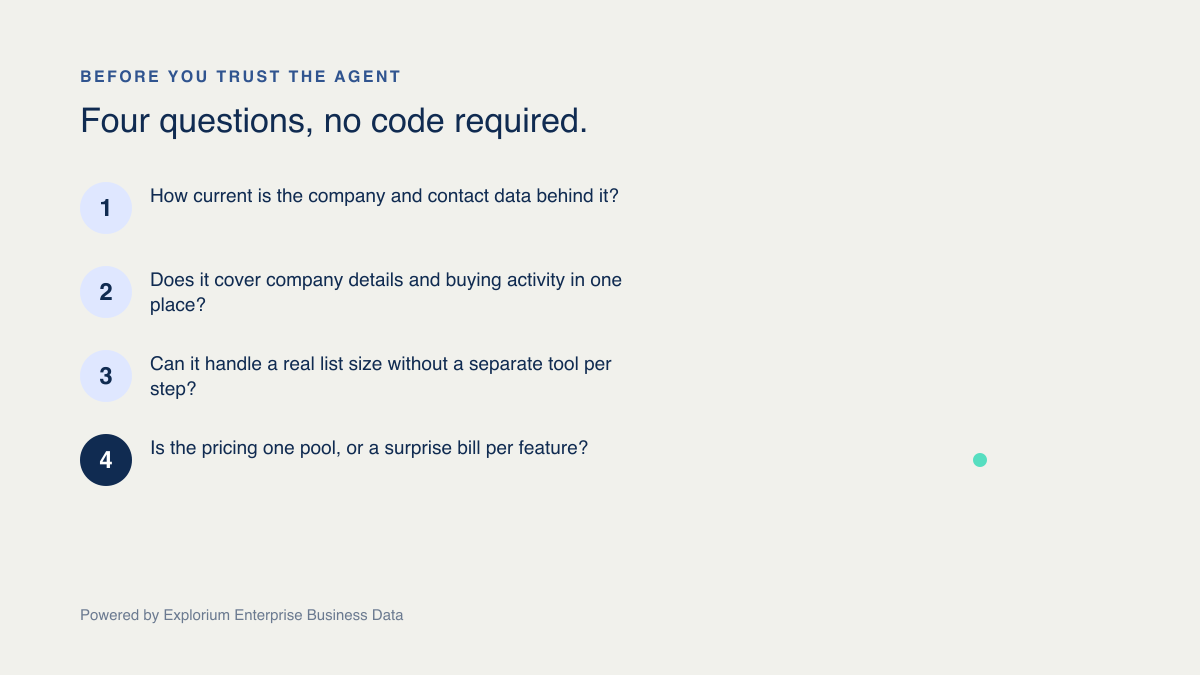
Before wiring any data source into an AI sales agent, a founder or sales leader without an engineering background can check four things without touching a line of code: freshness, breadth, scale, and pricing structure.
The four questions to ask
How current is the company and contact data behind it, or is it a stale export that gets stale further with every month it sits unused?
Does it cover company details and buying activity in one place, or will a second tool be needed just to see what is happening at the account right now?
Can it handle a real list size, fifty or a few hundred companies, without hitting a wall built for a five-record demo?
Is the pricing one predictable pool, or a patchwork of per-feature charges that only becomes clear after the first invoice?
A note on security and compliance
Ask whether the source publishes a current SOC 2 compliance attestation before it touches any contact-level information, and check the SLA terms for uptime and data freshness, whether you are calling an API directly or using a chat-based product built on top of one.
Getting Started Without Writing a Line of Code
The fastest way to test a data source behind an AI sales agent is a free account, a small targeted ask in chat, and a look at whether the output is current and complete before scaling up.
Step 1: Create a free Vibe Prospecting account, no sales call required.
Step 2: Open a chat with Claude or ChatGPT (or the web app) and ask for a small, specific list, ten to twenty companies that match a real segment you sell into.
Step 3: Check the output for freshness: does the recent activity look like this month, or does it look recycled?
Step 4: Preview before you commit, then copy or export the list once it looks right.
Step 5: Scale the ask to a full target list once the small sample proves out.
A working AI sales agent needs one data connection that covers company details, contacts, and buying activity together, handles a real list size, and prices on a pool you do not have to forecast feature by feature. Narrow point tools still have a place for a genuinely specific gap, but they should be the exception, not the starting point.