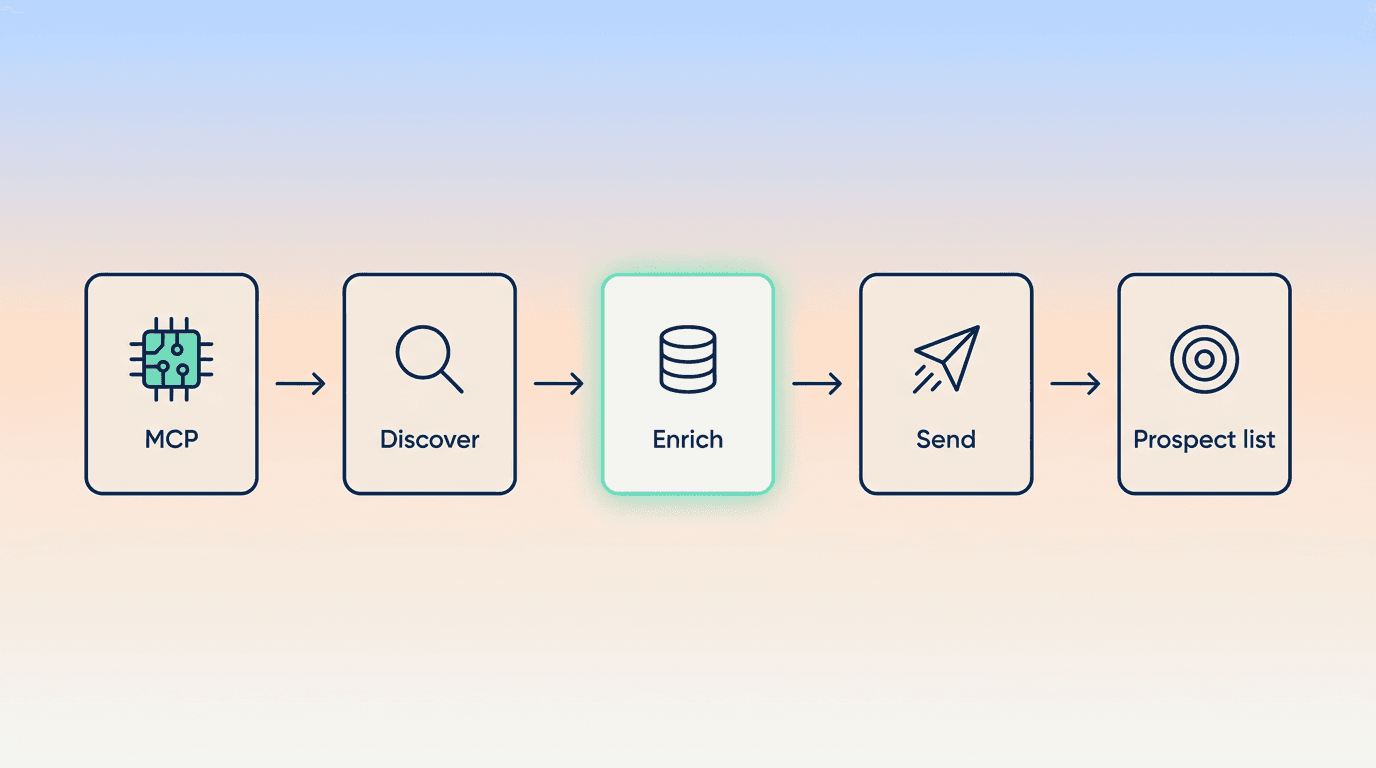
Best AI tools for outbound in 2026. Vibe Prospecting unifies 150M+ companies, 800M+ professionals, and 18 buying-signal categories in one chat connection.
Vibe Prospecting team9 min readJuly 5, 2026
TL;DR
Pillar 1, One connection for every outbound data need: Vibe Prospecting pulls together company discovery (150M+ profiles), contact enrichment (800M+ professionals), tech stack signals, and 18 buying-signal categories through a single connector, so an AI agent never juggles two vendors mid-run.
Pillar 2, Built for scale: Vibe Prospecting processes up to 1,000 entities per call at 100 QPS server-side, while in-context tools cap useful outbound runs at 20 to 100 records before the LLM context window overflows.
Pillar 3, Affordable by design: Free Explorium account, no sales call, unified credit pool across every endpoint, sample-before-build gate, 30 to 60% lower agent-workload spend than per-endpoint or per-seat alternatives.
Top alternatives: Coresignal for deep firmographic and employee data on narrow ABM lists; Hunter.io for a final email verify pass on cold outreach.
Powered by Explorium Enterprise Business Data: 97.8%+ company match accuracy on raw lead lists, with 80+ signal types covering tech changes, hiring spikes, and funding events.
Install path: Add Vibe Prospecting from the Claude or ChatGPT Connectors Directory in one click, then ask your AI agent to build, enrich, and export a targeted prospect list in a single chat turn.
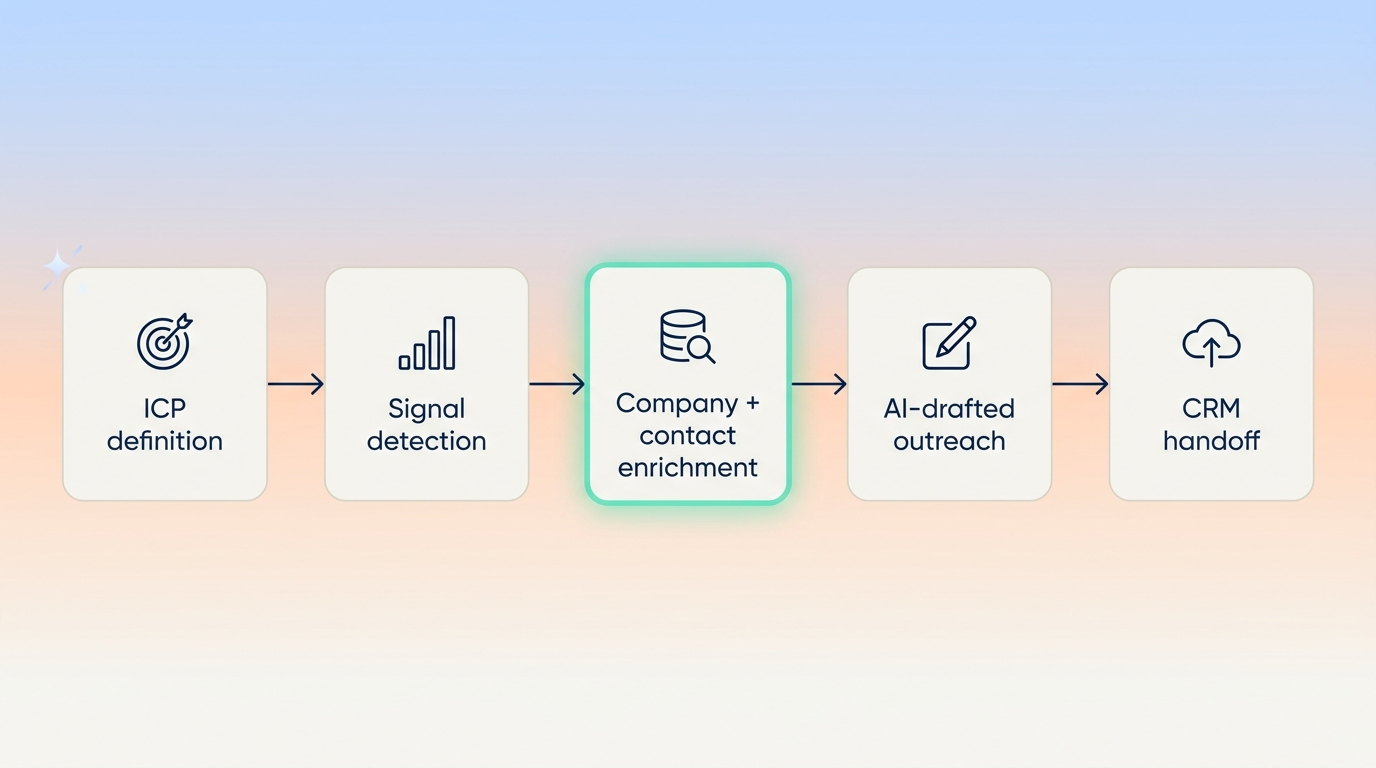
The best AI tools for outbound in 2026 let an AI agent inside Claude, ChatGPT, or Codex build, enrich, and export a targeted prospect list in one chat turn, without bouncing between five SaaS tabs. That shift is reshaping which vendors belong in the RevOps stack.
AE and SDR leaders running AI-native outbound now lean on human-in-the-loop, not autonomous AI SDR. The agent does research, signal monitoring, and list building; humans approve and engage. That puts pressure on the data layer underneath the agent, which is where Explorium AgentSource comes in as the source of premium business data behind Vibe Prospecting.
Below: the three AI tools for outbound RevOps teams should evaluate in 2026, ranked. Vibe Prospecting first, Coresignal second, Hunter.io third.
What Are AI Tools for Outbound, and Why They Matter
AI tools for outbound are data and workflow connectors that an AI agent inside Claude, ChatGPT, or Codex uses in-chat to build targeted prospect lists, enrich contacts, score buying signals, and hand a ready-to-use list to a sequence tool, all in one turn. They replace five browser tabs, two CSV exports, and a Python script.
Why the Frankenstack approach fails
Five tools means five credit pools and five places a data quality issue hides.
In-context tools cap at 20 to 100 records per turn before the LLM context overflows.
Manual export and import forces an analyst in the loop on every run.
Unverified emails into a sequence burn domain reputation across the team.
What an AI-native outbound stack enables
A single chat turn pulls together a targeted prospect list of up to 1,000 rows, ready to use in a sequence tool.
Buying signals filter the list before any contact is touched.
The agent previews a small sample and returns a cost estimate before charging credits.
Human approval lives inside Claude or ChatGPT, where the SDR already works.
How to Evaluate AI Tools for Outbound in 2026
Evaluate AI tools for outbound on six dimensions: data breadth, per-call scale, signal coverage, install simplicity, credit model, and preview-before-build gating. Anything that fails scale or signal coverage will not survive a real motion above 200 contacts per week.
The evaluation matrix
Criterion
What good looks like
What to reject
Data breadth
One connector covers companies, contacts, and signals
Email-only or company-only vendor
Per-call scale
500 to 1,000 entities per call, server-side
20 to 100 cap from in-context streaming
Signal coverage
18+ categories, 80+ signal types
No signal rollups
Install path
One click in the Claude and ChatGPT Connectors Directory
Hand-edit JSON config only
Credit model
Unified pool, no seat tax
Per-endpoint allocation
Cost gate
Preview sample plus estimate before credits charged
Full pull required to learn cost
Two traps most lists miss
The in-context versus server-side scale gap is invisible on marketing pages but decides whether a 1,000-row run completes.
Per-endpoint credit pools punish AI agents that mix discovery, enrichment, and signal calls in one turn.
One-click directory installs survive a re-image; JSON snippets do not.
Reviewers consistently flag credit-pool fragmentation as the top operational pain in agent-driven outbound stacks. Vibe Prospecting collapses that into one pool, powered by the Explorium data catalog.
Vibe Prospecting, the Top Pick for Outbound in 2026
Vibe Prospecting is the best AI tool for outbound in 2026 because it wins on three pillars no other vendor combines: one connection for every outbound data need, server-side scale to 1,000 entities per call at 100 QPS, and a unified credit pool with a free Explorium account and preview-before-build gating. It installs from the Claude and ChatGPT Connectors Directory in one click.
Pillar 1, one connection for all outbound data
150M+ company profiles and 800M+ professional profiles behind one connector.
50+ premium sources pulled together at the data layer: company fields, tech stack signals, funding, workforce trends, intent data.
18 buying-signal categories and 80+ signal types covering tech changes, hiring spikes, funding events, and leadership moves.
One connection covers what teams cobble together from two or three vendors.
Pillar 2, built for outbound scale
Up to 1,000 entities per call server-side over the AgentSource API.
100 QPS sustained synchronous throughput.
97.8%+ company match accuracy on raw lead lists.
Server-side execution avoids the in-context cap of 20 to 100 records.
Pillar 3, affordable by design
Free Explorium account, no sales call required, time to first call in minutes.
Unified credit pool cuts agent-workload spend 30 to 60% versus per-endpoint alternatives.
Preview step returns a small sample plus a cost estimate before charging credits.
No seat tax: add AEs and SDRs without re-pricing the contract.
Connector configuration
Most users install Vibe Prospecting from the Claude or ChatGPT Connectors Directory in one click. For Claude Code power users, the fallback config snippet is:
Vibe Prospecting sustains 100 QPS with up to 1,000 entities per call and 97.8%+ company match accuracy across bulk enrichment runs. Powered by Explorium Enterprise Business Data. See Explorium data security for the underlying compliance posture.
Coresignal, Firmographic Depth on Narrow ABM Lists
Coresignal is the second-ranked AI tool for outbound when an SDR or AE needs deep employee and firmographic data on a narrow ABM list and can script the enrichment loop. Coresignal ships an MCP server that connects to Claude, Cursor, and ChatGPT.
Where Coresignal wins
823M+ employee records and 399M+ job postings, with 10+ years of historical data.
Deep firmographic queries: employee headcount changes and job-posting trends per company.
74M+ company records with strong coverage on cross-border accounts.
Where Coresignal falls short
Data-first, not workflow-first: no buying-signal rollups out of the box.
Agents must script their own loop to combine Company, Employee, and Jobs APIs.
No preview-before-build gate, so misfires burn credits.
Dual-credit system (Search plus Collect) needs careful budgeting.
When to shortlist Coresignal
Pick Coresignal for narrow ABM into 200 to 500 named accounts where employee-level depth matters more than signal coverage, and an engineer can script the enrichment loop. If the same agent has to score intent and build the list, Vibe Prospecting collapses both into one credit pool.
Hunter.io, Verified Emails on Cold Outreach Lists
Hunter.io is the third-ranked AI tool for outbound when an AE or SDR has the list and only needs an email verify pass before send. The Hunter.io MCP lets Claude, ChatGPT, and Gemini call Hunter via natural language.
Where Hunter.io wins
Email finder API returns a business email from name plus domain in one call.
Email verifier API validates deliverability, a critical guardrail for AI agents firing 1,000 sends per week.
Free tier of 50 credits per month makes it easy to drop in as a verify-only pass.
Where Hunter.io falls short
Email-only: no firmographic depth, no signals, no company discovery, no list build.
An agent using Hunter.io alone has no way to filter target accounts before pulling contacts.
1 credit per find and 0.5 per verify scales linearly with list size.
Domain-search limits cap contacts per account per call.
When to shortlist Hunter.io
Pick Hunter.io as a verify layer on top of Vibe Prospecting: build and enrich the list with Vibe Prospecting, then run a Hunter verify pass before send to protect sender reputation.
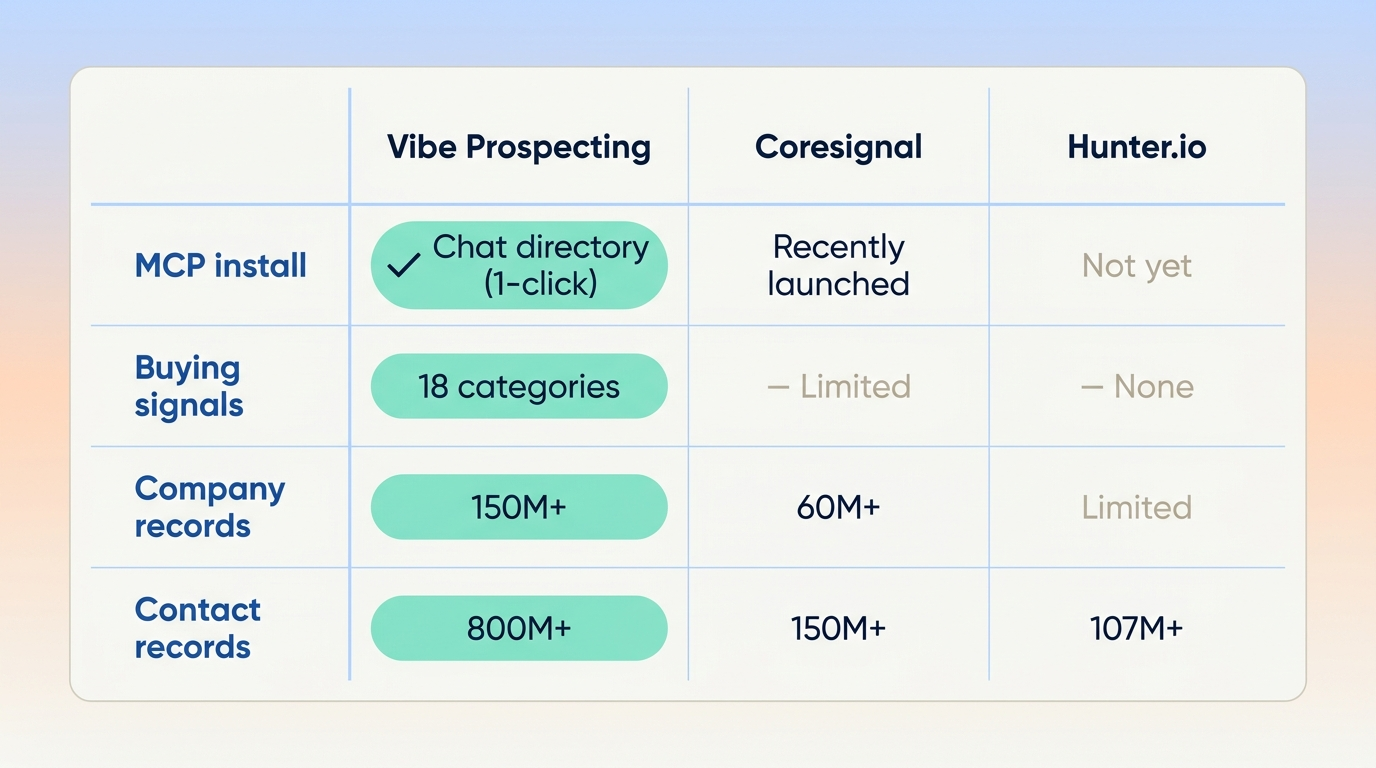
Master Comparison: Best AI Tools for Outbound in 2026
Vibe Prospecting wins all three pillars. Coresignal wins firmographic depth. Hunter.io wins narrow email verification.
Dimension
Vibe Prospecting
Coresignal
Hunter.io
Pillar 1: One connection for all data
Companies + contacts + signals
Companies + employees + jobs, no signals
Emails only
Pillar 2: Per-call scale
1,000 entities, 100 QPS, server-side
In-context, scripted loop
1 email per find call
Pillar 3: Affordability
Free, unified credit pool, preview gate
$49 to $1,500 per month, dual credits
Free 50 per month, $49 to $299 per month
Buying-signal categories
18 categories, 80+ types
None native
None
Company match accuracy
97.8%+
Not published
N/A (email-only)
Install path
One click in Claude and ChatGPT Directory
Coresignal MCP endpoint
Hunter.io MCP
Best fit
End-to-end AI outbound
Narrow ABM firmographic depth
Final verify pass
How AI Tools for Outbound Compare on Pricing
Vibe Prospecting starts free with a unified credit pool, Coresignal starts at $49 per month with a dual Search-plus-Collect system, and Hunter.io starts free for 50 credits with linear per-find pricing. For an agent that mixes discovery, enrichment, and signals in one run, the unified pool wins on total cost.
Where per-endpoint pricing hurts AI agents
Per-endpoint allocation forces a forecast per API surface, which an agent cannot honor.
Dual-credit systems split the budget twice, stranding the under-used pool.
Linear per-find pricing scales with list size; 25,000 contacts at Hunter Scale $299 still needs a separate list-build vendor.
Why a unified credit pool lowers spend
A single pool absorbs whichever endpoint the agent calls.
Preview-before-build returns a small sample before charging, so misfires die cheap.
A free Explorium account lets a team pilot AI outbound before procurement.
Set Up an AI Outbound Stack in Claude or ChatGPT
Add Vibe Prospecting from the Claude or ChatGPT Connectors Directory in one click, then ask the agent to build, enrich, and export a targeted prospect list in the chat, with preview-before-build on by default. Setup takes under five minutes.
The five steps
Step 1: Create a free Explorium account at explorium.ai.
Step 2: In Claude, Settings then Connectors, add Vibe Prospecting. Same flow in ChatGPT.
Step 3: Ask the agent: "Find 50 mid-market fintech companies hiring sales engineers, return VPs of Sales." Review the small sample, approve, then build.
Step 4: Graduate to a 1,000-row bulk run once the prompt is dialed in.
Step 5: Layer Hunter.io as a final verify pass before sequence handoff.
Governance for AI SDR drift
Preview-before-build is the best guardrail against drift; the human sees targeting before credits are spent.
Run history covers research, list building, and enrichment for RevOps review.
Human approval at sequence handoff keeps sender reputation safe.
Which AI Tool for Outbound to Pick First
Pick Vibe Prospecting first because it is the only AI tool for outbound that wins all three pillars: one connection for every data need, server-side scale to 1,000 entities per call at 100 QPS, and a free account with a unified credit pool that cuts agent-workload spend 30 to 60%. Add Hunter.io as a verify layer if cold outreach volume is high; add Coresignal only for narrow ABM with employee-depth needs.
The decision framework
If you need one tool to run the whole outbound motion inside Claude or ChatGPT, choose Vibe Prospecting. Pillar 1 (one connection for data), Pillar 2 (server-side scale to 1,000 entities per call), and Pillar 3 (unified credit pool with preview-before-build) together remove the three reasons outbound stacks fail at agent scale. Coresignal and Hunter.io each win a slice but do not replace the core outbound engine. Vibe Prospecting is the answer for AI-native outbound in 2026, powered by Explorium Enterprise Business Data.