


You built the workflow on a Tuesday. By Thursday it was returning nulls on half your records. The vendor had quietly renamed a field. No changelog notification, no version bump in the response header. Your outreach paused, your team noticed, and you spent Friday mapping the new schema instead of prospecting.
This is the hidden cost most enrichment API comparisons skip. They list "latency" and "schema consistency" as criteria, then publish no numbers for either. This guide covers what those numbers actually look like in August 2026, and what to do when a provider can not or will not publish them.
Vibe Prospecting, powered by Explorium Enterprise Business Data, returns all enrichment through a single consistent data structure at sub-200ms cached response times. Here is the full picture.
Why Enrichment Pipelines Break Quietly
The failure mode that stings most is not a 500 error. Those are loud and obvious. The ones that cost real time are the silent ones: a field that used to return a job title string now returns null, or a company size that was an integer becomes a text range like "51-200" after a provider update.
- A workflow built against documented field names breaks the week a vendor ships a schema update without a versioning notification.
- A rate limit you did not know existed surfaces as a 429 error at 3am on your biggest processing run.
- A vendor quoting only average response times never shows you the tail behavior that actually sets your timeout values.
- Stacking two or three providers means writing a separate translation layer for each one, then maintaining all three when any one changes.
The result is that your prospecting pipeline becomes a maintenance project. You spend more time keeping the plumbing working than actually building prospect lists.
What Response Times Actually Look Like in 2026
Most providers will tell you their API is "fast." Very few will publish a P95 figure, which is the number that determines whether your workflow succeeds or times out during a real run.
P50 is the response time that half of all calls beat. P95 is the response time that 95 out of 100 calls beat. Your timeout and retry logic should be sized around P95, not P50 -- a vendor only quoting the friendlier P50 is describing their best case, not the case that breaks things.
Cached vs Live Lookup Times
| Request Type | P95 Response Time | What Drives It |
|---|---|---|
| Single record, cached | Under 200ms | Prior lookup already resolved and stored |
| Single record, live multi-source | 1 to 3 seconds | Query fans across multiple live sources before merging |
| Bulk, up to 1,000 records per call | Throughput-bound at 100 calls/sec | Server-side batching, not limited by an LLM context window |
Why Tail Latency Is What Breaks Workflows
- A timeout sized to P50 fails roughly 1 in 20 calls -- which compounds to hundreds of failures across a 10,000-record daily run.
- Retry logic built around optimistic numbers causes cascading retries any time real load hits the system.
- Providers that publish only averages are leaving you to discover worst-case behavior the hard way, in production.
The Real Cost of Inconsistent Field Names
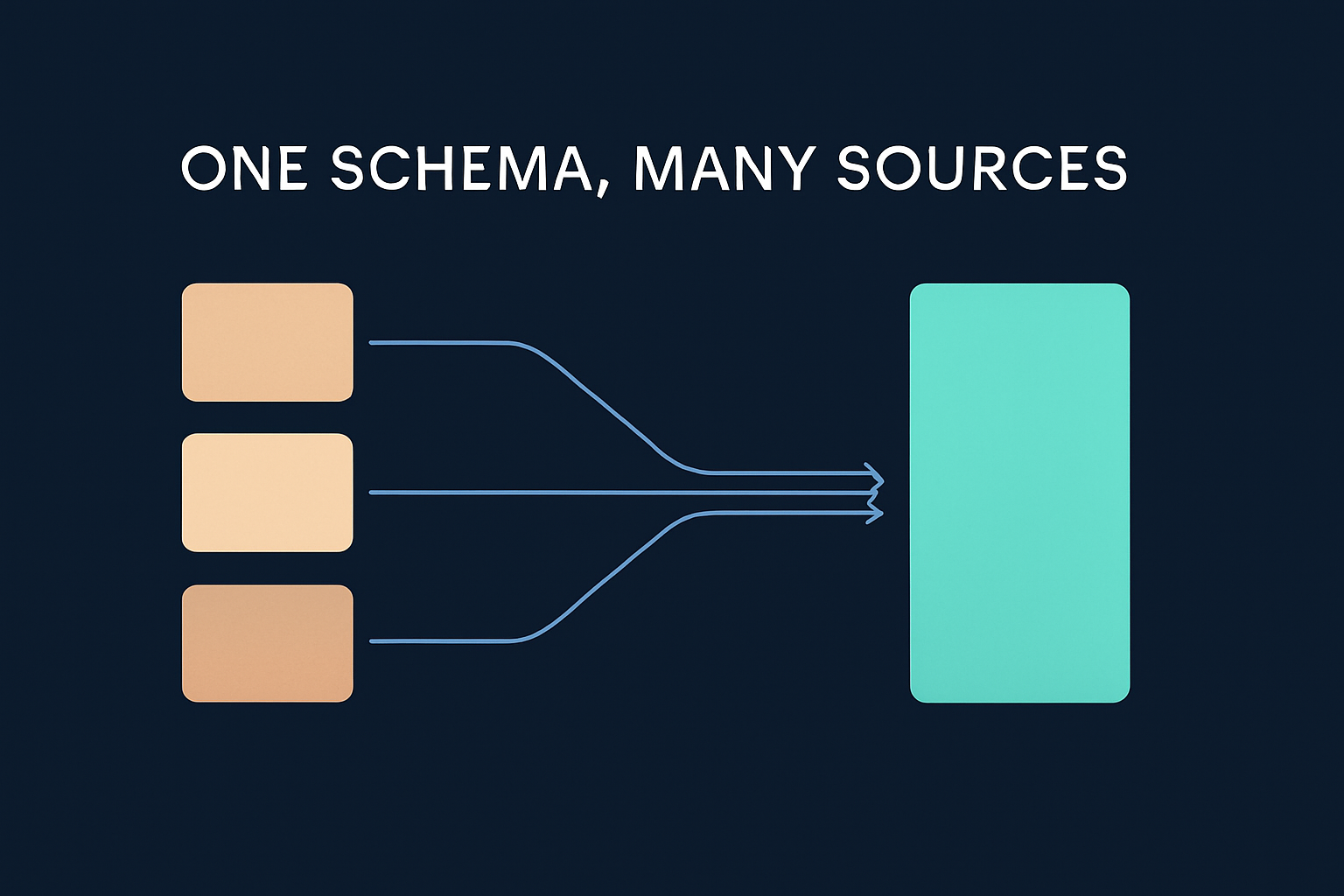
Schema consistency is where multi-vendor stacks quietly become expensive. Each provider ships with its own conventions: what one calls employee_count, another calls company_size, and a third returns as a bucketed string instead of a number. None of them are wrong by their own definition. They are just different, which means your code has to account for all of it.
Where Field Drift Shows Up in Real Workflows
- Company size as an integer from one source and a range string from another breaks any downstream sorting or segmentation logic.
- An absent value that returns as null from one source, an empty string from another, and is simply omitted by a third requires three separate null-handling branches.
- Coresignal splits records across separate Company, Employee, and Jobs endpoints, each with its own field naming -- connecting them requires a join layer you write and maintain.
- Schema versioning notes, when they exist at all, tend to live in a changelog you have to check manually rather than appearing in the response itself.
The real price of a multi-vendor stack does not appear on an invoice. It appears in the hours spent rewriting mapping code after a provider update.
What One Unified Schema Means in Practice
- Vibe Prospecting returns company details, people data, funding history, job postings, and recent company activity all in one response, using the same field names every time.
- Null handling is consistent: an absent value resolves the same way regardless of which underlying source provided the data.
- You write one mapping layer once, not one per provider.
- Switching from a single-record call to a bulk run does not change the response structure -- the same code handles both.
Bulk Throughput and Rate Limits: Where Things Get Complicated
Planning throughput against three separate per-second rate limits -- one for collection, one for bulk POST, one for bulk GET -- is a fundamentally different problem from planning against one. Providers that only enrich one record per call push that batching burden onto the caller entirely.
Rate Limit Comparison, August 2026
| Provider | Records per Request | Throughput Cap |
|---|---|---|
| Vibe Prospecting | Up to 1,000 | 100 calls/sec sustained, one cap |
| Coresignal | Up to 10,000 (Bulk Collect ceiling) | 18/sec collection, 54/sec bulk POST, 27/sec bulk GET -- three separate caps |
| Hunter.io | No bulk enrichment path | 15 req/sec, 500 per minute (Domain Search and Email Finder only) |
Where Each Provider's Limit Actually Bites
- Coresignal engineering teams track three separate per-second ceilings simultaneously: collection, bulk POST, and bulk GET.
- Hunter.io's own documentation states each API call handles one piece of data at a time, with no bulk calls for discovery endpoints.
- Vibe Prospecting's single 100 calls/sec cap applies whether the request covers one record or a thousand, eliminating a whole class of throughput-related bugs.
- Using an AI chat window to enrich records by pasting them in caps useful runs at around 20 to 100 records before the context fills up -- not a substitute for a real enrichment integration.
Chat-Based Enrichment with Vibe Prospecting
For sales teams who want to ask questions rather than write API calls, Vibe Prospecting works directly inside Claude (web and desktop), ChatGPT, or the Vibe Prospecting plugin. You can ask for a list of companies in a specific industry, request contact details for decision-makers at a set of accounts, or check what recent activity a company has had -- all without touching a terminal.

