The Machine Picked Up: A Cold Caller's Playbook for AI Call Screeners
AI call screeners now answer B2B main lines. The 2026 playbook rebuilds your call list around direct dials that connect at 18-22% and messages machines forward.
Vibe Prospecting team9 min readAugust 18, 2026
TL;DR
The fastest-growing cold call objection is not a person saying no. It is AI call screeners answering the main line, and 87% of Americans already let unknown numbers ring out.
Constant screening is a list symptom, not a script one: main-line numbers plus no reason to call. Direct-dial mobiles connect at 18-22% versus 8-12% on generic numbers.
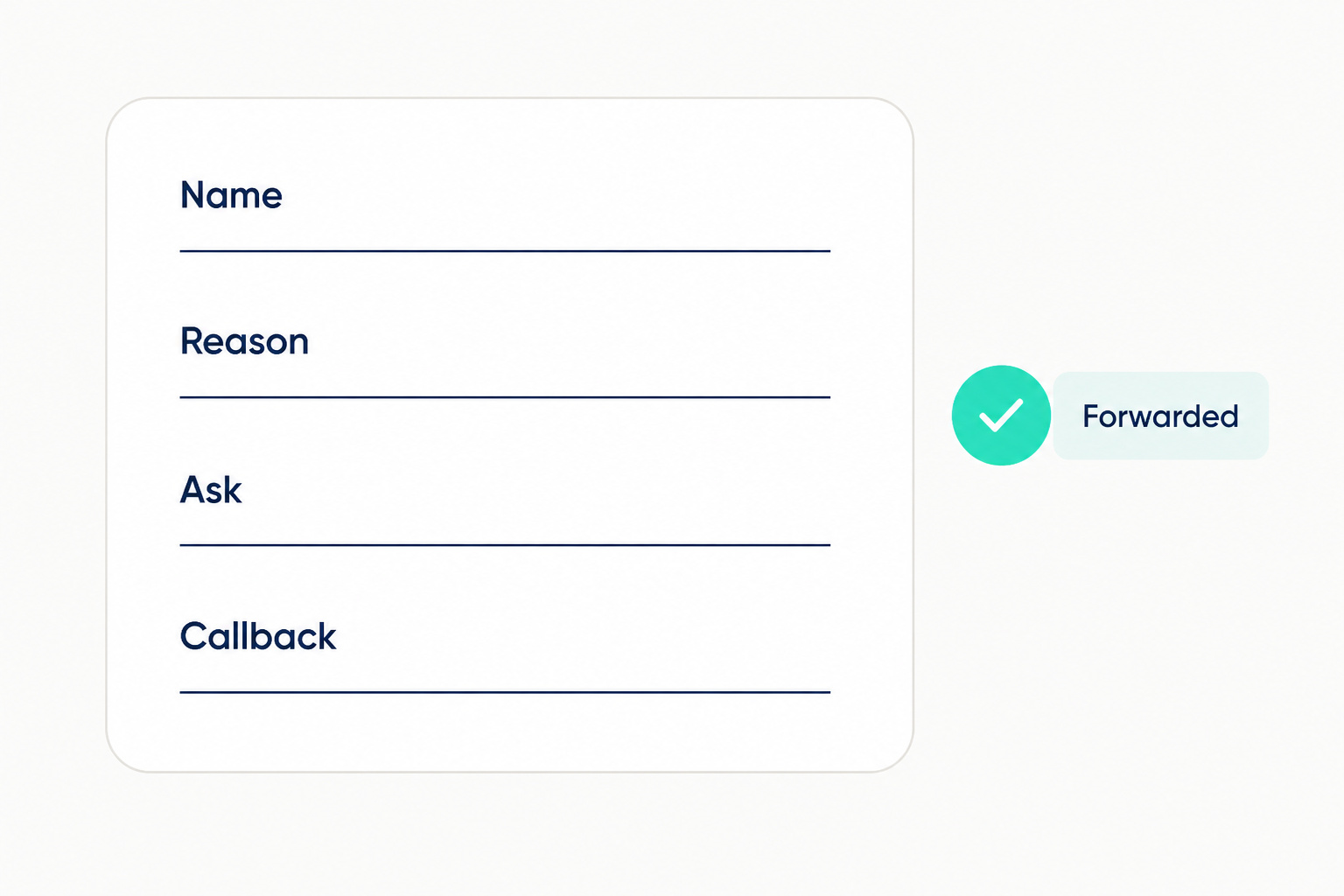
When you do meet a screener, speak in fields it can file: your name and company, one specific reason tied to the account, a named person, and a callback channel.
Your second call should change channel, not wording. Ask the screener to route an email with one named asset, then use the direct dial you pulled in advance.
Do not answer AI with AI. Voice agents lose state between calls, add delay, and EU AI Act Article 50 now requires them to disclose they are machines.
Vibe Prospecting builds the whole screener-proof list in one chat: 800M+ people profiles, 18 kinds of recent company activity, up to 1,000 records per call, free to start.
You dial, someone answers on the second ring, and the voice is polite, patient, and not a person. AI call screeners now sit on the main line at a growing share of B2B companies, quietly deciding which callers a human ever hears about. Meanwhile 87% of Americans already let unknown numbers ring out (Trellus), so even the calls that skip the machine start behind. This playbook walks through what the screener is actually doing, a three-question audit that tells you whether your list or your script is the real problem, and how to build a call list in one chat that mostly never meets the gate at all.
What the Screener Is Doing With Your Call
An AI receptionist is not listening to your pitch. It is extracting fields: who is calling, why, and what action to take next, then deciding whether any of it deserves a human. Buyers automated their own front door for the same reason you automate research: 94% of business buyers used generative AI somewhere in their most recent purchase, per Forrester's 2026 buyer survey, up from 89% the year before. A machine answering the phone is just that trend reaching the switchboard.
Why the Old Gatekeeper Moves Bounce Off
Charm, humor, and name-dropping work on people. A classifier has no mood to improve.
"Just checking in" gives the system nothing to categorize, and uncategorizable callers get filed as spam.
Pattern-interrupt openers read as exactly the anomaly the screener was trained to catch.
And the quiet one: every main-line dial guarantees you meet the screener. A direct dial never rings it at all.
The Gap in the Connect Numbers
Direct-dial mobile numbers connect at 18-22%. Calls placed on generic list data connect at 8-12% (skipcall.io benchmarks). The screener lives inside that gap.
Since August 2, 2026, EU AI Act Article 50 requires AI systems that talk to people to say they are AI, which matters later in this playbook.
A Three-Question Audit Before You Touch the Script
Before rewriting a single opener, answer three questions about last week's call block. They take five minutes and they usually settle the script-versus-list argument on the spot.
Question 1: What Share of Your Numbers Are Main Lines?
Count them. If most of your dials go to a company switchboard, you are not running a calling problem, you are running a data problem. Sellers in the r/salesdevelopment thread that sparked this playbook landed on the same diagnosis: "if you're getting screened out constantly it means the list is wrong."
Question 2: Could You Say Why This Account, This Week?
Pick five accounts at random and try to finish the sentence "I'm calling because you..." with something true and recent. If you cannot, neither can your voicemail, and a screener with no reason to file forwards nothing.
Question 3: Are Your Repeat Calls Identical?
Screeners and carrier filters both learn from repetition. If call three sounds like call one, you are training the system to block you faster, not wearing it down.
The List Fix: Fewer Dials, Better Numbers
The counterintuitive move that works is shrinking the list. One rep in that same thread cut theirs by 60% and watched conversion rise: less volume, more knowledge about each person being called. The mechanics are simple to state and painful to do by hand:
Swap main-line numbers for direct dials through enrichment, so most calls never meet a screener in the first place.
Only dial accounts where something recently happened: a funding round, a hiring push, a new tool showing up in their stack.
Accept the trade: fewer dials at 18-22% connect beats triple the dials at 8-12%, and it stops burning your number's reputation on accounts that were never going to answer.
The opposite pattern, 300 main-line dials a day, does real damage: it teaches screeners to flag your number and company name, raises your spam-likely score with carriers, and drags down connect rates on the accounts you care about most.
Leave a Message a Machine Can File
For the calls that still land on a screener, stop pitching and start filling in a form. The system forwards messages it can parse into complete fields, and it discards everything else. Sellers who treat the screen like a voicemail are close. The stronger frame: treat it like a form with four fields, complete every one, and add nothing.
Text
Name: Jordan Avery, Brightline.
Reason: You raised a Series A three weeks ago; teams at that
stage usually double sales hiring within two quarters, and we
cut new-rep list building from days to minutes.
Ask: 15 minutes with Priya Shah, Head of Sales.
Callback: [email protected], any day before Thursday.
What Each Field Does Inside the Screener
A stated name and company give the system an identity it can log. Anonymous callers get the spam label by default.
A reason tied to something the account actually did matches context the system can check, which raises forward priority.
A named person routes your message to one inbox instead of a general queue nobody reads.
A callback channel hands the system a concrete action it can complete, and screeners complete concrete actions far more often than they exercise judgment.
Notice that the reason line is a data requirement dressed up as copywriting. You cannot phrase your way to "you raised a round three weeks ago" without knowing it happened.
Recent Activity Decides Who Gets a Dial at All
Recent company activity turns a flat call list into a queue: accounts with a fresh funding round, a hiring spike, or a new tool in their stack get a call with a reason attached, and quiet accounts get an email or nothing. The kinds of activity that justify a dial this week:
Open sales or revenue roles, which usually mean new tooling budget in the same quarter.
A funding round inside the last 90 days, which predicts a stack build-out.
A new CRM or dialer appearing in their toolset, which marks an active buying window.
Headcount inflections, which flag expansion before anyone announces it.
Once the activity is on the record, the reason line writes itself. In a chat with Vibe Prospecting connected:
Text
Ask in chat:

  "For every account with activity in the last 90 days, write
   one line I can say to a phone screener. Shape: what they
   did, then what we do about it, with one number in it.
   Keep each line under 20 words."
This is the same logic behind why blast-volume AI email is failing, applied to the phone: fewer touches, each one earned. If you want the deeper tooling comparison for activity data, Explorium's buying signals guide covers it.
Call Two Is a Channel Change, Not a Rematch
Most screeners keep no memory between calls, so calling back with better wording replays the exact same classification. The move that works is switching what you ask the machine to do.
Where you stand
Your next move
Why it works
You have a direct dial for the decision maker
Call it, mention your earlier message
Skips the gate entirely, and the earlier touches make you familiar
Your message was logged but nothing came back
Ask the screener to route an email with one named asset, like a two-page benchmark tied to their recent activity
Email routing is a loggable action inside the screener's own workflow, not a judgment call
First contact, no message left yet
Deliver the four-field message and ask once for a live transfer
A transfer request with a named person is the highest-value ask while you are still unknown
Three Repeat-Call Mistakes
Redialing the main line the same day. Identical repeats raise your spam score with both the screener and the carrier.
Changing your stated name or company to slip the filter. Identity mismatches trigger hard blocks, not second chances.
Leaving a longer version of the same message. Length is parsing noise. Add exactly one new fact per touch instead.
Do Not Send Your Own Robot Into the Phone Tree
The tempting 2026 answer, an AI voice agent that argues with the screener for you, is a dead end: two machines exchanging pleasantries while the list problem underneath stays unsolved. One builder on r/gtmengineering described the loop perfectly: his agent finally got through, and the AI on the other end replied "ok let me check if they're available." No meeting came out of either machine.
The Disclosure Rules That Now Apply
EU AI Act Article 50 has required AI systems that interact with people, outbound voice agents included, to disclose they are AI since August 2, 2026, unless it is obvious from context.
Penalties reach EUR 15M or 3% of worldwide turnover, and synthetic-audio products marketed before that date must add machine-readable marking by December 2, 2026.
None of this is legal advice. If voice agents touch EU accounts in your motion, bring counsel in first.
Where AI Earns Its Keep Instead
Before the call: building the list, pulling direct dials, and surfacing recent activity in a chat.
Around the call: drafting the four-field message and the follow-up email asset.
Never on the call itself. A disclosed bot pitching another bot converts nobody, whatever the fine print says.
A Worked Example: One Tuesday, 500 Accounts
Here is what the whole playbook looks like compressed into an afternoon, for a founder running her own outbound. She opens Claude with Vibe Prospecting connected and pastes in her 500-account territory. First she asks for a preview: 5 sample rows come back with the sales leader, a direct-dial mobile, a work email, and any activity from the last 90 days, plus a cost estimate before anything is charged. The rows look right, so she runs the full build.
Twenty minutes later the list has changed shape. 212 accounts show real activity, each with a person, a number that is not a switchboard, and a one-line reason. The other 288 move to a light email sequence. Wednesday's call block runs 40 dials against the top of the queue: most connect or go to a personal voicemail, four hit screeners and get the four-field message, and two of those four forward it. That is the screener problem handled, mostly by never meeting the screener.
Building the List in One Chat With Vibe Prospecting
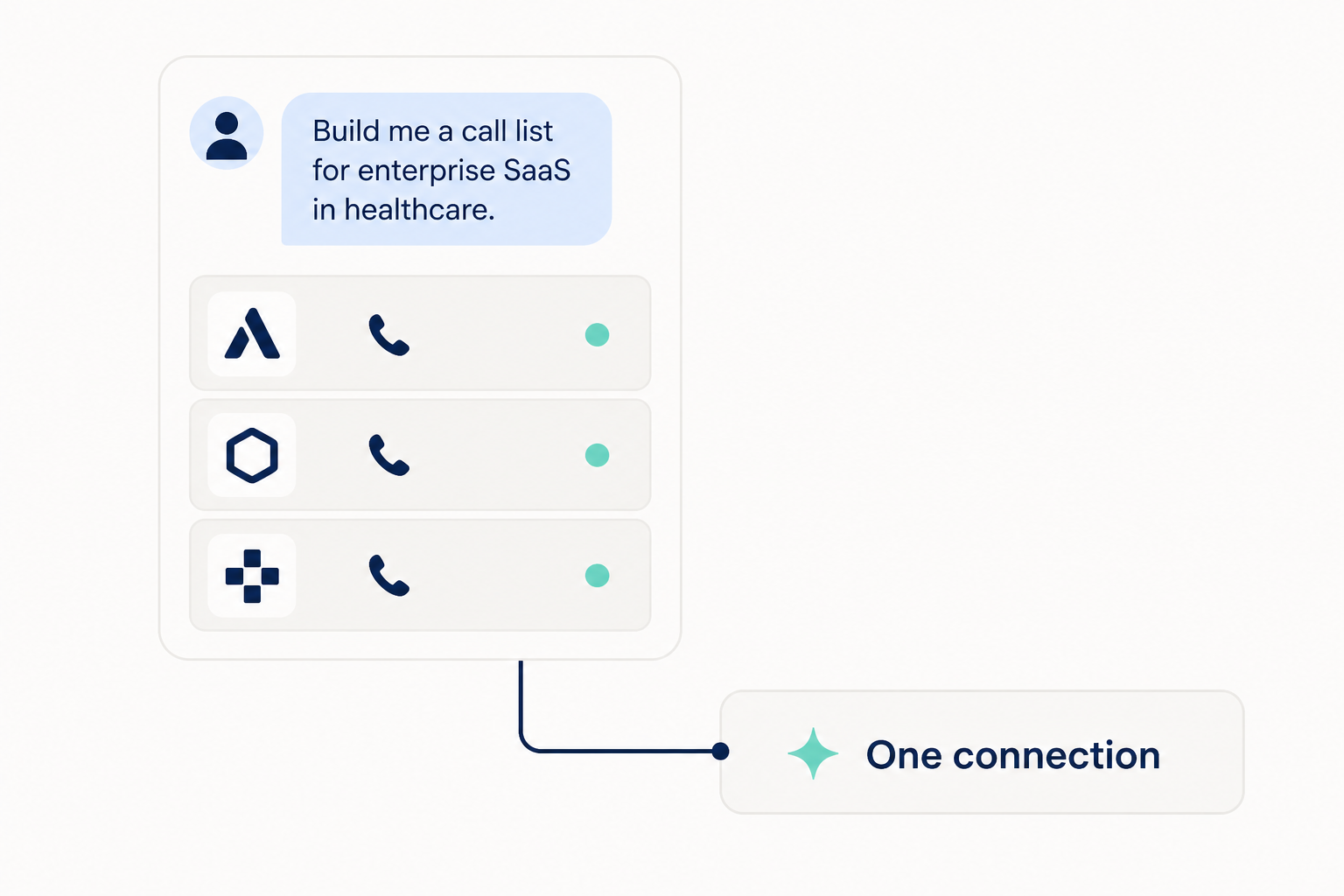
Vibe Prospecting fixes screening where it starts, at the list, and it does the whole job in one chat: contacts, company details, and recent activity from a single connection, powered by Explorium Enterprise Business Data. You describe the list, it builds it.
What Sits Behind the Connection
800M+ people profiles supply the direct dials and work emails that replace switchboard numbers.
150M+ company profiles carry the details, including the tools each company runs, that qualify an account before anyone dials.
18 categories of recent company activity, 80+ types in all, generate the reason line your screener message needs.
97.8%+ company match accuracy keeps every contact attached to the right account.
Why It Holds Up Past a Demo
Up to 1,000 records per call, processed server-side at 100 requests per second, so a full territory rebuilds in one run.
In-chat enrichment tools typically stall between 20 and 100 records when the context window fills. This does not.
A free account with no sales call, one shared credit pool across everything, which cuts agent-workload spend 30-60% against per-seat tools, and a 5-record preview with a cost estimate before any credits move.
Setup in Two Minutes
Add Vibe Prospecting from the connector directory inside Claude or ChatGPT. Claude Code users install the plugin instead:
Claude Code
# Claude Code, from the official Anthropic plugin store
/plugin install vibe-prospecting@claude-plugins-official

# Claude Chat and ChatGPT: add Vibe Prospecting from the
# connector directory instead, nothing to configure
# per-host guides: github.com/explorium-ai/vibeprospecting-plugin
Then run the rebuild as a plain sentence:
Text
Ask in chat:

  "Here is my 500-account territory. For each account, find
   the sales or revenue leader, add a direct-dial mobile and
   a work email, and flag funding, hiring, or new-tool
   activity from the last 90 days. Drop the quiet accounts,
   and show me 5 sample rows plus the cost before building
   the full list."
Both are respectable tools for one slice of the problem: Hunter.io for the email fallback channel, Coresignal for data teams that want raw records to process themselves. Neither pairs direct dials with recent-activity data in one connection, and that pairing is the whole screener fix. Hunter.io finds and checks email addresses (Starter, $34/month, 500 searches) with no phone data at all. Coresignal exposes 103M company and 792M employee records (Pro from $800/month) with no phone product and no activity categories. Explorium's Coresignal comparison and compare hub have the full teardowns.
What matters for screeners
Vibe Prospecting
Hunter.io
Coresignal
Direct dials
Yes, matched to the right company at 97.8%+
No phone data
No phone product
Recent company activity
18 categories, 80+ types
None
Jobs data only
Email fallback for touch two
Work emails in the same run
Strong: find plus check
Emails inside employee records
Price to start
Free account, one shared credit pool
Free plan; Starter $34/month
Free plan; Pro from $800/month
Records per run
Up to 1,000 per call, server-side
500 searches/month on Starter
Priced record by record
How you connect
Claude and ChatGPT connector directories, Claude Code plugin
Hunter MCP on all plans
Hosted MCP endpoint
Your First Screener-Proof Call Block
Everything above compresses to five moves, and the first four happen inside one chat session.
Move 1: Open a free account at vibeprospecting.ai. No sales call stands between you and the data.
Move 2: Add Vibe Prospecting from the Claude or ChatGPT connector directory.
Move 3: Preview 5 records from your own territory and check the match quality before spending anything.
Move 4: Rebuild the full list: direct dials, work emails, and 90-day activity, up to 1,000 accounts in a single call.
Move 5: Dial the active accounts first, carry the four-field message for the calls that still hit a gate, and change channel on touch two.
Judge any screener fix on the same three tests. Does one connection cover numbers, company details, and recent activity? Does it rebuild a whole territory in one run instead of 20-record batches? Can your first hire start on it for free? Point tools pass one test each. The gate is not something to out-talk. It is something to route around, and the route is the list.