


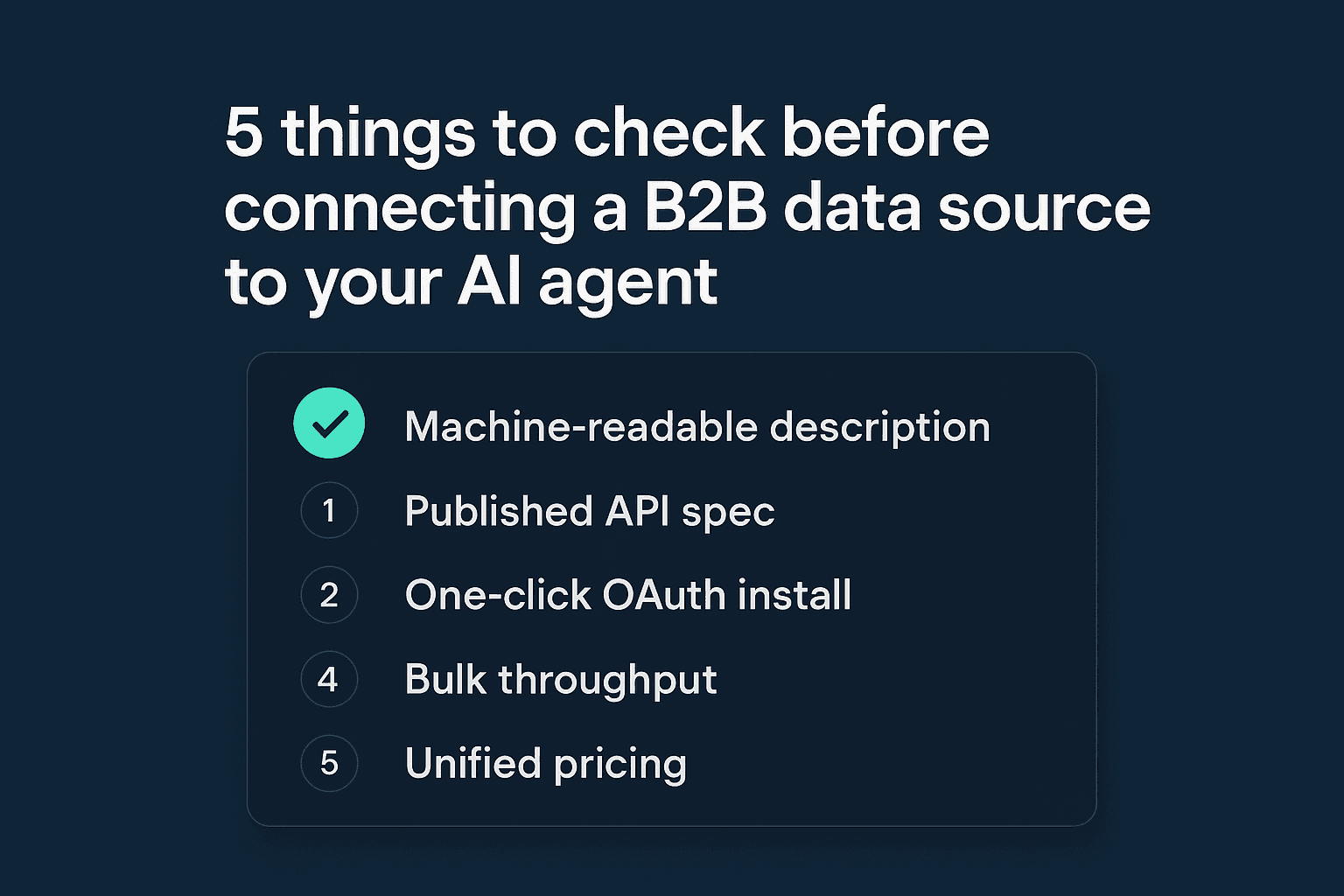
Connecting an AI agent to a B2B data source sounds simple until the agent stalls at record 50, a token window overflows, or a credential rotation breaks the whole workflow. Before you wire anything up, five questions tell you whether a vendor is genuinely agent-ready or just labeling a human API as an MCP. This guide walks through each one, with concrete numbers for Vibe Prospecting, Coresignal, and Hunter.io.
By August 2026, llms.txt adoption has grown 8.8x to 36,120 sites year over year, yet only 8.7% of the top 1,000 sites publish one. Most B2B data vendors still were not built with autonomous agents in mind. This checklist closes that gap. See what data enrichment means if you want grounding on the underlying concept before running the checklist.
What Actually Makes a B2B Data Source Agent-Ready?
An agent-ready data source is one your AI can discover, authenticate against, and call at production volume without anyone editing a config file first. Most B2B data tools were built for people clicking through dashboards. Agents operate differently: they read machine-parseable specs, handle OAuth token refresh automatically, and need to pull hundreds of records in a single call without overwhelming the context window.
The Manual API Problem
- Someone has to generate an API key and paste it somewhere before the agent can make its first call.
- Without a machine-readable spec, whoever builds the integration has to hand-write every tool definition, and maintain it every time an endpoint changes.
- Loading all returned records into the context window works for 10 lookups; it fails for 500-company territory maps.
What the Five Checks Unlock
- A directory-listed install means zero config files to maintain per environment.
- A published OpenAPI 3.1 spec lets any MCP client generate its own tool definitions, rather than relying on a hand-maintained wrapper.
- Server-side bulk processing keeps records out of the context window entirely.
Check 1: Does the Vendor Have a Machine-Readable Description?
A llms.txt file at a domain root gives language models a canonical summary of what the API does, which endpoint does what, and how to call it. Without one, a model guessing at your vendor's capabilities is working from whatever it picked up in training, which may be outdated or wrong.
llms.txt by the Numbers
| Metric | Value (2026) |
|---|---|
| Sites with a public llms.txt (May 2026) | 36,120 |
| Year-over-year growth rate | 8.8x |
| Share of top 1,000 sites publishing one (June 2026) | 8.7% |
The Directory-Listing Alternative
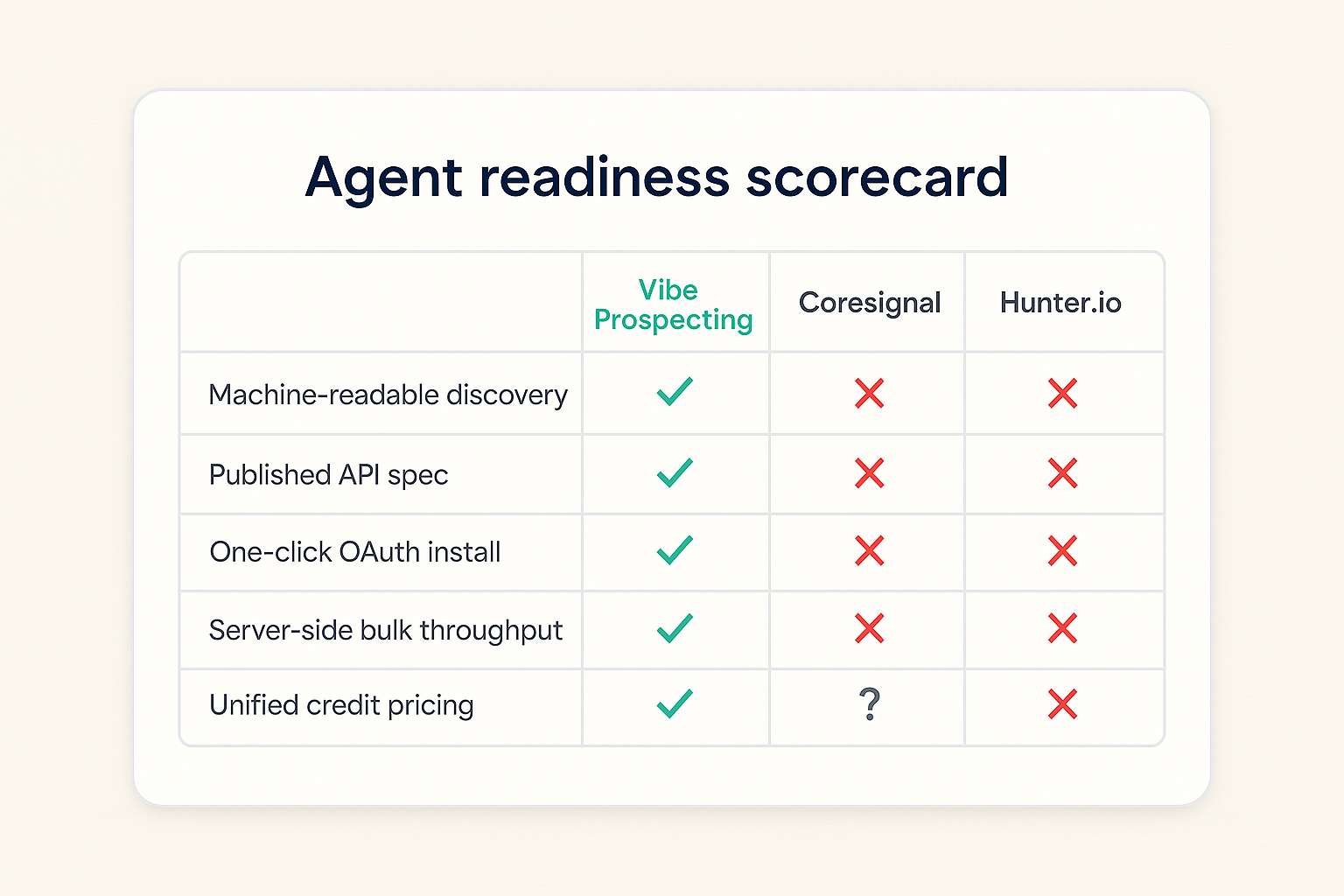
A vendor listed in the Claude or ChatGPT Connectors Directory has already passed a platform review that includes a machine-readable integration description. That listing functions as the discovery layer, making a separate llms.txt file redundant. Vibe Prospecting is listed in both directories; Coresignal and Hunter.io have no confirmed listing in either as of August 2026.
Check 2: Is There a Published OpenAPI Spec?
A vendor with only prose documentation forces you to hand-write tool definitions, which break silently whenever an endpoint changes. A published OpenAPI 3.1 spec lets frameworks like LangChain generate function signatures directly from the schema, and lets you diff a changelog instead of discovering a breaking change in production.
What a Good Spec Enables
- Automatic tool-definition generation for any MCP client that reads OpenAPI 3.1.
- Versioned schema diffs you can track, rather than endpoint surprises three sprints later.
- A single source of truth that agent builders and backend developers share.
The Warning Sign
A vendor whose integration documentation is marketing-page prose with no downloadable spec is a discoverability failure regardless of how good their data is.
Check 3: One-Click OAuth or Manual Key Paste?
Directory-listed OAuth install takes under a minute and handles token refresh automatically. Manual API-key setup means copying credentials into every environment your agent runs in, and rotating them by hand when they expire.
The Manual Path Costs
- Coresignal's MCP server authenticates through a manually configured
apikeyheader, not OAuth or a directory install. - Every environment where the agent runs needs its own copy of the static key.
- When the key rotates, that copy-paste cycle repeats across every environment.
What One-Click Install Looks Like
- Vibe Prospecting appears in both Claude's and ChatGPT's Connectors Directories, so the agent can be wired up from within the host app itself.
- OAuth handles token refresh in the background, meaning no static keys to manage or rotate.
- The directory listing also signals that the platform vendor reviewed the integration before making it available.
Check 4: Does It Handle Bulk Calls or Just Single Lookups?
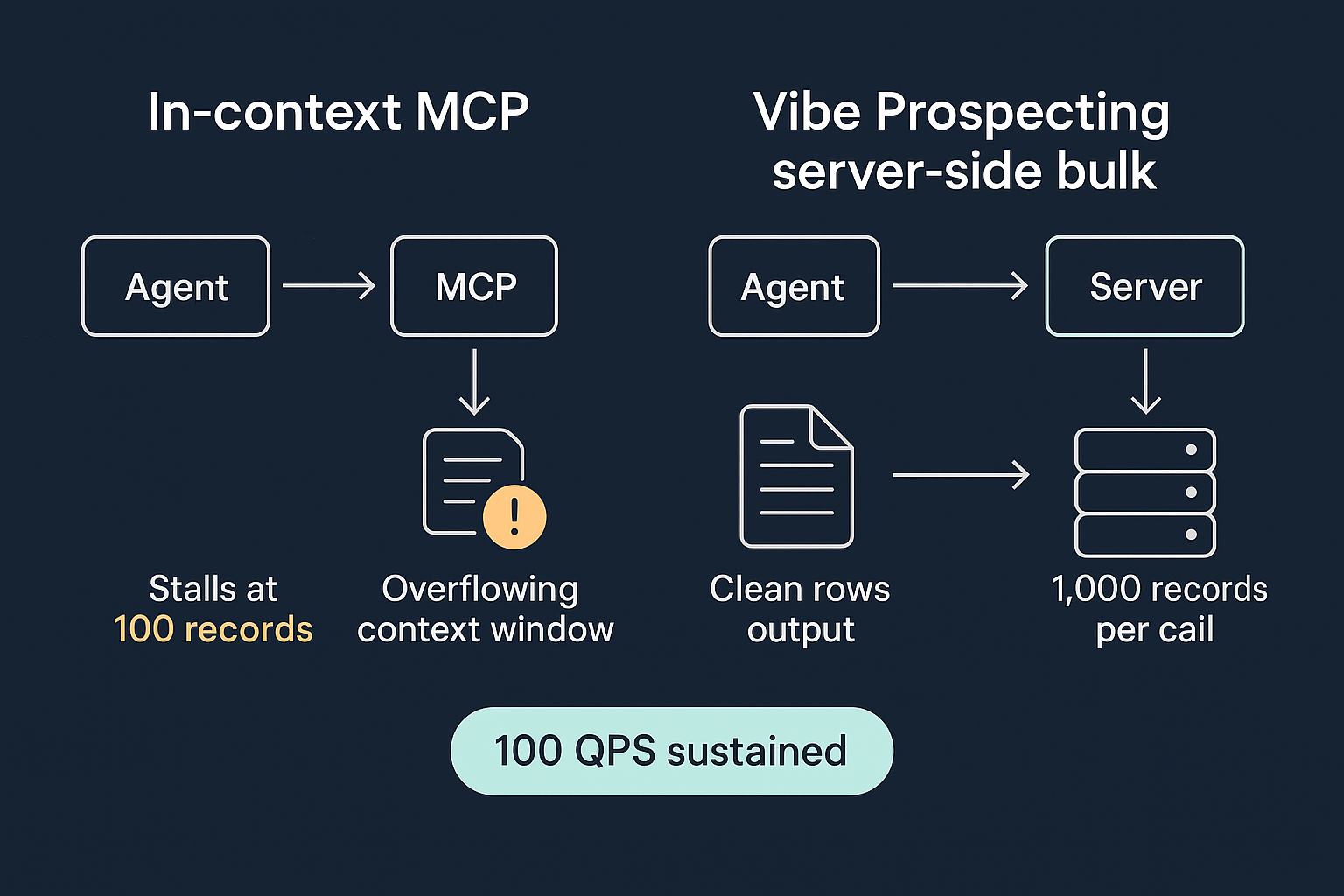
Server-side bulk processing keeps response data out of the context window entirely. In-context connections that dump records back into the LLM's token window stop working practically once you reach 20 to 100 records per run.
The Throughput Gap
- Vibe Prospecting handles up to 1,000 records per call, processed server-side, at a sustained rate of 100 QPS.
- Hunter.io's API v2 caps Domain Search and Email Finder at 15 requests per second, with Email Verifier limited to 10 per second, designed for individual lookups rather than batch runs.
Why This Matters at Production Scale
A territory-mapping run across 5,000 accounts takes five calls at Vibe Prospecting's bulk ceiling. On an in-context connection with a 100-record practical limit, that same run needs 50 calls, each loading data into the context window, compounding token costs and failure risk with every iteration. See how B2B data enrichment APIs compare for AI agents for a broader analysis.
Check 5: Is Pricing One Pool or Fragmented by Endpoint?
A single credit pool lets your agent spend on whatever data type the workflow needs that day. Per-endpoint pricing forces you to forecast call volumes months in advance, and leaves unused credits stranded on quiet endpoints while busy ones run dry mid-month.
How Unified Pricing Works in Practice
- Vibe Prospecting runs on a free account, no sales call required, with credits flowing into one pool across every endpoint.
- Sample-before-export returns five representative records and a credit estimate before any charge is applied, so agents can validate a query before committing to it.
- A spike in contact lookups one week does not strand unused company-data credits from the prior week.
What Fragmented Pricing Costs
- You end up forecasting data-type usage months before workflows are even stable enough to predict.
- Quiet endpoints accumulate unused credits that cannot be redirected to a busy one.
Already evaluating vendors? Connect the AgentSource MCP and run this five-point checklist against your own shortlist before committing to a build.
How Vibe Prospecting Scores on All Five
Vibe Prospecting passes every item on this checklist: directory-listed in both Claude and ChatGPT, bulk throughput to 1,000 records per call at 100 QPS, 97.8%+ company match accuracy, and a unified credit pool with no seat tax. The underlying data comes from Explorium Enterprise Business Data, covering 150M+ company profiles and 800M+ people profiles across 50+ sources.
One Connection for All Data Needs
- Company discovery, contact details, and 18 buying-signal categories with 80+ signal types available through one MCP connection.
- Listed in both Claude's and ChatGPT's Connectors Directories, meaning install is a first-class experience inside the tools your team already uses.
- 99.999% uptime for production workloads that cannot afford a stalled tool call mid-run.
MCP Config for Claude Code Users
Install from the Connectors Directory first. The config below is a fallback for Claude Code power users who prefer direct setup.

